Cross-Channel Marketing: Best Practices For 2025
16 MIN READ
AI · 20 Dec 2025 · 14 minHow AI automates approvals, drafts content, and accelerates team workflows-saving time and ensuring data sovereignty for UAE and GCC organizations.

AI is reshaping how teams collaborate by automating repetitive tasks, improving workflows, and enabling real-time content creation. Around 41% of desk workers' time is spent on low-value tasks, but AI tools reduce this by automating processes like task assignment, document approvals, and content generation. In the UAE and GCC, AI adoption is especially high, with 87% of employees using AI tools weekly, saving over an hour daily on average.
Key insights include:
AI tools are transforming workplaces in the UAE, aligning with national digital strategies while ensuring compliance with local regulations. The result? Teams save time and focus on impactful work, driving both innovation and growth.
AI takes the hassle out of manual tracking by monitoring conversations, identifying action items, and routing tasks automatically. This is especially useful in the UAE, where automation helps businesses save time on repetitive tasks.
Today’s AI tools integrate effortlessly into existing workflows. Take Microsoft’s Facilitator agent as an example - it actively participates in meetings, captures tasks in real time, assigns them to the right team members, and syncs everything with project management tools like Planner.
But AI doesn’t stop at tracking tasks. Cushman & Wakefield saved over 10,000 hours annually by using AI to produce compliant, localized marketing content. Similarly, Adidas automated 60% of its SEO processes with AI tools. Peter So, VP of Digital Innovation at Cushman & Wakefield, highlights the broader impact:
"It's not just about efficiency gains, it's about augmenting human creativity, scaling expertise, and unlocking new ways to engage customers and drive business outcomes".
For businesses in the UAE that prioritize data sovereignty, platforms like Presight Synergy offer a powerful solution. By integrating with local large language models, such as G42's Jais, these platforms enable quicker development cycles and lower costs. In December 2025, Presight AI partnered with First Abu Dhabi Bank (FAB) and HSBC UAE to bring advanced AI solutions into their operations. Thomas Pramotedham, CEO of Presight, describes the platform as:
"at the very heart of your organization to turn raw information into real intelligence... data, AI, and agentic workflows are seamlessly integrated to drive impact at scale".
Companies using such platforms report a 50% faster development and production cycle alongside a 50% reduction in professional service fees. These advancements pave the way for quicker and more efficient document approval processes.
Approval delays can stretch publication timelines by days. AI cuts through these bottlenecks by interpreting unstructured data - like PDFs, images, and text - and applying decision-making logic that traditional automation often struggles with. Documents are automatically sent to the appropriate stakeholders as soon as changes are made. For low-risk requests that meet predefined criteria, AI can even bypass human review entirely.
Every action is logged with an audit-ready trail, ensuring compliance and easing regulatory reviews. This transforms approval times from days to just minutes. The secret lies in leveraging multistage workflows where AI handles routine evaluations, while humans focus on critical decisions. This "human-in-the-loop" approach ensures a balance of speed and oversight.
AI acts as a collaborative partner, offering ideas, insights, and evaluations in real time. This integration streamlines the entire content creation process, building on the automated workflows and efficiency improvements discussed earlier. With AI, content creation shifts from being a solo effort to a dynamic, supported process where suggestions come exactly when needed.
Today’s AI tools can analyze chat logs, meeting transcripts, and shared documents to provide timely, contextual recommendations. For instance, Microsoft's Facilitator agent can deduce meeting agendas from initial discussions, take live notes, and even suggest creating new documents based on the conversation. Similarly, Channel Agents act as domain specialists, answering natural language queries and surfacing critical deadlines hidden in message threads.
AI's influence goes beyond meetings. It can instantly convert long-form content - like blog posts or case studies - into bite-sized promotional materials, such as social media captions, email drafts, or ad copy. This feature addresses a growing demand: 52% of marketing and sales teams now need tools to create their own branded creative assets. Additionally, when files are shared through hero links, AI can generate concise summaries within notifications, allowing recipients to grasp the key points before opening the document.
These real-time capabilities naturally lead into the realm of advanced text creation, which we’ll explore next.
AI text generation tools, powered by Natural Language Processing (NLP) and Machine Learning (ML), can predict and produce human-like text based on training data. They handle tasks like generating ad headlines, summarising meeting transcripts, and drafting outlines to help writers overcome creative blocks.
In addition to generating content, these tools offer real-time editing features, including grammar corrections, clarity improvements, and tone adjustments to ensure brand consistency. Christine Royston, CMO of Wrike, highlights this advantage:
"Your team's ability to read between the lines, to connect emotion with action, to embody your brand's identity in everything they create is a distinct creative advantage".
AI is transforming how teams collaborate by enabling immediate feedback during projects. Instead of waiting for scheduled review cycles, AI provides real-time insights, helping teams move faster. This is especially useful in the UAE and GCC markets, where teams often work across different time zones and languages.
AI tools are now active participants in collaborative sessions, offering real-time feedback and streamlining processes. Take Microsoft's Facilitator agent as an example - it manages meeting agendas live, tracks discussion points, and assigns tasks automatically during conversations. This eliminates the hassle of missed action items or unclear responsibilities, which are common challenges in multi-person reviews.
AI also simplifies lengthy feedback threads by consolidating them into concise, actionable briefs. No more endless scrolling through messages - this automation saves teams a lot of time.
Eugene Mejia, Chief AI Strategy and Digital Transformation Officer for the Town of Gilbert, Arizona, highlighted the efficiency AI brings:
"The Town of Gilbert, Arizona is saving at least 40 hours of work with Acrobat AI Assistant. This creates huge efficiencies, ultimately benefiting the citizens".
For organizations where marketing and sales teams - 56% of them - create their own content, AI writing assistants offer instant tone adjustments. Before sending out communications, team members can tweak drafts to align with the brand’s voice, ensuring a consistent message no matter who wrote the original text.
Beyond feedback, AI also enhances multilingual collaboration, a key need in GCC markets where Arabic and English are widely used in business. AI-powered translation tools let team members work in their preferred language while keeping everyone on the same page in real time.
The Jais model, developed by G42 and MBZUAI with 13 billion parameters, is tailored for Arabic-English business scenarios. Unlike generic tools, it captures cultural subtleties, which is crucial for maintaining brand authenticity in GCC markets.
Microsoft's Live Captions feature provides another practical example. It can translate video and audio content from 44 languages, including Arabic, into English during live sessions. Paired with devices like the Surface Pro 11th Edition, which boasts 90% faster performance than its predecessor, this ensures smooth, lag-free processing.
For UAE businesses, selecting AI tools hosted locally on Azure, AWS, or Google Cloud data centers ensures compliance with the Personal Data Protection Law (PDPL) while also reducing latency. With 75% of GCC companies adopting generative AI by late 2024 - compared to 65% globally - data sovereignty is no longer optional; it’s a competitive necessity.
Wick's Four Pillar Framework offers a structured roadmap for digital marketing, integrating AI tools to refine and streamline processes. The framework's core pillars - Build & Fill and Tailor & Automate - work in harmony to establish interconnected digital systems. These systems are designed to scale efficiently while preserving brand consistency, particularly in the UAE and GCC's diverse, multilingual markets. By embedding AI into this framework, businesses can elevate content creation and automation to better align with regional marketing strategies.
The Build & Fill pillar focuses on website development, content creation, and social media management. AI revolutionises these areas by removing inefficiencies and ensuring uniformity across all digital platforms. For instance, large language models (LLMs) can generate drafts, headlines, and social media content in mere seconds, effectively tackling writer's block. This is especially impactful, considering that 57% of creative and marketing professionals report losing valuable time on repetitive tasks.
One standout feature AI brings to the table is the "Master Spine" - a set of canonical descriptors that define the topic, intent, and audience value. This ensures semantic consistency across all digital channels, which is particularly critical for UAE businesses managing bilingual content in both Arabic and English. Such consistency helps prevent brand messaging from becoming fragmented across different platforms.
Take, for example, Beyond Better Foods. By leveraging Slack AI's enhanced search capabilities and automated thread summaries, the company significantly reduced the time spent on manual lookups. This kind of efficiency is a testament to how AI can transform content workflows.
The next step in Wick's framework is the Tailor & Automate pillar, which focuses on personalization and automation strategies.
The Tailor & Automate pillar is all about leveraging AI for marketing automation and personalization. Acting as a digital workforce, AI can handle a wide range of tasks, from onboarding to approvals and helpdesk routing, with the help of no-code tools. These tools simplify the creation of custom workflows, saving time and reducing manual effort.
Kenneth Reisman, a leader in Adobe's Enterprise business, encapsulated the potential of generative AI in this space:
"Generative AI's impact on content creation will be transformational, enabling productivity improvements of 10–100 times or more - for some workflows".
This pillar also aligns seamlessly with UAE national priorities. In October 2025, Microsoft UAE, under the leadership of General Manager Amr Kamel, introduced local data processing for Microsoft 365 Copilot. This initiative, in collaboration with the UAE Cybersecurity Council (CSC) and G42, aims to train one million UAE learners in AI by 2027 while creating over 152,000 jobs. By ensuring that AI-powered workflows adhere to the UAE National AI Strategy 2031 and uphold data sovereignty, this localized infrastructure underscores the strategic importance of AI in the region.
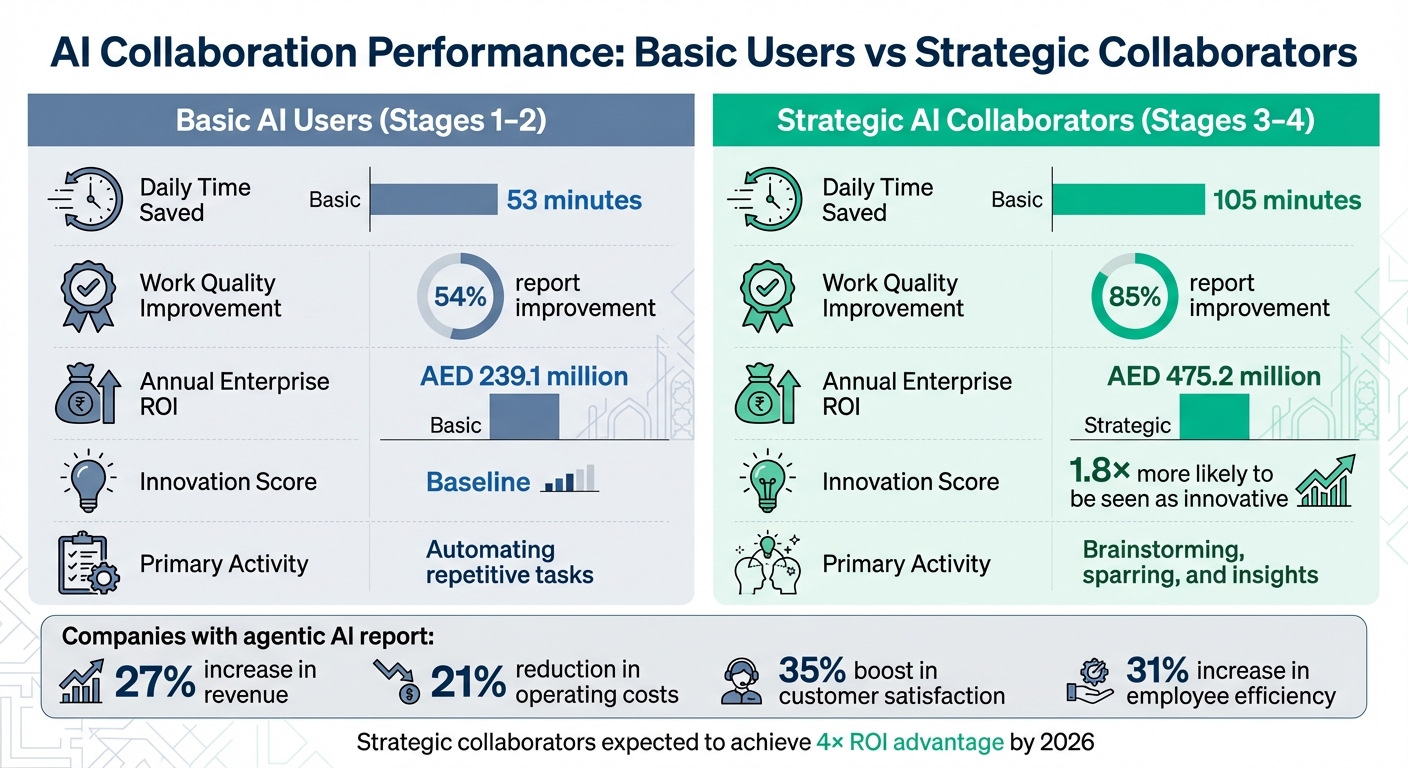
AI Collaboration ROI: Basic Users vs Strategic Collaborators Performance Comparison
Building on earlier discussions about AI-driven workflows, this section dives into how AI impacts collaboration efficiency in measurable ways. While implementing AI is important, tracking its actual impact is where the challenge lies. Surprisingly, fewer than 50% of businesses monitor the effect of generative AI on collaboration. This means many organizations are operating without clear insights into their return on investment (ROI).
The real game-changer isn’t just how much time AI saves - it’s how teams choose to use that extra time. Strategic AI users reinvest 1.5× more of their saved time into activities like skill development and innovation, whereas basic users tend to direct it towards routine tasks like administration.
Work quality also highlights the difference between these two groups. While 54% of basic AI users report better output quality, this number jumps to 85% among strategic collaborators - those who treat AI as a creative partner rather than just a tool for automation. Dr. Molly Sands, Head of the Teamwork Lab at Atlassian, summed it up well:
"Some people think of AI as a way to do the work they don't want to do. Top performers think of it as a way to do the work they've always wanted to do."
For businesses in the UAE, maintaining brand consistency and managing approval cycles in both Arabic and English are particularly important. Another critical metric to track is the "search-to-find" ratio - the time wasted searching for scattered information. Currently, this eats up 41% of desk workers' time. Companies embracing agentic AI have already seen a 35% boost in customer satisfaction and a 31% increase in employee efficiency, proving that focusing on the right metrics can uncover substantial operational improvements.
These metrics build on earlier discussions of efficiency gains. Next, we’ll explore how they translate into real-world performance differences.
The difference in performance between basic AI users and strategic collaborators is stark. Strategic collaborators deliver nearly double the annual ROI compared to basic users - AED 475.2 million versus AED 239.1 million for enterprise organizations. And this gap is expected to grow, potentially reaching four times the ROI by 2026 as strategic users continue to innovate and explore new applications for AI.
| Metric | Basic AI Users (Stages 1-2) | Strategic AI Collaborators (Stages 3-4) |
|---|---|---|
| Daily Time Saved | 53 minutes | 105 minutes |
| Work Quality Improvement | 54% report improvement | 85% report improvement |
| Annual Enterprise ROI | AED 239.1 million | AED 475.2 million |
| Innovation Score | Baseline | 1.8× more likely to be seen as innovative |
| Primary Activity | Automating repetitive tasks | Brainstorming, sparring, and insights |
These numbers clearly show how different approaches to AI integration can lead to vastly different outcomes.
Companies leveraging agentic AI have also reported a 27% increase in revenue and a 21% reduction in operating costs. Looking ahead, 90% of businesses globally anticipate positive returns on their AI investments by 2025–26. David Laves, Director of Business Programs at Microsoft Digital, highlights the importance of having the right tools to measure these impacts:
"The last thing you want to do is know what you want to measure but not understand how to measure it. That's like flying a plane without instruments."
To truly benefit, organizations should establish clear baselines and use visual scorecards to track improvements in time savings, work quality, and ROI.
AI has reshaped the way teams collaborate on content, transforming simple tools into intelligent systems that streamline workflows, draft materials, and uphold brand consistency across various channels. For businesses in the UAE and the broader GCC region, this shift holds particular importance. The region has emerged as a global leader in workplace AI adoption, showcasing how improved collaboration not only saves time but also fosters innovation and supports strategic growth.
The impact is tangible. Companies leveraging AI automation in the region report operational cost reductions of 20% to 30%, while AI-powered customer service solutions can cut response times by as much as 80%. On a larger scale, AI is expected to contribute AED 352.3 billion to the UAE’s economy by 2030. These benefits are most effective when AI tools are integrated into a connected digital framework, ensuring compliance with regulations and safeguarding data sovereignty, while also aligning with broader strategic goals.
As H.E. Omar Sultan Al Olama, UAE Minister of State for Artificial Intelligence, highlighted:
"Microsoft's investment in in-country AI infrastructure is a testament to our shared commitment to building a future where innovation and trust go hand in hand."
This vision aligns with Wick’s Four Pillar Framework, which bridges content creation (Build & Fill) with automation and personalization (Tailor & Automate), creating a unified digital ecosystem.
However, true competitive advantage lies in reimagining workflows rather than just deploying tools. While 84% of GCC organizations have adopted AI in at least one business function, only 11% are "value realisers", attributing 5% or more of their earnings to AI. Bridging this gap requires scaling AI enterprise-wide, continuous training, and setting clear metrics to measure productivity, quality, and return on investment.
AI is reshaping how teams collaborate on content in the UAE, making processes smoother, faster, and more precise. With tools like Microsoft Copilot now processing data locally, they align perfectly with the UAE’s data-sovereignty regulations. These systems assist with tasks like drafting, summarising, and automating workflows, significantly boosting efficiency.
In platforms such as Microsoft Teams, AI steps in as a virtual assistant, offering meeting notes, content suggestions, and real-time updates. Similarly, OneDrive enhances teamwork with personalized recommendations and co-authoring features. Slack also integrates AI to simplify tasks like summarising conversations and providing contextual writing support. These capabilities cut down on repetitive tasks and allow teams to focus on what truly matters.
The UAE’s government is also embracing AI in a big way. Initiatives like Digital Dubai and DEWA’s AI adoption roadmap highlight how public-sector organizations are using AI for multilingual collaboration and speeding up project timelines. On the business side, companies like Wick are leveraging AI to create content-driven campaigns tailored to local needs, all while adhering to strict data-privacy standards. Together, these advancements are changing the way teams collaborate across the Emirates.
AI brings a new level of efficiency to task automation and approval workflows by removing repetitive manual tasks, cutting down on errors, and streamlining processes. By automating routine duties, teams can reclaim valuable time and redirect their focus to more impactful, strategic work.
On top of that, AI-driven tools can analyze data and deliver smart recommendations, speeding up approval processes and enhancing accuracy. This boosts productivity and encourages seamless collaboration among teams - an advantage that's especially valuable in dynamic, fast-moving environments like those in the UAE.
To understand how AI impacts collaboration tools, businesses should focus on tracking key performance indicators (KPIs) that match their goals. These KPIs can be split into two main types: quantitative metrics and qualitative insights.
Quantitative metrics involve measurable data, such as adoption rates (e.g., the percentage of team members actively using AI features), time savings (e.g., a 30% reduction in meeting durations), and cost savings in AED (e.g., AED 1,000.00 saved for every 1,000 tasks completed). On the other hand, qualitative insights provide context through user feedback, helping businesses understand how well AI tools align with objectives like improving brand consistency or enhancing the user experience.
Take this example: a content team might compare the time spent creating a blog outline before and after introducing AI. If the process dropped from 2 hours to just 45 minutes, that's a 75% boost in efficiency. Additionally, surveys can gauge how users feel about AI's role in fostering creativity and teamwork. Tools like Wick assist in setting up these measurement frameworks with real-time dashboards tailored to UAE-specific formats, such as 19 Dec 2025, 14:30 GMT+4, or AED 1,250.00.
By tying AI performance metrics to strategic goals, organizations can clearly showcase return on investment (ROI) while improving team collaboration.
16 MIN READ
14 MIN READ
11 MIN READ
What worked, what didn't, and what we're building next - no noise, unsubscribe anytime.