Cross-Channel Marketing: Best Practices For 2025
16 MIN READ
AI · 18 Dec 2025 · 13 minAI unifies customer data to create live, adaptive journey maps in the UAE, enabling instant personalization, issue detection, and PDPL-aligned data governance.

Customer experiences in the UAE are evolving fast, and businesses need to keep up. Traditional customer journey maps often fail because they’re static, outdated, and miss key interactions. This is where AI steps in, offering a smarter way to track and respond to customer behavior in real time.
Here’s what you need to know:
AI-powered journey mapping isn’t just about tracking - it’s about responding instantly to customer needs, reducing friction, and improving loyalty. With the UAE’s multilingual, tech-savvy market, this approach is critical to staying ahead.
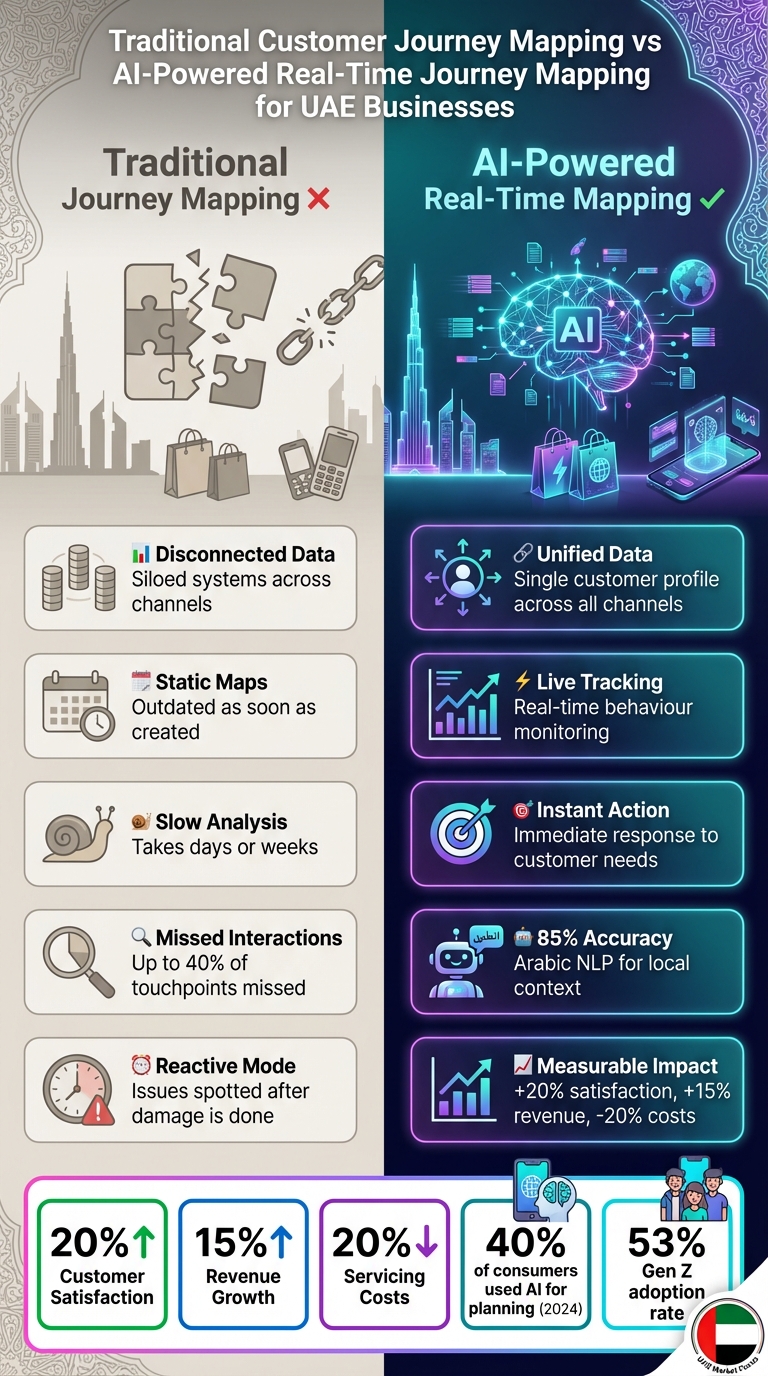
Traditional vs AI-Powered Customer Journey Mapping: Key Differences and Benefits
Businesses in the UAE gather customer information from a wide range of sources - think websites, mobile apps, Instagram, WhatsApp chats, in-store visits, email campaigns, and service desks. The problem? These sources often operate in silos, creating fragmented snapshots instead of a complete view of the customer.
Take the example of a QSR brand that expanded its digital presence. Despite its efforts, the brand struggled with disconnected communication channels and isolated systems, making it nearly impossible to deliver a seamless and personalized experience through its app. In the UAE, where a customer might discover a product on Instagram, research it on Google, visit a store at Dubai Mall, and finally purchase via an app, this lack of integration becomes a major challenge.
Traditional tools focus narrowly on individual channels or sessions, failing to link interactions into a cohesive, person-based narrative across multiple touchpoints. This leaves businesses unable to fully understand what influences customer decisions. This fragmented data landscape highlights the need for AI-driven solutions that can unify and analyze customer information in real time.
Static journey maps are outdated as soon as they’re created. Built on past assumptions, these maps fail to keep up with the constant shifts in customer behavior.
"Old personalization was surface work. Adding a name to an email. Greeting a caller with a script. Customers saw through it."
- Nicole Robinson, ComputerTalk
This issue is especially pronounced in the UAE, where customer behavior shifts significantly during events like Ramadan, the Dubai Shopping Festival, Eid, and back-to-school seasons. For example, a journey map created in February won’t account for the unique shopping habits that emerge during Ramadan. Add to that the complexity of Arabic, with its multiple dialects and diacritical marks that can change word meanings, and static systems fall even further behind. These limitations make it difficult to adapt to customer needs - a challenge AI can address by dynamically adjusting to real-time changes.
Identifying customer pain points in real time is nearly impossible with manual analysis. By the time businesses notice patterns like abandoned carts, slow support responses, or failed checkouts, the damage is often done - revenue is lost, and customers are left frustrated.
"Customer patience is limited. A single bad experience can end a relationship."
- Nicole Robinson, ComputerTalk
The sheer volume of data generated from various touchpoints overwhelms manual processes. This forces companies to react to issues after they’ve already occurred, rather than addressing them proactively.
Manual journey mapping is a slow process, often taking days or even weeks. By the time insights are ready, market conditions or customer preferences may have already shifted. These delays make it difficult for businesses to anticipate customer needs, leaving them stuck in reactive mode instead of being proactive.
Departments often operate without a unified, real-time view of the customer journey, leading to missed opportunities and inconsistent experiences. In a fast-paced market like the UAE, where customers seamlessly move between online and offline channels, slow responses can cost businesses both revenue and competitive edge.
These challenges underline the importance of AI-powered systems that can integrate and analyze customer data in real time, enabling businesses to respond quickly and effectively.
AI has transformed traditional journey mapping by creating systems that react instantly to customer behavior. By processing live data from various touchpoints - like social media, websites, mobile apps, emails, in-store visits, and messaging platforms - AI builds a comprehensive and up-to-date customer profile.
"The key to this transformation is artificial intelligence, which handles large customer data volumes like never before and at an even faster pace."
This dynamic approach ensures seamless data integration, detailed behavior tracking, and real-time adjustments tailored to local contexts.
AI connects every customer interaction into a single, continuously updated profile. For instance, a customer's Instagram activity, Google searches, visit to the Dubai Mall, and app purchases are no longer seen as separate events but as interconnected moments in a unified journey.
For businesses in the UAE, this cohesive view is especially impactful. At Wick, we combine CRM data with website analytics, customer feedback, sales records, and service logs to create accurate journey maps. These maps are tailored to specific personas, addressing the needs of diverse market segments - from Emirati consumers prioritising privacy and premium services to expatriate families seeking educational solutions. CRM data helps validate every touchpoint, ensuring a clear understanding of customer interactions.
This unified approach allows businesses to move past fragmented assumptions and gain a clearer picture of what truly drives customer decisions.
With unified data in place, machine learning algorithms monitor customer behavior in real time, identifying patterns that might otherwise go unnoticed. For example, if a sudden spike in drop-off rates occurs at a specific checkout step or if support requests surge, AI systems send immediate alerts.
AI also uses historical data to predict future trends, engagement levels, and the likelihood of churn. Companies leveraging advanced machine learning tools have reported higher conversion rates, increased average order values, and improved customer retention. Research shows that enhancing customer journeys can boost overall satisfaction by 20%, raise revenue by 15%, and cut servicing costs by up to 20%.
AI-powered journey mapping in the UAE is uniquely designed to adapt to the region's linguistic diversity, cultural preferences, and regulatory frameworks. Journey maps are customized based on user type, region, language, and channel, guided by CRM data.
For example, advanced text analytics engines achieve 85% accuracy in Arabic natural language processing (NLP), capturing nuances in language, sentiment, and dialect variations. Regional e-commerce platforms use this technology to tailor shopping suggestions to key events like Ramadan, Eid, and back-to-school seasons, while filtering out items that may not align with local norms.
At Wick, we ensure all journey mapping practices align with UAE data protection laws, consent protocols, and communication standards. Our designs reflect local preferences, incorporating customized tones, imagery, and timing for campaigns - such as adjusting for Ramadan or gender-specific insights. This adaptive, locally aware approach addresses the limitations of static assumptions and disconnected channels, offering a far more relevant and responsive customer experience.
With unified customer data and real-time behavior tracking, AI takes personalization to the next level by tailoring every interaction and dynamically adjusting customer journeys. Instead of relying on broad segmentation, AI evaluates each individual based on their intent, preferences, and potential value. This allows it to fine-tune offers, timing, and communication channels on the fly, creating a more engaging and relevant experience. This proactive approach not only boosts conversion rates but also fosters stronger customer loyalty across all touchpoints.
AI analyses massive amounts of data to build detailed customer profiles, uncover behavioral patterns, and predict needs at every interaction. At any given moment, it evaluates intent and selects the most appropriate message, offer, or channel to deliver. For businesses in the UAE, this means considering factors such as language, demographics, and local customs in real time. By moving beyond traditional segmentation and scoring individuals dynamically, AI can respond instantly to changes in behavior.
For example, a customer searching for luxury accommodations in Dubai during peak travel seasons might be presented with premium packages priced in AED. Meanwhile, someone browsing family-friendly activities on a budget could see tailored promotions for affordable outings. This level of precision ensures that every interaction is timely and relevant, enhancing the overall customer experience.
AI-powered systems can automatically adjust content and pricing based on live interactions and browsing history. These tools fine-tune rates, discounts, and bundled offers to match individual customer contexts. For instance, generative AI can craft personalized copy, visuals, and itineraries that align with a customer’s loyalty status, travel preferences, and destination.
In the UAE, this capability proves especially useful during high-demand periods like Ramadan, Eid, or the Dubai Shopping Festival. AI can create highly tailored experiences, such as offering a returning customer exclusive VIP packages in AED or presenting a first-time visitor with introductory discounts and helpful guides. By moving away from static templates, AI delivers experiences that feel uniquely personal, leading to higher engagement, increased satisfaction, and improved customer lifetime value.
AI doesn’t just react - it predicts. By analyzing past data, it forecasts trends like purchase habits, likelihood of churn, and engagement levels. It assigns scores to prioritize timely interventions and uncovers the factors driving customer actions. This predictive power allows businesses to shift from reactive to proactive journey management, addressing potential issues before they escalate.
For instance, if AI detects signs of disengagement, such as reduced app activity or abandoned shopping carts, it can trigger re-engagement efforts immediately. On the other hand, when a customer shows high intent to convert, the system can streamline their journey with features like a simplified checkout process or time-sensitive offers in AED. These predictive insights not only enhance the customer experience but also guide users toward desired outcomes, ensuring every interaction feels seamless and relevant.
To enable real-time journey adjustments, businesses need a strong technical foundation. Implementing AI-powered journey mapping requires systems capable of handling vast amounts of data, processing it instantly, and adhering to strict regulatory requirements. Without the right infrastructure, even the most advanced AI tools will fall short in delivering immediate insights. Companies should focus on three core pillars: unified data systems, tailored AI techniques, and governance frameworks aligned with UAE regulations. With these in place, raw data can be transformed into actionable customer insights in real time.
Real-time journey mapping hinges on integrated data platforms that consolidate customer interactions across websites, apps, call centers, and physical locations into a unified view. A microservices architecture is ideal here - allowing components like ticketing, routing, identity management, notifications, and analytics to scale independently. This ensures the system can handle spikes in activity, such as during the Dubai Shopping Festival, without compromising performance.
AI and machine learning engines drive key features like crowd forecasting, intelligent routing, sentiment analysis, and facial recognition. Event tracking systems capture customer actions as they happen, instantly updating journey maps. This setup enables businesses to adapt to customer behavior in real time, ensuring a seamless experience.
AI techniques play a pivotal role in turning raw data into meaningful journey insights. Supervised learning models, for instance, predict customer churn and likely behaviors, helping businesses proactively address disengagement. Unsupervised learning uncovers hidden patterns and segments that traditional methods might overlook. Natural language processing (NLP) analyses customer feedback, chat logs, and social media comments to gauge sentiment and identify recurring themes. Together, these techniques enable businesses to craft personalized, customer-focused experiences.
A robust infrastructure must not only support real-time processing but also prioritize privacy and governance. The UAE Personal Data Protection Law (PDPL), which became enforceable in January 2023, outlines strict requirements for consent, purpose limitation, breach notifications, cross-border data transfers, and individual rights. For AI systems managing sensitive data - such as Emirates ID details or biometric information - compliance with PDPL involves encrypted storage, limited data collection, and transparent user rights.
The Dubai Data Law further requires entities to classify, process, and share data under strict governance rules, including controlled access and audit trails. Data residency is another critical factor, as PDPL restricts cross-border data transfers unless specific conditions are met. To address this, many organizations opt for local cloud solutions like AWS UAE, Azure UAE, or G42. The UAE cloud computing market is projected to grow from AED 47.15 billion in 2025 to AED 166.77 billion by 2030.
At Dubai International Airport (DXB) Emirates Terminal 3, over 200 biometric-enabled cameras were installed as part of an AED 85 million investment. These cameras allow passengers to move from check-in to boarding using facial recognition instead of traditional documents. This example highlights the importance of robust compliance when handling biometric data. (Source: Appinventiv, December 10, 2025)
To meet compliance, organizations should implement UAE-local cloud hosting, end-to-end encryption, and detailed audit logs. They must also adhere to sector-specific regulations, such as those from the DHA and MOHAP for healthcare, CBUAE for banking, and SCA for financial services. Aligning with international standards like ISO 27001 for information security and ISO 27701 for privacy management can further support audits and build trust while ensuring local compliance.
AI-powered real-time mapping is transforming how businesses in the UAE engage with their customers. By seamlessly integrating data from websites, apps, social media, and physical stores, companies can deliver personalized experiences that adapt in the moment. This is especially critical in cities like Dubai and Abu Dhabi, where customers expect nothing less than efficiency and excellence.
The benefits are clear and measurable. AI’s ability to predict customer needs, adjust pricing and content on the fly, and resolve friction points before they escalate has a direct impact on efficiency and loyalty. In a diverse, tech-savvy market like the UAE, where customer journeys are rarely straightforward, this kind of responsiveness offers a distinct competitive edge. It’s a game-changer for meeting the rising expectations of today’s consumers, who demand more from service providers.
As discussed earlier, strategies that focus on real-time adjustments and proactive engagement are no longer optional - they're essential for staying ahead. With customer expectations evolving rapidly, businesses that fail to adapt risk losing customers to competitors offering better experiences. AI addresses this challenge by continuously learning and evolving, ensuring that customer journey maps keep pace with shifting behaviors and preferences. Younger generations are already embracing these AI-driven innovations; in 2024, around 40% of consumers used AI for trip planning, with adoption rates soaring among Gen Z (53%) and millennials (57%).
This ability to evolve alongside customer needs is what positions AI as a cornerstone for long-term success in the UAE’s competitive market.
AI is transforming how businesses approach customer journey mapping by analyzing real-time data across multiple channels. This approach provides insights that are dynamic and precise, unlike traditional methods that often depend on static diagrams and assumptions. AI-driven mapping evolves alongside customer behavior, paving the way for a more tailored and relevant experience.
By predicting future actions and preferences, AI generates data-backed, unbiased journey maps. These maps empower businesses to fine-tune touchpoints and make smarter decisions, ultimately enhancing customer engagement and crafting marketing strategies that align with individual needs.
Traditional customer journey maps often fall short because they depend on outdated information and assumptions, which can quickly lose relevance in fast-changing markets. Crafting and updating these maps demands a lot of manual work, and they typically lack the flexibility to adapt in real time. On top of that, they often fail to incorporate direct customer feedback, leaving businesses with strategies that don't fully align with what their customers actually need.
Overcoming these challenges allows companies to gain a clearer picture of customer behavior and develop strategies rooted in data. This not only improves engagement but also boosts customer satisfaction.
AI is a key player in helping businesses align with UAE data protection laws, especially the Personal Data Protection Law (PDPL). With its advanced algorithms, AI can quickly identify and categorise personal data across various platforms such as websites, apps, and social media. This ensures that data is only processed for lawful purposes. It also supports businesses in reducing the amount of data they collect and anonymising sensitive information before any analysis takes place.
AI-powered tools make it easier to handle Data Subject Requests (DSRs), manage consent or withdrawals in real time, and maintain comprehensive audit logs. These logs are essential for demonstrating compliance to regulatory bodies. By integrating AI with models like Wick's Four Pillar Framework, businesses can benefit from continuous data monitoring and encryption. This approach also ensures adherence to UAE data residency requirements, meaning all data is stored and processed within the country. The result? Enhanced customer privacy and full regulatory compliance.
16 MIN READ
11 MIN READ
12 MIN READ
What worked, what didn't, and what we're building next - no noise, unsubscribe anytime.