Cross-Channel Marketing: Best Practices For 2025
16 MIN READ
AI · 20 Dec 2025 · 12 minAnalytics - not generic ads - is the only way to achieve hyper-local, behavior-driven audience targeting across GCC markets.

Analytics is transforming how businesses in the GCC target their audiences. With over 54 million people in the region, representing diverse nationalities, languages, and behaviors, generic marketing is no longer effective. Here's why analytics is crucial for precise audience targeting in the GCC:
By using analytics, businesses can segment audiences by behavior, predict user intent, and personalize messages in real time. For example, brands that leverage first-party data and AI tools see revenue growth of 1.5× to 2.9× compared to those using broad demographic data. This approach ensures marketing budgets are spent wisely, focusing on high-value users and culturally aligned campaigns.
The GCC's digital landscape is evolving rapidly. Companies that invest in data-driven strategies will gain a competitive edge by connecting with their audiences in meaningful ways.
Even with the GCC region's advanced digital landscape, marketers face considerable hurdles in connecting with the right audiences at the right time. These issues often arise from outdated systems, overly simplistic targeting strategies, and a lack of attention to local nuances. Addressing these challenges is critical for improving targeting precision through analytics.
One of the biggest obstacles for GCC companies is the inability to unify customer data across various touchpoints. A shopper's journey - from browsing an app to visiting a store - often remains disjointed. A staggering 65% of survey respondents in the GCC admit their companies lack the technological infrastructure needed to enable advanced AI and data-driven insights. Many organizations still depend on outdated IT systems that aren't designed for real-time, cross-channel analytics.
Adding to the complexity, regulatory restrictions in sectors like finance and government limit where specific data types can be stored, such as prohibiting the use of public clouds or offshore servers for centralized analytics platforms. Furthermore, half of GCC executives acknowledge their companies lack a clear and unified data strategy. Without a robust data foundation, marketing decisions are often based on incomplete information, leading to campaigns that fail to resonate with their intended audiences.
Relying solely on demographic data is another common pitfall for marketers in the GCC. This approach often falls flat - only 14% of Saudi users feel accurately represented by current targeting efforts. While demographics provide a basic understanding, they fail to capture consumer behaviors.
For example, an Emirati professional and a Saudi expatriate may share similar demographic traits but differ significantly in their shopping habits, preferred platforms, and content consumption. Research highlights these contrasts: 57.1% of consumers in Saudi Arabia rely on social media for product research, whereas 46.4% in the UAE prefer search engines. Additionally, the UAE boasts the fastest median mobile download speed globally at 539.84 Mbps, while Saudi Arabia ranks 7th with 196.28 Mbps.
"In the GCC, relevance isn't about speaking Arabic, it's about speaking local." - Thando Mafongosi, Strategy Partner, We Are Social
Despite these behavioral differences, many marketers continue to run one-size-fits-all campaigns, ignoring the nuances that could make their efforts more effective.
Cultural events and seasonal considerations are equally critical but often overlooked. Occasions like Ramadan, Eid, and National Days bring about unique shifts in consumer behavior. Yet, some brands still rely on generic messaging that fails to capture the essence of these celebrations.
For instance, Saudi consumers tend to plan their purchases well in advance, while UAE shoppers are more inclined toward flash sales and mobile-first checkouts, with peak conversions typically occurring on Saturday evenings. Missing these key moments can lead to significant revenue losses, particularly during high-demand periods like Ramadan, when retail sales in 2023 reached a staggering US$66 billion.
Analytics takes the guesswork out of marketing by using behavior-based segmentation to focus on micro-segments driven by specific actions, like searching for luxury villas or using mortgage calculators. This strategy zeroes in on purchase intent and user engagement. Take Maggi’s 2022 Ramadan campaign across the Middle East and North Africa as an example. By leveraging Google's Performance Max and first-party website data, Maggi identified users interested in recipes and kitchen tips. The result? A 66% boost in website registrations and a 118% jump in click-through rates, thanks to tools like Customer Match that found new shoppers with similar behaviors. This behavior-driven method lays the groundwork for predictive analytics to anticipate what customers will do next.
Building on segmentation, predictive analytics steps in to forecast user intent before they even convert. For instance, platforms like Souq.com (now Amazon.ae) analyze browsing and purchasing habits to deliver personalized product recommendations and targeted ads. This approach not only increases conversion rates but also trims down ad spend. Emirates Airlines uses predictive models to dynamically adjust ticket prices and recommend upgrades or services tailored to individual travel habits. Similarly, Majid Al Futtaim uses predictive analytics to anticipate footfall and high-demand products across its malls and supermarkets, enabling real-time personalized offers that encourage repeat visits. These tools allow brands to focus their budgets on high-value users instead of wasting resources on low-intent clicks. Predictive insights also enhance real-time personalization, ensuring that content is delivered at the right moment.
Real-time personalization takes it a step further by instantly tailoring messages based on user behavior, location, and engagement. Using first-party data, brands can deliver dynamic content that significantly boosts revenue - by 1.5× to 2.9×, according to studies. The key is integrating online and offline data, such as CRM systems and website interactions. For example, if a customer visits a store, that data can immediately influence the next digital ad they see, creating a seamless experience.
Cross-channel integration ensures a unified customer journey across multiple platforms, avoiding fragmented messaging. Analytics tools bring together data from apps, websites, social media, and physical stores to create a single customer view. This consistency means that whether a user is browsing Instagram, searching on Google, or shopping in-store, they receive a coherent message. Moreover, budgets can be automatically reallocated to the channels generating the best conversion rates for specific segments, ensuring marketing efforts are as efficient as possible.
Finally, cultural and seasonal insights help brands align their campaigns with GCC-specific events like Ramadan and Eid. By tailoring campaigns to local customs and peak shopping periods, brands can fine-tune their strategies, making them more relevant and impactful. This approach underscores how analytics provides a comprehensive framework for effective targeting.
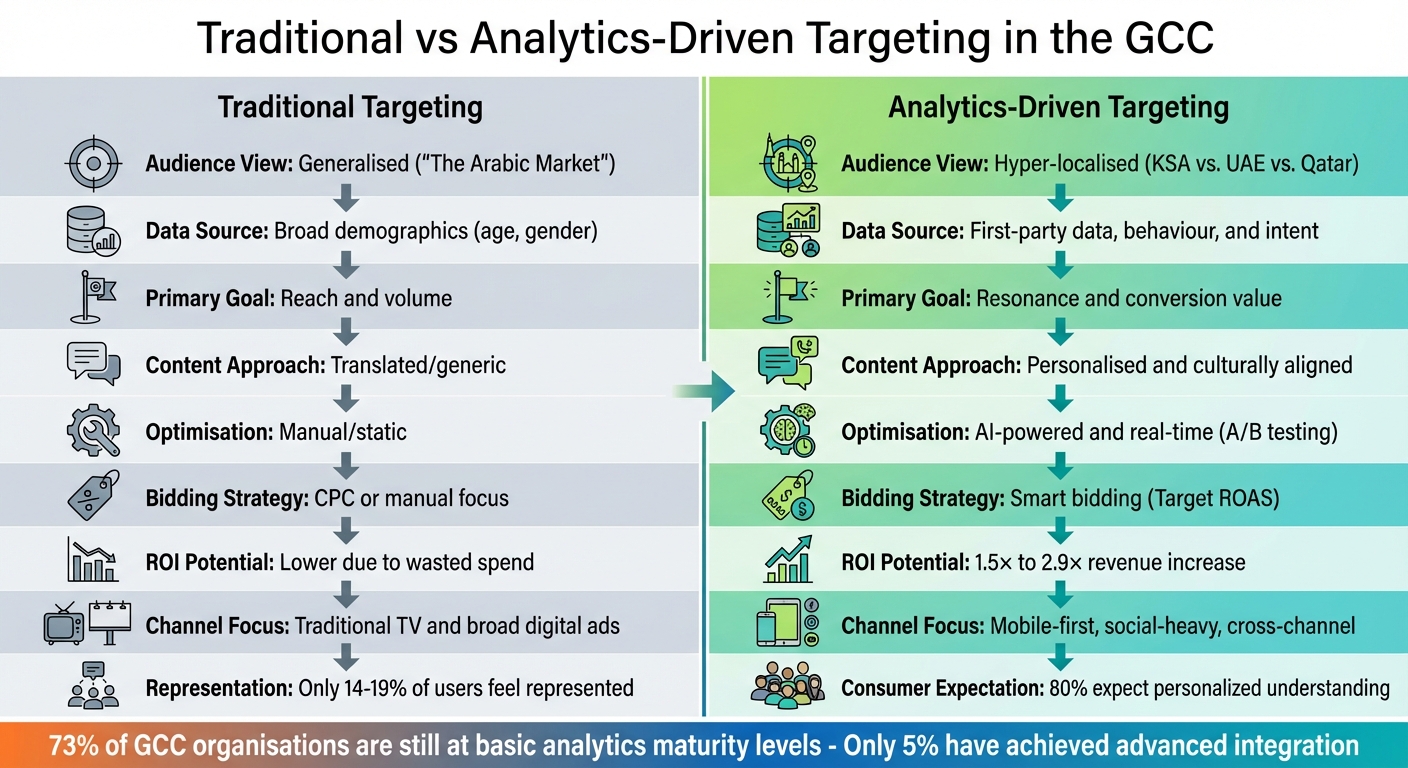
Traditional vs Analytics-Driven Marketing Targeting in GCC
When it comes to marketing in the GCC, the contrast between traditional and analytics-driven targeting highlights the growing need for precision. Traditional targeting tends to focus on reach, aiming to cast a wide net. This often involves buying TV spots, running generic social media ads, and targeting broad demographics like age or gender. However, in a region as diverse as the GCC, this approach often falls short. Broad demographic groupings and fragmented data make it challenging to connect with consumers in a meaningful way.
On the other hand, analytics-driven targeting takes a completely different route. By leveraging behavioral data, this method identifies individuals most likely to convert and crafts messages tailored to their specific needs and cultural nuances. For example, a consumer in Downtown Dubai may have vastly different shopping habits compared to someone in Riyadh or Doha. These differences extend to technology as well - while the UAE’s advanced mobile networks support high-definition video and augmented reality, other markets might require lighter, more optimized content to accommodate slower speeds.
Switching from manual strategies to AI-powered smart bidding further illustrates the advantages of analytics-driven targeting. Traditional approaches, such as "Maximize Clicks" strategies, might generate traffic but often waste budget on users with low purchase intent. In contrast, analytics-driven strategies like "Target ROAS" use machine learning to focus ad spend on high-value customers who are more likely to convert. The numbers back this up: companies that rely on first-party data for marketing see revenue increases of 1.5× to 2.9× compared to those using only broad demographic data.
Yet, there’s still a long way to go. Despite the clear benefits, 73% of organizations in the GCC are still at basic levels of analytics maturity, with only 5% achieving advanced integration. This gap presents a massive opportunity for brands willing to invest in robust data systems and analytics capabilities.
| Feature | Traditional Targeting | Analytics-Driven Targeting |
|---|---|---|
| Audience View | Generalised ("The Arabic Market") | Hyper-localized (e.g., KSA vs. UAE vs. Qatar) |
| Data Source | Broad demographics (age, gender) | First-party data, behavior, and intent |
| Primary Goal | Reach and volume | Resonance and conversion value |
| Content Approach | Translated/generic | Personalized and culturally aligned |
| Optimization | Manual/static | AI-powered and real-time (e.g., A/B testing) |
| Bidding Strategy | CPC or manual focus | Smart bidding (e.g., Target ROAS) |
| ROI Potential | Lower due to wasted spend | 1.5× to 2.9× revenue increase |
| Channel Focus | Traditional TV and broad digital ads | Mobile-first, social-heavy, cross-channel |
Consumer expectations in the GCC further underline the importance of analytics-driven targeting. In the UAE, 80% of consumers expect companies to understand their unique needs. Yet, only 19.3% of internet users in the UAE and 14.0% in Saudi Arabia feel represented in advertising. This disconnect is where analytics-driven methods shine. By focusing on behavior rather than just demographics, brands can move beyond simple translation to true localization, creating campaigns that genuinely resonate with their audiences.
To turn analytics into practical strategies, a well-structured framework is essential - especially when navigating the unique challenges of the diverse GCC consumer market. Wick's Four Pillar Framework offers a cohesive system to gather data, personalize interactions, and continuously optimize performance across varied audiences in the UAE, Saudi Arabia, Qatar, and beyond.
The first step involves consolidating first-party data from sources like CRM systems, media platforms, and website analytics. This creates a unified view of both online and offline interactions, such as call center conversations and in-store visits.
Before delving into advanced analytics, conducting a thorough data audit is crucial. This ensures the data aligns with business goals, is accessible, reliable, and up-to-date. Privacy also plays a pivotal role, especially in the GCC, where 55% of consumers in the UAE, Egypt, and Saudi Arabia say trust in a brand depends on how well it protects personal data. Companies adopting integrated data platforms have reported revenue lifts of 1.5× to 2.9× compared to those relying on broad demographics alone.
Once the data foundation is established, the focus shifts to AI-powered personalization. In a market where 80% of UAE consumers expect brands to understand their unique needs and 66% demand personalized offers, generic campaigns are no longer effective.
AI tools help segment data to identify behavioral patterns and create personas that resonate culturally - whether targeting expatriates in Downtown Dubai or local families in Riyadh. This includes running tailored campaigns in both Arabic and English, where native speakers optimize keywords for local dialects rather than relying on machine translation.
In competitive markets like Dubai, smart bidding strategies are essential. Switching from "Maximize Clicks" to "Maximize Conversion Value" or Target ROAS allows machine learning to allocate budgets more effectively. Enhancing campaigns with ad extensions - like Location Extensions for physical offices in Riyadh or Dubai, and Callout Extensions that highlight trust factors such as "Licensed and Regulated" or "24/7 Arabic Support" - further boosts their impact. This AI-driven approach ensures a personalized and effective user experience.
The final pillar focuses on keeping the strategy adaptable. In the GCC, where market dynamics often follow seasonal cycles, continuous optimization means tracking region-specific KPIs like Cost Per Lead (CPL), Cost Per Sale, and Return on Ad Spend (ROAS). This allows for real-time adjustments to budgets and strategies. Tools like A/B testing and performance dashboards help brands quickly adapt to trends during Ramadan, Eid, or major events like the Dubai Expo.
Brands across the GCC are shifting from generic campaigns to strategies powered by analytics, achieving noticeable gains in targeting accuracy and campaign effectiveness. This region requires more than just broad marketing efforts - it demands a deep understanding of cultural nuances, consumer behavior, and the ability to adapt in real time. Data reveals unique digital habits, technology preferences, and purchasing behaviors in each market, proving that impactful campaigns must adopt a hyper-local focus.
The results speak for themselves. Companies using first-party data for their marketing efforts report revenue increases of 1.5× to 2.9× compared to those relying on basic demographic data. Yet, there's room for growth - while 84% of GCC organizations have integrated AI into their operations, only 11% are classified as "value realisers", showing a clear opportunity for businesses to adopt more structured, data-driven strategies. These results underline the importance of a comprehensive and analytics-focused approach.
Wick's Four Pillar Framework provides a roadmap for success by combining data collection, AI-driven personalization, and ongoing performance optimization. This method not only aligns with the high privacy expectations of GCC consumers - 55% say data protection directly influences their trust in brands - but also meets the demand for personalized experiences. In fact, 80% of UAE consumers expect companies to understand their individual needs. Whether it's planning for Ramadan’s seasonal dynamics, connecting with affluent audiences in Downtown Dubai, or tailoring content for varying internet speeds, analytics ensures every marketing dirham is spent with precision and purpose.
Analytics plays a crucial role in addressing the data unification challenges often encountered in the GCC region. Businesses here regularly grapple with data silos and inconsistencies in formats and languages. Advanced technologies like AI and predictive analytics come into play by cleaning, standardising, and integrating data from various sources - ranging from internal databases to social media and third-party platforms - into a single, cohesive system. This process helps create detailed customer profiles that accurately capture audience behaviors and preferences, potentially boosting marketing ROI by up to 20%.
In the UAE, analytics further ensures data consistency by automating standardisation. For instance, it aligns currency to AED, adjusts to local date and time formats, and applies appropriate decimal separators. Real-time dashboards empower marketing teams to track performance and tweak strategies on the fly, enhancing customer trust and ensuring alignment with regional regulations. By breaking down data silos, businesses can deliver tailored, targeted campaigns that truly connect with the GCC’s diverse and dynamic audience.
Behavior-based targeting zeroes in on analyzing users' real-time actions, preferences, and online behaviors. This lets businesses deliver tailored and relevant messages that feel more personal. The result? Better engagement and improved conversion rates compared to using just static demographic data.
In the GCC region, where consumer habits and preferences vary widely due to diverse cultural and economic backgrounds, this approach becomes even more effective. By using advanced analytics, businesses can navigate these unique market dynamics and craft campaigns that genuinely connect with their audience.
Cultural events like Ramadan, UAE National Day, and White Friday play a major role in shaping consumer behavior across the GCC, leading to predictable surges in spending and engagement. By incorporating these events into analytics tools, marketers can better anticipate changes in online traffic, shopping patterns, and media consumption. This foresight allows them to fine-tune budgets and optimize campaigns well in advance.
Take Ramadan as an example: businesses can use event-based segmentation to offer tailored deals, such as exclusive Iftar bundles, or roll out UAE National Day-themed promotions, perfectly timed to when shoppers are most likely to engage. Real-time analytics further enhance this approach by pinpointing peak traffic periods, enabling brands to adjust ad spend and refine messaging on the fly. By weaving cultural insights into a unified data strategy, businesses in the GCC can turn these festive moments into opportunities for meaningful growth while staying deeply connected to their audience.
16 MIN READ
14 MIN READ
11 MIN READ
What worked, what didn't, and what we're building next - no noise, unsubscribe anytime.