Cross-Channel Marketing: Best Practices For 2025
16 MIN READ
AI · 22 Dec 2025 · 14 minConversational AI boosts martech by automating support, enabling real-time personalization, improving lead qualification and delivering measurable ROI.
Conversational AI is reshaping marketing by enabling natural, human-like interactions through advanced technologies like NLP and machine learning. Unlike basic chatbots, it understands intent, delivers context-aware responses, and continues improving over time. This technology integrates seamlessly into marketing tools, automating tasks like lead qualification, customer support, and scheduling, while offering real-time personalization based on live customer data.
Key highlights:
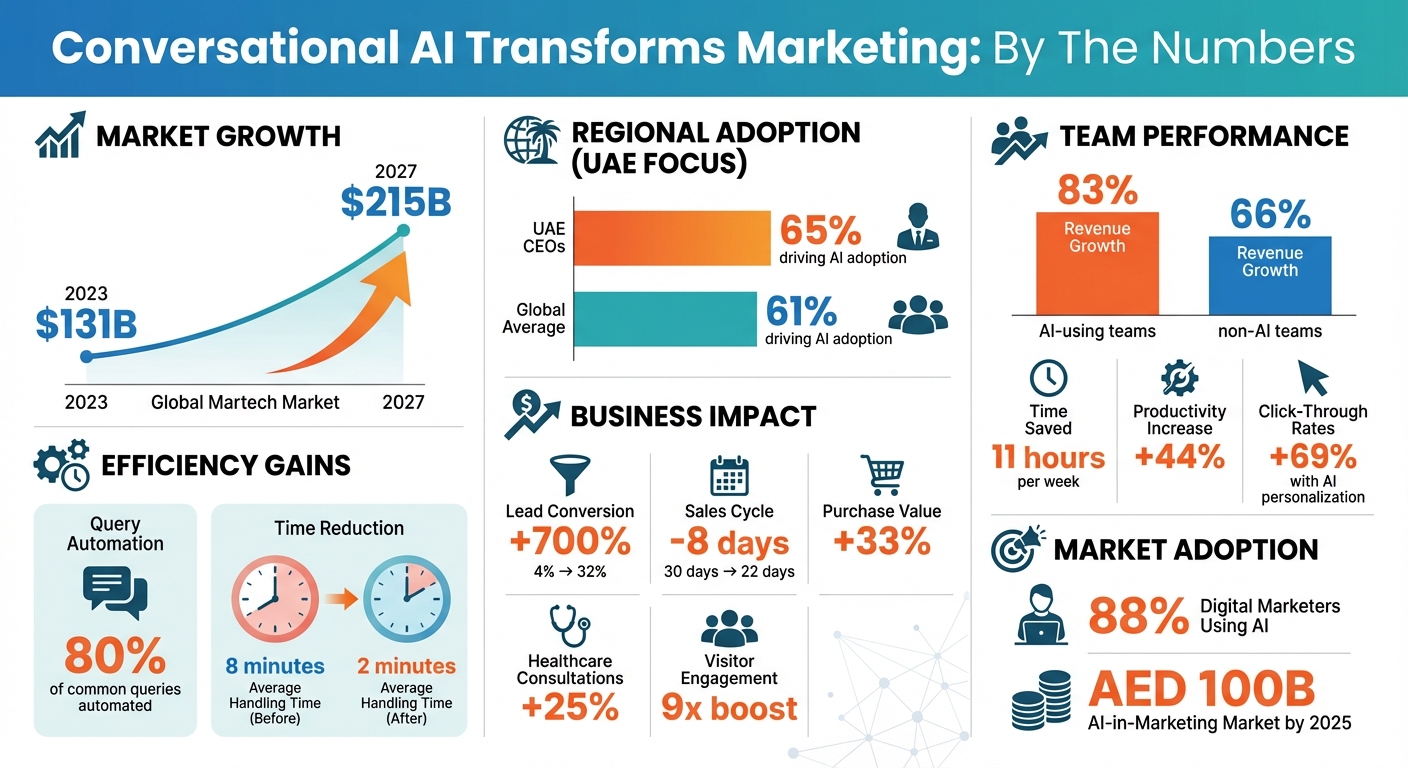
Conversational AI Impact on Marketing: Key Statistics and ROI Metrics
Conversational AI is reshaping how businesses engage with customers by enabling real-time, intent-driven interactions. Gone are the days of waiting for prospects to fill out forms or navigate clunky websites. Instead, AI-powered agents initiate meaningful, adaptive conversations, transforming marketing from a one-way broadcast into a dynamic, two-way exchange across multiple platforms. This shift opens up new opportunities for businesses to connect with customers at every stage of their journey.
Take the example of Waiver Group, a healthcare consulting firm that introduced "Waiverlyn", an AI agent, in early 2025. This tool operates 24/7, identifying visitor needs and automating tasks like appointment bookings. The results? A 25% boost in consultations and a ninefold increase in visitor engagement. Likewise, hostifAI's "Virtual Butlers" engage with 70% of hotel guests before their arrival, and 20% of those guests purchase additional services - such as tours, dining, or room upgrades - before even checking in.
"By the time customers reach a brand's website, they already expect relevance, speed, and a conversational flow."
- Adobe Spokesperson
What makes this technology stand out is its ability to go beyond simple keyword recognition. Conversational AI analyses sentiment and context, enabling it to interpret what customers mean - not just what they say. This is particularly crucial for UAE businesses that cater to a diverse, multilingual audience, as it allows them to offer instant, multilingual support seamlessly.
One of the standout benefits of conversational AI is its ability to deliver hyper-personalized experiences at scale. By integrating with CRM systems and leveraging first-party data, AI adapts in real-time to each customer's behavior and preferences. Unlike traditional automation tools that rely on fixed rules, AI dynamically adjusts to customer needs. For instance, when a customer asks about eco-friendly or budget-friendly options, the AI can instantly recommend tailored solutions based on their profile.
It doesn’t stop there. AI can also personalize content like images, videos, and messaging across emails, landing pages, and social media in real time. According to internal data from Microsoft Copilot, this level of personalization has been shown to increase click-through rates by 69%. By continuously learning from each interaction, conversational AI ensures that every customer touchpoint builds on the last, creating a seamless and enriched experience.
Conversational AI is a game-changer for automating repetitive tasks that often drain marketing and sales resources. From resetting passwords and processing payments to scheduling meetings and updating CRM records, AI handles these tasks effortlessly. It also streamlines lead generation by engaging prospects in natural conversations, asking smart questions to gauge their interest, and routing qualified leads directly to sales teams.
This approach is paying off: 83% of sales teams using AI reported revenue growth over the past year, compared to 66% of teams that don’t use AI. For routine queries, AI provides instant answers, and for more complex or sensitive issues, it seamlessly transitions the conversation to human agents. This balance ensures efficiency without sacrificing the personal touch.
Conversational AI plays a pivotal role in refining the overall marketing journey. By analyzing data from conversations, browsing patterns, and engagement metrics, it identifies friction points where customers are likely to drop off. This allows marketing teams to address these issues proactively, improving conversion rates.
The technology also enables proactive engagement by triggering conversations at key moments. For example, it might suggest adding items to a shopping cart, offer assistance when a visitor hesitates on a pricing page, or recommend products based on recent browsing activity. This anticipatory approach makes the customer experience feel intuitive and efficient.
Moreover, conversational AI ensures consistency across all channels. By remembering past interactions and preferences, it eliminates the need for customers to repeat themselves, creating a unified experience. This is especially important in the UAE's highly connected digital market, where seamless experiences are not just expected - they’re essential.
Rolling out conversational AI into your marketing technology stack can feel like a big task, but breaking it into clear, actionable steps makes the process much smoother. The key is to align these steps with your business goals and existing tools to create a seamless integration.
Start by identifying what you want to achieve. Are you looking to improve lead conversion, speed up support response times, or provide real-time personalization across channels? With the AI-in-marketing market expected to hit nearly AED 100 billion by 2025, and 88% of digital marketers already using AI, it's clear this technology is becoming a must-have. To gain leadership support, position conversational AI as a strategic investment that deserves proper funding.
Take a close look at your organization's marketing maturity. Are you in the "Developing", "Operational", or "Transformational" stage? This will help you determine if your team is ready for advanced AI solutions. Then, focus on high-impact use cases like real-time lead qualification, 24/7 customer support, or automating customer journeys. Map out your buyer journey to identify moments where instant responses or human-like interactions can make a real difference.
"The real edge today isn't speed. It's intention. It's marketers who know how to wield AI with heart and curiosity."
- Tanya Thorson, Strategic Growth Marketing Leader
Before adding new tools, audit your current martech stack. Eliminate outdated systems that duplicate functionality to streamline your setup. Once your goals and needs are clear, you can move on to integrating conversational AI with your existing tools.
A unified customer experience depends on connecting AI with the tools you already use. Yet, 47% of martech decision-makers say stack complexity and data integration issues prevent them from getting full value from their systems. To address this, link your conversational AI platform with your CRM, customer data platform (CDP), and analytics tools. This ensures AI agents can access real-time customer data during conversations and update records automatically.
"We've seen positive impacts across all stages of the buyer's journey from Drift, owing to meaningful personalization. We've improved website conversion, sourced incremental leads, and accelerated the sales process."
- Steve Measelle, VP of Marketing Global Performance & Strategy at Salesloft
Use AI-driven orchestration to identify redundancies in your stack and coordinate workflows across different systems. For example, real-time routing can connect qualified leads to sales reps instantly, with all the context they need - saving customers from repeating themselves. Instead of long-term plans, adopt shorter, flexible cycles that can adapt as AI technology evolves.
Your AI agents should reflect your brand and act as intelligent assistants. Start by preparing your data - clean up duplicates, fix errors, and fill in missing details. Apply feature engineering to turn raw data into useful variables for AI algorithms.
Use industry-specific models tailored to your workflows. Test AI agents in phases, beginning with your most critical use cases. Research shows that marketing teams using AI save around 11 hours a week and increase productivity by 44%.
Human oversight is essential. For example, Salesforce integrated Einstein GPT into its CRM workflows but ensured accountability through an AI Ethics Advisory Council. Similarly, HubSpot used AI-powered sentiment analysis and behavioral testing to adjust responses based on buyer intent.
"AI isn't here to replace human intelligence but to augment it. The real magic happens when we empower people with the right AI tools."
- Satya Nadella, CEO of Microsoft
Treat AI training as an ongoing process, not a one-time task. Use modular learning that updates with platform changes, and measure success by meaningful business outcomes like higher customer lifetime value (CLV) or better conversion rates - not just operational metrics like open rates. Incorporate AI-powered sentiment analysis to understand customer signals before deploying automated responses, ensuring your agents stay authentic and empathetic. With proper training, conversational AI can become an agile and evolving part of your martech strategy.
To ensure your conversational AI is delivering tangible results, it’s crucial to track the right metrics. Balancing customer experience insights with solid business data gives you a well-rounded view of how effective your AI really is. Once your system is properly integrated and trained, measuring its performance not only validates your investment but also ensures that every interaction contributes to your overall goals.
Start by focusing on metrics that reflect customer satisfaction and the effectiveness of interactions. Customer Satisfaction (CSAT) and Net Promoter Score (NPS) are excellent indicators of whether users are pleased with their experiences. Another key metric is First Contact Resolution (FCR), which measures how often issues are resolved during the first interaction. A higher FCR rate indicates that your AI is genuinely solving problems rather than creating additional steps for customers.
Time to Resolution is another important factor. The quicker your AI resolves queries, the lower the chances of customers abandoning the conversation. Strive for an accuracy rate of at least 80%, ensuring your AI delivers correct and helpful responses most of the time. Additionally, tracking your Interaction Completion Rate helps you understand how often conversations reach a meaningful conclusion.
While customer satisfaction metrics focus on engagement, business metrics reveal the financial impact of your AI.
Customer experience data is only part of the story - business metrics provide insight into how AI contributes to your bottom line. For example, AI-driven chat interactions have been shown to increase lead conversion rates from 4% to 32%, representing an eightfold improvement. Keep an eye on Customer Lifetime Value (CLV) to evaluate the long-term financial benefits and Customer Acquisition Cost (CAC) to measure the efficiency of your AI system.
"At the end of the day, what matters is that this is producing revenue for the business...Unless more people are buying because you made it easier for them, none of this matters."
- Kyle Bastien, Director of Sales Enablement, Drift
Another crucial metric is the Lead Qualification Rate, which tracks how effectively your AI identifies high-value prospects during initial interactions. Shorter sales cycles are another benefit - research shows that customers engaging with AI chat complete purchases eight days faster and spend 33% more compared to those who don’t. By integrating your AI platform with your CRM, you can monitor the entire journey from the first conversation to the final sale.
To demonstrate the effectiveness of your conversational AI, create a side-by-side comparison of key metrics before and after implementation. This approach makes it easy to show stakeholders the immediate impact.
| Metric | Pre-AI Implementation | Post-AI Implementation | Improvement |
|---|---|---|---|
| Lead Conversion Rate | 4% | 32% | +700% |
| Average Purchase Value | AED 3,670 | AED 4,880 | +33% |
| Sales Cycle Length | 30 Days | 22 Days | -8 Days |
| Cost Per Lead | AED 184 | AED 129 | -30% |
When calculating ROI, include Total Cost of Ownership (TCO), which factors in vendor fees, implementation time, and ongoing costs. Industry benchmarks suggest that payback periods vary: one month for B2C, six months for B2B small and medium businesses, and up to 12 months for larger B2B enterprises. Use real-time data for quick adjustments while analyzing long-term trends to account for seasonal variations.

Implementing conversational AI goes beyond just picking the right technology - it’s about creating a seamless digital ecosystem. Wick's Four Pillar Framework lays the groundwork for businesses to integrate conversational AI effectively into their marketing technology (martech) stack. Instead of treating AI as a standalone tool, this framework ensures it becomes an integral part of existing marketing operations. Let’s take a closer look at how the Tailor & Automate pillar is transforming customer interactions.
The Tailor & Automate pillar reshapes how businesses interact with customers by moving away from one-size-fits-all campaigns towards real-time journey orchestration. By combining historical data, real-time insights, and natural language processing, AI agents can deliver customized responses, predict customer needs, and even make timely product recommendations.
These AI agents go a step further by recognising the emotional tone of customer interactions, enabling them to adjust responses for a more empathetic and human-like experience. In Dubai, for example, over 60% of consumers now favour AI-driven customer service because of its speed and convenience. Whether customers engage through WhatsApp, social media, or websites, the system ensures consistent, personalized communication across all channels.
A solid conversational AI system needs a unified data foundation, which is precisely what the Capture & Store pillar delivers. This pillar uses a Customer Data Platform (CDP) to gather, normalise, and unify data from multiple sources into comprehensive customer profiles. By resolving identities across email addresses, phone numbers, and cookies, businesses can create a single, cohesive view of each customer. This allows AI agents to maintain context no matter where or how a customer interacts.
"To create personalized customer experiences, you have to lay the groundwork for a unified data strategy across all channels." - Martech Cube
A unified data strategy is critical for enabling conversational AI to work effectively within the broader digital ecosystem. Real-time data ingestion through mobile SDKs, APIs, and webhooks ensures AI can respond to current user behavior instead of relying on outdated records. This data feeds into the decision-making layer, where predictive intelligence helps AI anticipate customer needs and determine the best next steps. A great example is The Waiver Group, which introduced a conversational marketing bot in January 2025. By integrating it with their data systems, they achieved a 25% increase in consultations booked and a ninefold boost in visitor engagement.
Wick also provides enterprise-level support to ensure conversational AI integrates seamlessly into a broader martech ecosystem. With 47% of martech decision-makers citing stack complexity and data integration as major hurdles, Wick’s framework offers the expertise needed to simplify integration and address common data challenges. This approach helps recover the 44% of martech investments that often go underutilised, ensuring that conversational AI adds real value instead of increasing complexity.
Wick’s support includes strategic consulting to evaluate your martech stack and align it with specific goals - whether that’s acquiring new customers, boosting retention, or driving revenue growth. Teams are trained to interpret AI-driven insights and fine-tune algorithms for better customer segmentation, addressing a key issue: 34% of martech buyers report a lack of skilled talent as a barrier. Wick also prioritizes data hygiene through deduplication and standardisation, ensuring AI systems have high-quality data to work with. After all, clean data directly translates to better AI performance.
Conversational AI is reshaping marketing technology by automating routine tasks and delivering highly personalized customer experiences. But to truly benefit, businesses must go beyond viewing AI as just another tool. Instead, it should be woven into their entire digital ecosystem - connecting CRM systems, data platforms, and marketing automation tools to create a smooth and unified customer journey.
This transformation extends beyond operational efficiency. The shift towards intent-based discovery is changing how customers interact with brands. For instance, data from Microsoft Copilot reveals a 69% increase in click-through rates with AI-driven personalization, while 85% of marketers report increased productivity in areas like content creation and visual storytelling. Rather than replacing human expertise, AI allows teams to focus on strategic work by handling repetitive tasks like lead qualification, answering FAQs, and initial customer interactions.
"2023 was about 'WOW.' 2024 is about 'HOW.' And 2025 will be 'NOW.' The shift to AI-first marketing requires agencies and brands to rethink workflows, partnerships and strategies." – Sir Martin Sorrell, Executive Chairman, S4 Capital
Wick's Four Pillar Framework offers a structured approach to implementing conversational AI effectively. The Tailor & Automate pillar focuses on real-time journey orchestration, while the Capture & Store pillar ensures a unified data foundation for AI agents to maintain context across various channels. With enterprise-level support addressing challenges like complex tech stacks and skill shortages, Wick's framework helps businesses get the most out of their martech investments. This strategy highlights the importance of a well-thought-out approach to unlock AI's full potential.
For AI adoption to succeed, organizations need clear goals, consistent ROI tracking, and a thoughtful balance between automation and human involvement. Integrating AI across CRM systems, data platforms, and automation tools ties back to the broader goal of building a seamless martech ecosystem. Regularly measuring customer satisfaction and business performance ensures that companies fully capitalise on their conversational AI investments.
Conversational AI takes customer personalization to the next level by tapping into real-time data like browsing habits, purchase history, location, and preferences. Through machine learning algorithms, it anticipates what customers might need and provides tailored content, customized product suggestions, and even exclusive deals.
This kind of detailed personalization helps businesses craft marketing campaigns and shopping experiences that feel uniquely tailored to each customer. The result? A deeper connection with customers and stronger loyalty to the brand.
Integrating conversational AI into a marketing technology stack isn't always straightforward. The process often faces technical hurdles like ensuring AI tools - chatbots, voice assistants, and similar solutions - work seamlessly with platforms such as CRMs, email systems, analytics tools, and ad-tech platforms. Problems like mismatched data models, siloed databases, and inconsistent identifiers can disrupt data flow, resulting in fragmented customer profiles and unreliable AI-driven insights.
On top of that, there are operational obstacles to consider. Limited in-house expertise in AI, unclear ownership of AI-generated content, and challenges in measuring ROI can all slow down adoption. To address these issues, businesses need a solid strategy. This includes implementing thorough data-cleaning processes and developing a clear roadmap to ensure smooth integration.
For companies in the UAE, Wick’s data-driven consultancy and AI-personalization services offer tailored solutions to tackle these challenges, helping businesses build cohesive, high-performing marketing technology ecosystems.
All monetary values referenced are in AED, and dates follow the UAE format (dd/MM/yyyy).
To gauge the return on investment (ROI) of conversational AI, businesses need to link its performance metrics - like response accuracy, engagement rates, and average response time - to tangible business results. These results might include improved conversion rates, reduced cost-per-acquisition, increased average transaction value, and overall revenue growth.
By weighing the financial gains, such as additional revenue, against the costs of implementing and maintaining the AI system, companies can assess its overall value. This method ensures the investment supports their strategic objectives and delivers long-term benefits.
16 MIN READ
14 MIN READ
11 MIN READ
What worked, what didn't, and what we're building next - no noise, unsubscribe anytime.