Cross-Channel Marketing: Best Practices For 2025
16 MIN READ
DIGITAL · 17 Dec 2025 · 17 minClear, concise guide to GCC data protection: identify laws, inventory data, assign a DPO, manage consent, secure/localize data, and audit compliance.
Data compliance is now essential for businesses operating in the GCC. With strict laws like the UAE’s Federal Decree-Law No. 45 of 2021 (UAE PDPL) and similar regulations in Saudi Arabia, Bahrain, and Qatar, failing to comply can result in heavy fines, reputational harm, and operational disruptions. Here's how you can stay compliant:
Why it matters: Non-compliance can lead to fines of up to AED 5 million under UAE PDPL, loss of customer trust, and operational risks. Businesses that align with these regulations can also unlock growth opportunities by building trust and ensuring data integrity.
Follow these steps to protect your business, build customer confidence, and meet GCC data compliance requirements.
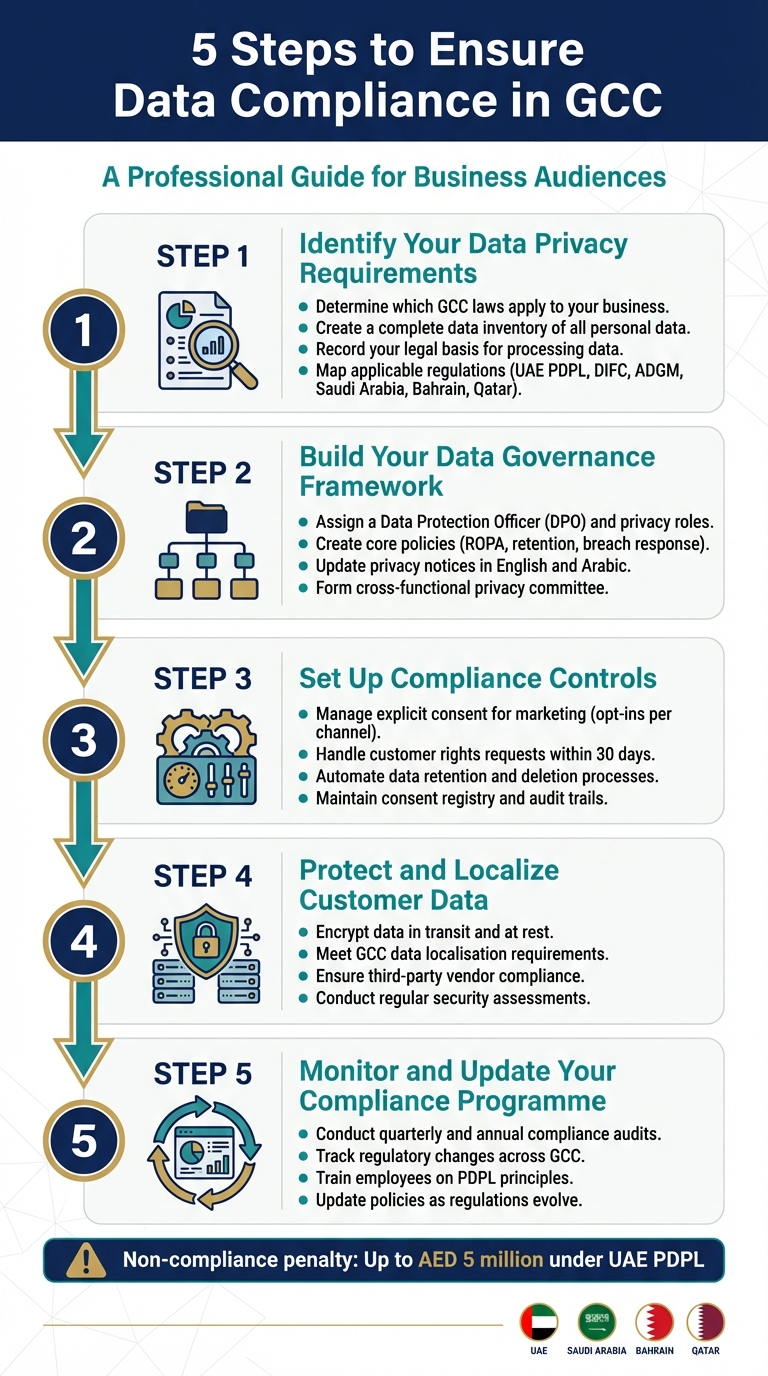
5 Steps to Ensure Data Compliance in GCC
Understanding and meeting data privacy requirements is crucial to avoid penalties, which can climb as high as AED 5 million under the UAE Personal Data Protection Law (PDPL).
Your data privacy obligations hinge on where your business operates and the location of your customers. For companies based in the UAE, DIFC, ADGM, or those catering to GCC customers, it’s essential to document the specific laws that govern your operations.
If your business operates in mainland UAE, the Federal Decree‑Law No. 45 of 2021 (UAE PDPL) applies. Meanwhile, businesses in the Dubai International Financial Center (DIFC) must adhere to the DIFC Data Protection Law No. 5 of 2020, which was updated in July 2025 to include AI-related regulations. Similarly, companies in the Abu Dhabi Global Market (ADGM) are subject to the ADGM Data Protection Regulations 2021.
For businesses serving customers across the GCC, additional regulations come into play. For instance, Saudi Arabia's Personal Data Protection Law applies to any business handling the data of individuals residing in the Kingdom, regardless of the business’s location. Likewise, Bahrain's PDPL (Law No. 30 of 2018) and Qatar's Law No. 13 of 2016 impose similar requirements. For example, if your UAE-based e-commerce platform ships to Saudi Arabia, you must ensure compliance with Saudi Arabia's PDPL for those transactions.
Once you’ve mapped the applicable legal framework, the next step is to create a detailed inventory of your data.
Start by cataloguing all systems that collect, store, or share personal data. For each dataset, document the types of data collected, its purpose, the storage location, and the individuals it pertains to. Include any cross-border data transfers and ensure safeguards, such as Standard Contractual Clauses, are in place to meet the requirements of the UAE PDPL and DIFC regulations.
Regularly review and update your inventory to account for new risks, such as changes in international data transfer rules. Having a comprehensive inventory not only helps avoid penalties but also ensures smoother audits and compliance checks.
GCC data privacy laws require businesses to clearly identify and document their legal basis for processing personal data. Maintain a detailed register that outlines:
For example, a UAE-based fintech company might use consent to collect location data from app users while relying on contractual necessity to process transaction history.
This register should be updated whenever circumstances change, as it’s a key tool for demonstrating accountability during audits and responding to customer requests. UAE regulators actively enforce compliance, making this documentation an important safeguard.
These initial steps lay the groundwork for effective data governance, which will be explored further in Step 2.
After mapping out your data landscape, the next step is to create a governance framework that turns legal obligations into actionable roles, well-documented policies, and clear communication. The data inventory from Step 1 serves as the foundation for these governance efforts.
In the GCC, organizations involved in large-scale or high-risk data processing are often required to appoint a Data Protection Officer (DPO) or an equivalent privacy expert. Even if a formal DPO isn’t mandatory, regulators still expect a designated point of contact for both data subjects and authorities.
Start by appointing a senior leader, typically someone at the C-level, to oversee privacy risks and set the tone for compliance. Then, assign a DPO or privacy officer who has the authority to manage your data protection strategy, conduct impact assessments, and serve as the liaison with regulators. This individual should be accessible during local working hours and fluent in both English and Arabic to effectively address enquiries from UAE residents and local authorities.
Additionally, form a cross-functional privacy committee that meets regularly - either quarterly or during incidents. This committee should include representatives from key departments such as Legal, IT Security, HR, Marketing, and Operations. For businesses reliant on data-driven campaigns, collaborating with partners like Wick can help ensure marketing automation and analytics comply with the UAE’s Personal Data Protection Law (PDPL). Define each role’s responsibilities, reporting structure, and contact details in your governance framework, and make sure the DPO’s contact information is included in your privacy notices.
Regulators across the GCC require written policies that demonstrate accountability. Essential documents include:
Make it a habit to review and update these policies annually or whenever regulatory changes occur. Once these policies are established, ensure they are communicated transparently through updated privacy notices.
Privacy notices are essential for building trust and ensuring transparency. Under the UAE PDPL and similar GCC laws, these notices must clearly explain your identity, data practices, recipients, retention periods, and the rights of data subjects. For audiences in the UAE and the wider GCC, provide these notices in both English and Arabic, ensuring the Arabic version is both legally accurate and easy to understand.
Your privacy notice should include the following:
Include a section on cross-border transfers, specifying where the data is stored - whether in UAE-based data centers or global cloud locations - and outlining the safeguards in place. Ensure the privacy notice is mobile-friendly and designed to accommodate Arabic’s right-to-left display.
For businesses driven by marketing, partners like Wick can assist with integrating consent flows and tracking mechanisms into your digital platforms. This ensures your privacy notices align with your marketing practices and automation systems, maintaining consistency across all channels.
To make your policies work in everyday operations, it's crucial to establish effective compliance controls. This involves managing marketing consent, addressing customer rights requests, and automating data retention processes. These measures help ensure your business operates in line with UAE PDPL and other GCC regulations.
Under UAE PDPL, consent for marketing must be explicit, informed, freely given, and unambiguous, and customers should be able to withdraw it at any time. Pre-ticked boxes or bundled consents are not acceptable. Instead, use clear, separate opt-ins for each communication channel.
Clearly explain what customers are agreeing to at each consent point - whether it’s for promotional emails, SMS updates, WhatsApp messages, or personalized recommendations based on behavior. For UAE-based audiences, provide consent options in both English and Arabic, ensuring the language is respectful and avoids unnecessary or intrusive questions unless legally required. Include a brief privacy summary at each point, linking to your full privacy notice, which should explain the legal basis, retention periods, and any cross-border data transfers.
Maintain a consent registry that logs details such as the purpose, channel, timestamp, and version of the consent. This log, whether stored in your CRM, customer data platform, or a consent management system, serves as an audit trail. For WhatsApp and SMS campaigns, ensure there’s a clear opt-in record, like a message saying, "Reply YES to receive offers from [Brand]".
If you have older marketing lists with unclear or missing consent, segment them based on how the data was initially collected. For contacts where compliant consent cannot be verified, run a re-permissioning campaign. This campaign should explain your updated privacy practices and invite users to opt in again. This approach shows regulators that you’re acting responsibly and reduces your risk exposure. Companies relying heavily on data-driven marketing can partner with firms like Wick to ensure their automation systems are properly configured to track consent across all channels, keeping campaigns effective while minimising risks.
Efficient consent management also simplifies handling customer rights requests.
Robust processes are essential for managing customer rights requests. UAE PDPL grants individuals rights such as access to their data, rectification, erasure, restriction of processing, objection (including to marketing), data portability, and review of automated decisions. Although statutory response times may vary, it’s good practice to acknowledge requests within a few business days and complete most within 30 calendar days, providing documented reasons for any extensions.
Offer multiple ways for customers to submit requests, such as dedicated web forms, secure self-service portals, a privacy-specific email address, or call-center and in-branch options. Verify identities using existing KYC data, like Emirates ID numbers, registered mobile numbers, or recent transaction details, while avoiding requests for unnecessary personal data. For high-risk requests, apply stricter verification methods.
Set internal service-level agreements (SLAs) for different types of requests: for example, provide access within 20 days, complete rectifications or erasures within 25 days, and handle marketing objections within 5–7 days. Create workflows that cover every step - from request intake and identity verification to triage, fulfillment, and closure. Complex cases should be escalated to your Data Protection Officer or privacy lead. Ensure that personal data is shared securely, using encrypted channels in line with PDPL standards.
| Data Subject Right | Internal SLA | Key Actions |
|---|---|---|
| Access to personal data | 20 days | Verify identity; compile data from all systems; deliver via secure portal |
| Rectification or correction | 25 days | Update records across CRM, marketing, and support systems; confirm changes |
| Erasure (right to be forgotten) | 25 days | Delete from active systems, backups, and third-party processors; document execution |
| Objection to marketing | 5–7 days | Update consent registry; suppress across email, SMS, WhatsApp, and ad platforms |
| Data portability | 30 days | Export data in machine-readable format (CSV, JSON); verify identity before delivery |
Integrate your marketing, CRM, and support systems so that consent choices and rights requests are consistently applied across all platforms and third parties. Use a centralized system - like a CRM or customer data platform - as the single source of truth for consent and rights statuses, and link other systems through APIs or scheduled synchronisations. When a user opts out or exercises their rights on one channel, all connected systems should update accordingly to stop processing their data for marketing or other purposes. Include clauses in contracts with processors (e.g., email providers or marketing agencies) requiring them to act promptly on instructions related to consent withdrawal, erasure, or restrictions, and to provide evidence of compliance.
Streamlining your data lifecycle is another critical step. A well-defined data retention framework ensures compliance with PDPL while balancing legal requirements and business needs. Set a clear retention policy for key data types, such as marketing leads, customer records, invoices, support tickets, CCTV footage, and behavioral analytics. Align these retention periods with UAE-specific legal and regulatory obligations, like finance, tax, and anti-money laundering rules, while considering local dispute or limitation periods.
Use system configurations or lifecycle rules to automate transitions between data states, such as "active", "inactive", "archived", "anonymised", and "deleted". Many cloud storage and SaaS platforms offer built-in lifecycle management features that can automatically archive or delete data after a specified period. Scheduled jobs or scripts can identify records that have exceeded their retention period - based on activity dates, contract end dates, or case closures - and either delete or anonymise them.
Ensure backup and archive policies rotate older backups, preventing erased data from lingering indefinitely. To confirm secure deletion, keep logs of deletion activities, including timestamps, record counts, and affected systems or databases. For sensitive or high-risk data, consider advanced methods like cryptographic erasure (destroying encryption keys) or physically destroying storage media, and retain certificates of destruction for compliance purposes. Establish governance for exceptions, documenting approvals and justifications for extended retention in specific cases, such as ongoing disputes. Periodically review your retention policies to stay aligned with any regulatory updates.
By taking these steps, you can demonstrate accountability under PDPL while reducing risks associated with breaches or regulatory scrutiny. For businesses with integrated digital systems, consultancies like Wick can help design workflows that balance marketing performance with compliance, ensuring data is used effectively without violating GCC privacy standards. Automated retention controls also help keep your data footprint manageable and secure.
These measures ensure your compliance framework is not just theoretical but actively supports everyday operations across GCC jurisdictions.
Securing customer data and adhering to GCC residency laws should now take center stage. Regulations like the UAE PDPL mandate strict measures to safeguard personal data, including encryption, access controls, and regular security assessments. In addition to these technical safeguards, it's crucial to address data localization requirements and ensure third-party vendors align with GCC standards.
The foundation of protecting customer data lies in implementing strong technical defences. Encrypt sensitive data, both during transmission and when stored - this is especially critical for information like Emirates ID numbers, payment details, and health records. Store encryption keys separately, enforce role-based access controls, and require multifactor authentication. Regularly run vulnerability scans, penetration tests, and real-time monitoring to catch and address potential weaknesses. Also, maintain a tested incident response plan to handle breaches effectively.
Document all these measures in clear policies, and use techniques like data minimisation and pseudonymisation. For instance, instead of displaying full customer profiles in analytics dashboards, rely on anonymised or aggregated data. These precautions form the backbone of your security framework, setting the stage for tackling localization requirements.
Many GCC nations now require specific types of data to remain within their borders or the region. Identify datasets that fall under localization rules - such as those related to government, defence, telecommunications, banking, or healthcare - and ensure they are hosted in GCC-certified data centers. For any cross-border data transfers, conduct a transfer impact assessment, implement contractual safeguards, and maintain a detailed register documenting the purpose, legal basis, and risk controls for each transfer. Where allowed, obtain clear and informed consent for such transfers, providing details about destination countries, potential risks, and intended uses.
Once these localization measures are in place, ensure they extend to any third-party processors handling your data.
Even when working with third-party vendors, your organization remains accountable for how customer data is managed. Start by maintaining a detailed vendor inventory and performing risk assessments for all third-party processors. Review their security certifications, incident histories, test reports, and data protection policies to ensure compliance. Secure robust data processing agreements that enforce GCC standards, include confidentiality clauses, and outline breach-notification protocols. These agreements should also limit sub-processing without prior approval and uphold data-subject rights like access, deletion, portability, and objection.
To keep vendors accountable, conduct regular reviews, use security questionnaires, and exercise audit rights. Service-level agreements should tie security and uptime standards directly to performance metrics.
For marketing efforts, ensure compliance with consent and localization rules by working closely with internal teams or consultancies like Wick. Proper data segmentation and tracking can make all the difference in staying within legal boundaries while achieving marketing goals.
Staying compliant is not a one-time task, especially as GCC regulations continue to develop. With the UAE PDPL, recent amendments in DIFC regulations, and other regional frameworks evolving, businesses must remain vigilant. Enforcement agencies are becoming more active, and further regulatory updates are expected through 2025. A well-maintained compliance program helps protect your business from fines and reputational damage.
Regular audits are essential to ensure your compliance framework stays effective. Start with an annual audit and add quarterly reviews to keep your data processes and systems aligned with the UAE PDPL, DIFC rules, and other GCC regulations. Pay extra attention to high-risk areas like customer data platforms, payment systems, and cross-border data transfers.
Use tools like questionnaires, IT walkthroughs, and audits of 20–50 files per system to check crucial elements such as consent logs, breach registers, rights handling, and vendor agreements. If your organization lacks in-house expertise, consider hiring specialized consultants or leveraging ISO 27001/27701 frameworks to simplify the process.
Keeping up with legal updates is just as important as regular audits. GCC data protection laws are changing quickly. For example, the DIFC introduced significant amendments to its Data Protection Law in July 2025, which expanded its scope, introduced a private right of action, and raised fines. These changes require businesses to reassess their operations, update privacy notices, and strengthen incident response plans.
To stay informed, subscribe to UAE government portals and legal advisory services for updates on the PDPL and other GCC regulations. Internally, create a process for managing regulatory changes. This should include analyzing new legal requirements, assessing their impact on your systems and processes, prioritising actions, documenting decisions, and validating the implementation with mini-audits. Maintaining a central register that maps regulatory obligations to your policies, procedures, and system settings can also help demonstrate compliance during inspections.
Training is a cornerstone of effective compliance. Start with mandatory baseline training for all employees, covering key PDPL principles like lawfulness, transparency, data minimisation, and security. Include essential topics such as individual rights, incident reporting, and phishing awareness.
For more effectiveness, tailor training to specific roles. For instance:
New employees should complete their training within the first month, with annual refreshers for all staff. Additional sessions should follow any major legal or policy updates. To gauge the program's effectiveness, use quizzes, incident reviews, and employee feedback. In the UAE’s diverse workforce, offer training in multiple languages and formats - such as e-learning modules and interactive workshops - to ensure everyone is engaged and informed.
Data compliance across the GCC isn’t just a one-time task - it’s a continuous capability your business needs to cultivate. To navigate this complex landscape, focus on these five key steps: map your data and the laws that apply, create a governance framework with clear policies and roles, establish controls for consent and data rights, secure and localize your data, and regularly monitor compliance through audits and training. These actions align with PDPL requirements and broader standards across the region.
The regulatory environment is always shifting. Updates like those from the DIFC and evolving federal guidelines highlight the importance of embedding compliance into your risk management, digital transformation efforts, and board-level reporting. By weaving principles such as transparency, data minimisation, and security into your data strategy, you’ll not only meet legal requirements but also improve data quality and build stronger customer trust.
What’s more, compliance can open doors to new business opportunities. When your organization has clear consent processes, solid legal documentation, and compliant cross-border data transfer mechanisms, you’ll be better equipped to roll out new digital services, expand into regional markets, and collaborate with global partners. In competitive industries like finance, retail, tourism, and e-commerce, customers and stakeholders increasingly expect privacy-conscious practices. This approach transforms compliance from a regulatory checkbox into a competitive advantage.
For many businesses in the GCC, expert consultancies can provide the operational expertise needed to transform legal requirements into practical, growth-oriented solutions. For example, data-driven marketing consultancies like Wick specialize in creating compliant digital ecosystems that respect user choice and data minimisation - turning regulatory challenges into opportunities for innovation.
In the GCC region, data localization rules often require businesses to store certain categories of data within the borders of the country where it is generated. This involves complying with local data protection laws, maintaining stringent data security protocols, and, in some instances, utilising nationally approved digital infrastructure. Examples of such regulations include the UAE Personal Data Protection Law and Saudi Arabia’s data privacy frameworks.
To ensure compliance, organizations need to consistently monitor and understand local regulations, adopt secure data storage practices, and align their operations with both regional mandates and international privacy standards.
To handle customer rights requests effectively under GCC data privacy regulations, businesses need to put in place straightforward and transparent processes. Make it easy for users to submit their requests by offering accessible options like online forms or dedicated customer service portals. It’s crucial to verify the identity of each requester to safeguard data security and privacy.
Keep a detailed record of every step taken during the process, and ensure you meet any regulatory deadlines for responding to these requests. Using data management tools can simplify the workflow, ensure compliance, and help your teams handle requests consistently and efficiently.
A Data Protection Officer (DPO) plays a key role in helping organizations adhere to data privacy laws and regulations. Their responsibilities include crafting and managing data protection strategies, ensuring compliance with legal requirements, and advising on the proper handling of personal data.
Additionally, the DPO acts as the primary liaison with regulatory authorities, facilitating clear communication and addressing any issues that may arise. By steering organizations towards responsible data practices, they help reduce risks and build trust among stakeholders.
16 MIN READ
14 MIN READ
11 MIN READ
What worked, what didn't, and what we're building next - no noise, unsubscribe anytime.