Cross-Channel Marketing: Best Practices For 2025
16 MIN READ
AI · 19 Jan 2026 · 13 minHow GCC brands balance personalization, privacy and compliance using first-party data, explicit consent and ethical AI to build consumer trust within GCC law.

Trust is the foundation of marketing in the Gulf Cooperation Council (GCC) region. Brands that handle consumer data responsibly not only meet legal requirements but also build lasting relationships with their customers. Here's what you need to know:
Key Takeaway: Ethical marketing in the GCC is about balancing personalization, privacy, and compliance with regional norms and regulations. Brands that prioritize transparency and respect for consumer rights see improved trust and business outcomes.
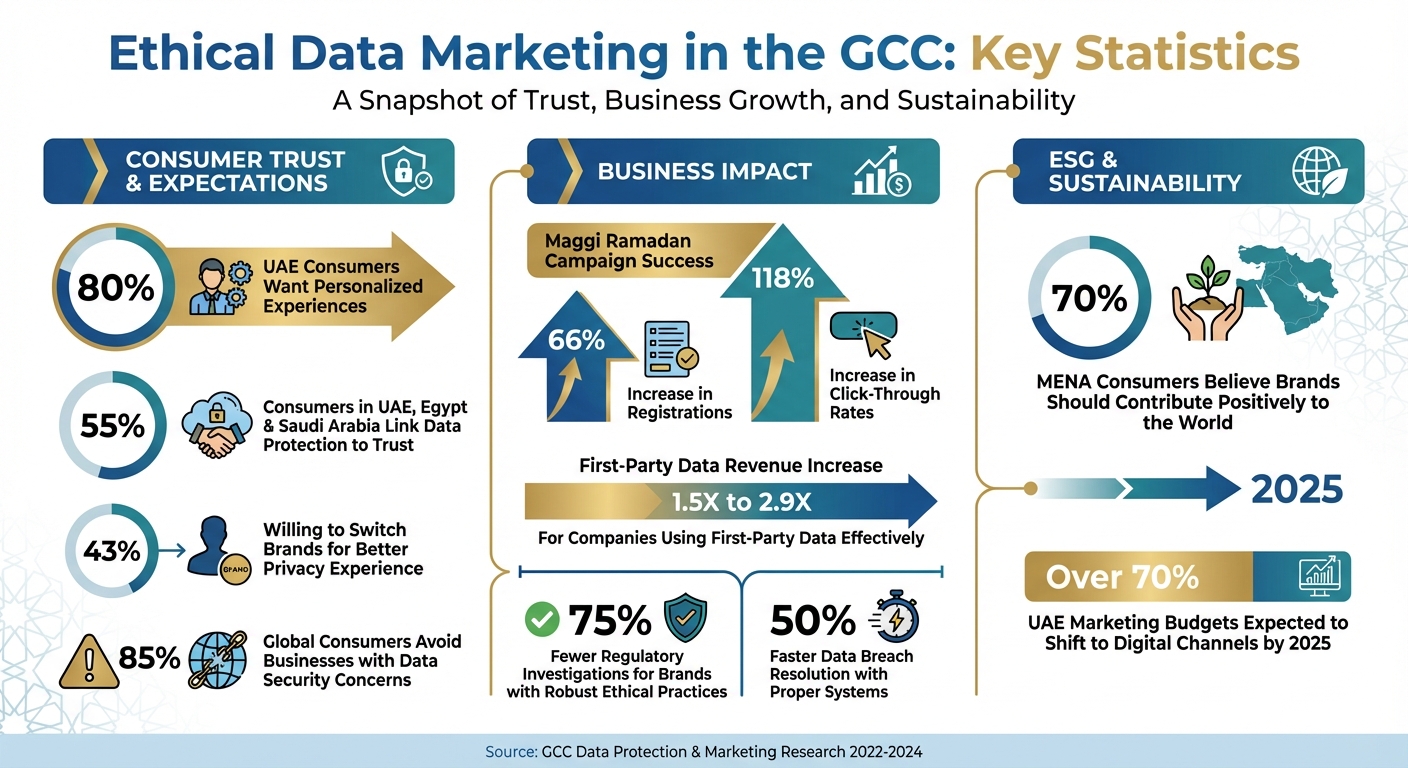
Key Statistics on Ethical Data Marketing in the GCC Region
Ethical marketing in the GCC is deeply rooted in respecting cultural values, safeguarding privacy, and earning trust. Business practices in the region often revolve around trust, which extends to how data is handled and used.
For brands in the GCC, ethical marketing goes beyond meeting legal obligations - it's about recognising that consent is the cornerstone of trust. Consumers expect their data to be used responsibly and in ways that provide them with clear benefits. In fact, 43% of people are willing to switch from their favorite brand to another if it offers a better privacy experience. This mindset aligns perfectly with the data-driven strategies discussed earlier, reinforcing the importance of ethical personalization.
Local regulations further support these expectations. The UAE's Personal Data Protection Law (PDPL), which took effect on 2 January 2022, requires explicit, clear, and unambiguous consent for all data processing activities. Unlike the GDPR in Europe, the PDPL does not allow "legitimate interest" as a basis for data use, making consumer consent the primary requirement for marketing activities.
The following sections explore how cultural norms and regional laws shape ethical marketing practices in the GCC.
Consumer expectations in the GCC are shaped by the region’s unique cultural values. People here value personal engagement over impersonal, automated interactions. Brands that rely solely on automation without fostering a personal connection risk losing consumer trust.
Privacy holds particular importance in the GCC. For instance, taking or sharing photos and videos of individuals without their explicit consent is not only culturally inappropriate but also against the law. Similarly, tracking someone’s geographical location or retaining location data is considered sensitive under UAE regulations, requiring clear consent. Marketing campaigns must also respect religious and cultural observances.
The diversity of the expatriate workforce in the GCC adds another layer of complexity. Marketers must navigate various cultural backgrounds while understanding that family and social obligations often outweigh professional commitments. Hospitality is also a core value in the region, influencing both consumer behavior and the rigorous data protection laws. These cultural nuances are critical for brands aiming to build trust and comply with regional expectations.
The GCC has made significant progress in developing its data protection laws, aligning them with global standards while maintaining regional priorities. The UAE PDPL, for example, applies to any organization processing data from UAE residents, regardless of where the organization is based. This extraterritorial scope means international brands must adapt their practices to comply with local requirements.
Privacy must be integrated into every aspect of marketing under this framework.
| Feature | UAE PDPL (Onshore) | Saudi Arabia PDPL | Qatar Data Law |
|---|---|---|---|
| Primary Regulator | UAE Data Office | SDAIA | National Cyber Security Agency |
| Consent Requirement | Explicit, clear, unambiguous | Express consent for transfers/sensitive data | Prior consent required |
| Marketing Objection | Explicit right to stop direct marketing | Right to object to automated decisions | General right to object |
| Breach Notification | Required for any risk to privacy | Required for breaches | Required to report to regulator |
Under the PDPL, consumers have the right to stop their data from being processed for direct marketing or profiling. They also have the "Right to be Forgotten", allowing them to request the deletion of their data, as well as rights to access, correct, and transfer their information. This requires brands to maintain transparent and user-friendly data management systems.
Non-compliance with these laws carries serious consequences. Violations can result in criminal charges and even imprisonment, making it essential for brands to adopt "privacy by design" in their marketing strategies. Additionally, there’s no threshold for reporting data breaches - any risk to personal data privacy or security must be reported to the relevant regulator. Data collected for one purpose cannot be reused for another without obtaining new consent from the consumer.
Collecting and analyzing data ethically requires a firm commitment to respecting consumer rights at every stage. By adhering to both cultural norms and legal regulations, businesses can ensure their data practices align with ethical standards.
Transparency starts with obtaining explicit consent. Regulators across the UAE, Saudi Arabia, Qatar, and Kuwait insist that consent must be clear, unambiguous, and freely given. Companies should clearly explain what data they are collecting and why, using straightforward, bilingual communication.
Equally important is purpose limitation. Data collected for one purpose cannot be reused for another without fresh consent. For example, if a customer provides their email address for a newsletter, that email cannot be used for promotional SMS messages unless they explicitly agree.
Non-compliance comes with steep consequences. For instance, processing images without explicit consent could lead to fines of up to AED 367,000 per violation, along with potential criminal charges. Beyond legal risks, consumer trust is at stake - 85% of global consumers say they would avoid doing business with a company if they have concerns about its data security practices.
To build trust, brands must also offer simple and immediate options for withdrawing consent. These requests should be processed promptly, ensuring all systems are updated, and consumers are aware of their rights to access, correct, delete, or object to data processing.
By prioritising transparency, companies can lay the groundwork for ethical and effective data-driven marketing strategies.
A unified data system integrates information from various sources - like CRM platforms, website activity, and social media engagement - while ensuring consumer privacy. In the GCC, where data laws differ by jurisdiction, these systems must be adaptable to local regulations, especially when dealing with sensitive data or cross-border transfers.
The foundation of this approach is first-party data. Information gathered directly from loyalty programs, website registrations, or customer interactions is more reliable, easier to manage for consent purposes, and often trusted by consumers. In the UAE, 80% of consumers expect businesses to understand their individual needs, and 66% expect personalized offers.
Companies that effectively use first-party data see significant benefits, with revenue increases of 1.5X to 2.9X compared to companies that don't. Before integrating such data, conducting a thorough audit and using privacy-enhancing tools like pseudonymisation and anonymisation can help safeguard individual identities during analysis.
"Data ethics compels organizations to look beyond legal permissibility and commercial strategy in the 'can we, should we' decisions about data use."
– Matt Whalley, Partner, Law, Ernst & Young LLP
Once transparent data practices and unified systems are in place, the next step is using AI responsibly to strengthen consumer trust. AI can predict customer behavior, analyze sentiment, and fine-tune marketing campaigns, but its use must be carefully governed. Senior management remains accountable for AI-driven decisions, even when those processes are automated.
AI models should be transparent, dependable, and regularly reviewed to ensure fairness and accuracy. Companies must also explain in plain language how AI and data analytics are used to engage with customers.
Establishing a Data Ethics Board - comprising legal, technology, and compliance experts, along with external advisors like academics or customer representatives - can help scrutinise decisions before they are implemented. A structured framework that weighs ethical considerations against business goals can also help manage risks effectively.
Consumer trust is crucial: 55% of individuals in the UAE, Egypt, and Saudi Arabia believe a brand's ability to protect personal data directly impacts their trust. Meanwhile, 43% would switch to a competitor if it offered a better privacy experience.
"Trust-based marketing can help you market your brand or product in a way that's helpful to people, using trustworthy dialogue and unbiased information to do so."
– Sonia John, Business Director of Digital and Performance Marketing, Publicis Groupe
Despite technological advancements, GCC consumers still value human interaction. By leveraging consented first-party data to create privacy-respecting, relevant audience personas, brands can achieve a thoughtful balance between digital personalization and human connection.
Tying marketing efforts to environmental, social, and governance (ESG) goals builds trust and supports sustainable growth. In the GCC, where initiatives like Saudi Vision 2030 and UAE Net Zero 2050 shape the corporate landscape, ethical use of data becomes even more impactful when aligned with broader ESG objectives.
Consumers today demand more than words - they expect action. In fact, 70% of MENA consumers believe brands should contribute positively to the world. However, they are quick to see through vague claims about sustainability. Brands that succeed are those that back their promises with measurable, tangible actions.
Take SABIC in Saudi Arabia, for example. Through its TRUCIRCLE™ portfolio, the company focuses on certified circular polymers, using technical labelling like ISCC certification and detailed case studies to demonstrate the effectiveness of recycled feedstock. Instead of broad environmental claims, SABIC delivers results through data-driven, product-focused storytelling, which has led to global commercial success.
Meanwhile, Qatar Airways has committed to achieving Net Zero by 2050 with clear, actionable steps. The airline signed a Sustainable Aviation Fuel (SAF) agreement with Gevo and introduced a voluntary carbon offset portal for corporate clients. This initiative empowers businesses to track and reduce their travel-related emissions, transforming sustainability into a transparent, data-backed service.
Even smaller initiatives can make a difference when communicated effectively. Oman Air, for instance, replaced single-use plastic packaging for blankets and earphones with recyclable, paper-based alternatives. By promoting these efforts through targeted passenger outreach and dedicated sustainability web pages, Oman Air shows how practical changes resonate with consumers.
Cultural relevance also plays a critical role in how these messages are received. Marketing strategies in the region should incorporate Arabic language content and symbols that reflect local values of stewardship and community. Campaigns tied to occasions like Ramadan, which emphasize charity and social responsibility, often achieve higher engagement.
By extending ethical data practices to include environmental and social accountability, brands can build trust while validating their ESG initiatives through measurable results.
Effective ESG marketing goes beyond privacy and requires distinct metrics to measure real-world impact. Tracking both consumer perception and operational outcomes ensures transparency and accountability.
Metrics such as trust indicators, like privacy experience surveys and opt-in rates for data sharing, reveal whether consumers feel secure in how their information is handled. Similarly, advocacy metrics - including Net Promoter Scores (NPS) for sustainability efforts - indicate whether customers are willing to recommend a brand based on its values. Retention rates for eco-friendly product lines further show whether ethical marketing fosters long-term loyalty.
Operational data provides hard evidence to back up ESG claims. Numbers like carbon footprint reductions, waste diverted from landfills, and energy savings validate marketing messages while supplying material for transparent reporting. These reports align with frameworks like the Global Reporting Initiative (GRI), which the UAE Securities and Exchange Commission made mandatory for listed companies in 2021.
"Harnessing the power of trust and data is vital to create long-term value for the business."
– Ali Pirinccioglu, EY MENA Business Transformation and Customer Consulting Leader
Setting specific, measurable goals - such as cutting plastic usage by a set percentage within a defined timeframe - enables precise tracking and ensures both internal clarity and external transparency.
Trust forms the backbone of commerce in the GCC. As highlighted by industry experts, it’s not just important - it’s everything. When brands collect data but fail to use it meaningfully to enhance customer experiences, or when they focus solely on ticking legal boxes instead of considering genuine ethical practices, they risk losing consumer trust - sometimes for good.
The numbers back this up. For example, 55% of consumers in the UAE, Egypt, and Saudi Arabia say a brand’s ability to safeguard their personal data directly impacts how much they trust it. These aren’t just theoretical concerns; they have real-world consequences for customer loyalty and revenue. The data clearly illustrates the importance of aligning data practices with both compliance and the creation of real value for consumers.
To achieve this, ethical data use must prioritize embedding principles like Privacy by Design and offering transparent, bilingual communication. Every instance of data usage should provide clear benefits to the customer. These measures reflect the core ideas discussed earlier about respecting consumer privacy and cultural nuances. Brands that embrace these practices see tangible advantages - 75% fewer regulatory investigations and the ability to resolve data breaches 50% faster than those lacking robust systems. This directly ties back to earlier discussions on leveraging first-party data and adhering to regulatory standards, showing how technology and trust go hand in hand.
With the growing emphasis on first-party data, stricter GCC regulations, and heightened consumer expectations, ethical marketing has become a necessity rather than an option. By 2025, over 70% of UAE marketing budgets are expected to shift to digital channels. This underscores the importance of ethical strategies for sustainable growth. Grounded in regional values and guided by stringent data laws, these approaches encapsulate the key themes of ethical marketing in the GCC. Brands that prioritize transparency, cultural sensitivity, and genuine human connection will build loyalty that stands the test of time.
GCC brands are placing a strong emphasis on data privacy while still delivering personalized marketing experiences. They achieve this by adhering to regional data protection laws like the UAE's Federal Decree Law No. 45 of 2021 on the Protection of Personal Data (PDPL). These regulations require businesses to obtain clear consent for data use, empower individuals to manage their personal information, and enforce strict measures to maintain confidentiality.
To stay compliant, marketers are prioritising first-party data - data collected directly from customers. They also anonymise or pseudonymise information for analytics purposes and adopt "privacy-by-design" principles, such as encryption and restricted access to sensitive data. Transparent privacy notices and user-friendly tools for data requests further help build consumer confidence.
Wick supports businesses in the UAE by incorporating consent-based data collection and AI-driven insights into its Four-Pillar Framework. This method enables personalized marketing - like tailored offers priced in AED - while safeguarding privacy. It ensures alignment with regulatory standards and meets customer expectations for ethical and secure marketing practices.
The UAE’s Personal Data Protection Law (PDPL) and the EU’s General Data Protection Regulation (GDPR) share a common goal: safeguarding personal data. However, they diverge significantly in their scope, individual rights, and enforcement mechanisms.
The PDPL is specific to data processing activities within the UAE, excluding free zones like DIFC and ADGM. It mandates explicit consent or other safeguards for transferring data across borders. On the other hand, the GDPR has a much broader application. It governs organizations worldwide that handle the personal data of EU residents and offers additional rights, such as data portability and the right to be forgotten.
When it comes to penalties, the contrast is stark. Under the PDPL, fines can climb as high as AED 5,000,000. Meanwhile, GDPR violations can result in fines of up to 4% of a company’s global annual revenue or €20 million, depending on which is higher. For businesses operating in the UAE, it’s crucial to ensure compliance with the PDPL, especially in areas like obtaining consent, correcting data, and managing cross-border transfers.
To create marketing strategies that resonate with GCC audiences, brands need to focus on trust and a deep respect for Islamic traditions, both of which are fundamental to consumer relationships in the region. This involves tailoring language, visuals, and messaging to align with values like family unity, modesty, and the preferences of Arabic-speaking communities. It's equally important to steer clear of sensitive subjects such as alcohol, politics, or explicit content. Ensuring a familiar experience for local consumers also means using the UAE’s date format (dd-MM-yyyy), the AED (د.إ) currency symbol, metric measurements, and Celsius for temperature.
Leveraging data-driven insights is crucial for meeting these cultural expectations. By responsibly collecting and analyzing first-party data in compliance with GCC data protection laws, brands can better understand their audience. This allows for segmentation based on factors like language, religious practices (such as Ramadan), and regional tastes. Campaigns designed with these nuances in mind - and compliant with guidelines from authorities like the National Media Council (NMC) - not only build trust but also ensure regulatory alignment.
For brands looking to simplify this process, partnering with experts like Wick can make a difference. Wick’s Four Pillar Framework combines website development, SEO, content creation, social media management, marketing automation, analytics, and AI-driven personalization. This approach helps brands create strategies that respect GCC cultural norms, safeguard data privacy, and establish long-term consumer trust.
16 MIN READ
14 MIN READ
11 MIN READ
What worked, what didn't, and what we're building next - no noise, unsubscribe anytime.