Cross-Channel Marketing: Best Practices For 2025
16 MIN READ
AI · 19 Dec 2025 · 17 minML automates A/B testing with real-time traffic allocation, personalization, and faster decisions-optimized for UAE campaigns with AED revenue tracking.

Machine learning (ML) transforms A/B testing by automating tasks like traffic allocation, real-time analysis, and decision-making. This reduces test durations from weeks to hours and allows marketers to run multiple experiments simultaneously. In the UAE, where digital markets are fast-paced and diverse, ML-powered A/B testing is particularly useful for optimizing campaigns in both Arabic and English, adapting to high-traffic periods like Ramadan or the Dubai Shopping Festival, and improving revenue in AED.
Key takeaways:
ML-driven testing systems, such as those offered by companies like Wick, simplify experimentation by integrating analytics, AI, and marketing automation. This allows marketers to focus on strategy and insights rather than manual processes.
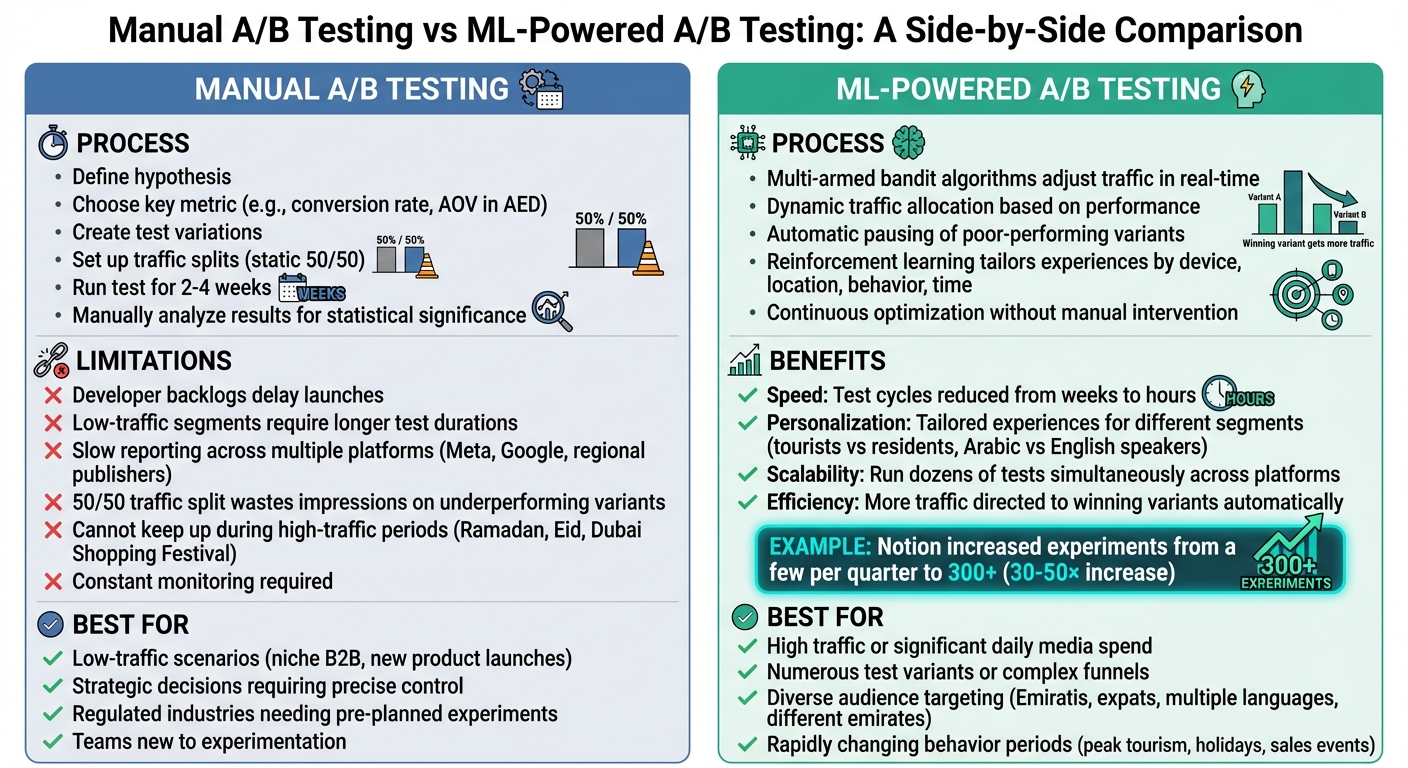
Manual vs ML-Powered A/B Testing: Key Differences and Benefits
Traditional A/B testing involves several steps: defining a hypothesis, choosing a key metric like conversion rate or average order value in AED, creating test variations, setting up traffic splits, running the test for two to four weeks, and finally analyzing the results manually to determine statistical significance.
Marketers in the UAE face unique challenges with this approach. For instance, developer backlogs often delay the launch of test variants, and low-traffic segments - such as specific emirates or Arabic-speaking audiences - require longer test durations to gather meaningful data [6]. Reporting across multiple platforms like Meta, Google, and regional publishers slows the decision-making process even further. High-traffic periods, such as Ramadan, Eid, or the Dubai Shopping Festival, add to the complexity. During these times, keeping up with campaigns across various channels becomes nearly impossible to manage manually. Additionally, the standard 50/50 traffic split wastes valuable impressions on underperforming variants, which can significantly impact revenue during peak periods when every visitor matters.
Machine learning addresses these challenges by automating and optimizing the testing process. Instead of sticking to a rigid 50/50 traffic split, ML-powered systems use algorithms like multi-armed bandits to adjust traffic allocation in real time based on performance. These systems begin with equal traffic distribution but gradually direct more users to better-performing variants while still testing alternatives. Poor-performing variants are automatically paused, eliminating the need for constant monitoring. This dynamic approach is particularly valuable in the UAE, where fast-changing user behavior and high-stakes campaigns demand quick adjustments.
Reinforcement learning takes this a step further by tailoring experiences based on factors like device type, location, past behavior, or time of day. The system learns through rewards - such as sign-ups or purchases - and adapts its strategy to maximize long-term outcomes. This allows for personalized marketing at scale. For example, the system can decide in real time whether to display a specific hero banner, product recommendation, or message in English or Arabic to each user. Platforms like Evolv leverage ML to test a wide range of design elements and combinations, learning what works best without requiring marketers to manually configure every test.
A great example of this in action is Notion, which switched to an ML-powered platform and increased its experiment volume from just a few tests per quarter to over 300. This represents a 30–50× increase in their testing capacity.
ML-driven testing is best suited for campaigns with high traffic or significant daily media spend - such as those for large e-commerce platforms, airlines, banks, or hospitality brands - where showing a losing variant could lead to substantial financial losses in AED [6]. It’s also ideal for situations involving numerous test variants or intricate funnels, where manual testing would be too slow [6]. For UAE businesses targeting diverse audiences - such as Emiratis, expatriates, English and Arabic speakers, or residents of different emirates - ML systems can customize experiences for each segment rather than settling on a single global winner. Additionally, during periods of rapidly changing behavior, like peak tourism seasons, national holidays, or major sales events, ML systems can adapt without restarting tests.
That said, manual A/B testing still has its place. It works well for low-traffic scenarios, like niche B2B websites or new product launches, where there isn’t enough data for algorithms to learn effectively. Similarly, strategic decisions - such as testing a new pricing model - require precise control and detailed manual analysis rather than continuous algorithmic adjustments. In regulated industries, pre-planned and fully interpretable experiments may be necessary to meet compliance requirements. Teams that are new to experimentation may also benefit from starting with manual tests to build foundational skills before incorporating ML.
The choice between manual and ML-based testing ultimately depends on the scope of the test and the volume of data available. Selecting the right approach ensures that resources are used effectively and results are actionable.
These points lay the groundwork for understanding the technical aspects of ML-automated A/B testing.
For ML-powered A/B testing to work effectively, precise event-level tracking is non-negotiable. This includes capturing actions like page views, clicks, scrolls, form submissions, add-to-carts, and purchases. Each event must be timestamped in ISO 8601 format and synced to Gulf Standard Time. To ensure algorithms can evaluate user behavior accurately, consistent identifiers for users and sessions are critical. This way, multi-step user journeys are analyzed holistically rather than as disconnected actions. For commercial websites, it’s equally important to track revenue-related metrics, such as cart value, order value, customer lifetime value, and lead value, in AED. These figures should be passed to the experimentation platform as numeric properties.
Audience data is just as crucial. Key attributes to track include users’ location within the UAE, language preferences (English or Arabic), device type, traffic sources, campaign origins, and whether the user is new or returning. To make this data actionable, a consistent schema and a centralized analytics layer - like a Customer Data Platform (CDP) or data warehouse - are essential. This setup ensures ML models have access to both historical data for training and real-time signals without discrepancies between tools. For instance, Wick manages over 1,000,000 first-party data points for its clients, consolidating fragmented insights into a single, unified system. This unified approach is the backbone of effective predictive decision-making.
In the UAE, adhering to consent regulations and data residency requirements is a must. Experiments should exclude users who opt out of tracking or personalization. Additionally, any cross-border data transfers must comply with governance standards. Special care is needed for sensitive groups, such as children or individuals facing financial challenges, to avoid discriminatory practices. Techniques like pseudonymisation (using hashed IDs instead of raw data), role-based access control, data aggregation, and setting minimum sample thresholds help reduce re-identification risks, particularly in smaller UAE-specific segments.
The mechanics of ML-driven A/B testing often rely on multi-armed bandit (MAB) algorithms. These algorithms treat each test variant like an "arm" of a slot machine, where each pull (or user interaction) yields a reward - such as a conversion or AED revenue. Initially, traffic is distributed evenly across all variants to gather performance data. Over time, the algorithm shifts more traffic to better-performing variants while still allocating some traffic to underperforming ones to continue learning. For example, in a UAE e-commerce scenario, a test might begin with 25% of traffic assigned to each of four landing page versions. As data comes in, the algorithm might adjust to allocate 60% of traffic to the variant generating the highest AED revenue, while maintaining smaller allocations for ongoing exploration.
Bayesian optimization is another key approach. It models the performance of test variants using probability distributions that update as new data is collected. Instead of waiting for fixed-sample significance, Bayesian methods allow for dynamic decision-making, such as determining that "variant B outperforms A with 95% probability". This approach is particularly helpful for short testing windows, like holiday campaigns in the UAE, or when prior knowledge from earlier experiments can be leveraged. Platforms like ABsmartly employ group sequential testing to speed up experiments, often concluding tests 80% faster than traditional methods.
Data from user interactions continuously updates performance estimates for each variant. These updates are carefully managed with guardrails - such as limits on daily traffic changes, minimum sample sizes, or error rate thresholds - to avoid overreacting to temporary fluctuations or seasonal spikes in UAE browsing behavior.
Seamless integration across three tool layers - experimentation platforms, analytics systems, and marketing automation software - is essential for ML-driven A/B testing. Experimentation platforms like Kameleoon, AB Tasty, VWO, and Statsig power the tests using techniques such as Bayesian optimization and multi-armed bandits. These platforms connect with analytics tools like Google Analytics or Adobe Analytics to capture behavioral data and present experiment results. Meanwhile, data warehouses such as Snowflake or BigQuery serve as central repositories for the event-level data feeding ML models. Marketing automation tools then act on the experiment outcomes, triggering personalized emails, dynamic website content, or targeted ads.
A unified data strategy is key to avoiding fragmented systems. Using tools from different vendors often creates data silos, a common issue for marketers in the UAE. A Customer Data Platform (CDP) can consolidate customer insights, behavioral tracking, and journey mapping into a single source of truth. Wick's Four Pillar Framework addresses this challenge systematically. For example, Pillar 3 focuses on implementing intelligent analytics and unified data systems like CDPs to establish a strong data foundation for ML algorithms. Pillar 4 then leverages this foundation to deploy AI-driven solutions and marketing automation for scalable growth. Wick’s collaboration with Baladna in Qatar is a great example: implementing a CDP unified customer insights, enabling automated email marketing and lead nurturing based on experiment results. Similarly, for Hanro Gulf in the UAE, Wick combined comprehensive analytics tracking with performance optimization and SEO strategies, creating a streamlined digital ecosystem for ML-powered testing.
When selecting tools, consider whether they support features like real-time variant deployment (using feature flags), warehouse-native capabilities that integrate seamlessly with your existing data infrastructure, and oversight tools like testing calendars and governance features. The ultimate goal is a continuous feedback loop where data flows smoothly from capture to analysis to action. With the right tools, reliable data, and advanced algorithms, building a cohesive testing ecosystem becomes achievable.
The first step is to turn your business objectives into a focused optimization goal. For instance, if you're running an e-commerce business in Dubai, your main metric might be incremental revenue per session (AED) or average order value (AED). These are calculated by dividing total revenue in AED by the number of sessions in the treatment and control groups. On the other hand, if you're managing a lead-generation campaign in Abu Dhabi, your primary KPI could be cost per qualified lead (AED) or pipeline value per visit (AED) - metrics that can be directly integrated from your CRM into the testing system.
It's equally important to define the minimum detectable effect you’re aiming for, such as a +5% increase in AED revenue, and determine the time frame (in Gulf Standard Time) over which this change will be measured. This helps the ML system evaluate performance consistently. Additionally, set up guardrail metrics like bounce rate, session duration, refund rate, or gross margin in AED to avoid over-optimization. These guardrails ensure campaigns align with local sensitivities, such as respecting cultural norms during Ramadan or prayer times. In ML tools, these are applied as constraints or thresholds that the algorithm adheres to when reallocating traffic.
Finally, design test variants that align with your hypothesis and resonate with local preferences.
Crafting a strong hypothesis is key. It should clearly link a specific change to a measurable outcome. For example: "Adding Arabic-language social proof from Dubai customers to the product page will increase checkout conversions by 5% and revenue per visitor in AED among Arabic-speaking users." This hypothesis guides the design of your test variants - such as creating an Arabic testimonial module versus an English-only version - and identifies the target segment features (like language preference, location within the UAE, or device type) that the ML model will use to determine what works best for different audiences.
Aim to start with 3–6 distinct variants per test. For UAE-based audiences, these variants might include differences in language (full Arabic, bilingual, or English), currency display (highlighting AED pricing and savings), imagery (local landmarks like the UAE skyline versus generic stock photos), or timing (promotions tied to Ramadan, UAE National Day, or the Dubai Shopping Festival). Each variant should represent a clear strategic idea so that when the ML system reallocates traffic, your team can understand the reasoning behind a winning variant's success. Using ML-powered creative tools can help generate and evaluate copy ideas, allowing you to feed the most promising options into the testing system for further exploration.
Once your hypotheses and variants are ready, move on to configuring and launching the experiment.
Start by configuring the experiment. Choose the method (Bayesian, multi-armed bandit, or reinforcement learning), define your primary KPI in AED, set guardrail thresholds, and establish traffic allocation rules. Typically, ML-powered tools begin by evenly distributing traffic among variants, then dynamically shift towards better-performing ones as data accumulates. Specify your target audience (e.g., UAE visitors, Arabic speakers, or high-intent retargeting lists) and set clear start and end conditions, such as minimum sample size, required run time in calendar days (using GST), or statistical significance thresholds. Also, enable auto-pause rules to stop the test if guardrails are breached.
Use experiment dashboards to track time-series trends for your primary KPI in AED, guardrail metrics, and traffic allocation across variants. A well-optimized ML test will show a gradual shift in traffic towards the top-performing variants, stable or improving guardrail metrics (like bounce rate or gross margin), and increasing confidence in the leading variant over time. However, be prepared to intervene if you notice anomalies, such as sudden conversion spikes caused by bot traffic, a sharp decline in guardrail metrics (like higher refund rates), or negative feedback about imagery or timing that clashes with cultural norms during sensitive periods. Early in the test, schedule regular reviews to catch and address these issues.
Once the test concludes, analyze the results to identify how different segments performed. For example, you might find that Arabic testimonials worked exceptionally well for mobile users in Sharjah but had little impact on English-speaking expatriates in Abu Dhabi. Document these findings in a central knowledge base, complete with screenshots, metric tables in AED, and detailed summaries. These insights can then guide future creative strategies, targeting approaches, and testing plans, creating a cycle of continuous improvement and growth.
To ensure reliable results, it's crucial to standardize event tracking across all platforms - whether it's your website, app, or CRM. This consistency ensures that events are logged accurately, no matter where they occur. For businesses operating in the UAE, make sure revenue events are recorded in AED using the correct currency field. Mixing currencies can lead to skewed results and unreliable insights. To keep your data clean, implement a tracking QA checklist for every cycle and document any schema changes to maintain integrity.
Maintaining experiment integrity requires careful planning, especially in a market influenced by seasonal events like Ramadan, Eid, or the Dubai Shopping Festival. Avoid running major UX or pricing updates during tests, as these can interfere with results. Also, be mindful of overlapping experiments targeting the same audience or funnel step. Structured test windows and periodic A/A testing are essential tools here. A/A tests, where users are split into two identical groups, help confirm that traffic randomisation, tracking, and ML-based allocation are functioning as expected. If significant differences arise in an A/A test, it's a sign of bias or data issues that need addressing before you trust ML-driven A/B testing outcomes. For UAE e-commerce sites with high traffic, running a 7–14 day A/A test can provide a realistic baseline for metric variance under local conditions.
Even with strong data foundations, striking the right balance between automation and human oversight is key. While ML can handle smaller optimizations - like selecting hero images or tweaking subject lines - strategic decisions should remain in human hands. To manage this, create governance tiers for experiments:
Set hard limits within your platforms to ensure ML-driven experiments align with your brand and local standards. For example, define minimum and maximum discount levels, cap customer acquisition costs, and enforce tone and language guidelines for dynamically generated content. Sensitive categories should be explicitly excluded. Schedule weekly reviews with stakeholders from marketing, product, legal, and data teams to monitor active ML-driven tests. This allows you to override any experiments that conflict with brand values or local rules. A good approach: let ML decide how much and to whom among pre-approved options, but let humans determine what to test and why.
Once data quality and governance are in place, the next step is measuring the true impact of ML-driven tests on your business. Clean, well-managed data allows for precise evaluation beyond just conversion rates. Track metrics like incremental revenue per visitor (RPV) in AED, average order value (AOV) in AED, customer acquisition cost (CAC), and customer lifetime value (CLV). For subscription-based or fintech products, focus on additional metrics such as activation rates, churn, and repayment rates.
When assessing results, look at uplift in AED. For example, "Variant B increased RPV by AED 3.50, leading to an estimated AED 210,000 additional revenue per month at current traffic levels." Also, measure uplift in CLV for specific segments, such as high-value expats or local SME owners.
To streamline insights, build a central experiment repository. This should include key details for every test: the hypothesis, variants, audience (noting UAE-specific segments), timeframe, seasonality context, metrics (with AED values), algorithm type, and final decision. Use consistent labels for channels, funnel stages, and themes like trust or urgency. Tag experiments that account for UAE-specific conditions so they aren't misapplied to other markets. Integrate this repository into your BI tools, enabling stakeholders to query results easily. For instance, you could search for "all tests that improved checkout RPV in AED by >5% in the last 12 months" and use those insights to inform future ML experiments.
If you're looking for expert guidance, a consultancy like Wick can help UAE businesses audit analytics setups, ensure accurate AED-based revenue tracking, design ML-powered testing tools, and build robust governance frameworks. By consolidating learnings across channels, you can create a system where insights from one area fuel growth across your entire digital ecosystem.
Machine learning has revolutionised A/B testing, turning it into a fast, scalable, and personalized optimization system. By automating processes like traffic allocation, analysis, and decision-making, ML-powered tools can run hundreds of experiments at once across various channels and touchpoints. Adaptive algorithms redirect traffic to the most successful variants in real time, boosting conversions and cutting down on missed opportunities. For marketers in the UAE, this speed and efficiency mean they can test ideas more frequently, adapt quickly to shifting local market trends, and respond effectively to seasonal events or pricing adjustments in AED.
But it’s not just about speed - it’s about understanding customers on a deeper level. Machine learning enables personalization on a scale that was once unimaginable. Instead of settling on one "winning" variant for all users, predictive models can deliver tailored experiences to specific audience segments - or even individual users - based on their behaviors, preferences, and likely responses. For UAE businesses catering to diverse audiences, whether Arabic or English speakers, mobile or desktop users, expats or locals, this level of customization leads to stronger engagement and higher revenue per visitor.
That said, automation doesn’t mean human expertise is no longer needed. Crafting the right hypotheses, maintaining brand integrity, and interpreting results still require strategic insight. Without proper tracking and consistent data logging, even the most advanced algorithms can falter. Expert guidance is essential to make the most of these insights.
Wick offers ML-powered testing systems tailored specifically for the UAE market. Using their Four Pillar Framework, they integrate data analytics, AI-driven personalization, and marketing automation to build unified digital ecosystems. With a strong track record, Wick ensures precise AED-based revenue tracking, robust compliance structures, and ongoing optimization across SEO, content, social media, and CRM channels. By consolidating data and insights, Wick transforms ML-automated A/B testing into a continuous growth engine designed for the UAE’s dynamic market. Together, these tools and strategies empower marketers to achieve sustained growth.
Machine learning simplifies A/B testing by taking over the heavy lifting of data analysis. It automatically spots patterns and forecasts outcomes with impressive precision. This means marketers can skip the tedious manual interpretation of data and instead focus on making quicker, smarter decisions.
What’s more, machine learning allows for real-time tweaks during tests, ensuring campaigns are fine-tuned as they run. This dynamic approach not only saves time and effort but also helps businesses in the UAE get the most out of their resources, driving better results with less hassle.
Using machine learning (ML) for A/B testing during peak traffic periods in the UAE offers some powerful advantages. One standout benefit is faster data analysis, which helps marketers pinpoint the best-performing variations in real time, even during short bursts of high traffic. This speed ensures timely decisions that maximize campaign impact without unnecessary delays.
Another key advantage is the accuracy in decision-making. ML processes large datasets with precision, reducing the chances of human error or bias. On top of that, it supports adaptive optimization, where campaigns can automatically adjust to match audience preferences and behavior patterns. This is particularly valuable during high-stakes periods like shopping festivals or holiday sales, allowing UAE businesses to remain flexible and responsive in a competitive digital environment.
To ensure top-notch data quality and comply with regulations in ML-driven A/B testing, businesses should put in place strong data governance policies and routinely check and clean their data. Following local laws, such as UAE data protection regulations, is crucial. This involves using secure storage systems, anonymising personal data, and being transparent about how data is handled.
Focusing on precise data collection methods and keeping an eye out for inconsistencies is equally important. By adopting these measures, organizations can effectively harness machine learning while staying aligned with both ethical and legal responsibilities.
16 MIN READ
14 MIN READ
11 MIN READ
What worked, what didn't, and what we're building next - no noise, unsubscribe anytime.