Cross-Channel Marketing: Best Practices For 2025
16 MIN READ
AI · 28 Jan 2026 · 18 minHow GCC companies use Arabic NLP, sentiment analysis, bilingual chatbots and real-time tracking to personalize customer experiences and boost conversions.

Want to connect better with GCC customers? Start with NLP.
Here’s why it matters:
Businesses in the UAE and GCC can use NLP to:
NLP isn’t just about translation - it’s about creating experiences that match local habits, language, and expectations. With the right tools, GCC businesses can boost conversions by 30–40% and increase order values by 20–30%.
Why wait? The future of personalized customer engagement starts now.
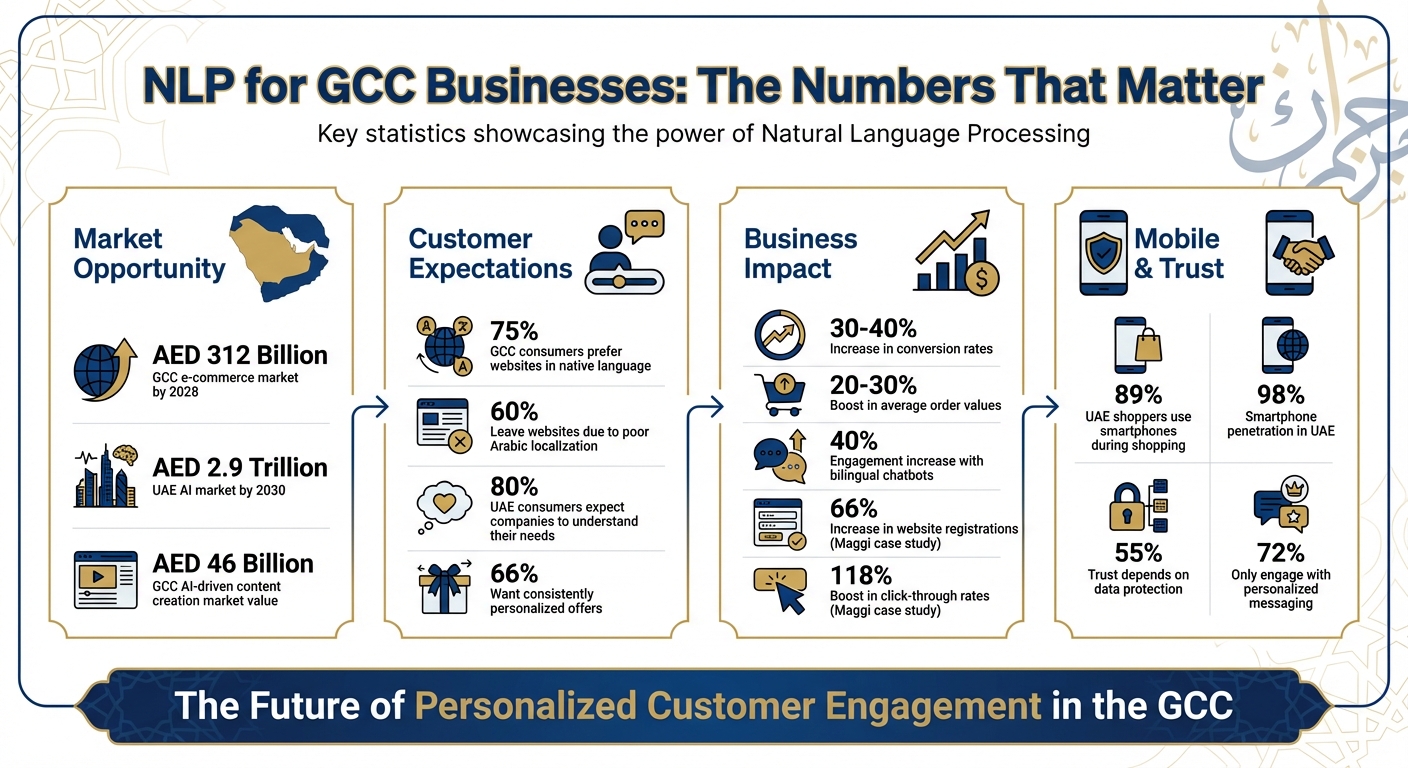
NLP Impact on GCC Business Performance: Key Statistics
Arabic's unique structure, with its root-and-pattern system and diglossia, presents challenges for generic translation tools. Many models not specifically designed for Arabic fail to capture its subtleties. In the GCC region, diglossia - the coexistence of Modern Standard Arabic (MSA) for formal use and various regional dialects for daily speech - plays a significant role in communication. For example, relying solely on MSA in marketing can feel detached from the conversational tone customers use in everyday life, especially on social media. Businesses that embrace culturally aligned AI solutions have seen conversion rates jump by 30–40%. These linguistic nuances make it clear that targeted NLP strategies are essential for effective communication in the region.
To better engage with customers, businesses should consider bilingual chatbots that can instantly detect users' language preferences. This simple yet effective feature can increase engagement by 40%. The ability to seamlessly switch between Arabic and English - something common in the UAE - creates a smoother and more personalized customer experience.
Instead of relying on generic, Western-trained models, companies should explore regional options like Jais, designed with Arabic fluency in mind, or Falcon 40B, developed in the UAE. These models are better suited to the linguistic patterns of the region. Additionally, Arabic-specific techniques such as stemming and lemmatisation help manage the complexities of diverse word forms and diacritics. By tailoring NLP tools to these regional nuances, businesses can build stronger customer trust and achieve higher conversion rates.
Take the example of Maggi, which in 2022 used AI-driven solutions to craft personalized content for its MENA audience during Ramadan. By analyzing first-party data from website registrations, they created newsletters featuring customized recipe suggestions and kitchen tips. The results? A 66% increase in website registrations and a 118% boost in click-through rates.
Arabic NLP offers more than just translation - it captures the cultural context that resonates with customers. For instance, AI that understands shopping trends during Ramadan, incorporates modest and family-focused imagery, and uses messaging that aligns with local values can significantly elevate engagement. With 80% of UAE consumers expecting companies to understand their specific needs, businesses that invest in culturally aware communication gain a clear competitive edge. This understanding not only enhances customer loyalty but also supports ongoing personalization efforts.
The Arabic language presents unique challenges for sentiment analysis due to its complexity. Its rich morphology and the frequent omission of diacritics create ambiguities that standard Western NLP tools often fail to handle effectively. Adding to this is the coexistence of Modern Standard Arabic with regional dialects like Gulf, Levantine, and Egyptian Arabic, each carrying distinct emotional and cultural nuances. These variations are particularly significant during key periods like Ramadan and Eid, where consumer behavior and sentiment shift noticeably. To address these intricacies, sentiment analysis tools tailored to the region's linguistic and cultural context are indispensable for capturing real-time customer emotions accurately.
Rather than diving into a full-scale implementation, businesses should start with a focused pilot program. For instance, analyzing customer reviews on your e-commerce platform or monitoring sentiment in support tickets can provide valuable insights and demonstrate the tool's effectiveness before scaling up. For Arabic-specific needs, prioritize tools like Lucidya, which are built to handle GCC dialects and cultural contexts effectively.
Integrating sentiment analysis with existing communication channels, such as the WhatsApp Business API, can amplify its impact. For example, linking it with chatbots can help detect "frustration alerts" when dissatisfaction arises, allowing businesses to respond promptly and prevent issues from escalating. These initial efforts not only provide actionable sentiment insights but also strengthen personalized marketing strategies. To ensure accuracy and minimize risks, involve local experts to review and validate the model's outputs.
These strategies lead to noticeable improvements in customer engagement. In the UAE, financial institutions and telecom providers already use sentiment analysis to gauge emotional tones during customer interactions. This enables them to offer highly tailored products and resolve issues proactively. Such approaches are crucial, especially as 80% of UAE consumers expect companies to understand their unique needs, while 66% want consistently personalized offers.
"AI-powered sentiment analysis can accurately interpret Arabic text nuances, understanding emotional tone and satisfaction levels."
Beyond enhancing customer service, sentiment analysis also plays a key role in product development. By analyzing unstructured data from sources like social media, support tickets, and reviews - which account for up to 80% of business data - companies can identify micro-segments and refine their offerings. This turns everyday customer feedback into actionable insights, fuelling the personalized strategies discussed throughout this article.
Connecting with audiences in the GCC region requires a deep understanding of the local context. This includes awareness of right-to-left text orientation, regional dialects, and cultural norms. Thanks to NLP-powered tools, businesses can create product descriptions, marketing content, and social media posts that feel natural and align with the linguistic nuances of the region .
The GCC's unique commercial calendar adds another layer of complexity. Consumer behavior shifts significantly during key periods like Ramadan, Eid, and National Days, necessitating content tailored to these moments. AI models designed with Arabic fluency are particularly effective at generating content that honours local values while driving commercial goals. With the GCC's AI-driven content creation market valued at around AED 46 billion and over 60% of the population under 30, automating content creation is no longer optional - it’s a strategic necessity. By embracing these targeted strategies, businesses can ensure stronger local engagement.
To get started, businesses should adopt AI tools specifically designed for Arabic content. These tools ensure that marketing materials resonate authentically with the audience. Segmenting customers based on their shopping behaviors and cultural preferences is equally important - retailers using machine learning for segmentation have reported conversion rates that are 30–40% higher than competitors.
Generative AI can also streamline repetitive tasks like writing ad copy or blog posts, cutting content creation time by as much as 40% . However, before launching major campaigns, it’s wise to have local cultural consultants review AI-generated content to ensure it aligns with religious and cultural sensitivities. This approach not only saves time but also enhances personalized customer interactions.
Automated content creation allows small teams to accomplish what would traditionally require a much larger workforce. This efficiency means businesses can deliver highly personalized experiences on a large scale. For instance, in 2025, wellness brand Loftie used generative AI to launch "Storymaker", which created customized bedtime stories based on user preferences. This initiative attracted 15,000 app subscribers. While this example is from outside the GCC, it highlights the potential for businesses in the region to craft personalized experiences that respect local values.
"The retailers thriving in data-driven retail GCC markets are those who view personalization not as a technical feature but as a cultural bridge, leveraging AI to deliver experiences that feel authentically local."
- Aneesh Sreedharan, CEO, 2Hats Logic Solutions
Lastly, businesses must ensure that their automated content processes comply with regional data protection laws like Saudi Arabia's PDPL and the UAE’s data frameworks. With 55% of people in the UAE, Saudi Arabia, and Egypt stating that their trust in a brand depends on its ability to protect personal data, compliance isn’t just about legal obligations - it’s essential for maintaining customer trust.
Voice search and chatbot interactions are becoming indispensable for businesses in the GCC, particularly due to the UAE's impressive smartphone penetration rate of over 98%. One standout feature is their ability to handle bilingual conversations effortlessly, which is a huge plus in a region where both Arabic and English are widely spoken. For instance, chatbots that can automatically detect a customer’s language preference - whether Arabic or English - can boost engagement rates by as much as 40%. This capability directly addresses one of the region’s most pressing language challenges.
However, there’s a catch: many AI models still rely heavily on Modern Standard Arabic, which doesn’t always resonate with everyday users. To make these tools more effective, businesses need to train AI systems to understand regional dialects and local expressions, rather than sticking to formal, textbook-style Arabic. For voice interactions, ensuring a smooth and natural flow - like eliminating pauses of over two seconds - is equally important. The next step is figuring out how to implement these features seamlessly in business operations.
To get started, businesses should choose platforms with advanced Arabic natural language processing (NLP) capabilities. Options like IBM Watson, Microsoft Bot Framework, or Google Dialogflow are excellent choices. These platforms can deliver sub-second response times and achieve high deflection rates, making interactions smoother and more efficient. By integrating chatbots with CRM systems, businesses can also use purchase histories to provide tailored recommendations.
Compliance with regional regulations is another critical aspect. Hosting AI services within local GCC data centers can reduce latency while adhering to data sovereignty laws, such as Saudi Arabia’s Personal Data Protection Law (PDPL). Regular updates to natural language understanding (NLU) models using real customer interactions can further improve intent recognition accuracy, taking it from 85% to 90%. Before launching, it’s also wise to have local cultural consultants review the chatbot’s responses to ensure they align with religious and cultural norms.
When done right, voice and chatbot interactions can revolutionise how customers explore and purchase products. A great example comes from Ikea, which launched an AI assistant in early 2024 via OpenAI's GPT store. This assistant offers personalized furniture suggestions based on a user’s home size and budget. According to Francesco Marzoni, Ikea’s Chief Data and Analytics Officer, 20% of these interactions led to direct store visits within just a few months. It’s a clear demonstration of how conversational AI can guide customers from browsing to buying.
The secret to achieving this level of personalization lies in leveraging first-party data. In the UAE, 73% of customers prefer shopping at stores that use their data to create tailored experiences. Moreover, 90% are willing to share their information if it ensures smoother interactions. High-performing AI chatbots can handle 85.6% of routine tickets, reducing resolution times by nearly 39%. This not only enhances efficiency but also allows human agents to focus on more complex issues, ensuring seamless service in both Arabic and English.
Building on the advancements in Arabic NLP and sentiment analysis, semantic analysis takes personalization a step further by uncovering the true intent behind customer interactions - not just focusing on keywords. This is especially important in the GCC, where the linguistic landscape is complex. The challenge extends beyond translation to understanding the subtleties of Modern Standard Arabic, various regional dialects, and the bilingual habits of UAE consumers, who often browse in English but expect a deep understanding of Arabic cultural nuances.
What sets semantic analysis apart in this region is its ability to enable culturally aware personalization. For instance, during Ramadan or Eid, consumer behavior undergoes noticeable shifts - shopping peaks occur in the evenings, product preferences change, and marketing messages must align with religious traditions. Semantic tools can automatically detect these shifts in intent and adjust strategies in real time.
"The retailers thriving in data-driven retail GCC markets are those who view personalization not as a technical feature but as a cultural bridge." - Aneesh Sreedharan, CEO, 2Hats Logic Solutions
To harness the power of semantic analysis, businesses should start by adopting regionally relevant language models like Jais, which is specifically designed for Arabic, or Falcon 40B, trained on both Arabic and English. These models can identify language preferences during the very first customer interaction, eliminating the need for manual selection and boosting engagement rates by up to 40%. Additionally, integrating semantic analysis with your Customer Data Platform (CDP) can provide a unified view of customer behavior by combining data from website clicks, CRM interactions, and purchase history.
Customising these models for key GCC-specific events - such as Saudi National Day or neighbourhood-specific celebrations in Dubai - can further enhance their effectiveness. This hyper-local approach allows businesses to tailor offerings by city or emirate, taking into account local product availability and dialect differences. AI-driven insights during culturally significant periods can dramatically improve customer engagement and also optimize voice search for localized queries.
In the UAE, 80% of consumers expect businesses to understand their individual needs, while 66% demand consistently personalized offers. Semantic analysis makes this possible by interpreting emotional tones and satisfaction levels in Arabic text. When paired with recommendation engines, this approach can boost average order values by 20% to 30% across the Gulf region.
Additionally, semantic analysis enhances voice search optimization for localized queries. As Arabic voice assistants gain popularity, customers increasingly use phrases like "near me in Jumeirah", incorporating local accents and place names. With the UAE's AI market expected to surpass AED 2.9 trillion by 2030, businesses that invest in semantic analysis now will gain a critical edge in understanding and serving their customers' true needs and intentions.
Real-time tracking systems play a crucial role in enhancing personalized interactions by enabling businesses to respond instantly to customer actions. This is especially important in the GCC, where mobile-first shopping dominates. For instance, 89% of shoppers in the UAE and 85% in Saudi Arabia use their smartphones during their shopping journeys. These systems should also account for the region's unique commercial patterns, such as increased evening shopping during Ramadan and heightened activity around Eid, ensuring they adapt dynamically to these cultural shifts.
One of the key challenges for businesses in the GCC is fragmented customer data across multiple touchpoints. A single customer might browse your website in English on their phone, call your Arabic-speaking support center, and visit your physical store - all within a single day. Real-time tracking systems powered by Arabic Natural Language Processing (NLP) can bridge these gaps by recognising regional dialects and emotional cues. This integration creates a unified view of the customer's journey, enabling timely and culturally relevant responses.
To implement real-time personalization effectively, businesses should take the following steps:
These measures not only ensure compliance but also build customer trust. In fact, 55% of consumers in the UAE, Saudi Arabia, and Egypt say their trust in a brand depends on how well it protects their personal data. Additionally, configuring your tracking systems to automatically detect language preferences can improve engagement rates by up to 40%.
Real-time tracking transforms customer experiences into what experts call "culturally intelligent" interactions. Instead of generic campaigns, businesses can deliver content tailored to factors like local weather, time of day, and cultural events. This aligns with the expectations of 80% of UAE consumers, who want companies to understand their unique needs, and the 66% who demand consistently personalized offers.
The benefits extend to measurable outcomes. First-party data usage can increase revenue by 1.5–2.9 times, while recommendation engines powered by real-time tracking can boost average order values by 20–30% across the GCC. Moreover, these systems address a significant issue: 6 out of 10 GCC shoppers abandon their carts on international websites due to inadequate personalization. By tracking customer behavior in real time and providing culturally relevant recommendations, businesses can turn these missed opportunities into successful transactions.
"The retailers thriving in data-driven retail GCC markets are those who view personalization not as a technical feature but as a cultural bridge, leveraging AI to deliver experiences that feel authentically local while meeting global standards for convenience and sophistication." - Aneesh Sreedharan, CEO, 2Hats Logic Solutions
Bilingual customer service bots are more than just a convenience - they’re a necessity in the UAE and the broader GCC, where multilingualism is a way of life. Customers here frequently switch between languages, often mid-conversation, blending Gulf dialects with English. It’s not just about translating text; it’s about creating bots that naturally handle right-to-left text, understand Gulf-specific idioms, and seamlessly interpret mixed-language input.
These bots can significantly enhance customer engagement. For instance, bots that automatically detect and adapt to language preferences can increase engagement rates by 40%. Considering that 89% of UAE shoppers rely on their smartphones during their shopping journey, and WhatsApp reigns as the top communication channel with over three hours of daily usage, integrating bilingual bots via the WhatsApp Business API is no longer optional - it’s essential.
To build effective bilingual bots, start by training your NLP models on data that reflects real-life communication in the UAE. This means accounting for the mix of Khaleeji Arabic and English, local slang, and the frequent language-switching habits of residents. Pair this with CRM integration to deliver personalized, context-aware responses based on customer history . This ensures your bot isn’t just fluent in language but also in context.
Begin by deploying these bots for straightforward tasks such as order tracking, FAQs, and appointment scheduling. Once these functions are running smoothly, you can expand into more complex areas like sales journeys. Additionally, ensure your bot can seamlessly escalate conversations to human agents when needed, passing along the full conversation transcript to avoid frustrating customers with repeated explanations. For compliance, align with the UAE’s Personal Data Protection Law and ensure your cloud infrastructure meets local data sovereignty requirements . These steps will not only streamline operations but also enhance the customer experience.
Bilingual bots take personalization to the next level by combining earlier strategies like real-time tracking with culturally aware communication. Imagine a bot that not only switches to Arabic for a customer but also remembers their past purchases - this creates the kind of tailored experience that 72% of consumers expect. Such personalization fosters trust, which is critical in the region. In fact, 55% of people in the UAE, Egypt, and Saudi Arabia say a brand’s ability to protect their data directly influences their trust in that brand.
The business impact is undeniable. In the UAE’s banking sector, for example, well-designed bots can handle 70–90% of interactions without needing human intervention. Leading chatbots in various industries manage to triage 85.6% of tickets and resolve issues 39% faster. In retail and travel, a bot with less than a 70% deflection rate is now seen as underperforming, given the region’s demand for 24/7 self-service. By engaging customers in their preferred language and platform, businesses can deliver a seamless experience that turns occasional shoppers into loyal customers.
Natural Language Processing (NLP) has become a game-changer in how businesses connect with their customers, especially in the GCC region. By leveraging NLP, companies are seeing impressive results - conversion rates improving by 30–40% and average order values increasing by 20–30%. These gains come from a deep understanding of Arabic language nuances, real-time data insights, and scalable automation.
In a region where 75% of consumers prefer engaging in their native language and 60% abandon poorly localized websites, basic translation simply isn't enough. A robust NLP strategy must go further, addressing both formal Arabic and local dialects while enabling effortless language switching for a seamless user experience.
Real-time data analysis is another cornerstone of successful customer engagement. Personalized recommendations, dynamic content, and culturally relevant offers - tailored in the moment based on live customer behavior - are what today’s shoppers expect. Research shows that 72% of consumers only interact with messaging that aligns with their specific interests. This level of personalization not only meets customer expectations but also builds loyalty and drives repeat purchases.
To get started, consider using AI-powered recommendation engines for quick returns, implementing bilingual chatbots that detect language preferences automatically, and consolidating your data streams into a single, reliable source. This approach combines technical accuracy with cultural understanding, which is essential for thriving in the GCC market.
"The retailers thriving in data-driven retail GCC markets are those who view personalization not as a technical feature but as a cultural bridge, leveraging AI to deliver experiences that feel authentically local while meeting global standards for convenience and sophistication." - Aneesh Sreedharan, CEO, 2Hats Logic Solutions
With the GCC e-commerce market expected to surpass AED 312 billion by 2028, businesses that prioritize adaptable and culturally aligned NLP systems today will position themselves as market leaders tomorrow.
At Wick, we’re committed to helping GCC businesses combine cutting-edge technology with cultural expertise. Our goal is to ensure every customer interaction feels personal and impactful, creating meaningful connections that drive long-term success.
Natural Language Processing (NLP) plays a crucial role in improving Arabic localization by tackling the unique linguistic and cultural aspects of the GCC region. Arabic’s intricate grammar, wide range of dialects, and script variations often create hurdles, but advanced NLP models can navigate these complexities to produce content that feels intuitive and relatable.
Customising NLP solutions for local contexts allows businesses to align their messaging with important cultural moments like Ramadan or UAE National Day. This thoughtful approach ensures the content resonates deeply with audiences, fostering trust, engagement, and loyalty by making customers feel seen and valued. For businesses in the GCC, using Arabic NLP effectively is essential to providing genuine, localized digital experiences that cater to the expectations of a tech-savvy audience.
Sentiment analysis provides an invaluable way for businesses in the GCC to tap into customer emotions and preferences by digging into feedback, reviews, and social media conversations. This approach allows brands to create messages that resonate on a personal and cultural level, particularly during significant occasions like Ramadan or UAE National Day, fostering deeper connections with local audiences.
By keeping a pulse on customer sentiment in real time, businesses can swiftly respond to negative feedback, protect their reputation, and build stronger loyalty. It also helps uncover individual customer preferences, paving the way for more customized marketing strategies. In a mobile-first region like the GCC, where quick and culturally attuned communication is a must, sentiment analysis stands out as a key tool for boosting engagement and driving results.
To tailor NLP tools for the GCC region, businesses need to prioritize incorporating local cultural and linguistic details. This means training models using data that reflects regional dialects, idiomatic expressions, and cultural context. For example, recognising shopping patterns during Ramadan or providing seamless Arabic language support - even when users switch to English - can make interactions feel more connected and meaningful.
Equally important is acknowledging regional customs and sensitivities. Adjusting content to align with occasions like Ramadan or Eid demonstrates cultural awareness. Moreover, adhering to local data protection regulations, such as the UAE’s Federal Data Protection Law, not only ensures compliance but also fosters trust. Collaborating with local experts to interpret these cultural subtleties can elevate the performance of NLP tools, delivering personalized and culturally considerate experiences specific to the GCC market.
16 MIN READ
14 MIN READ
11 MIN READ
What worked, what didn't, and what we're building next - no noise, unsubscribe anytime.