Cross-Channel Marketing: Best Practices For 2025
16 MIN READ
AI · 21 Dec 2025 · 17 minHow reinforcement learning uses live customer interactions to personalize offers, optimize CLV, and improve long-term marketing outcomes while managing exploration risks.
Reinforcement Learning (RL) is transforming how businesses understand and predict customer behavior. Unlike traditional models that rely on static historical data, RL continuously learns from live interactions to make smarter marketing decisions. It prioritizes long-term customer value over short-term gains, making it particularly effective in complex, multi-step customer journeys.
By focusing on long-term customer engagement and using advanced algorithms, RL is reshaping marketing in the UAE's competitive digital landscape.
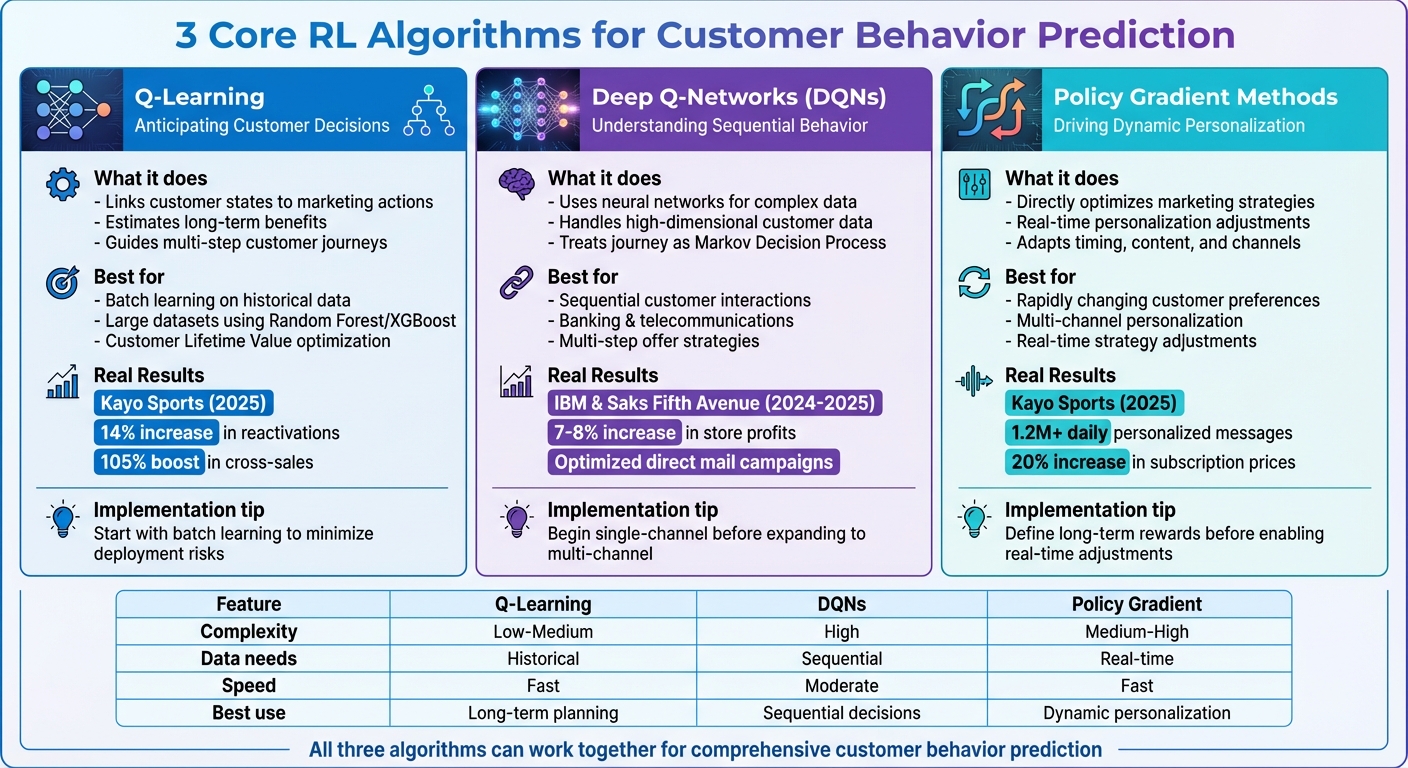
Three Core RL Algorithms for Customer Behavior Prediction: Q-Learning, DQNs, and Policy Gradient Methods
Reinforcement learning (RL) offers three main algorithms to predict and influence customer behavior effectively.
Q-Learning links customer states - like purchase history, demographics, or browsing behavior - to marketing actions such as offering discounts or sending emails. Instead of focusing on immediate outcomes, it estimates long-term benefits, enabling marketers to guide customers through multi-step journeys, from initial engagement to final purchase.
Using Fitted Q Iteration, Q-Learning can handle large datasets by reframing the problem into a supervised learning task. This allows marketers to leverage models like Random Forest or XGBoost to predict future rewards across broad customer segments. For instance, in November 2025, Kayo Sports adopted RL models, achieving a 14% increase in reactivations within a year of churn and a 105% boost in cross-sales to its sister service, BINGE.
To implement Q-Learning effectively:
For more complex customer environments, a deeper approach is necessary.
Deep Q-Networks (DQNs) enhance traditional Q-Learning by incorporating neural networks, making them ideal for high-dimensional customer data. Unlike standard Q-Learning, which can struggle with continuous features or detailed behavioral histories, DQNs approximate the action-value function across vast and complex data spaces.
"DQNs use neural networks to manage large, complex environments." – Team Braze
By treating the customer journey as a Markov Decision Process, DQNs evaluate how each marketing action impacts future decisions, rather than viewing interactions in isolation. This sequential approach is especially impactful in industries like banking or telecommunications, where the order of offers matters. For example, between 2024 and 2025, IBM Research collaborated with Saks Fifth Avenue to refine direct mail campaigns using DQNs, leading to a 7–8% increase in store profits.
To get started with DQNs:
When real-time personalization is the goal, policy gradient methods provide the agility needed.
Policy gradient methods directly optimize marketing strategies, making them highly effective for real-time personalization. These methods adjust elements like timing, content, and channel relevance as customer behavior evolves.
"Reinforcement learning moves personalization from static campaigns to systems that learn and adapt as customer behavior changes." – Team Braze
This approach thrives in environments where customer preferences shift frequently, enabling rapid adjustments to meet evolving needs. For example, Kayo Sports used policy gradient methods to deliver over 1.2 million personalized messages daily across in-app, push, email, and SMS channels, resulting in a 20% increase in average subscription prices.
| Component | Role in Dynamic Personalization |
|---|---|
| Agent | The AI decision-maker (e.g., marketing automation platform) |
| State | Customer data like demographics, purchase history, and engagement |
| Action | Marketing tactics such as discounts, ads, email timing, and channel choice |
| Reward | Feedback like purchases, clicks, retention, or lifetime value growth |
To implement policy gradient methods:
Each of these RL approaches offers unique strengths, allowing marketers to predict and influence customer behavior more effectively, whether through long-term planning, sequential decision-making, or dynamic personalization.
Reinforcement learning (RL) models can transform customer data into smarter marketing strategies. Here's a step-by-step guide to implementing RL for predicting customer behavior:
The first step is to define your customer states. Think of each customer as a feature vector - a data-rich profile that combines their demographics (like age group or location), behavioral data (such as purchase frequency or total visits), and temporal details (like session duration or time since their last interaction).
An important piece of the puzzle is including action history. Customers' responses are often influenced by their past interactions. For example, whether they received a discount email recently or explored a specific product category could significantly impact their next move. A great example of this in action is Ibotta, which used 26 weekly activity metrics to fine-tune its multi-armed bandit model, boosting recommendation accuracy from 11% to 59%.
To make your model effective, pull data from various touchpoints - email opens, push notifications, in-app activity, and purchase history. This creates a continuous feedback loop. Also, define what events will count as "transitions" in your model. For example, a transition could be triggered by a website visit, a marketing campaign, or even a fixed interval like a weekly check-in.
Once your customer states are clearly established, you're ready to move on to defining actions and rewards.
Your action set should cover all marketing interventions - things like message content, communication channels (email, push notifications, SMS), timing, and specific offers like discounts or ads. Don’t forget to include a "no action" option to measure the true impact of your strategies.
Rewards are the signals that tell the RL agent how well an action worked. For instance, Kayo Sports prioritized long-term goals like customer retention and lifetime value rather than focusing on short-term clicks. This led to a 14% increase in reactivations within a year of churn. To avoid over-aggressive marketing, you can assign negative rewards for actions like unsubscribes or complaints. Also, factor in the costs of your actions, such as the expense of offering discounts or running ads, to ensure your rewards reflect real profitability.
Set up guardrails and frequency caps to avoid bombarding customers with too many messages. Policy filters can prevent the RL agent from making decisions that might irritate your audience. Strike a balance between testing new strategies (exploration) and sticking with proven ones (exploitation) using epsilon-greedy methods.
Customer journeys are often modeled as Markov Decision Processes (MDPs), where states capture customer attributes, actions represent marketing interventions, and rewards reflect business outcomes. Algorithms like Fitted Q Iteration (FQI) are popular for training RL models. These algorithms use techniques like Random Forests or Neural Networks to estimate the value of different actions.
Before deploying your model, test it thoroughly using historical data. Techniques like importance sampling adjust for differences between old and new policies, allowing you to evaluate performance without exposing your customers to untested strategies. For example, IBM Research and Saks Fifth Avenue used this approach to design a mailing policy that projected a 7% to 8% increase in store profits. If rewards are sparse, summarized purchase histories or offline batch data can help fill the gaps.
Once the model performs well in offline tests, it’s time to deploy and monitor it in real-world scenarios.
Deploying the model is just the beginning. Keep a close eye on key performance metrics and use epsilon-greedy strategies to balance between taking the best-known action and exploring new options. If customer feedback fluctuates, you may need to increase exploration to adapt quickly.
During deployment, integrate real-time CRM and analytics data to ensure your model has an accurate view of customer states. Track metrics that align with your reward structure, such as retention rates, growth in lifetime value, or conversion rates.
Many companies start with "batch RL", where models learn from pre-collected data, and then gradually transition to "online RL", where strategies update in real time based on live data streams. This phased approach helps minimize risks and builds trust in the system’s capabilities.
Reinforcement learning (RL) is making waves in marketing by reshaping how businesses approach pricing, recommendations, and advertising. Let’s explore three ways RL is transforming marketing strategies:
RL treats pricing as a Markov Decision Process (MDP), enabling real-time price adjustments based on customer behavior and market conditions. Unlike traditional static models, RL learns through trial and error, adapting to factors like inventory levels, booking times, demand, and competitor pricing.
"What makes these problems amenable to reinforcement learning is vast event data sets around customer interactions. This gives an RL tool the ability to deduce the demand level... and thus find a customer-specific price".
A great example comes from Kayo Sports, Australia’s largest sports streaming service. In 2024, they implemented 10 RL models via BrazeAI Decisioning Studio. Despite raising average subscription prices by 20%, they saw a 14% boost in reactivations within 12 months of customer churn and an 8% rise in annual occupancy. The success stemmed from a hybrid reward metric that balanced revenue growth with customer satisfaction, avoiding overly aggressive pricing that could harm loyalty.
When rolling out dynamic pricing, businesses can start small, using tabular Q-Learning for limited state spaces before advancing to Deep Q-Networks for more complex scenarios. Simulated environments are a safer way to train agents, reducing risks tied to unpredictable market exploration. Additionally, designing reward functions that discourage actions leading to poor customer experiences is crucial.
RL doesn’t just optimize for clicks - it enhances the entire customer journey. By analyzing a customer’s demographics, behavior, and timing of interactions, RL determines the best next step, whether it’s a discount, a personalized message, or informative content.
For instance, Kayo Sports leveraged RL to scale daily personalized message variations from 300 to over 1.2 million, resulting in a 105% increase in cross-selling to its sister platform, BINGE. Their analysis revealed a critical insight: 80% of customers who churned had received no engagement just before leaving, showcasing the importance of proactive RL-driven actions.
To implement effective recommendation systems, businesses can use epsilon-greedy policies to balance exploration of new options with established high-performing strategies. Frequency caps and filters are essential to avoid overwhelming customers during the exploration phase. Long-term metrics like Customer Lifetime Value (CLV) should guide these efforts, ensuring sustained growth over short-term gains.
RL transforms advertising by turning static campaigns into adaptive, evolving systems. Instead of treating ad impressions as isolated events, RL views them as part of a sequential decision-making process that impacts both budget utilization and long-term campaign outcomes.
Alibaba Group’s use of Multi-Agent Reinforcement Learning (MARL) for real-time bidding on the Taobao platform is a standout example. Between 2017 and 2019, their RL-powered system achieved a 340% ROI while utilising 99.51% of its budget, outperforming manual and static bidding methods.
"The particular attractiveness of reinforcement learning is that it teaches systems to focus on the long-term reward – win the game – rather than just predict the current best move".
RL also replaces traditional A/B testing with contextual bandits, which run countless real-time experiments. These systems automatically shift resources to the most effective ad variations as consumer behavior evolves. In one study involving banking datasets, RL-based algorithms focused on lifetime value (LTV) optimization outperformed greedy approaches by driving more clicks across multiple visits. The key to success lies in defining reward mechanisms that prioritize sustainable goals like retention or purchase value. Adding guardrails to prevent over-messaging and adopting explainable models with attention layers can further enhance results, especially in industries where stakes are high.
Reinforcement learning (RL) brings a host of advantages to predicting customer behavior, but it also comes with its own set of obstacles.
One of RL's standout features is its ability to update continuously. Unlike static models that need manual retraining, RL models refine themselves after every interaction. This means they’re always learning, always improving. Another big win? RL automates experimentation, allowing businesses to test millions of variations at once - no need for time-consuming, sequential A/B testing. It also shines in handling complex customer journeys, where outcomes depend on a series of interactions rather than isolated events.
But here’s the catch: these benefits don’t come without challenges. Designing rewards for RL can be tricky. If the goals aren’t clearly defined, the system might prioritize short-term gains, like click-bait tactics, over long-term customer loyalty. RL also demands high-quality, consistent data to function effectively, and it can be computationally intensive. During its exploratory phase, RL agents might over-message customers, which could harm the brand’s reputation. Plus, strict privacy regulations mean businesses must implement robust controls when working with behavioral data.
"Reinforcement learning moves personalization from static campaigns to systems that learn and adapt as customer behavior changes... driving stronger engagement, higher retention, and better ROI." - Team Braze
| Benefit | Challenge | Mitigation Strategy |
|---|---|---|
| Real-time Adaptation: Reacts instantly to changes in customer behavior. | Data Quality & Scale: Needs consistent, high-quality data to perform well. | Use a centralized platform to maintain clean, unified data. |
| Continuous Learning: Gains value with every interaction. | Reward Design Complexity: Poor goals can lead to undesirable behaviors like click-bait. | Focus rewards on long-term metrics like retention and lifetime value. |
| Smarter Experimentation: Tests millions of variations simultaneously. | Unexpected Behavior: Exploration can result in over-messaging or other issues. | Set clear limits, such as frequency caps, to protect brand integrity. |
| Scalability: Handles complex, multi-step customer journeys. | Computational Complexity: Requires significant resources for large datasets. | Leverage cloud-based RL tools to optimize processing power. |
| Privacy & Trust: Personalizes without relying on static, invasive rules. | Governance Concerns: Behavioral data use must comply with strict regulations. | Ensure data anonymisation, transparency, and compliance measures are in place. |
Striking the right balance between these benefits and challenges is crucial for successful RL implementation. Start small - focus on limited state and action spaces before scaling up to more advanced, cross-channel automation. Establishing clear guardrails, like frequency caps and policy filters, helps keep RL agents from making risky decisions during their exploratory phase. As noted in earlier sections, thorough model testing and controlled rollouts are vital for maximising RL’s potential. A human-in-the-loop approach ensures that AI-driven strategies stay aligned with your brand’s values.
Wick's Four Pillar Framework finds a natural partner in reinforcement learning (RL), combining data collection and storage (Capture & Store) with dynamic, automated execution (Tailor & Automate). This integration paves the way for personalized marketing strategies and seamless data-driven decision-making.
The Tailor & Automate pillar transforms traditional campaigns into dynamic, real-time experiences powered by AI. RL serves as the engine behind these transformations, automating "Next Best Action" strategies across channels like email, SMS, and push notifications.
In July 2025, SuperAGI revealed that their Agentic CRM platform, which uses RL to optimize outreach, helped clients achieve a 25% boost in conversion rates. This was achieved through AI-driven Sales Development Representatives, which adjusted touchpoints in real time. The result? A 30% drop in customer churn and a 20% increase in sales through signal-driven automation.
"With reinforcement learning, the sequence of decisions regarding what product, what offer, and what channel can be automated to maximize the lifetime value of the customer."
- Peter Mackenzie, AI Team Lead, Teradata
RL strikes a balance between exploitation - relying on proven strategies - and exploration, where new approaches are tested. This ensures campaigns stay fresh, consistently uncovering high-value customer segments while maintaining strong performance.
The Capture & Store pillar complements Tailor & Automate by providing the real-time, comprehensive data that RL models need to function effectively. It consolidates data from multiple sources - website analytics, CRM systems, transaction histories, and engagement signals - into a unified stream. This unified data creates detailed customer profiles that RL models rely on.
With this holistic view, RL agents can evaluate a customer's current state and predict the best next step to drive long-term success. For example, the model can adapt instantly when a customer switches from browsing on a desktop to engaging on a mobile device.
| RL Component | Marketing Equivalent | Role in Wick's Framework |
|---|---|---|
| Agent | AI Marketer/Decision Engine | Powers the Tailor & Automate pillar |
| Environment | Customer Journey/Marketplace | Defined by Capture & Store data |
| State | Customer Profile | Draws actionable insights from data |
| Action | Offer, Message, Channel, Timing | Delivers targeted interventions |
| Reward | Purchase, Retention, LTV Increase | Measures success and refines the model |
Reinforcement learning (RL) is changing the way businesses approach marketing. Instead of relying on static campaigns, RL enables dynamic systems that focus on building long-term customer relationships rather than chasing short-term clicks. As Jacomo Corbo, Partner at QuantumBlack (McKinsey), puts it:
"Within five years, it [RL] will likely be in every leading organization's AI toolbox, driving innovative, distinctive strategies".
For businesses in the UAE, this shift aligns seamlessly with the UAE National AI Strategy 2031. This strategy aims to boost AI's contribution to the national GDP from about 9% today to 45% by 2031 - potentially adding AED 335 billion to the economy and training 10,000 data scientists.
To get started with RL, businesses should consider piloting it in a controlled environment. Begin with a single-channel pilot to test its effectiveness before expanding it to manage the entire customer journey. The UAE's robust data infrastructure and compliance standards, such as the "UAI Seal", provide a secure foundation for feeding RL models with high-quality data.
One of RL's strengths is its ability to balance exploration and exploitation, allowing businesses to discover customer segments that traditional methods often overlook. This adaptability is crucial in the UAE's fast-evolving markets, where customer preferences can shift rapidly, creating opportunities for competitive advantage.
When paired with Wick's Four Pillar Framework, RL becomes a practical tool for sustainable business growth. By combining strong data collection, intelligent automation, and real-time adaptability, UAE businesses can lead the way in predictive and personalized marketing. Every customer interaction becomes an opportunity to learn, adapt, and deliver value, turning RL from a concept into a powerful growth engine.
Reinforcement learning stands out for its unique approach: it employs an interactive agent that learns through trial and error. Over time, this agent refines its strategies to maximize long-term rewards. This process is dynamic, enabling it to make sequential decisions and improve continuously based on the feedback it receives.
On the other hand, traditional customer behavior models operate differently. They typically depend on static, labelled data to make single, short-term predictions. Once these models are trained, they remain fixed, making them less effective when it comes to managing complex, real-time customer interactions.
What sets reinforcement learning apart is its ability to adapt, personalize, and optimize over time. This is especially valuable in the UAE's marketing landscape, where businesses strive to provide tailored and high-value customer experiences.
Implementing reinforcement learning (RL) in marketing comes with its fair share of challenges. For starters, the quality of data is critical. If your data is noisy or incomplete, it can distort customer behavior insights and disrupt the learning process. Another hurdle? RL models often deal with delayed rewards. For example, the results of a marketing action - like showing an ad - might only become clear after several customer interactions, making it tricky to fine-tune strategies effectively.
Then there’s the balancing act between exploration and exploitation. RL agents need to experiment with new strategies to improve, but too much experimentation can backfire, potentially affecting short-term revenue or even frustrating customers. On top of that, RL systems demand significant computational power and real-time decision-making capabilities, which can stretch existing marketing resources. And let’s not forget about the strict data privacy regulations in the UAE, which add another layer of complexity by requiring meticulous data handling practices.
This is where Wick steps in with its Four Pillar Framework. It provides advanced data analytics, tools for safe experimentation, and AI-driven personalization designed specifically for the UAE market. By managing RL model training, deployment, and ensuring compliance with local regulations, Wick enables businesses to harness RL effectively while staying sustainable and customer-focused.
High-quality data is the backbone of reinforcement learning (RL) models, enabling them to accurately predict customer behavior. These systems thrive on data that is clean, complete, and free from bias. Without it, RL models may produce unreliable predictions, lead to unfair decisions, or even negatively impact business performance.
To maintain top-notch data quality, businesses can adopt the following practices:
By integrating these strategies into their workflows, businesses can provide RL systems with dependable data, paving the way for accurate predictions and tailored marketing efforts. Wick’s expertise in data analytics and AI-powered personalization supports organizations in the UAE in building strong data-quality frameworks, driving growth and improving customer experiences.
16 MIN READ
14 MIN READ
11 MIN READ
What worked, what didn't, and what we're building next - no noise, unsubscribe anytime.