Cross-Channel Marketing: Best Practices For 2025
16 MIN READ
AI · 22 Dec 2025 · 12 minROI benchmarks and actionable KPIs for Gulf influencer campaigns: ROAS, CAC, CTR, AOV/LTV; platform trends, micro-influencers, AI analytics and local compliance.
Influencer marketing in the Gulf is booming, with spending expected to surpass AED 1.01 billion by 2025. Yet, many brands face challenges in proving whether their campaigns deliver real results. The key lies in focusing on metrics that matter - like conversions, sales, and customer loyalty - rather than vanity numbers like likes or follower counts.
Here’s what you need to know to measure and improve ROI in Gulf influencer campaigns:
To succeed, Gulf brands are using data analytics, AI tools, and hyper-localized strategies while staying compliant with local regulations like Saudi Arabia’s Mawthooq licensing system. By prioritising measurable outcomes over superficial metrics, influencer campaigns in the region are becoming powerful tools for growth.
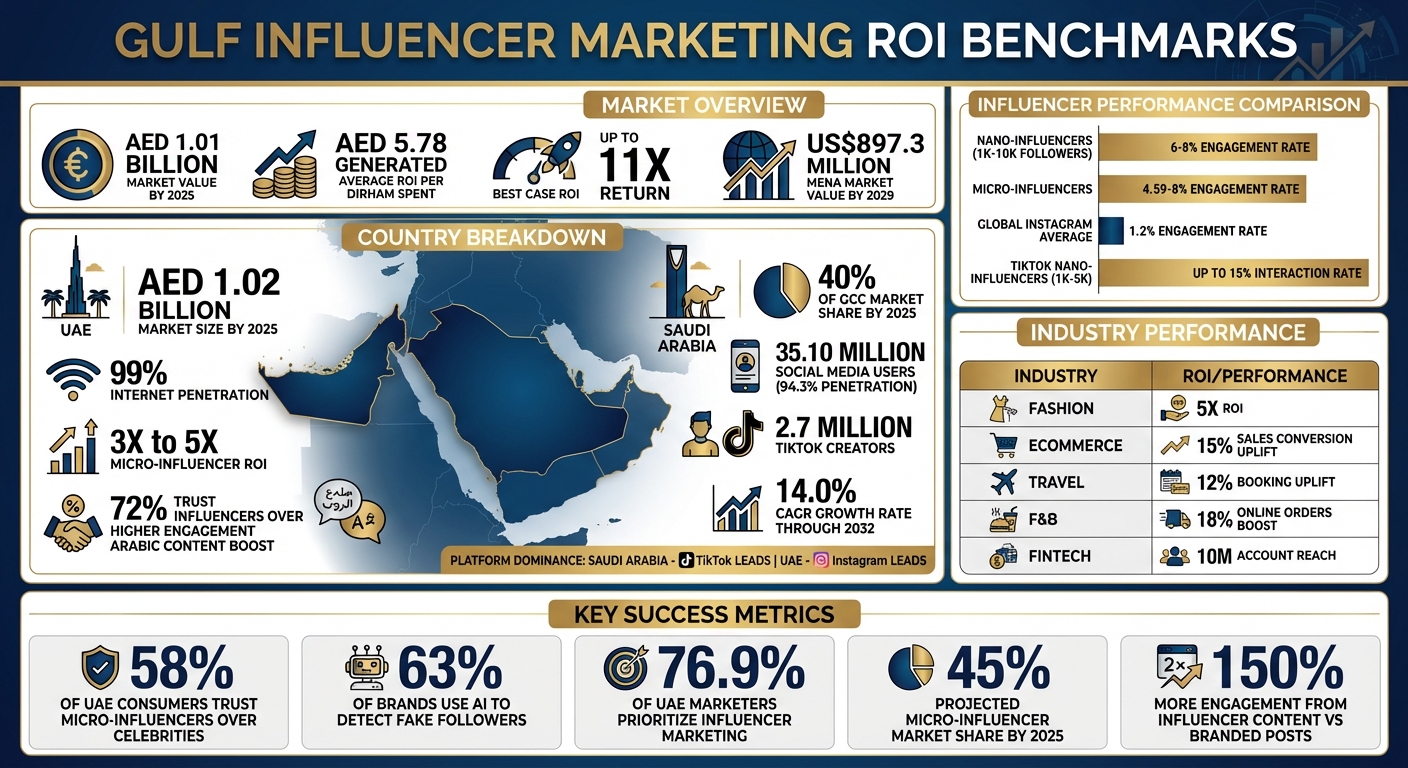
Gulf Influencer Marketing ROI Benchmarks 2025: Key Statistics and Performance Metrics
In the Gulf region, brands are zeroing in on performance metrics that directly tie their investments to measurable outcomes like revenue and customer acquisition. While traditional metrics such as impressions and follower counts still make an appearance, the focus has shifted to KPIs that demonstrate real business impact.
Return on Ad Spend (ROAS) is a standout metric, calculated by dividing the revenue generated by the campaign cost. For Gulf brands, this means scrutinising every dirham spent and its corresponding sales impact. Take Noon.com, for instance. During a seasonal sale, they collaborated with over 40 niche and micro-influencers, resulting in a 25% boost in website traffic and a 15% increase in sales conversions compared to previous periods. This clearly showcased the value of their influencer strategy.
Another critical metric is Customer Acquisition Cost (CAC), which measures the expense of gaining each new customer through influencer campaigns. A great example is Salt Dubai's three-month initiative involving 30 food and lifestyle micro-influencers. The campaign generated 10 million impressions, increased foot traffic by 20%, and drove an 18% rise in online orders. By calculating the cost per new customer, brands can determine whether influencer marketing offers a more efficient alternative to traditional advertising.
Click-Through Rate (CTR) is also essential, tracking the percentage of viewers who take action after engaging with influencer content. In the Gulf, TikTok influencers with follower counts between 1,000 and 5,000 often achieve interaction rates as high as 15%. Brands use tools like UTM parameters and unique discount codes to accurately measure clicks and conversions across various influencers and platforms.
To round out the picture, metrics like Average Order Value (AOV) and Lifetime Value (LTV) are invaluable. AOV reflects the average spend per transaction, while LTV highlights customer loyalty and repeat purchases. These metrics are especially relevant in influencer campaigns, as 51% of businesses report that influencers attract more loyal, higher-value customers compared to traditional advertising. For example, Trendyol’s influencer-driven approach in the GCC led to a fourfold increase in traffic and AED 7.34 million in sales.
To make the most of these metrics, Gulf brands are increasingly turning to advanced data analytics to refine their strategies and optimize campaigns.
Data analytics has become the backbone of effective ROI measurement, turning raw numbers into actionable insights. In the Gulf, the challenge isn’t just gathering data - it’s ensuring the data reflects genuine engagement from the intended audience. With 63% of businesses now using AI tools to detect fake followers, analytics play a crucial role in safeguarding ad spend from inflated or misleading metrics.
A well-rounded approach combines several tracking methods. UTM parameters integrated with Google Analytics, unique discount codes for direct sales tracking, and tracking pixels from platforms like Meta and TikTok all help brands capture conversions across various channels.
Each platform, however, comes with its own nuances. Instagram, TikTok, and Snapchat require tailored analytics strategies, and Arabic language support is vital for accurate sentiment analysis. Moreover, tools must verify that an influencer’s audience primarily resides in key markets like the UAE, Saudi Arabia, or Qatar to ensure campaigns are relevant and impactful.
The rise of AI-powered analytics is also transforming how brands measure and optimize campaigns. While only 37% of MENA brands currently use AI for influencer discovery, the potential is enormous. Advanced tools can now predict engagement trends in real time, flag authenticity issues before contracts are signed, and precisely attribute results across complex customer journeys. These capabilities are turning influencer marketing into a highly measurable and reliable growth channel for Gulf brands.
The UAE stands out as a leader in digital marketing, with its influencer industry projected to reach AED 1.02 billion by 2025. With an impressive 99% internet penetration and 11.3 million active social media users in a country of 10 million, the UAE offers a highly connected audience.
Brands in the UAE can anticipate a 3× to 5× return on investment (ROI) from micro-influencer collaborations, with conversion rates typically ranging from 1% to 3%. Nano-influencers, those with 1,000 to 10,000 followers, achieve engagement rates between 4.59% and 8% - far exceeding the global Instagram average of 1.2%. Luxury brands in Dubai have seen standout results, with some reporting sales increases of up to 120% through partnerships with nano-influencers.
Consumer trust in influencers is particularly strong in the UAE. A notable 72% of consumers trust influencers more than traditional ads, and 65% have purchased products endorsed by local influencers. Additionally, Arabic-localized content consistently outperforms translated English content, delivering 35% to 50% higher engagement rates. These trends highlight the importance of aligning with local culture to maximize returns. Saudi Arabia, with its scale and dynamic content trends, mirrors many of these opportunities.
Saudi Arabia is set to command 40% of the Gulf Cooperation Council (GCC) influencer market by 2025. With 35.10 million social media users and a penetration rate of 94.3%, the Kingdom offers unparalleled reach for brands willing to adapt to its unique market dynamics.
TikTok has emerged as a dominant platform in Saudi Arabia, with the Kingdom boasting 2.7 million creators compared to 1.3 million in the UAE. This platform’s popularity, particularly among younger audiences, underscores the importance of short-form video content. The launch of TikTok Shop in February 2025 has further enhanced conversion potential by enabling direct purchases through influencer campaigns.
Saudi Arabia’s influencer market is also bolstered by a clear regulatory framework, including the Mawthooq license system, which ensures greater transparency and accountability. With a projected compound annual growth rate (CAGR) of 14.0% through 2032, the market offers ample opportunities for brands that prioritize culturally relevant, video-first strategies.
While smaller in scale compared to the UAE and Saudi Arabia, Qatar’s influencer market focuses on quality over quantity. Despite its size, the country enjoys high social media penetration, making it an attractive option for targeted campaigns.
Success in Qatar hinges on hyper-localized content that resonates with the country’s cultural identity. Campaigns tailored specifically to Qatari audiences consistently outperform generic GCC-focused efforts. Although specific ROI data for Qatar is limited, the market follows similar patterns to the broader Gulf region: micro-influencers deliver stronger engagement than celebrity endorsements, Arabic content outpaces English, and video formats generate the highest interaction rates.
For brands entering Qatar, investing in authentic local voices and understanding the nuances of its culture is key to achieving meaningful campaign results. Hyper-localized strategies can unlock better returns in this quality-driven market.
Building on earlier ROI metrics, industry-specific data sheds light on how Gulf brands are achieving standout results.
ROI performance varies across Gulf industries, with fashion and beauty taking the lead, commanding a 35% GCC market share by 2025. Fashion brands thrive on visually engaging platforms like Instagram and TikTok, which effectively convert user interest into purchases.
eCommerce platforms also deliver impressive results, thanks to measurable strategies. For instance, Noon.com's seasonal campaign involving over 40 micro-influencers amassed 20 million views, leading to a 25% spike in website traffic and a 15% boost in sales conversions compared to previous periods. This success was driven by tools like unique promo codes and pixel tracking, which directly linked influencer efforts to consumer purchases.
| Industry | Primary Platform | Key Performance Benchmark |
|---|---|---|
| Fashion | Instagram/TikTok | 5× ROI |
| eCommerce | Instagram/TikTok | 15% sales conversion uplift |
| Travel | Lifestyle/Travel | 12% booking uplift |
| F&B | Instagram/TikTok | 18% boost in online orders |
| Fintech | Multi-platform | 10 million account reach |
In the F&B sector, Salt Dubai's three-month campaign with 30 micro-influencers achieved 10 million impressions, a 20% increase in foot traffic, and an 18% rise in online orders.
These benchmarks highlight campaigns that have set new standards for ROI in their respective industries.
Trendyol’s eCommerce campaign across the GCC demonstrated exceptional results, generating AED 7.35 million in sales and a 4× increase in web traffic. The campaign's success came from strategically engaging niche influencers across Gulf markets rather than relying solely on celebrity endorsements. Similarly, Level, a fashion retailer, partnered with micro-influencers to achieve a 5× ROI, driving regional sales growth. These examples underscore how micro-influencer collaborations consistently outperform traditional advertising in the Gulf’s fashion sector.
Building on established ROI benchmarks, these focused strategies can help fine-tune campaign results.
Micro-influencers are proving to be a game-changer in Gulf markets, delivering higher engagement rates compared to celebrity influencers. In the UAE, 58% of consumers trust micro-influencers' recommendations over those from celebrities. Nano-influencers, in particular, achieve impressive engagement rates of 6% to 8%. By 2025, micro-influencers are projected to command 45% of the GCC influencer marketing space. Additionally, content created by influencers generates 150% more engagement than traditional branded posts. TikTok has emerged as a standout platform for nano-influencer campaigns across the MENA region.
When collaborating with micro-influencers, it's essential to choose those with a valid National Media Council license (≈AED 15,000/year) and a solid reputation for community trust. This approach ensures compliance while capitalising on their influence.
By mastering these influencer strategies, brands can seamlessly integrate advanced AI tools to optimize campaign tracking and performance.
AI is revolutionising influencer marketing by tackling key challenges like verifying authenticity. In fact, 63% of businesses now use AI to detect fake followers, while 40% rely on it to track campaign performance in real time and predict engagement levels before launching campaigns.
For Gulf-specific campaigns, it's important to select AI platforms equipped with Arabic language sentiment analysis. This enables accurate monitoring of brand perception across the UAE, Saudi Arabia, and the wider GCC region. Pair AI analytics with tools like UTM tracking, discount codes, and pixel data to directly link influencer efforts to measurable outcomes such as website visits, bookings, and sales. Shifting the focus from vanity metrics to actionable results ensures campaigns deliver tangible value.
"Brands are investing more in influencers... but are facing maturity challenges and common pain-points - not everyone knows how to make effective use of the increased spend... nor how to make the influencer operations scalable with right tech choices." - Sherry Wu, Associate Director, Boston Consulting Group
When running campaigns across multiple Gulf countries, localization is key. A one-size-fits-all approach won’t resonate. For instance, Saudi Arabia accounts for 40% of the GCC influencer market, while the UAE is the fastest-growing, with a projected 14% CAGR. Each country has unique preferences in terms of content style, platform usage, and cultural norms.
To maximize impact, adopt a tiered influencer strategy that combines nano and micro-influencers, ensuring both wide reach and authentic connections. Stay compliant by adhering to Saudi Arabia's "Mawthooq" licensing requirements and tailoring content to reflect local dialects, cultural nuances, and platform behaviors. These steps ensure that campaigns not only meet regulatory standards but also resonate deeply with diverse audiences across the Gulf.
The influencer marketing scene in the Gulf is evolving at lightning speed, with the MENA region expected to hit a market value of US$897.3 million by 2029. However, many brands still lean heavily on macro-influencers, often overlooking the impressive engagement rates that nano-influencers consistently deliver. A smarter approach involves diversifying your influencer mix and focusing on long-term collaborations rather than one-off campaigns. This strategy can yield impressive returns, with average ROI reaching US$5.78 per dollar spent, and some campaigns achieving up to 11x ROI.
To succeed, brands need a data-driven strategy that balances platform selection, regulatory compliance, and authentic engagement. For instance, TikTok's 2.7 million influencers in Saudi Arabia underscore the platform's grassroots appeal, while Instagram continues to dominate luxury campaigns. The challenge lies in aligning the right platform and influencer tier with specific goals - whether that's driving website traffic, increasing store visits, or boosting conversions.
AI-powered tools have become indispensable in this space. Currently, 63% of successful brands use these tools to spot fake followers and monitor real-time performance metrics. When combined with UTM codes and pixel tracking, influencer marketing transforms from a creative expense into a measurable growth channel. At the same time, adhering to local regulations, such as UAE media licensing and Saudi Arabia's Mawthooq requirements, ensures campaigns remain compliant and effective.
Ultimately, Gulf brands that thrive in influencer marketing treat it as a long-term investment. They embrace a multi-tiered approach, prioritize transparency, and craft ongoing narratives that resonate with local audiences. With 76.9% of UAE marketers now ranking influencer marketing as a top priority, the key to staying competitive lies in building campaigns that are not only data-driven but also tailored to the region's unique cultural and regulatory landscape.
To measure ROI effectively for influencer campaigns in the Gulf region, brands need to start by setting clear objectives. These could include sales growth, lead generation, or reducing cost-per-acquisition (CPA). Once the goals are defined, track key metrics such as reach, engagement rate (calculated as likes and comments divided by followers), click-through rate (CTR) on tracked links, and conversion rate from landing pages or checkouts. Assigning monetary values to these metrics, like using earned media value (e.g., impressions multiplied by industry CPM), and tracking actual sales in AED through promo codes or UTM-tagged traffic can provide a clearer picture of performance.
For deeper insights, advanced techniques like multi-touch attribution or incremental lift analysis can help pinpoint the influencer's direct impact on revenue. Regional benchmarks also offer a useful point of reference. For instance, macro-influencers in the UAE typically deliver an average 1.8× ROAS, while nano-influencers often achieve higher engagement rates (around 6%) and lower CPAs (approximately AED 45).
Leveraging a data-driven approach, supported by tools like AI-powered attribution systems and unified dashboards, can help Gulf-based brands turn these metrics into precise AED-based ROI figures. This enables smarter budget decisions and lays the groundwork for sustainable growth.
Brands in the Gulf region are leaning more towards micro- and nano-influencers rather than celebrities, and for good reason. These smaller-scale influencers often come across as more relatable and genuine, building stronger emotional bonds with their followers. People are drawn to influencers who share personal stories and interact directly with their audience, creating a sense of trust and loyalty that extends to the brands they promote.
What’s more, data from the region highlights that micro- and nano-influencers not only drive higher engagement rates but also provide better value for money. Their ability to connect on a personal level often translates into improved conversion rates, all without the hefty price tag that comes with celebrity endorsements. This makes them a smart choice for brands in the UAE and across the Gulf, especially when aiming for a solid return on investment.
AI is reshaping influencer marketing in the Gulf by offering precise, data-backed insights that help brands maximize their return on investment (ROI). With advanced algorithms, AI sifts through massive amounts of social media data - likes, comments, video views, and audience demographics - to pinpoint influencers whose followers are most likely to engage and take action. This allows brands to make smarter choices about partnerships and predict campaign performance with greater accuracy.
AI also spots subtle patterns, such as the best times to post for specific audiences or which types of content generate the most engagement per dirham spent. Armed with this information, marketers can fine-tune their creative strategies and allocate budgets more efficiently, ensuring campaigns deliver tangible results. This approach aligns seamlessly with the UAE’s focus on precision-driven marketing and long-term growth.
16 MIN READ
14 MIN READ
11 MIN READ
What worked, what didn't, and what we're building next - no noise, unsubscribe anytime.