Cross-Channel Marketing: Best Practices For 2025
16 MIN READ
AI · 23 Dec 2025 · 15 minExplains UAE media rules for 2025: mandatory commercial and media licenses, 20 content standards, AI monitoring, and fines up to AED 1,000,000.
If you're creating content in the UAE or targeting its audience, compliance with UAE's updated media regulations is non-negotiable in 2025. The introduction of Federal Decree-Law No. 55 of 2023, along with Cabinet Decisions No. 41 and 42, has reshaped the rules for businesses, influencers, and digital platforms. Violations can lead to fines starting from AED 5,000 and escalate up to AED 1,000,000, with severe cases risking operational shutdowns or license revocations.
Here’s what you need to know:
This framework applies to all forms of media, including social media, video-on-demand, podcasts, and traditional outlets. Without proper licensing and adherence to the 20 national media content standards, businesses risk financial, legal, and reputational harm.
Key takeaway: Compliance isn’t optional - it’s a legal requirement for anyone producing or sharing content in or for the UAE. Stay licensed, follow the rules, and review content carefully to avoid penalties.
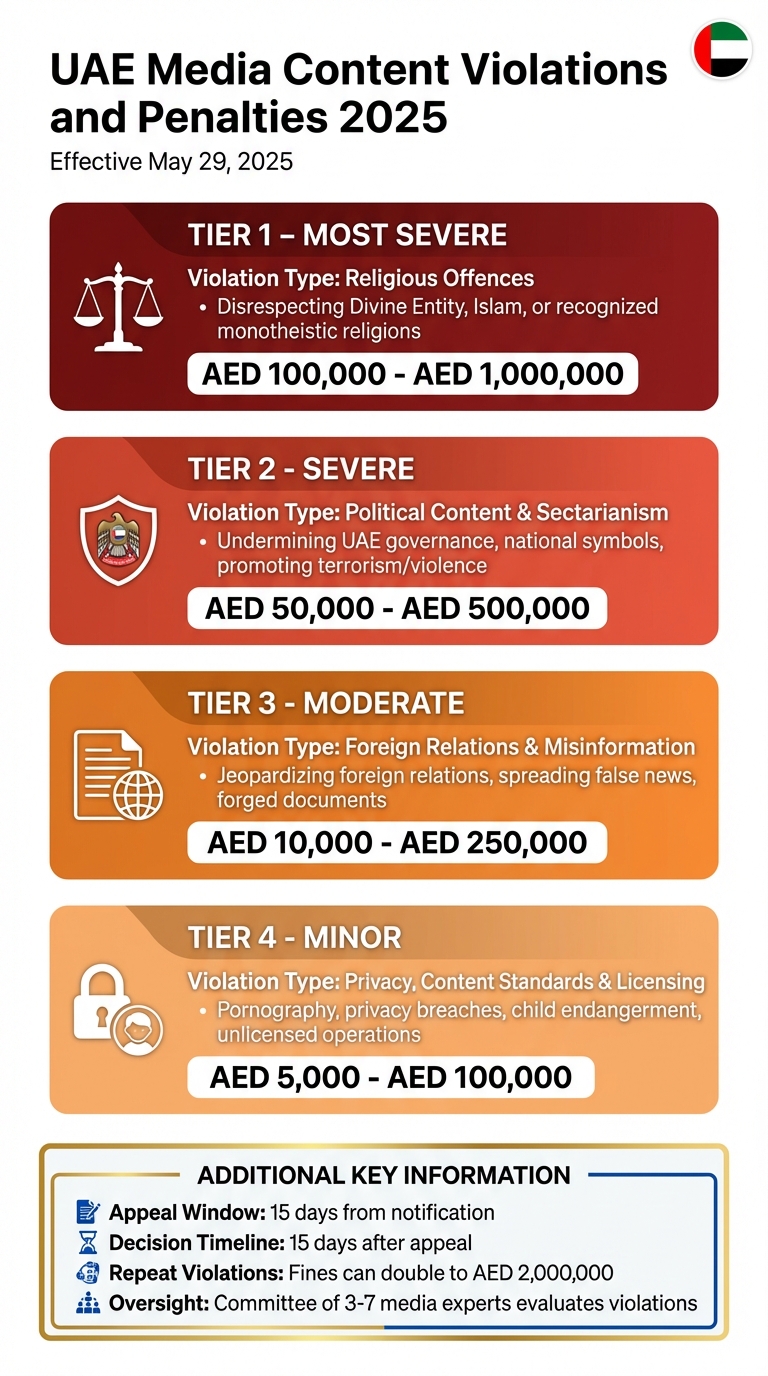
UAE Media Content Violations and Penalties 2025
The UAE's media regulations saw a major update with the introduction of Federal Decree-Law No. 55 of 2023, which came into effect on 18 December 2024. This new framework replaced the outdated 1980 legislation and now includes digital platforms, social media influencers, podcasters, video-on-demand services, and electronic publishers. Essentially, anyone creating, sharing, or publishing media content in audio, video, or digital formats must comply with these updated rules. Below is a breakdown of the key legislative texts shaping UAE media regulations in 2025.
Under this law, all media practitioners must obtain a license or permit from the UAE Media Council or relevant local authorities before publishing content. Licenses are valid for one year, with applications reviewed within three working days. Renewal must occur at least 30 days before expiry to avoid automatic cancellation and fines, which must be settled within 90 days. The law also enforces 20 national content standards, focusing on areas like respect for Islamic values, UAE sovereignty, national identity, public morals, and individual privacy. Oversight responsibilities are split between the UAE Media Council, the National Media Office (NMO), and the Telecommunications and Digital Government Regulatory Authority (TDRA), which supervises the digital sector.
"The New Law not only replaces the preceding Federal Law No. 15/1980, but also introduces comprehensive guidelines impacting a wide spectrum of media operations including those in the digital realm." – Saleem Adam, Partner, Trowers & Hamlins
Licensing fees depend on the type of activity, ranging from AED 500 to AED 100,000. Electronic media applications and renewals, for instance, cost around AED 15,000. Additionally, applicants must provide financial guarantees - AED 50,000 for newspapers and AED 20,000 for other media outlets. Cabinet Resolution No. 42 of 2025 further details penalties for violations within this licensing framework.
Starting 29 May 2025, Cabinet Resolution No. 42 enforces a tiered system for violations, ranked from First (least severe) to Fourth (most severe). Fines range from AED 5,000 to AED 1,000,000, depending on the severity of the offence. A specialized Committee for Violations of Media Content Standards, composed of three to seven media experts, evaluates the economic, political, and social impact of each breach before deciding on penalties.
"Cabinet Decision Nos. 41 and 42 of 2025 provide welcome granularity and clarity for media businesses as to how violations of licensing requirements and media content standards are to be enforced and penalised in practice." – Alexandra Lester, Partner, Clyde & Co
Violations such as disrespecting the Divine Entity or Islamic beliefs carry fines between AED 100,000 and AED 1,000,000. Offences against the UAE's regime, symbols, or institutions result in penalties ranging from AED 50,000 to AED 500,000. Content promoting sectarianism, violence, or terrorism incurs fines from AED 100,000 to AED 500,000. Publishing without a valid license starts with fines of AED 5,000, escalating for repeat violations. Those penalised can appeal within 15 days of receiving notification, with decisions issued within an additional 15 days. These measures highlight the UAE's strict commitment to ensuring compliance with media standards and licensing requirements, as well as the importance of adherence for businesses operating in the sector.
Understanding the UAE's media content standards is crucial for businesses operating in the region. These regulations apply to all forms of media, including traditional broadcasting, social media, podcasts, and digital productions. The focus is on upholding Islamic values, safeguarding UAE sovereignty, preserving national identity, respecting public morals, and protecting individual privacy - all while maintaining accuracy and transparency.
Media content in the UAE must adhere to strict ethical and quality guidelines. Accuracy is paramount, and transparency is a must - advertisements, for instance, must be clearly marked as "paid advertisement" rather than using ambiguous terms like "in collaboration with." Claims made in any content must be verifiable and truthful. Additionally, creators are required to follow the Age Rating System established by the UAE Media Council for artistic works, video games, and media productions. This ensures that content is suitable for its intended audience, particularly shielding younger viewers from inappropriate material.
Content should also reflect and preserve UAE heritage while fostering social unity. Any material that could incite divisions or disrupt societal harmony is strictly prohibited. To enforce these principles, the TDRA's Internet Access Management Policy and the A'men digital platform enable active monitoring and community reporting of non-compliant content. While these standards outline what is acceptable, certain types of content are entirely banned.
Breaching these content standards can result in heavy penalties, ranging from AED 5,000 to AED 1,000,000. Religious offences - such as disrespecting the Divine Entity, Islam, or other recognized monotheistic religions - carry the most severe fines, between AED 100,000 and AED 1,000,000. Similarly, political content that undermines the UAE's governance system, national symbols (like the flag, anthem, or coat of arms), institutions, or founding leaders can lead to fines of AED 50,000 to AED 500,000.
Content promoting sectarianism, violence, or terrorism is penalised with fines ranging from AED 100,000 to AED 500,000. Material that jeopardises foreign relations may result in fines between AED 30,000 and AED 250,000. Violations involving misinformation - such as spreading false news, rumours, or forged documents - are subject to fines of AED 10,000 to AED 100,000. Other prohibited categories include pornography, nudity, promotion of drugs or gambling, human trafficking, unlicensed medical products, and anything breaching privacy rights or endangering children, with fines ranging from AED 5,000 to AED 100,000.
"The combination of high fines, AI-driven monitoring, and dual licensing for influencers marks a watershed in how Gulf states regulate digital ecosystems." – Lisa Zhang, Middle East Briefing
Starting in 2025, the UAE requires all digital content creators earning revenue to obtain dual licenses. This applies to solo influencers and media companies alike. Both a Commercial License (Trade or Freelance) and a Media License from the UAE Media Council are mandatory. These licenses cover income from activities like brand partnerships, sponsored posts, affiliate marketing, product sales, and YouTube AdSense earnings.
Here’s a closer look at the licensing requirements for influencers and businesses.
Influencers must first secure a Commercial License, which is issued by Free Zone authorities or the Department of Economic Development (DED). This license provides the legal foundation for operating as a business and allows for visa sponsorship. Solo creators typically choose a Freelance License, which costs between AED 5,000 and AED 15,000, depending on the Free Zone (e.g., Meydan, RAKEZ, or IFZA). Those planning to hire staff will need a full Trade License.
Once the Commercial License is active, influencers must apply for a Media License, which costs AED 1,000 annually. This license specifically permits the creation and distribution of paid content on social platforms. In Abu Dhabi, influencers are also required to hold a trade license issued by the DED. Penalties for non-compliance start at AED 10,000 and can escalate to AED 40,000 for repeat violations. Additionally, the UAE Media Council offers a free permit valid for three years.
Businesses involved in content creation must follow similar protocols. Like influencers, they need a Commercial License as the first step. After that, specific permits must be obtained through the UAE Media Council portal. These permits are necessary for activities such as podcasting, digital advertising, news services, and various types of filming. Even foreign media agencies and global platforms operating in the UAE must comply with these regulations.
| License Type | Issuing Authority | Cost (AED) | Purpose |
|---|---|---|---|
| Commercial/Freelance License | DED or Free Zones | 5,000–15,000 | Legal business operation, visa sponsorship, and banking |
| Media License | UAE Media Council | 1,000 (Annual) | Authorisation to publish and distribute paid content |
| UAQ FTZ Bundle | Umm Al Quwain FTZ | 9,999 | Includes freelancer license, residency visa, and Emirates ID |
Failure to renew the Media License results in a daily fine of AED 40.84, capped at AED 3,000. Beyond financial penalties, authorities may suspend operations for up to six months or permanently shut down non-compliant media outlets. To ensure compliance, the UAE is introducing AI-powered monitoring systems that detect unlicensed commercial activities in real time.
UAE authorities take a structured and proactive approach to ensure media compliance across traditional and digital platforms. This is built on a solid legal framework and strict media standards. Two key entities oversee this process: the National Media Office (NMO) and the Telecommunications and Digital Government Regulatory Authority (TDRA). Both work closely with the UAE Media Council to ensure that media activities align with national guidelines.
The NMO plays a pivotal role in shaping the UAE's media landscape, aiming to position the country as a global media hub. It coordinates with various media offices, oversees the operations of the Emirates News Agency (WAM), and invests in training Emirati professionals for leadership roles in the industry.
On the enforcement side, the NMO tackles issues like false news and unethical practices. Under its umbrella, the Media Regulatory Office (MRO) issues licenses and monitors media content to ensure it complies with the UAE's 20 national standards. Additionally, the public can report violations through the 'A'men' platform.
When breaches occur, a specialized Committee for Violations of Media Content Standards - consisting of three to seven media experts - evaluates the severity and societal impact of the violation. Meanwhile, the TDRA extends these oversight efforts into the digital space.
The TDRA enforces digital compliance through its Internet Access Management (IAM) Policy, which monitors online content accessible to users in the UAE. It works with licensed internet service providers to block content that violates national standards. The IAM policy covers 19 restricted categories, including pornography, defamation, cybercrime, and unlicensed medical promotions.
Beyond general content monitoring, the TDRA closely regulates digital advertising, particularly for medical and pharmaceutical products, ensuring they adhere to legal standards. It also supervises emerging sectors like the Internet of Things (IoT), requiring IoT service providers to register and obtain operational certificates in the UAE. For instance, in May 2024, the ADGM Commissioner of Data Protection fined Okadoc Technologies Limited USD 20,000 for failing to comply with a data subject's access request.
When violations are detected, the TDRA notifies website operators to address the issue. If non-compliance persists, internet service providers may be instructed to block access to the offending content. This collaborative effort between the TDRA, NMO, and other local authorities ensures a unified and well-regulated digital environment. Human oversight is complemented by advanced AI systems to maintain continuous monitoring and enforcement.
Navigating compliance in the UAE requires careful planning, ongoing monitoring, and adherence to regulations. Penalties for violations are steep, ranging from AED 5,000 to AED 1,000,000, with repeat offences potentially doubling fines to AED 2,000,000. A structured approach not only shields your business from legal risks but also strengthens audience trust. Here’s a checklist to help you translate legal and licensing requirements into actionable steps.
Before publishing any content, ensure that every team member and collaborator has the necessary dual licenses: a business license and a UAE Media Council media license for monetized content. Operating without these licenses can lead to fines starting at AED 5,000 and escalating to AED 40,000 for repeated violations. Additionally, confirm that all influencers you work with hold valid MRO licenses.
Set up a pre-publication review process to screen content for compliance with UAE national standards. This includes respecting Islamic values, national symbols, and ensuring the accuracy of all claims. For specialized topics like health, finance, or trading, obtain prior approvals from relevant authorities such as the Ministry of Health and Prevention (MOHAP) or the Securities & Commodities Authority (SCA). Substantiate claims like "guaranteed ROI" or "top-rated" with verifiable evidence to avoid penalties.
If your operations involve handling large volumes of sensitive personal data or automated profiling, appoint a Data Protection Officer (DPO) to ensure compliance with Federal Decree-Law No. 45 of 2021. Keep detailed records of data categories, authorised personnel, and security measures, as these may be requested by authorities. Apply the Age Rating System to all artistic and digital content as mandated by the UAE Media Council, as violations can result in fines ranging from AED 5,000 to AED 100,000.
Once your content is live, continuous monitoring helps maintain compliance and adapt to evolving regulations. Use the A'men digital platform, accessible via UAE PASS, to report any non-compliant content and ensure alignment with UAE Media Council standards. This community-driven tool enables real-time reporting of misleading, unsafe, or unauthorised advertising directly to authorities.
Develop takedown protocols to swiftly remove flagged content, safeguarding your brand’s reputation and minimising legal risks. If penalised, you have 15 days to file a grievance, with authorities required to respond within another 15 days. Remember, even if your content targets a foreign audience, UAE-based companies must adhere to Emirati media laws as these are based on the origin of activity, not just the audience location. Stay updated by regularly reviewing new resolutions from the NMO and TDRA to ensure your strategies remain compliant.
"In the UAE's dynamic digital landscape, compliance isn't optional - it's the cornerstone of sustainable growth." - ULEGENDARY Digital
In the UAE's ever-evolving regulatory landscape, Wick ensures that every digital strategy aligns with local compliance requirements. By embedding these mandates into its processes, Wick helps businesses navigate the complexities of UAE regulations. Its Four Pillar Framework integrates website development, content creation, social media management, and data analytics into a seamless digital ecosystem. Advanced tools powered by data further enhance Wick's ability to manage compliance effectively, as outlined below.
Wick’s Build & Fill pillar focuses on creating websites and content that adhere to the 20 national standards outlined in Federal Decree-Law No. 55 of 2023. This ensures all content reflects Islamic values, respects UAE sovereignty, and promotes national identity. Meanwhile, the Plan & Promote pillar guarantees that marketing efforts - such as SEO strategies, advertising campaigns, and influencer collaborations - comply with licensing rules. For instance, any influencer partnership requires collaborators to hold valid MRO licenses before engaging in commercial activities.
For businesses operating in sensitive industries, Wick offers tailored consulting to streamline authorisation processes. This includes securing approvals from entities like MOHAP or the Securities & Commodities Authority, ensuring smoother compliance workflows. Additionally, all promotional materials are labelled transparently, with claims backed by verifiable evidence. This approach helps businesses avoid fines, which can range from AED 10,000 to AED 100,000 for misleading content.
Beyond content creation, Wick leverages AI and data analytics to strengthen compliance oversight. The Capture & Store and Tailor & Automate pillars incorporate AI tools to identify and flag high-risk content - such as material that could insult religious beliefs or undermine ruling systems - before it is published. This reflects the UAE's growing focus on AI-driven regulatory intelligence.
"The law contemplates an AI-powered content review system to flag misinformation or prohibited content before publication." – Lisa Zhang, Middle East Briefing
Wick also implements Data Protection Officer (DPO) frameworks and pseudonymisation practices for businesses managing large datasets, ensuring compliance with Federal Decree-Law No. 45 of 2021. By using customer journey mapping and Customer Data Platform (CDP) tools, Wick enables real-time performance tracking. This ensures businesses stay aligned with new resolutions issued by the National Media Office (NMO) and the Telecommunications and Digital Government Regulatory Authority (TDRA). These efforts are designed to meet the UAE's rigorous legal and ethical standards for content compliance.
By 2025, the UAE's media landscape has solidified under a unified national framework, requiring all content creators, influencers, and businesses to secure proper licensing from the UAE Media Council. As outlined earlier, failing to comply can lead to penalties, fines, and other serious repercussions. Compliance is no longer a one-off task - it demands continuous attention and proactive management.
One of the most notable updates is the extra-territorial reach of these regulations, meaning international media accessible within the UAE must also meet local standards. For businesses, missing license renewals now incurs daily fines, while repeated violations can lead to more severe consequences, including six-month license suspensions or even permanent closures of media outlets.
Navigating these regulations is no small feat. Dual licensing requirements, sensitivity audits, and real-time content monitoring add layers of complexity. As Fabrizio Speranza of WH Partners points out, expert guidance is critical to ensure activities, communications, and content align with the latest provisions. Wick has responded to these challenges with its Four Pillar Framework, which integrates compliance directly into every stage of content creation and distribution. From securing licenses to leveraging AI for content monitoring, Wick ensures businesses go beyond merely meeting requirements - they create robust systems that evolve with regulatory changes.
For companies operating in the UAE's digital economy, compliance is not just a legal necessity - it’s a cornerstone of sustainable growth. With enforcement mechanisms becoming more sophisticated, partnering with experts who understand both technical and cultural elements of UAE media law is key. By adopting proactive compliance strategies and advanced oversight tools, businesses can focus on thriving in the UAE's ever-evolving digital environment.
Content creators in the UAE will need two important licenses to operate legally in 2025. The first is a commercial or freelance license, which depends on the specific type of work they plan to do. The second is a media license issued by the UAE Media Council, specifically covering electronic media activities.
To obtain the media license, applicants must provide a valid Emirates ID, their passport (this applies to both UAE citizens and residents), and a business activity license linked to electronic media. Applications can be conveniently submitted online, ensuring adherence to the latest regulations governing content creation in the UAE.
The UAE ensures adherence to media content regulations through the Media Regulatory Office, which manages licensing, keeps an eye on media outputs, and enforces penalties for any breaches. These actions are rooted in Federal Law No. 55 of 2023 and its executive regulations, as well as the penalty framework detailed in Cabinet Resolution No. 42 of 2025.
For businesses, it’s crucial to produce content that respects the UAE's legal, ethical, and cultural expectations. Failure to comply could lead to administrative fines or other consequences. Keeping up-to-date with changes in these regulations is key to staying compliant in the ever-shifting media environment.
The UAE's updated media regulations set clear boundaries for content to ensure respect and harmony within the country. Content is prohibited if it:
These rules are designed to uphold public order, safeguard national values, and maintain social unity in the UAE.
16 MIN READ
14 MIN READ
11 MIN READ
What worked, what didn't, and what we're building next - no noise, unsubscribe anytime.