

Blog / How AI Improves Content Publishing Workflows
How AI Improves Content Publishing Workflows
AI is reshaping how businesses in the UAE manage content publishing by solving three main challenges: timing, personalisation, and scaling operations. It automates repetitive tasks, analyses data for audience preferences, and ensures content reaches the right people at the right time. For industries like e-commerce and tourism, this means faster publishing, better audience engagement, and efficient multi-channel distribution. With AI, businesses can reduce production timelines, personalise content for diverse audiences, and manage growing content demands without increasing team sizes.
Key insights:
- Faster timelines: AI reduces SEO ranking times from 6–9 months to 2–4 months.
- Personalisation: Tracks user behaviour to tailor content for the UAE's multilingual market.
- Efficiency: Automates scheduling, translation, and compliance checks, saving time and resources.
AI is not about replacing human creativity but enhancing workflows to help teams focus on strategy and storytelling.
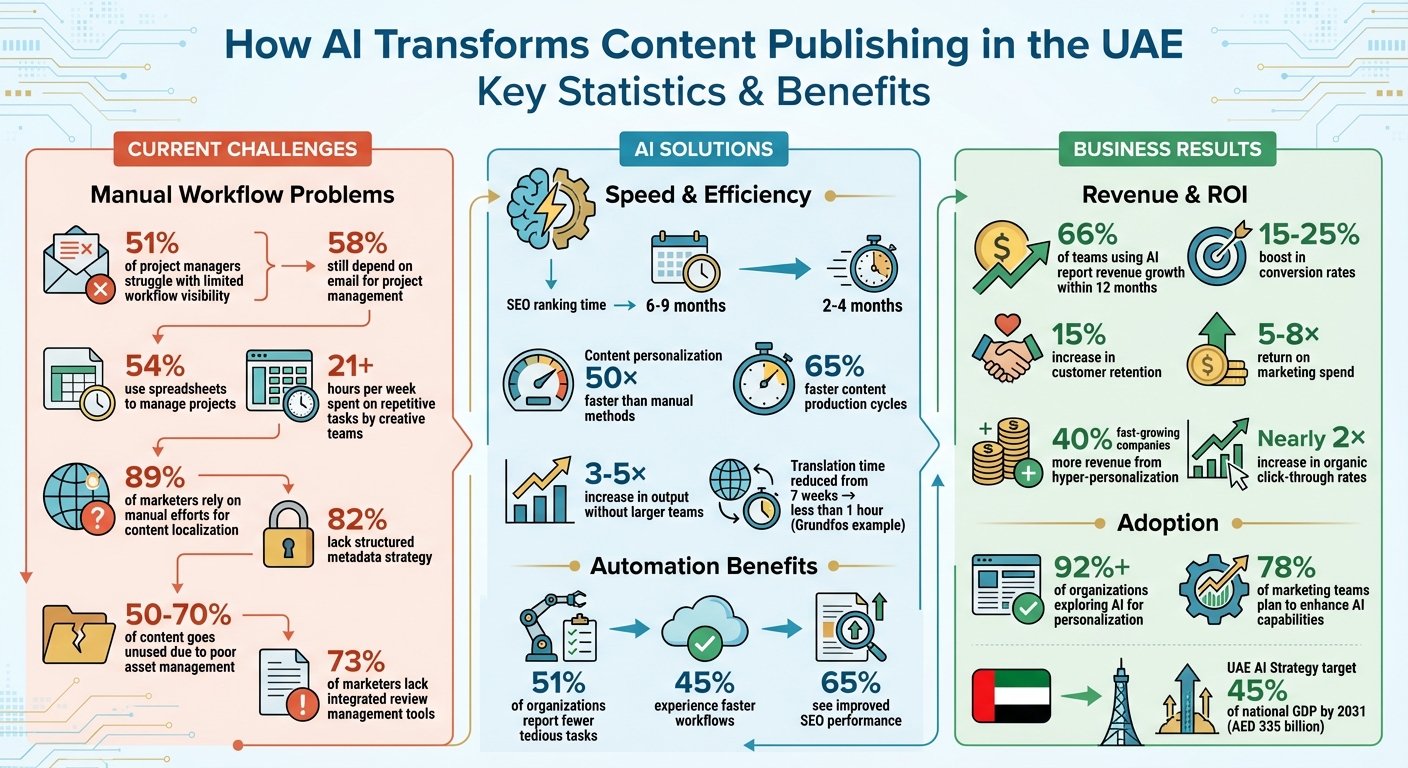
AI Impact on Content Publishing: Key Statistics and Benefits
AI Automation with Make: Create an Automated Blog Post Generator
sbb-itb-058f46d
Common Problems in Content Publishing Workflows
Content publishing in the UAE can be resource-intensive and hinder growth when relying solely on manual processes. These inefficiencies can slow down operations and limit the ability to meet market demands effectively.
Manual Scheduling and Timing Problems
Managing schedules manually often results in delays and inefficiencies. For example, 51% of project managers report struggling with limited visibility into workflows and audit trails, while 58% still depend on email and 54% use spreadsheets to manage projects. This outdated approach leads to missed deadlines and wasted effort. Take Dubai-based e-commerce businesses as an example - they often lose resources monitoring brand sentiment manually. Additionally, creative teams in the UAE spend over 21 hours each week on repetitive tasks, which disrupts consistency in messaging.
These challenges highlight the importance of automated marketing solutions to streamline workflows and ensure timely delivery.
But timing is just one piece of the puzzle - creating meaningful, localised content is another major hurdle.
Difficulty Creating Personalised Content
In the UAE, where cultural diversity is vast, creating personalised content that resonates with different audiences is critical. Manual workflows often fall short in addressing these cultural nuances. For instance, 89% of marketers rely on manual efforts or external services to localise content for multi-market projects, and 82% lack a structured metadata strategy to organise and repurpose assets. As Go-Digital.ae aptly puts it:
"Dubai is a unique melting pot of cultures, languages, and expectations. A one-size-fits-all content strategy will inevitably fail."
This lack of personalisation has real consequences. Dubai’s luxury retailers, for example, risk losing customers when follow-ups lack relevance and timeliness. This is especially concerning given that 66% of brands fail to deliver the right content at the right moment, even though 78% of consumers expect seamless, personalised digital experiences.
These gaps in personalisation underline the need for AI-driven solutions that adapt content to audience expectations.
When scheduling and personalisation falter, scaling content operations becomes an even bigger challenge.
Limited Ability to Scale Operations
Scaling content manually is a daunting task. Between 50% and 70% of content goes unused because teams struggle to locate assets stored across fragmented systems like personal cloud drives or local devices. With content demand expected to increase fivefold in the next two years, these inefficiencies will only grow. Tammy Pienknagura, Head of Strategy and Innovation for Content Supply Chain at Adobe, explains:
"Based on our conversations with customers, we often see that 50% to 70% of content produced is never used because teams can't easily find it."
This issue is especially pressing for industries like real estate and tourism in Dubai. Businesses risk becoming "invisible" in voice searches when they rely on manual keyword optimisation instead of using conversational AI tools. Media companies also face setbacks due to slow, manual link building and partnership monitoring, leading to further inefficiencies. Additionally, 73% of marketers lack integrated tools to manage reviews, further complicating scalability.
These limitations make it clear: automation powered by AI is no longer optional - it’s essential for sustainable growth in content publishing.
How AI Solves Content Publishing Problems
AI has stepped in to tackle the hurdles of timing, personalisation, and scalability in content publishing, offering practical solutions that transform how teams work.
By automating repetitive tasks, AI allows teams to focus on strategy and creativity rather than mundane workflows. For instance, instead of spending 65% of their time managing processes, content teams can now automate these tasks. In fact, 51% of organisations report fewer tedious tasks, and 45% experience faster workflows thanks to AI integration.
But it’s not just about speeding things up. AI brings precision to the table. Generative AI, for example, can personalise content 50 times faster than manual methods. It’s no surprise that 66% of marketing and sales teams using AI tools have seen revenue growth within a year. This combination of speed and accuracy directly addresses the inefficiencies of traditional publishing workflows.
Automated Scheduling and Better Timing
AI takes the guesswork out of scheduling by analysing audience activity and engagement patterns. Tools like Sprout Social and Pressmaster.ai identify the best times to post, ensuring content reaches audiences when they’re most likely to engage. This "smart scheduling" approach eliminates the trial-and-error of manual planning.
Beyond social media, AI also optimises email campaigns by recommending send times based on individual recipient behaviour. Teams can batch-create content and use AI to handle scheduling across multiple platforms, all from a single dashboard.
This automation is critical because outdated content can harm visibility. For example, pages not updated quarterly are three times more likely to lose AI search citations compared to refreshed ones. Mark Williams-Cook highlights this advantage:
"Automating the monitoring of intent shift over all of your content is a massive opportunity".
AI tools can even prioritise updating older content to keep it relevant, a key advantage in Dubai’s fast-paced digital environment.
Personalisation at Scale
AI has revolutionised how content connects with diverse audiences, making personalisation seamless. For a market as varied as the UAE, AI eliminates the need for countless copywriters. By tracking customer behaviour across multiple touchpoints, AI adjusts content in real time to deliver tailored experiences. This approach ensures one-to-one personalisation without manual effort.
The secret lies in structured content and metadata. By breaking information into reusable modules enriched with metadata, AI can reformat content - like product descriptions - for different platforms (web, mobile, or voice) while maintaining consistency. Saibal Bhattacharjee from Adobe explains:
"The quality of AI's output is directly related to the quality of the content and information it processes. Structured content is the foundation for AI success".
The numbers back this up. Over 92% of organisations are exploring AI for personalisation, with fast-growing companies generating 40% more revenue from hyper-personalisation. AI-driven efforts typically lead to a 15–25% boost in conversion rates, a 15% increase in customer retention, and a 5–8 times return on marketing spend.
For businesses in the UAE, this means AI can automatically serve technical guides to installers or security protocols to administrators, all managed from a single content library. Kenneth Reisman of Adobe describes the impact:
"Generative AI's impact on content creation will be transformational, enabling productivity improvements of 10–100 times or more - for some workflows".
Faster Review and Compliance Processes
AI doesn’t just speed up scheduling and personalisation - it also ensures quality and compliance. Drafts are reviewed for clarity and style before human editors step in, streamlining the process while preserving human judgement.
Brand voice consistency becomes scalable when AI is trained on approved examples and style guides. The system suggests alternatives that align with the brand’s tone, ensuring uniformity across vast amounts of content. For compliance, AI scans for legal or brand guideline issues, flagging sensitive or regulated content for human review.
The benefits are clear. Companies using AI-driven production systems report 65% faster content cycles, and 65% see improved SEO performance. Julia McCoy, Founder of FirstMovers.ai, summarises it well:
"AI is a powerful assistant, not a replacement for human creativity and judgement".
This "human-in-the-loop" model lets AI handle routine tasks like drafting and initial quality checks, while humans focus on strategy, storytelling, and final approvals. As Chaviva Gordon-Bennett from monday.com puts it:
"AI won't replace content marketers, but content marketers who know how to use AI will replace those who don't".
The result? Faster publishing without compromising quality or brand integrity. AI takes care of the heavy lifting, freeing up teams to focus on what truly matters.
AI for Multi-Channel Distribution and Scaling
After creating content, the next big hurdle is getting it in front of the right audience across various platforms. In the UAE, where digital audiences are spread across LinkedIn, Instagram, X, and email, manually managing this process can quickly become unmanageable. This is where AI steps in, transforming a single piece of content into multiple platform-ready formats. Beyond just scheduling and personalisation, AI now plays a critical role in streamlining multi-channel distribution and improving team collaboration, making the entire process significantly more efficient.
The sheer volume of enterprise content is staggering, with projections showing it will grow from 47 exabytes in 2021 to 155 exabytes by 2026. Yet, 76% of companies still face challenges in managing and storing digital assets manually. AI addresses these issues by automating distribution tasks, freeing up teams to focus on strategic initiatives rather than repetitive processes. This automation also opens the door for better content repurposing and improved collaboration across teams.
Repurposing Content Across Platforms
AI doesn't just make distribution easier; it also amplifies the value of every piece of content. For example, a single long-form asset like a blog post or webinar can be transformed into multiple formats tailored for different platforms. That 2,000-word article? It can become LinkedIn posts, X threads, email newsletters, and even infographics, each optimised to suit the specific needs of the platform. This approach ensures that every piece of content works harder and reaches a wider audience.
Real-world examples highlight the impact of this approach. In November 2024, Grundfos, a global pump manufacturer, leveraged AI-driven workflows to reduce content translation times from seven weeks to less than one hour. Their system managed over 750,000 reusable content topics across various formats and channels. Similarly, KONE used Adobe Experience Manager Guides to deliver consistent technical documentation across websites, apps, and voice assistants, dynamically adapting content for each platform.
The secret to this efficiency lies in structured content and metadata. By tagging content with details like audience, region, or purpose, AI can determine the right channel for each asset. For instance, in 2024, Palo Alto Networks adopted this method to organise technical documentation. The result? Better SEO, increased web traffic, and far less manual effort in updating content.
Ross Simmonds, Founder and CEO of Distribution.ai, sums it up perfectly:
"The brands and teams that succeed are not the ones creating twice as much. They are the ones making what they have already created go twice as far".
In Dubai’s fast-paced environment, this means a single case study can fuel weeks' worth of social posts, sales materials, and email campaigns - all managed efficiently from a single source.
Better Team Collaboration Through Automation
AI isn’t just about scaling distribution - it also transforms how teams collaborate by cutting out delays caused by traditional workflows. In conventional setups, multiple handoffs between teams often lead to miscommunication and slow progress. AI-powered platforms eliminate these inefficiencies by automating repetitive tasks and centralising workflows.
Consider this: 58% of professionals still rely on email for project management, and 51% report visibility issues in content workflows. With AI, campaign kits - including briefs, tasks, and social posts - can be generated in minutes, keeping everyone on the same page and reducing back-and-forth communication.
The numbers back this up. A September 2024 survey revealed that 78% of marketing teams plan to enhance their AI capabilities. The results are striking - AI-driven workflows can boost content production speeds by 5 to 10 times compared to manual methods.
Team Asana offers a fitting analogy:
"Content marketing is a lot like running a relay race where success hinges on perfect handoffs".
AI ensures these handoffs are seamless. Marketers can now handle "last-mile edits" - like resizing graphics or tailoring copy for local audiences - on their own, without waiting for creative teams. This self-service model reduces bottlenecks and allows teams to work faster while maintaining consistency across all channels. By streamlining collaboration, AI-driven frameworks optimise every stage of content strategy, empowering teams to achieve more in less time.
Using AI in Wick's Four Pillar Framework
At Wick, AI is more than just a trendy term - it's a core element of the Four Pillar Framework designed to simplify content publishing. This framework integrates Build & Fill, Plan & Promote, Capture & Store, and Tailor & Automate into a cohesive system. Two of these pillars - Tailor & Automate and Plan & Promote - harness AI to reduce manual tasks, improve efficiency, and deliver measurable results. With the UAE National AI Strategy 2031 aiming to boost AI's share in the national GDP to 45% by 2031, adding an estimated AED 335 billion in value, businesses across the region are rapidly adopting AI-driven frameworks to maintain their competitive edge.
Tailor & Automate: AI-Powered Publishing Automation
The Tailor & Automate pillar focuses on using AI to handle repetitive tasks and optimise workflows. AI systems analyse user data - such as browsing habits, demographics, and behavioural patterns - to deliver personalised content. For instance, a website visitor in Dubai may see different recommendations compared to someone browsing from Abu Dhabi, even on the same platform.
AI also takes over technical tasks like generating metadata, SEO tags, and alt-text, ensuring consistency and optimisation. In the UAE's bilingual landscape, AI-powered translation tools handle both Arabic and English content with ease, using advanced neural networks to replicate human tone and reflect local nuances. This not only eliminates delays in translation but also maintains high-quality output. To ensure alignment with brand values and cultural expectations, human oversight complements AI's speed and efficiency, striking the perfect balance between automation and sensitivity.
Plan & Promote: Data-Driven Timing and Strategy
While automation fine-tunes content delivery, the Plan & Promote pillar leverages AI to guide what content to publish and when. AI-driven analytics uncover audience preferences, search intent, keyword gaps, and trending topics. Real-time data from platforms like Google Trends enables the creation of timely, relevant articles.
Timing is crucial, and AI ensures content reaches the audience at the right moment. Algorithms analyse metrics like dwell time, conversion rates, and SEO rankings to refine publishing strategies. For example, if LinkedIn engagement data reveals that posts perform best at 09:00 on Tuesdays in Dubai, the system schedules content accordingly. The impact is clear: 66% of marketing and sales teams using generative AI reported revenue growth over 12 months. Additionally, companies incorporating AI into their content strategies have managed to produce short-form videos three times faster by integrating automation into their workflows.
Conclusion
Facing challenges like timing, personalisation, and scalability, AI offers three key advantages for businesses: streamlining repetitive tasks through automation, delivering personalised experiences at scale using data analysis, and boosting output by 3–5× without needing a larger team. For businesses in the UAE's multilingual and culturally diverse market, these strengths are crucial for staying competitive.
The numbers speak for themselves. AI-driven workflows can dramatically cut down content production times while delivering impressive ROI within the first year. Even better, AI-enhanced strategies lead to faster SEO results, with organic click-through rates nearly doubling. On top of that, 66% of marketing and sales teams using generative AI report measurable revenue growth. These results highlight how AI can drive success, especially when implemented systematically, as demonstrated by Wick's integrated framework.
Wick's Four Pillar Framework illustrates how to make AI integration practical. By combining Tailor & Automate for streamlined publishing and Plan & Promote for data-backed strategies, businesses can manage everything from content creation to distribution in one cohesive system.
The secret to success lies in treating AI as a strategic co-pilot, not a replacement for human creativity. Start small by automating specific content types, ensure brand voice remains consistent with human oversight, and scale up gradually. This approach aligns perfectly with Wick's Four Pillar Framework, ensuring businesses can leverage AI effectively while preserving the authenticity and cultural sensitivity that resonate with UAE audiences. With clean data, proper training, and the right strategy, businesses in the UAE can transform their content workflows and thrive in a competitive market.
FAQs
How does AI help create personalised content for diverse audiences in the UAE?
AI takes content personalisation to the next level by analysing massive datasets, including search habits, social media interactions, and on-site activity. This allows it to pinpoint what truly resonates with diverse audience groups in the UAE. By factoring in elements like preferred language, cultural subtleties, and local interests, AI ensures content feels relatable and engaging for both Arabic-speaking residents and English-speaking expatriates.
With tools like natural language processing and machine learning, AI can dynamically tailor content. It can seamlessly translate and refine text in both Arabic and English, adjust formats for dates (dd-MM-yyyy), prices (AED), and metric measurements, and even integrate UAE-specific details such as public holidays or Celsius temperatures. This makes it possible for brands to create highly targeted experiences across various platforms - whether it’s an article, email, or social media post.
Wick taps into these AI-driven capabilities through its Four-Pillar Framework, enabling businesses in the UAE to scale personalised content efficiently. Every piece of content aligns with the brand’s unique voice while catering to the diverse needs of the local audience.
How can AI streamline content publishing tasks and save time?
AI plays a powerful role in streamlining content publishing by taking over repetitive, time-consuming tasks. It can help with generating topic ideas, crafting outlines, drafting initial content, and even handling SEO keyword optimisation. Beyond that, AI can rephrase content, perform quality checks, update outdated material, and schedule posts for distribution - all with remarkable efficiency.
What’s more, AI tools can adapt metadata and content to suit regional preferences, accounting for language differences and local nuances. This ensures your content not only saves time but also resonates deeply with your target audience.
How can AI help businesses in the UAE streamline and scale their content publishing?
AI-powered workflows are revolutionising content publishing by taking over time-consuming tasks like topic research, drafting, SEO optimisation, and scheduling across multiple platforms. This automation can slash production time by as much as 60–80%, boosting output without sacrificing quality, thanks to human oversight. For businesses in the UAE, AI also makes localisation easier, ensuring content remains consistent in both Arabic and English while respecting cultural sensitivities.
When AI tools are integrated into every stage of the process - ideation, drafting, editing, optimisation, and publishing - companies can expand their content efforts without needing to grow their team. This approach allows brands to keep up with tight publishing deadlines, tailor content for local audiences, and drive growth while staying true to their quality standards and brand identity.