

Blog / AI Personalization Trends in GCC
AI Personalization Trends in GCC
AI personalization is reshaping the GCC's business landscape, driven by substantial investments from the UAE and Saudi Arabia. Key highlights include:
- Massive Investments: The UAE's MGX (launched in March 2024) and Saudi Arabia's $40 billion AI fund are fueling growth in AI technologies like data centers, AI software, and high-performance computing.
- Economic Impact: AI contributed $1.8 billion to the GCC personalization engines market by late 2025 and is projected to add $260 billion to GDP by 2030.
- Sector Growth: Fintech, retail, and media are leveraging AI for real-time personalization, reducing costs, and increasing efficiency. For example, 73% of UAE and Saudi consumers made purchases via AI-driven recommendations on social media in 2025.
- Cultural Relevance: AI systems are adapting to regional habits like Ramadan shopping surges and Arabic NLP for better engagement.
- Challenges: Despite 84% of GCC organizations adopting AI, only 11% have scaled it effectively, citing issues like data localization laws, employee resistance, and fragmented infrastructure.
AI personalization offers immense potential for the GCC, but scaling and aligning with local needs remain critical hurdles.
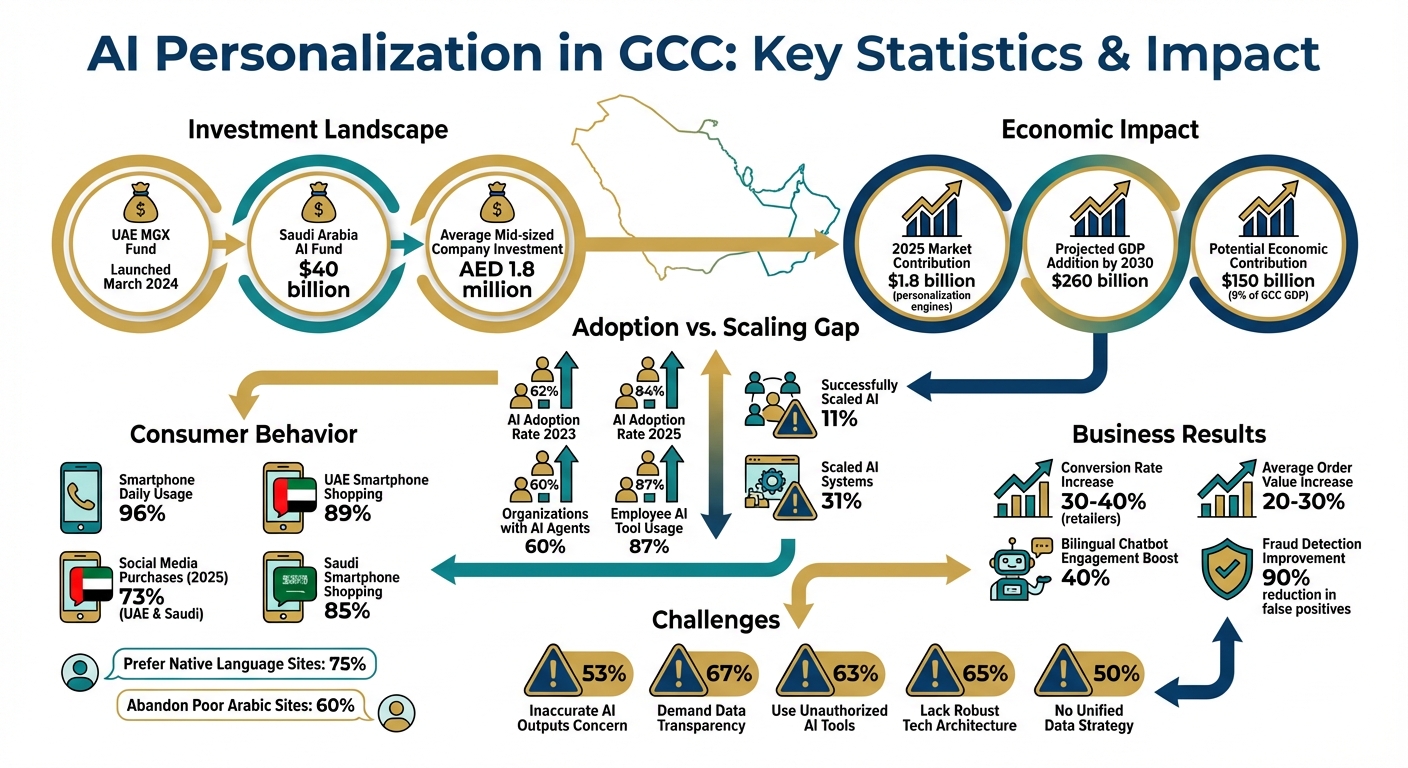
AI Personalization in GCC: Key Statistics and Investment Trends 2024-2030
Current AI Personalisation Trends in the GCC
The GCC's strong focus on AI investment is paying off, with businesses across the region benefiting from advanced personalisation technologies. AI adoption in the GCC surged from 62% in 2023 to 84% in 2025, and 60% of organisations now incorporate AI agents into their operations to some degree. This shift has led to measurable outcomes: retailers in the region have seen 30–40% higher conversion rates and 20–30% increases in average order values, thanks to AI-powered recommendation systems. For mid-sized companies, the average initial investment in AI stands at approximately AED 1.8 million, with clear returns on investment.
Real-Time AI Personalisation
One of the most exciting advancements in the GCC is the emergence of agentic AI, which autonomously manages complex workflows. These AI agents can solve problems, streamline development cycles, and reduce selling, general, and administrative costs - all with minimal human intervention. A standout example is Saudi Aramco's generative AI model, launched in March 2024. With 250 billion parameters, this model analyses drilling plans, geological data, and historical costs to optimise drilling efficiency. Unlike general-purpose chatbots, such vertical AI solutions are tailored to deliver specialised value.
Real-time personalisation has also become more regionally aware, with AI engines adapting to unique cultural and behavioural patterns. For instance, these systems account for shopping surges during Ramadan and national celebrations in the UAE and Saudi Arabia, as well as family-oriented buying habits. The GCC's widespread use of the WhatsApp Business API has further propelled personalisation into messaging platforms, where consumers in Saudi Arabia and the UAE spend over three hours daily. This integration allows for real-time product discovery and transactions directly within the app, offering both convenience and predictive insights.
Predictive Analytics for Customer Behaviour
AI in the GCC is evolving beyond immediate responses to anticipate customer needs. Advanced Natural Language Processing (NLP) now supports right-to-left Arabic text, multiple dialects, and even sentiment analysis to gauge emotional tones in customer feedback. This capability has revolutionised sectors like fintech, where AI-driven fraud detection has reduced false-positive rates by up to 90%. Predictive analytics goes a step further by forecasting customer actions, enabling businesses to intervene proactively rather than reactively. The energy and fintech industries exemplify this shift from general AI models to sector-specific solutions, using AI for tasks like credit scoring and drilling analysis to achieve higher compliance and deliver actionable insights.
Multilingual Content Generation
Bilingual chatbots that identify a user's language preference from their first interaction have boosted engagement rates by 40%. Today's technology goes beyond basic translation to provide culturally nuanced experiences. Generative AI now creates natural-sounding Arabic product descriptions in real time, addressing a critical need: 75% of GCC consumers prefer shopping on websites in their native language, and 60% abandon sites with poor Arabic localisation.
"The retailers thriving in data-driven retail GCC markets are those who view personalisation not as a technical feature but as a cultural bridge, leveraging AI to deliver experiences that feel authentically local whilst meeting global standards for convenience and sophistication",
says Aneesh Sreedharan, CEO of 2Hats Logic Solutions.
In February 2025, the Qatar Ministry of Communications and Information Technology underscored its commitment to AI by forming a five-year partnership with US-based Scale AI during the Web Summit Qatar. This collaboration aims to develop cutting-edge AI projects that enhance public services and accelerate AI adoption in the government sector. With 57% of GCC organisations allocating at least 5% of their digital budgets to generative AI, multilingual content generation has shifted from being a competitive edge to an essential component of digital infrastructure.
AI Personalisation Challenges in the GCC
By late 2025, 84% of organisations in the GCC had adopted AI, with 87% of employees actively using AI tools. However, only 11% managed to scale AI effectively enough to contribute at least 5% to their earnings. This highlights a critical gap: while AI adoption is widespread, turning that adoption into meaningful value through strategic scaling remains a significant hurdle.
Cultural Considerations in AI Automation
Language and cultural nuances play a major role in AI adoption challenges. A notable 53% of GCC respondents identified inaccurate outputs as a major obstacle, forcing organisations to decide between using generic AI models or investing in systems that cater specifically to regional dialects and cultural contexts. Additionally, employee resistance and concerns over data-sharing further complicate matters. For instance, 67% of customers demand full transparency before agreeing to share their data, while 63% of employees rely on unauthorised AI tools, creating compliance risks for businesses.
These challenges underscore the importance of organisation-wide AI literacy programmes. Without such initiatives, employees may perceive AI as a threat to their roles rather than a tool to enhance efficiency, leaving adoption fragmented and fraught with risks.
However, cultural considerations are only one part of the equation. Regulatory and technical barriers also play a significant role in limiting AI scalability across the region.
Scaling AI While Meeting Regional Requirements
Beyond cultural factors, regional regulations and infrastructure gaps pose additional challenges to AI scalability. For example, data localisation laws in the GCC significantly impact technical operations. Saudi Arabia’s Personal Data Protection Law (PDPL) and the UAE’s Federal Data Protection Law require that customer data be stored locally and restrict cross-border data transfers. This makes the use of global cloud infrastructure more complex, driving up costs and limiting scalability options. Adding to the complexity, regulations vary across the GCC. Qatar enforces binding AI guidelines for financial firms, while Bahrain has proposed a standalone Artificial Intelligence Regulation Law, which includes administrative penalties for non-compliance.
On top of regulatory challenges, many organisations face internal technical limitations. Sixty-five percent lack robust technology architectures, and half operate without a unified data strategy, leaving data silos that hinder effective personalisation efforts. To scale AI effectively, organisations need more than just technical updates - they need strategic overhauls. Modular architectures that allow for incremental upgrades to legacy systems, hybrid cloud strategies that balance local data residency laws with computational needs, and centralised data governance frameworks are essential. Treating data as a product with a single source of truth can streamline operations and improve scalability.
The UAE’s Charter for the Development and Use of Artificial Intelligence, introduced in June 2024, reflects this balance between innovation and compliance:
"The privacy of community members remains a top priority... the UAE seeks to provide a thriving environment that adheres to the highest standards of safety and privacy".
sbb-itb-058f46d
Wick's Four Pillar Framework for AI Personalisation

Wick's Four Pillar Framework provides a practical guide for tackling the challenges of scaling AI and adhering to regional regulations in the GCC. By addressing these obstacles head-on, the framework combines technical robustness with cultural awareness to ensure AI systems not only comply with local laws but also deliver customised experiences that resonate with consumers.
Tailor & Automate: Customising Customer Experiences
The Tailor & Automate pillar focuses on leveraging Customer Data Platforms (CDPs) as the backbone of AI-driven personalisation. CDPs consolidate scattered data from various sources - email, social media, mobile apps, and CRM systems - into a comprehensive, 360-degree customer profile. This unified perspective is crucial in a region where 96% of consumers use smartphones daily, and 73% have made purchases through social media in the past year.
Wick's method shifts from static audience segmentation to real-time individualisation, powered by AI and machine learning. By analysing behavioural trends, businesses can dynamically adjust their strategies, creating one-to-one interactions instead of broad demographic targeting. For instance, predictive analytics can help identify customers likely to churn or highlight top spenders during Ramadan's evening shopping peaks, enabling timely adjustments to messaging and offers.
Yet, technical capabilities alone won't cut it. As Aneesh Sreedharan, CEO of 2Hats Logic Solutions, aptly puts it:
"Gulf consumers don't just want personalised experiences, they demand culturally intelligent ones".
This means businesses must train recommendation engines on regional behaviours rather than relying solely on Western patterns. For example, understanding Ramadan shopping habits or local payment preferences is essential. Retailers who integrate deep cultural nuances into their AI systems have reported conversion rate boosts of 30–40% compared to those using global-only strategies.
Such individualisation forms the foundation for a seamless, interconnected digital marketing landscape.
Connected Digital Marketing Systems
The next pillar focuses on creating a unified digital ecosystem that amplifies personalisation efforts. Wick's framework integrates website development, data analytics, and content creation into a single, cohesive system to eliminate data silos that can hinder personalisation.
A major component of this pillar is Arabic NLP and bilingual automation. AI systems must handle right-to-left text, various regional dialects, and sentiment analysis to ensure natural and engaging interactions in chatbots and marketing materials. These capabilities, coupled with seamless language detection across customer touchpoints, enhance engagement and ensure a more personalised experience.
Additionally, a mobile-first and omnichannel strategy is critical in a region where smartphone usage dominates. With 89% of UAE consumers and 85% of Saudi consumers shopping via their smartphones, businesses must prioritise Progressive Web Apps and cross-device identity resolution. Integration with platforms like the WhatsApp Business API is equally vital, as consumers in these countries spend over three hours daily on WhatsApp for discovering and purchasing products.
Finally, data sovereignty and privacy compliance are non-negotiable. AI systems must align with regional laws such as Saudi Arabia's PDPL and the UAE's data protection regulations. This often requires "Sovereign AI", where both data and computing resources remain within national borders. Such measures not only ensure compliance but also address the transparency concerns of 67% of customers, who demand clarity before sharing their data.
Conclusion: AI Personalisation Outlook for the GCC
The GCC is at a critical juncture where widespread AI adoption meets the challenge of scaling effectively. While 84% of organisations in the region have embraced AI, only 31% have managed to scale their systems, and a mere 11% report measurable revenue gains from AI initiatives. This gap highlights both the hurdles to overcome and the immense potential that lies ahead.
AI has the capacity to contribute up to USD 150 billion to the GCC economy, equivalent to around 9% of the region's combined GDP. Currently, financial institutions lead the way with a maturity level of 29%, followed by the healthcare sector at 23%. To fully unlock AI's potential, organisations need to balance technical expertise with a deep understanding of the region’s unique cultural dynamics - an essential factor in achieving meaningful results.
Top-performing organisations in the GCC invest 2.4 times more in AI and employ 2.3 times more dedicated AI staff compared to their peers. They also follow the 10-20-70 framework: allocating 10% of their efforts to developing algorithms, 20% to technology and data infrastructure, and 70% to people, processes, and organisational transformation.
Practical Steps for GCC Businesses
To bridge the gap between adoption and tangible outcomes, GCC businesses can take several actionable steps:
- Focus on high-impact projects: Identifying and prioritising "lighthouse" projects with visible, high ROI can serve as a foundation for broader AI transformation. For instance, Careem’s fraud detection system successfully blocked 35,000 fraudulent users by May 2023, showcasing the value of targeted AI applications.
- Address "shadow AI" risks: With 63% of employees in the region admitting to using unauthorised AI tools, organisations must implement clear policies and provide approved alternatives. Establishing a Centre of Excellence to centralise AI expertise - such as data scientists, engineers, and Arabic NLP specialists - can further enhance responsible and effective AI usage.
- Ensure measurable outcomes: Every AI initiative should have well-defined KPIs to demonstrate its value. For example, DEWA’s Rammas assistant handled 6.8 million customer queries between 2017 and 2022, significantly improving service efficiency. Similarly, AI-driven improvements in conversion rates during Ramadan shopping peaks highlight the importance of tracking and showcasing results.
In a region where 75% of consumers are expected to become more cautious about sharing personal data, demonstrating clear value through AI is essential for building and maintaining trust. By taking these steps, GCC businesses can align with the emerging trends and challenges, setting the stage for sustainable, AI-powered growth.
FAQs
How is AI-driven personalisation shaping the GCC economy?
AI-driven personalisation is reshaping industries across the GCC, fueling growth in sectors like retail, finance, and tourism. Research suggests that AI could contribute up to AED 550 billion - around 9% of the region's GDP - by enhancing decision-making processes, refining customer targeting, and opening up new revenue opportunities. In the UAE alone, more than 58% of consumers are already using generative AI tools, pushing businesses to adopt AI-powered solutions that elevate customer experiences and increase sales.
This trend isn't limited to consumers. GCC workplaces are among the global leaders in AI adoption, with employees leveraging these tools to boost productivity and streamline workflows. AI personalisation is also making waves in niche markets, such as luxury hospitality and halal e-commerce, by enabling hyper-targeted marketing and reducing operational costs. These advancements align seamlessly with the region's ambitions for economic diversification. Companies like Wick are at the forefront, helping businesses create integrated digital ecosystems that promote sustainable growth.
By driving innovation and fostering a knowledge-based economy, AI personalisation is shaping the GCC’s digital future in profound ways.
What are the key challenges in scaling AI across the GCC region?
Bringing AI to its full potential in the GCC region isn’t without hurdles. One of the biggest roadblocks is the lack of skilled AI professionals and deep-tech expertise. Without the right talent, many organisations find themselves stuck in the pilot phase, unable to fully integrate AI into their operations.
Another issue is the fragmented data infrastructure. Inconsistent systems and governance frameworks make it tough to access and work with high-quality datasets tailored to the region. This can slow down progress and limit the effectiveness of AI solutions.
Then there’s the matter of regulatory uncertainty. Questions around data privacy, cross-border data sharing, and emerging AI laws often leave businesses hesitant to commit to large-scale investments. This cautious approach can delay innovation.
Finally, cultural resistance and unclear metrics for return on investment (ROI) can make it hard for organisations to align AI projects with their overall business strategies. Without clear benefits, stakeholders may be reluctant to embrace change.
To tackle these challenges, companies should prioritise upskilling their teams, building stronger data systems, and encouraging a regulatory landscape that promotes progress and creativity.
Why is cultural relevance important for AI personalization in the GCC?
In the GCC region, ensuring AI-driven personalisation aligns with local customs, languages, and seasonal habits is key to creating meaningful user experiences. Take, for example, the integration of Arabic-language interfaces on platforms that are otherwise predominantly in English. Or AI systems designed to adapt to unique patterns, like increased online activity during Ramadan or heightened demand around Eid. These adjustments deeply resonate with Gulf consumers. On the other hand, AI models built solely on Western data often miss the mark, leading to lower engagement rates and higher instances of cart abandonment.
The region's mobile-first audience further underscores the importance of contextual relevance. With smartphone usage in the UAE reaching an impressive 89%, AI systems need to leverage real-time data - such as the time of day, user location, or regional holidays - to keep users engaged. Beyond functionality, trust and transparency play a pivotal role. Consumers in the UAE and Saudi Arabia expect adherence to local regulations, like the UAE’s Federal Data Protection Law. AI solutions that prioritise these standards while offering culturally attuned experiences not only build trust but also encourage loyalty and sustainable growth in the long run.