

Blog / How AI Personalizes Marketing Frameworks
How AI Personalizes Marketing Frameworks
AI is transforming marketing in the UAE by enabling businesses to deliver tailored customer experiences. With over 90% of the population using smartphones, personalization has become an expectation rather than a luxury. Here's the big picture:
- 60% revenue growth is reported by marketers who use AI.
- 72% of consumers engage more with personalized messages.
- The UAE AI market is projected to exceed $800 billion by 2030.
AI tools analyze data, segment audiences, and personalize content at scale. They also automate delivery and measure outcomes effectively. This shift is critical for businesses to remain competitive in a diverse and fast-evolving market.
Key Takeaway: AI simplifies complex tasks, allowing marketers to focus on strategy while ensuring every customer interaction refines the approach. Businesses that adopt AI-driven personalization are better positioned to thrive in the UAE's dynamic environment.
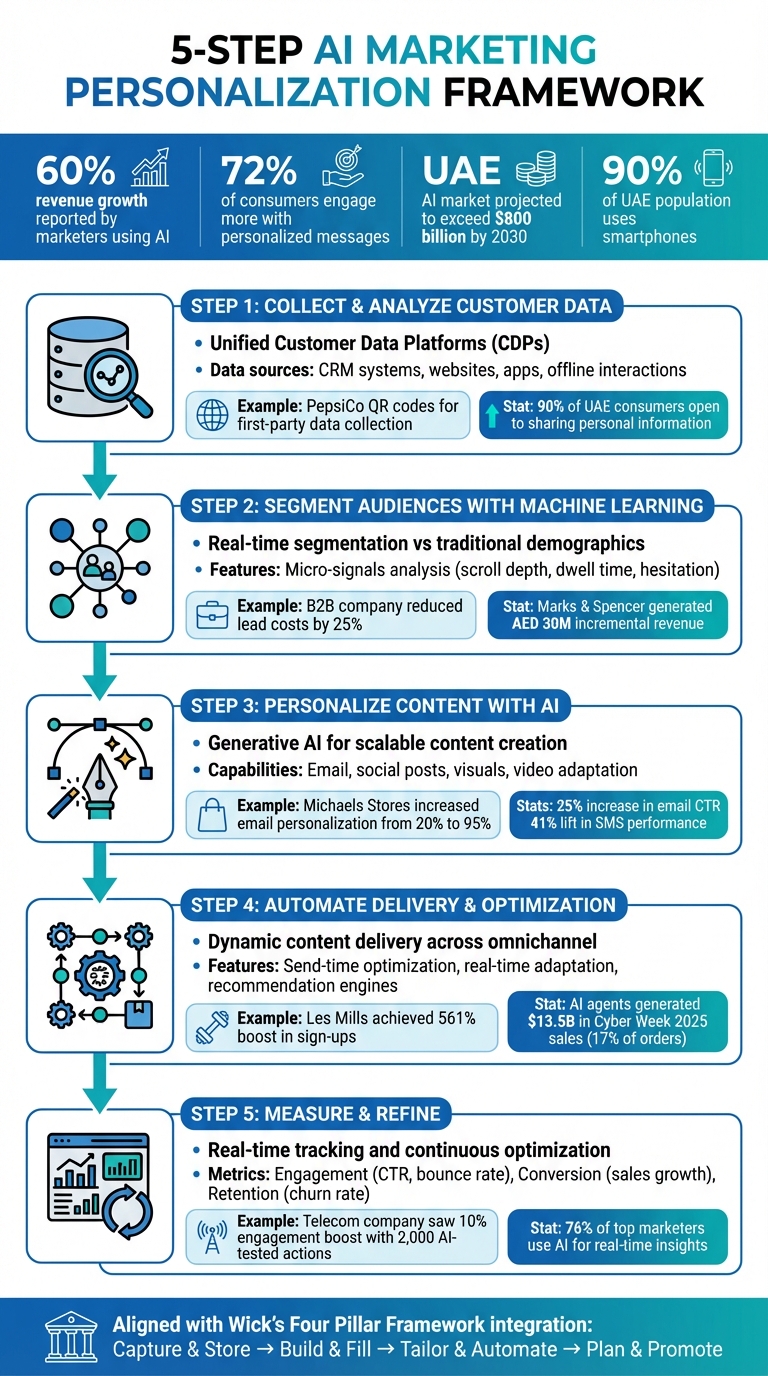
5-Step AI Marketing Personalization Framework for UAE Businesses
How to Use AI to Personalize Customer Marketing at Scale–Erika Heald
Step 1: Collect and Analyze Customer Data
AI personalisation begins with reliable, high-quality data - it’s the backbone of every decision. In the UAE, where 90% of consumers are open to sharing personal information to enhance their experiences, having strong data collection systems isn’t just helpful - it’s essential to staying competitive.
The tricky part? Bringing together scattered data. Most businesses have customer details spread across CRM systems, websites, apps, and even offline interactions. AI needs a single, clean source of truth to function properly. This is where Customer Data Platforms (CDPs) come in. These platforms pull together everything - purchase history, browsing habits, survey responses, and social media activity - into one unified system. This consolidated approach is the cornerstone of Wick's Capture & Store pillar, ensuring your data is organised, accessible, and ready for AI to process.
"First-party data is the fuel that AI uses to uncover unique insights and trends, identify valuable audiences, and help you better measure customer lifetime value." - Marie Gulin-Merle, Global VP of Ads Marketing, Google
Take PepsiCo's strategy in 2024 as an example. By adding QR codes to their packaging, they collected direct first-party data, turning one-off transactions into ongoing customer relationships. In the UAE, where digital ad spending is set to surpass AED 4.4 billion by 2025 (with 70% allocated to AI-driven programmatic channels), owning your customer data is no longer just a good idea - it’s a necessity.
Unified, high-quality data is the first step in creating a seamless customer journey powered by AI.
AI for Customer Journey Mapping
AI is especially skilled at mapping out every touchpoint a customer encounters - from their first visit to your website to post-purchase support. It tracks behaviour across multiple channels, uncovering patterns that manual analysis often misses. For example, AI can identify when a customer repeatedly compares products but hesitates at checkout, possibly due to price concerns or uncertainty. These insights allow businesses to address friction points and improve the customer’s path to purchase.
In early 2025, Ikea's AI assistant, under the guidance of Chief Data and Analytics Officer Francesco Marzoni, achieved a 20% conversion rate from AI-driven interactions to in-store visits. By analysing uploaded photos, room dimensions, personal style, and budget, the AI tailored furniture recommendations to each customer’s unique needs. This level of precision is only achievable with comprehensive, well-structured journey data.
Behavioural and Contextual Data Analysis
AI doesn’t just monitor what customers do - it also seeks to understand why they do it. By analysing micro-signals like scroll depth, dwell time, search adjustments, and moments of hesitation, AI can infer intent even before a customer explicitly states it. Add contextual elements like location, time of day, and device type, and you’ve got a system that adapts in real time to individual needs.
In November 2025, wellness brand Loftie, led by CEO Matthew Hassett, grew its "Loftie Rest" app to 15,000 subscribers. Their AI tapped into Apple Health data, tracked late-night screen usage, and analysed self-reported sleep quality to deliver personalised bedtime stories and sleep coaching. By combining behavioural and contextual data, they created highly relevant experiences that fuelled subscriber growth.
To make all this possible, clean and unified data is a must. Regularly update your datasets to eliminate duplicates and outdated information - AI’s accuracy depends entirely on the quality of the input. When your Capture & Store system is solid, every other step in your personalisation strategy becomes more effective.
Step 2: Segment Audiences with Machine Learning
Once your data is clean and unified, machine learning steps in to uncover patterns that would be impossible for humans to detect manually. Traditional audience segmentation often relies on broad categories like "Women 25–34" or "High Spenders", updated every so often. Machine learning, on the other hand, dives deep into thousands of micro-signals - like scroll depth, dwell time, on-site searches, and even hesitation moments - to create segments that evolve in real time.
The result? Continuously updating segments that shift with every click, swipe, or purchase. This transformation turns your unified data into dynamic, behaviour-driven groups that adapt to changing customer needs. It also lays the groundwork for more precise, data-driven customer engagement.
Take this example: In 2024, a B2B software company used its customer data platform to identify a "seed audience" of high-value prospects. By running this data through a predictive AI model, they created look-alike audiences, dramatically expanding their reach while cutting lead costs by 25%. This showcases how machine learning doesn’t just describe your audience - it predicts who is most likely to convert.
Real-Time Segmentation
Real-time segmentation takes audience targeting to the next level by instantly updating customer groups based on live actions. For instance, if a customer repeatedly explores a particular product category during a session, they can be flagged for targeted offers before they leave your site. This ability to update segments on the fly is critical for making the most of every customer interaction.
A great example comes from Marks & Spencer in 2025. Using mParticle's Customer Data Platform, they unified real-time data from mobile apps, websites, and in-store POS kiosks. Under the leadership of Alex Williams, Head of Online Trading & Growth, the company launched the "Free Basket Award" campaign. By sending personalised winner notifications at the point of sale, Marks & Spencer generated approximately AED 30 million in incremental yearly revenue and boosted CRM revenue by 17%.
"Our marketing team is being empowered to do and think differently. mParticle allows our teams to access real-time data and run tests across channels more easily, which has resulted in greater confidence leveraging data and a change in mindset." - Alex Williams, Head of Online Trading & Growth, Marks & Spencer
The key to this success lies in identity resolution - ensuring a customer is recognised consistently across devices and channels so their profile updates seamlessly. Without this, you risk working with fragmented data instead of cohesive customer profiles.
While real-time segmentation focuses on the present, predictive modelling looks ahead, helping you anticipate future customer actions and stay one step ahead.
Predictive and Historical Data Modelling
Machine learning doesn’t just react to what customers do - it also predicts what they’ll do next. By analysing historical data, these models assign scores that indicate the likelihood of specific outcomes, such as conversion, churn risk, or potential lifetime value. This allows businesses to spot warning signs early and take action before losing a customer.
Collaborative filtering also plays a key role by grouping users with similar behaviours into highly relevant clusters. For example, if two customers linger on the same product categories and abandon similar items, AI might determine that they’ll respond to the same offers - even if their demographics differ.
In 2024, fitness brand Les Mills ran a four-week test using Google's AI-powered Demand Gen campaigns to attract new subscribers. By focusing on visual storytelling and predictive intent, they achieved a 561% increase in sign-ups while reducing the cost per trial by 72%. Similarly, Vans used Performance Max to create personalised journeys for diverse groups, from skateboarders to parents, leading to a 46% increase in conversions and an 86% sales lift.
| Feature | Traditional | AI-Driven |
|---|---|---|
| Data Basis | Static demographics | Real-time micro-signals & intent |
| Update Frequency | Periodic | Continuous |
| Logic | Manual rules | ML algorithms |
| Granularity | Broad groups | Micro-segments |
| Primary Goal | Reach | Precision & Prediction |
Marketing leaders who adopt AI-driven segmentation report 60% higher revenue growth than their peers, yet only 20% of companies have successfully integrated real-time, AI-powered segmentation into their strategies. The gap is wide, but so is the potential for growth. With these insights, marketers can seamlessly integrate evolving segments into automated, tailored strategies designed for maximum impact.
Step 3: Personalise Content with AI
Once you've segmented your audience, the next hurdle is delivering messaging, visuals, and formats that truly connect with each group. This is where AI steps up, transforming raw data into personalised, scalable experiences.
Here's the reality: 71% of consumers want personalised content, yet 67% feel frustrated when brands miss the mark, and 72% only engage with messages that align with their interests. The gap between what customers expect and what they get has been a challenge - but AI is rapidly narrowing that divide.
Generative AI for Content Creation
Generative AI eliminates the bottleneck of manually creating content by producing countless variations of messaging - whether it's email subject lines, social media posts, website copy, or even visuals. Instead of crafting one generic campaign, marketers can now deploy dozens of micro-campaigns, each tailored to factors like regional language, browsing habits, or purchase behaviour.
Take Michaels Stores, for example. In March 2022, they adopted a generative AI platform to improve customer engagement. By boosting email personalisation from 20% to 95%, they achieved a 25% increase in email click-through rates and a 41% lift in SMS campaign performance. The AI analysed customer demographics and preferences, crafting messages that felt uniquely tailored to each recipient.
AI doesn't stop at text - it also customises visuals. It can adjust website layouts, product images, and even video formats to suit individual preferences. For instance, AI can edit videos by trimming content, adding captions, resizing for different platforms, or dubbing in regional dialects - all without human intervention. This capability lets brands scale their creative efforts while staying relevant to diverse audiences.
But AI's work doesn’t end once the content is created. It continuously refines and adapts messaging to align with changing user profiles.
Align Content with Customer Profiles
AI goes beyond simply creating more content; it ensures the content is tailored to the right person at the right time. By analysing real-time user behaviour - like scroll depth, dwell time, search patterns, or moments of hesitation - AI fine-tunes messaging style, tone, and format. For example, a traveller exploring retreat options might see phrases like "calm mornings", while someone looking for nightlife sees "vibrant neighbourhoods."
This level of personalisation relies on "intelligent content" - structured, metadata-rich assets that AI can reassemble dynamically across platforms and audiences. Instead of building separate campaigns for emails, social media, and websites, brands can create modular content pieces that AI adapts in real time based on user behaviour.
In June 2024, Carrefour partnered with Google Cloud to develop an AI-powered creative studio. This tool, trained on Carrefour’s brand guidelines and historical campaigns, generated first drafts of marketing materials in minutes, cutting down production time significantly. Despite AI’s efficiency, human oversight remained crucial. As Drew Panayiotou, Pfizer’s Global CMO, put it:
"The role of humans is not going away any time soon... generative AI can significantly increase the quantity and variety of marketing content 'stimuli' - and marketers still have a very important role in reviewing and optimising it."
This hybrid approach - where AI handles high-volume production and humans ensure quality - balances speed, creativity, and brand consistency. It also helps mitigate AI’s potential pitfalls, like unintentional biases or inaccuracies.
For brands using Wick's Four Pillar Framework, this step aligns with the Build & Fill pillar. Generative AI ensures that websites, social channels, and email campaigns are consistently filled with fresh, relevant content that resonates with different audience segments. By integrating AI into content workflows, businesses can deliver personalised messaging without overwhelming their teams.
| Traditional Content Creation | AI-Driven Content Creation |
|---|---|
| Manual copywriting for broad audiences | Automated, tailored copy for specific segments |
| Static visuals and layouts | Dynamic, user-specific visuals and formats |
| Campaigns take weeks to launch | Campaigns ready in days or hours |
| Limited message variations | Thousands of personalised variations |
| Broad, generic messaging | Hyper-targeted, customised messaging |
AI-driven personalisation doesn’t just save time - it delivers results. Personalised campaigns can reduce customer acquisition costs by up to 50%, while tailored product recommendations can drive a 3% to 5% revenue increase. With the right tools, brands can meet customer expectations for personalised experiences - without compromising on speed or scale.
sbb-itb-058f46d
Step 4: Automate Delivery and Optimisation
Delivering personalised content is only part of the equation. The other half? Ensuring the message reaches the right person at the perfect moment across all channels. This is where AI-powered automation steps in, turning marketing from a reactive process into a predictive powerhouse. It ensures that messages are not only relevant but also delivered at precisely the right time.
Automated journey orchestration uses AI to trigger messages based on specific customer behaviours, like abandoning a shopping cart or being inactive for an extended period. It also adjusts the frequency of these messages by analysing engagement levels and signs of fatigue. This approach can lead to a 10% to 15% increase in revenue, as it tailors the customer experience using real-time insights. Instead of relying on scheduled email campaigns, brands can now deliver messages that align with actual customer interactions. But that’s just the beginning - dynamic delivery takes this predictive approach even further.
Dynamic Content Delivery
AI doesn’t just observe; it adapts. Dynamic content delivery modifies elements like landing pages, calls-to-action, and layouts in real time by analysing micro-signals such as how far a user scrolls, how long they linger, or even moments of hesitation. For example, if a user seems ready to abandon their cart, AI can instantly display a free shipping offer. Or, if someone spends extra time browsing a specific category, the system can swap in tailored product recommendations to keep them engaged.
Take Les Mills, the global fitness brand, as an example. In June 2024, they used Google’s Demand Gen AI-powered campaigns to automate their visual storytelling across multiple platforms. Over just four weeks, their campaign achieved a 561% boost in sign-ups and a 72% more efficient cost per trial compared to their previous manual methods. The AI analysed user behaviour across channels, fine-tuning creative content and delivery timing to maximise engagement.
This adaptability isn’t limited to websites. Omnichannel personalisation ensures that messaging remains consistent across fragmented customer journeys, syncing communications across email, SMS, social media ads, and mobile apps. Since 76% of customers prefer different communication channels depending on the context, AI doesn’t just decide what to say - it determines where to say it. For instance, a mobile shopper might receive an SMS reminder, while someone checking their email at night could get a detailed product comparison. Along with these dynamic adjustments, recommendation engines play a critical role in refining customer choices.
Recommendation Engines
Recommendation engines simplify decision-making by presenting the most relevant options, using two key techniques: collaborative filtering and content-based filtering. Collaborative filtering identifies patterns among similar users, while content-based filtering focuses on product attributes that align with a customer’s past preferences. The most advanced systems combine these methods with real-time data, such as the time of day, the device being used, or the customer’s current browsing habits.
Research shows that 78% of customers are more likely to return to brands offering personalised experiences. During Cyber Week 2025, AI agents were responsible for about 17% of online orders, generating a massive $13.5 billion in sales. These systems don’t just recommend products - they anticipate customer intent before it’s even expressed, allowing brands to proactively adjust their content and offers.
Aligned with Wick’s Four Pillar Framework, the Tailor & Automate pillar leverages these AI tools to deliver precise, timely messaging. By integrating AI-driven automation into marketing workflows, brands can create consistent, personalised experiences across all customer touchpoints. This also frees up marketing teams to focus on strategy rather than repetitive tasks. On average, automation saves marketers 2.3 hours per campaign, and 71% of employees believe generative AI will eliminate time-consuming manual work, enabling them to concentrate on higher-impact initiatives.
| Manual Delivery | AI-Automated Delivery |
|---|---|
| Scheduled email blasts at fixed times | Send-time optimisation based on individual engagement patterns |
| Static landing pages for all visitors | Dynamic content that adapts while users browse |
| Generic product recommendations | Predictive suggestions based on behaviour and context |
| Separate campaigns for each channel | Omnichannel orchestration with consistent messaging |
| Reacting to customer actions | Proactive interventions based on intent signals |
This shift from manual to automated delivery isn’t about replacing human creativity - it’s about scaling personalisation to levels no team could achieve on their own. AI takes care of the intricate, real-time decision-making involved in managing thousands of customer interactions, while marketers focus on setting strategies and refining the system using performance data. It’s a partnership that combines the best of human insight with the precision of AI.
Step 5: Measure and Refine Marketing Frameworks with AI
To make automation effective, tracking real-time data is key. Monitoring micro-signals as they happen allows marketers to tweak campaigns on the fly. This approach ensures budgets, assets, and messages can be adjusted during a campaign to maximise impact.
Take this example: 76% of top marketers use AI to extract real-time insights by analysing campaign, creative, and customer data automatically. In 2024, a North American retailer shifted from broad discounting to AI-driven personalised offers. The AI not only tracked campaign performance but also predicted which customers were most likely to respond to specific deals. This approach helped protect profit margins while boosting sales. Such instant feedback creates a foundation for identifying key metrics that keep campaigns optimised as they progress.
Key Metrics for Personalisation Success
Once you have real-time data, the next step is focusing on the right performance indicators. The metrics you choose should align with your goals. For instance:
- Engagement metrics like click-through rates (CTR), time spent on site, and bounce rates show how well your content connects with users.
- Conversion metrics such as add-to-cart rates and overall sales growth measure how effectively AI nudges lead to purchases.
- Retention metrics like churn rate, repeat purchase rate, and recommendation acceptance rates gauge customer loyalty over time.
In the UAE, where B2B and B2C markets differ in price sensitivity and decision-making speed, metrics should reflect these differences. B2B campaigns might prioritise lead nurturing and qualified leads, while B2C strategies often focus on reach and quick conversions.
For a deeper understanding of performance, advanced methods like Marketing Mix Modelling (MMM) provide a complete view of results across all channels - digital, offline, and even TV. Incrementality testing, on the other hand, acts like a "postgame analysis", using AI to identify which ads or media buys directly drove sales. In 2025, an OTT media company investing US$500 million annually used AI-powered MMMs to fine-tune both brand and performance strategies, improving marketing efficiency by 20%.
AI for Performance Tracking and A/B Testing
AI also plays a big role in speeding up testing and optimisation. Following Wick's Plan & Promote framework, "always-on" testing helps brands respond to trends twice as quickly. In 2024, a European telecommunications company introduced a personalisation engine powered by machine learning. By testing 2,000 different actions with generative AI-enhanced messaging, they saw a 10% boost in customer engagement compared to non-personalised campaigns. AI also reduced analysis time from eight hours to just 30 minutes, giving marketing teams more time to focus on strategy.
AI-driven optimisation now dynamically shifts budgets based on forecasts to maximise return on ad spend (ROAS) across Search, Display, and Social channels. This creates a powerful "marketer-AI flywheel", where AI predicts trends and suggests real-time changes, while marketers focus on shaping the overall strategy and goals. Notably, 80% of senior marketing analysts report that applying insights from incrementality experiments significantly boosts revenue growth.
Integrate AI into Wick's Four Pillar Framework
Wick's Four Pillar Framework is designed as a seamless system that connects media planning, creative development, activation, and measurement to maximise ROI. AI isn’t confined to a single function here - it drives every step, from predicting audience behaviour to customising assets for specific platforms.
In the Measurement and Insights pillar, AI shifts the focus from analysing past performance to forecasting future opportunities. Instead of just reviewing last quarter's campaign results, the framework leverages first-party data to predict customer lifetime value and pinpoint high-value audiences - even before they make a purchase. The Media and Personalisation pillar acts as a real-time optimisation tool, using automated bidding and solutions like Performance Max to match the right ad with the right person at the right time. Over in the Creative and Content pillar, generative AI steps in to handle tasks like resizing, formatting, and creating thousands of tailored asset variations for different audience segments - eliminating the need for manual adjustments. Finally, the Integration and Culture pillar ensures the entire system works smoothly by aligning teams across finance, legal, IT, and HR. This alignment moves AI from small-scale pilots to fully integrated, scalable programmes.
This framework is particularly valuable for businesses in the UAE, where the market is shaped by over 200 nationalities and diverse customer needs. AI's ability to personalise at scale is a game-changer in such a multicultural environment. By analysing micro-signals like scroll depth, dwell time, and on-site search patterns, AI detects customer intent early and adapts experiences in real time. With 81% of UAE businesses already defining clear AI strategies and 60% appointing dedicated AI leaders, this framework aligns perfectly with the nation's drive towards AI-powered innovation and governance.
By embedding scalable AI solutions into this framework, businesses in the UAE can address their unique challenges while staying ahead in a competitive market.
Scalable AI Solutions for Businesses
To complement this integrated framework, Wick offers scalable AI solutions tailored to businesses of different sizes and growth stages. The pricing structure reflects the level of AI adoption and maturity within your organisation.
- The Basic plan is ideal for businesses just starting with AI. It includes off-the-shelf solutions and built-in AI tools within ad platforms, allowing companies to test AI-powered campaigns alongside manual ones.
- The Advanced plan is designed for mid-sized businesses ready to expand. It introduces predictive AI for outcome forecasting, automated budget allocation across channels, and custom creative studios.
- The Enterprise plan is geared towards large organisations. It offers an integrated "marketer-AI flywheel", enabling real-time, one-to-one messaging at scale and fostering deep cross-functional collaboration.
For example, in 2024, the footwear brand Vans used Performance Max to craft personalised customer journeys for a wide range of audiences, from skateboarders to parents. This strategy led to a 46% increase in conversions and an 86% boost in sales compared to their previous shopping solutions. These results highlight how scalable AI solutions can adapt to different business needs, whether the goal is protecting profit margins or accelerating growth.
Conclusion
AI has completely reshaped how businesses approach marketing. Instead of relying on broad, one-size-fits-all campaigns, companies now use personalised marketing strategies that predict customer needs, customise experiences, and improve performance in real time. For businesses in the UAE - where the market is expected to surpass US$800 billion by 2030 - this shift isn’t just useful; it’s critical for staying ahead in a competitive landscape.
The numbers speak for themselves: marketing leaders who fully integrate AI into their operations see 60% higher revenue growth compared to others. Additionally, 72% of consumers engage only with content tailored to their interests, and 78% are more likely to remain loyal to brands that offer personalised experiences. In a region with diverse customer expectations, the ability of AI to scale personalisation is what sets successful businesses apart from the rest.
As Marie Gulin-Merle, Google’s Global VP of Ads Marketing, puts it:
"AI can transform measurement's role in your marketing, helping you go from analyzing historical trends to acting on predictive insights and enabling outcome-based marketing."
Wick’s Four Pillar Framework aligns perfectly with this approach. By embedding AI at every stage - from predictive audience insights and automated media optimisation to generative content creation and real-time performance tracking - it ensures businesses can scale their strategies regardless of size or complexity.
To stay ahead, businesses should focus on prioritising first-party data, building cross-departmental support, and testing strategies before scaling them. In a region where consumers increasingly tune out generic ads and expect brands to understand their preferences, AI-driven personalisation isn’t just a strategy - it’s the key to long-term growth. By integrating AI across every aspect of your marketing, you can ensure your business stays innovative and competitive in a rapidly evolving market.
FAQs
How does AI improve customer data collection for marketing in the UAE?
AI is transforming how businesses in the UAE collect and use customer data. Every digital interaction - whether it’s a website visit, app usage, email click, or social media activity - can now be turned into actionable insights. Using advanced algorithms, this data is analysed in real-time and enriched with demographic, behavioural, and multilingual attributes (Arabic/English). The result? Detailed customer profiles that reflect the UAE’s diverse population, enabling businesses to craft marketing strategies that truly connect with their audience.
AI-powered tools take it a step further by simplifying data management. They consolidate information from multiple channels, break down silos, and create precise audience segments. Predictive models fine-tune this data, improving forecast accuracy and helping marketers stay ahead of customer needs. For key moments in the UAE, like Ramadan or National Day, generative AI offers personalised recommendations and sentiment analysis, ensuring campaigns resonate deeply with local audiences.
At Wick, these AI-driven capabilities are part of a Four-Pillar Framework that integrates website analytics, SEO, content performance, and marketing automation. This cohesive approach empowers UAE businesses to optimise customer-focused strategies while staying compliant with local data privacy regulations.
How does machine learning enable real-time audience segmentation?
Machine learning takes audience segmentation to the next level by continuously analysing user behaviour and predictive signals in real time. It doesn’t just stop at identifying audience segments - it keeps updating micro-segments automatically, ensuring businesses can send highly tailored messages as users engage.
This dynamic method gives marketers the ability to adjust their strategies on the fly, creating content that aligns with shifting customer needs and preferences. The result? Better engagement and deeper, more meaningful connections with the audience.
How can businesses ensure AI-generated content stays true to their brand identity?
To make sure AI-generated content reflects your brand accurately, start by developing a detailed style guide. This guide should outline your tone of voice, key messages, preferred terminology, and visual identity. Use these guidelines as prompts for the AI system to ensure consistency across all types of content, whether it's a social media post or an email campaign.
A human review process plays a critical role in maintaining quality. By comparing AI-generated content with your brand standards, you can identify and correct any mismatches. These corrections can then be used to improve the AI’s performance over time. Additionally, incorporating brand-specific language into the AI’s training data or fine-tuning the model can further refine its accuracy.
In the UAE, where multilingual communication is essential, AI tools with localisation features are incredibly useful. They help ensure your brand stays consistent across English, Arabic, and other regional languages. Wick’s Four Pillar Framework combines these strategies, ensuring that every piece of content aligns with your brand identity while taking advantage of AI-driven personalisation and automation to achieve the best results.