

Blog / Arabic vs. English in GCC Marketing: What Works
Arabic vs. English in GCC Marketing: What Works
Want to connect with GCC audiences effectively? Use the right language.
Arabic resonates deeply with local communities, while English dominates professional and expat communication. Each language offers unique strengths across platforms and industries:
- Arabic: Best for emotional connections, cultural relevance, and higher conversion rates (2.3x more effective). Ideal for social media (TikTok, Instagram) and local audiences.
- English: Essential for professional contexts, global reach, and expat-heavy industries like tech and finance. Performs well on LinkedIn and Google Search.
A bilingual strategy often works best, as 67% of Middle Eastern consumers engage with both languages. Tailor your campaigns based on audience, platform, and goals to maximize impact.
| Language | Strengths | Best Use Cases |
|---|---|---|
| Arabic | High conversions, emotional appeal | Local audiences, social media, events |
| English | Broader reach, professional credibility | Expat audiences, B2B, global industries |
Key takeaway: Align your language choice with your audience and platform for better engagement and results.
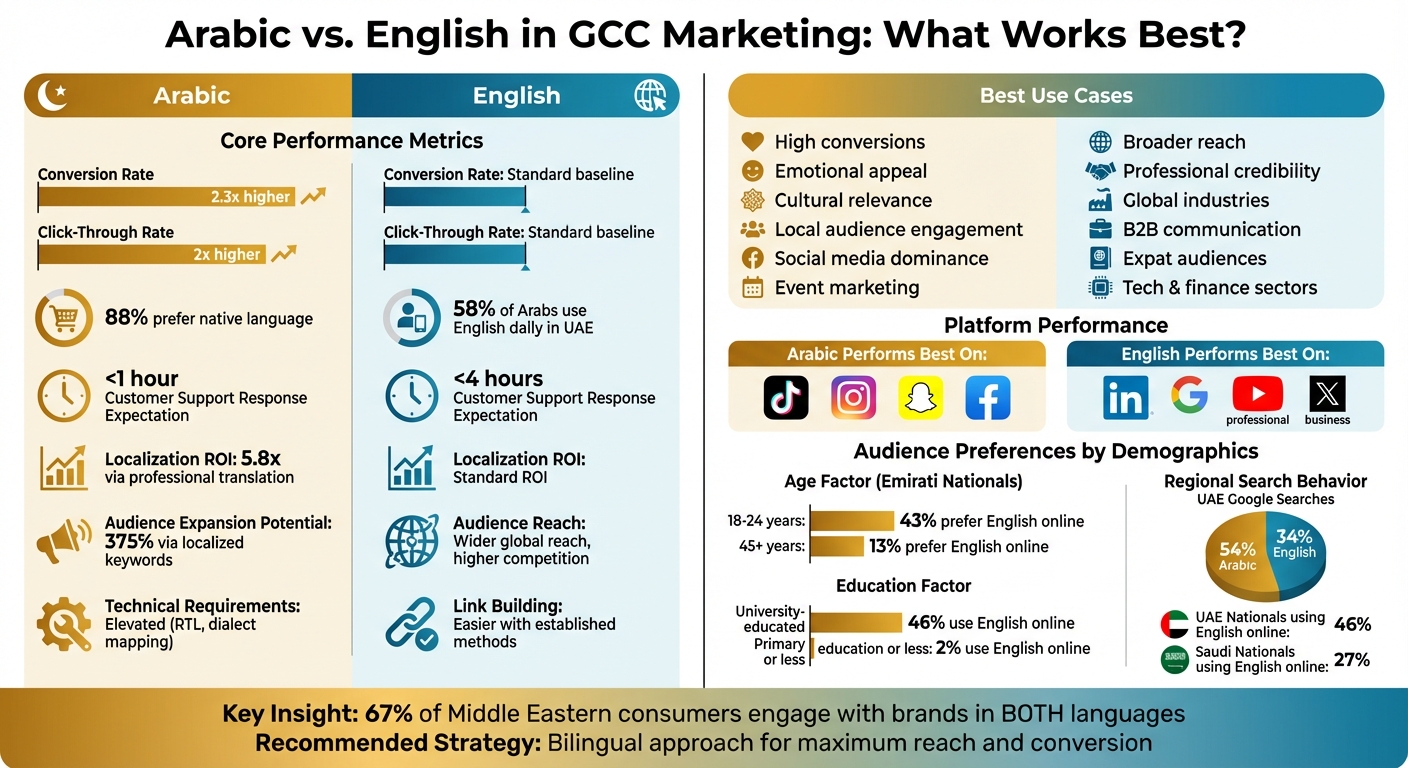
Arabic vs English Marketing Performance in GCC: Key Metrics Comparison
GCC Audience Language Preferences
How Culture Affects Language Choice
Arabic plays a central role in the identity of GCC nations, deeply embedded in government, literature, and cultural traditions. It holds emotional significance and reinforces trust, especially when engaging with local communities or implementing initiatives that resonate on a personal level. On the other hand, English dominates business and technology discussions among the expatriate majority, offering a practical and globally accessible medium. In bustling urban hubs like Dubai and Abu Dhabi, English is the go-to language for professional settings, while Arabic takes precedence in smaller towns and personal interactions. These cultural nuances directly influence language preferences, as explored in the next section.
Language Preferences by Audience Segment
Cultural factors strongly shape language preferences, which in turn affect marketing strategies and outcomes. Native Emiratis naturally gravitate toward Arabic content, while the expatriate majority leans on English or their native languages, such as Hindi, Urdu, and Tagalog.
For instance, 43% of 18–24-year-old Emirati nationals prefer using the internet in English, compared to only 13% of those aged 45 and older. Education also plays a role: university-educated nationals (46%) are far more likely to use English online than those with primary education or less (2%). Gender differences are slight but notable, with 33% of men browsing in English compared to 28% of women.
| Audience Segment | Language Preference | Primary Use Case |
|---|---|---|
| Native Emiratis | Arabic (Gulf Dialect) | Government, Culture, Family |
| Expatriates (Western) | English | Business, Social, Tech |
| Expatriates (South Asian) | English / Native Dialects | Business, Community |
| Youth (18–24) | Bilingual / English-leaning | Social Media, Tech, Entertainment |
| Seniors (45+) | Arabic | News, Official Communication |
| B2B Professionals | English / Arabic | Relationship Building, Technical Communication |
Language usage also varies by industry. High-tech businesses, digital marketing agencies, and international operations heavily depend on English. Meanwhile, Arabic is essential in sectors like government, healthcare, airports, and community-focused organisations, where it meets legal requirements and aligns with cultural expectations. Interestingly, 46% of UAE nationals report using English online, a figure that drops to 27% in Saudi Arabia.
Marketing Performance: Arabic vs. English
Engagement Rates by Language
Content in a native language performs significantly better, converting 2.3 times more effectively and doubling click-through rates on visual platforms like Instagram, TikTok, and Snapchat. This effect is even stronger when using the Khaleeji dialect, which feels more relatable compared to the more formal Modern Standard Arabic.
However, in the UAE's multicultural environment, the difference in performance is less stark. With 58% of Arabs using English daily, the preference for English is evident, especially for professional contexts. Still, language plays a crucial role in consumer behaviour - 56.2% of consumers prioritise receiving information in their native language over price. This aligns with platform-specific trends: TikTok and Instagram thrive on Arabic storytelling, while English dominates LinkedIn and Google Search for professional and informational needs.
These engagement patterns naturally raise the question of how localisation influences conversion rates.
Conversion Rates and Localisation
Localised Arabic campaigns have proven to deliver impressive results. For instance, between early and mid-2025, Luxury Abaya Co., based in Dubai, ran Arabic product videos with English subtitles alongside separate Google Ads campaigns tailored for Arab and expat audiences. This strategy resulted in a 320% revenue increase within six months. The success lay in aligning language expectations with landing page content, reducing bounce rates and improving user experience.
Another example comes from a Saudi e-commerce platform that replaced generic English-translated navigation terms with localised Arabic keywords. This adjustment expanded their audience by 375%. The change required a nuanced understanding of Arabic search habits, such as omitting the Hamza character, which is a common practice. Broader data supports this trend: localised campaigns can boost conversion rates by up to 75%, and 68% of consumers would switch brands if native-language support were available.
Interestingly, response times also differ by language. Arabic-speaking customers expect replies within one hour, compared to four hours for English queries. This faster response requirement directly influences customer satisfaction and, ultimately, conversion rates. Localisation is not just about creating new content - it’s also about maximising existing resources. For example, repurposing English content through professional translation yields 5.8 times higher ROI compared to creating entirely new English material.
Marketing Metrics Comparison Table
Arabic content drives stronger local engagement, while English offers broader global reach. Here's how they compare:
| Metric | Arabic Content | English Content |
|---|---|---|
| Conversion Rate | 2.3x higher | Standard rate |
| Click-Through Rate | ~2x higher | Standard rate |
| Consumer Purchase Preference | 88% prefer native language | Preferred by 58% of UAE Arabs daily |
| Customer Support Response Expectation | <1 hour | <4 hours |
| Localisation ROI | 5.8x via professional translation | Standard ROI |
| Potential Audience Expansion | 375% via localised keywords | Wider reach, higher competition |
Arabic content excels in fostering deeper connections and driving conversions, while English remains the go-to for reaching a broader audience. For instance, 57.1% of Saudi users rely on social media for product research, favouring Arabic influencer content. Meanwhile, in the UAE, 46.4% of consumers lean on search engines, where English dominates. These regional differences highlight the importance of tailored strategies rather than a one-size-fits-all approach for the GCC market.
SEO Performance: Arabic vs. English
Arabic SEO: Benefits and Obstacles
Arabic SEO presents a unique chance for brands ready to invest in proper localisation. Despite Arabic being the 4th most used language online, it makes up less than 1% of total web content. This scarcity creates a golden opportunity - ranking for high-volume Arabic keywords is often easier than in English, especially across many industries.
"Arabic is the 4th most used language online, [but] there is less than 1% content in Arabic online. This is an open door to creating attractive, relevant content." - Ammar Badr, Digital Marketing Consultant, RBBi
That said, Arabic SEO comes with its own set of challenges. Websites need to support Right-to-Left (RTL) layouts, ensure accurate hreflang tagging, and address differences in dialects. Spelling variations also play a major role in search behaviour. For instance, many users skip the Hamza character on the letter Alef, leading to multiple search results for the same word. Regional dialects complicate things further - what’s called “Arabaya” (car) in Egypt is “Syarra” in Saudi Arabia.
Building backlinks for Arabic sites is another hurdle. The Middle East has a limited culture of linking, and weaker copyright enforcement means content is often reused without proper attribution. On the bright side, Arabic websites can rank well with fewer backlinks compared to English ones, thanks to the lower competition.
English SEO: Wider Reach, More Competition
While Arabic SEO thrives on low competition, English SEO benefits from its broad global reach. It’s particularly effective in the UAE, where it connects brands with the country’s large expat population and international audiences. English is crucial for B2B industries, professional services, and platforms like LinkedIn, where it dominates informational and networking searches.
However, the trade-off is intense competition. Every keyword battle pits you against well-established players with strong link profiles and massive content libraries. While English SEO provides access to a wider audience, it demands more resources to achieve visibility and often delivers lower conversion rates among local Arab users compared to Arabic content.
SEO Performance Comparison Table
| Factor | Arabic SEO | English SEO |
|---|---|---|
| Competition Level | Low; many niches untapped | High; global and regional competition |
| Search Volume | Lower, but highly targeted | Higher; reaches expats and locals |
| Conversion Rate | 2.3x higher for Arabic | Moderate; better for international/B2B |
| Technical Requirements | Elevated (RTL, dialect mapping, hreflang) | Standard (LTR, established tools) |
| Link Building Difficulty | Challenging; fewer sites link out | Easier; established guest posting/PR |
| Content Availability | <1% of web content | Saturated in most niches |
| Keyword Tool Accuracy | Limited availability | Extensive and highly accurate |
In the UAE, 54% of Google searches are conducted in Arabic, while 34% are in English. This bilingual split highlights why many successful brands in the GCC adopt dual-language strategies instead of choosing one over the other. By understanding these SEO dynamics, brands can effectively combine both languages to maximise reach and impact.
sbb-itb-058f46d
Choosing the Right Language Strategy
Selecting the best language strategy means aligning your choice of language with your audience, industry, and goals. It’s about understanding who you’re speaking to, where they are, and what message you want to convey.
When to Use Arabic
Arabic plays a key role in government communications, legal requirements, and official documents across the GCC. It’s also unmatched when it comes to connecting with local citizens on an emotional level, especially during key cultural events like Ramadan, Eid, and National Days.
Take, for example, Unilever’s brand Comfort. In September 2024, they celebrated the 94th Saudi National Day by creating the "World's Largest Saudi National Day Logo" in Jeddah, using 125,000 fresh flowers over 94 square metres. The entire campaign was conducted in Arabic to create a meaningful connection with the local audience. This approach worked because Arabic content resonates deeply, converting 2.3 times better among local audiences compared to English.
Geography also plays a role. Countries like Saudi Arabia, Kuwait, and Oman lean heavily on Arabic, especially outside major cities. If your target audience includes older demographics, local retail customers, or services catering to nationals, Arabic should be your go-to language. Social media platforms like Snapchat, TikTok, and Facebook also see higher engagement rates with Arabic content.
To make your message even more authentic, consider using the Khaleeji dialect. It’s a powerful way to connect with local audiences, as consumers often prioritise receiving information in their own language.
When to Use English
While Arabic fosters trust and cultural connection, English is essential for reaching global and professional audiences.
English dominates industries like finance, technology, and B2B, serving as the primary language for business and communication in the UAE, where expatriates make up 88% of the population. For brands based in Dubai, targeting international tourists, Western professionals, or younger, tech-savvy locals, English is a must. Platforms like LinkedIn, X (Twitter), and professional YouTube channels perform far better with English content.
If you’re launching a SaaS product, fintech service, or luxury brand with global appeal, English provides the modern standard that aligns with your audience’s expectations. Timing also matters - English email campaigns scheduled at 10 AM during office hours tend to see the highest engagement rates.
Using Both Languages Together
Combining Arabic and English allows you to tap into the strengths of both languages. In fact, 67% of Middle Eastern consumers interact with brands in both languages. This isn’t just a smart approach - it’s often necessary to fully engage your audience.
A great example of this is The Luxury Abaya Co., a Dubai-based brand that saw a 320% revenue increase in just six months. They achieved this by creating Arabic product videos with English subtitles and running separate Google Ads campaigns for Arab and expat audiences. This dual-language strategy worked because 42% of UAE Arabs prefer Arabic content, while 58% use English daily.
To make the most of this approach, keep your campaigns separate for each language. This allows you to track performance more accurately and tailor your messaging to each audience. Also, ensure that your landing page matches the language of your ad - mismatches can lead to high bounce rates.
| Scenario | Recommended Language | Reason |
|---|---|---|
| Government & Official | Arabic | Legal requirement and cultural formality |
| Tech, Finance & B2B | English | Industry standard for global business |
| Ramadan & National Day | Arabic | Strong cultural connection |
| Expat Targeting | English | Main language for over 200 nationalities |
| E-commerce & Airlines | Bilingual | Appeals to both local and international buyers |
When working with Arabic, avoid relying on machine translation. Automated tools often miss cultural nuances, proper tone, and right-to-left formatting. Instead, invest in native speakers who understand local idioms and can adapt your message effectively. For instance, when Nike launched the Pro Hijab, they featured Middle Eastern athletes and created tailored Arabic content and visuals. This approach earned them significant social media engagement and loyalty among Muslim women.
Key Takeaways
When it comes to marketing in the GCC, understanding the role of language is crucial. Arabic plays a key role in building trust and driving conversions, with localised Arabic content increasing conversion rates by up to 75%. On the other hand, English helps brands connect with global markets and the region’s diverse expatriate population, particularly in industries like tech, finance, and B2B.
Interestingly, 76% of online shoppers prefer websites in their local language, even though Arabic accounts for less than 1% of all web content. This highlights a massive opportunity for brands willing to invest in well-crafted Arabic content. At the same time, many consumers in the region engage in both languages, making a bilingual approach highly effective.
Arabic tends to perform better on platforms like Snapchat, TikTok, and Twitter, while English takes the lead on LinkedIn and YouTube. In Saudi Arabia, social media plays a major role in product research, with 57.1% of consumers using these platforms to explore options. Meanwhile, in the UAE, search engines are the go-to tool for product discovery.
As discussed earlier, successful brands make data-driven decisions by tracking language-specific metrics, steering clear of machine translation, and aligning campaigns with key cultural events such as Ramadan and National Days. This strategic approach ensures that your message resonates with the right audience.
FAQs
How does using both Arabic and English enhance marketing in the GCC?
Using both Arabic and English in marketing across the GCC region can make your campaigns far more impactful by catering to its diverse audience. Arabic connects deeply with the local population, while English appeals to the expatriate community and remains the dominant language in business and digital spaces. In the UAE, where Arabic is the official language and English is widely spoken, blending the two ensures your message resonates with a wider audience.
This bilingual strategy doesn’t just broaden your reach - it enhances engagement and builds trust. Studies show people are more likely to engage with content presented in their native language. Crafting Arabic content that reflects local nuances, rather than relying on direct translations, strengthens credibility and avoids potential misunderstandings. Plus, using both languages opens up opportunities for A/B testing on platforms like Meta and Google, enabling businesses to fine-tune their campaigns based on what works best for different audiences.
By combining Arabic and English thoughtfully, businesses can connect with various communities, improve conversion rates, and deliver marketing that feels relevant and effective.
How do I decide between Arabic and English for marketing campaigns in the GCC?
Choosing the right language for your marketing campaign in the GCC involves considering a few important aspects:
- Audience and context: While Arabic is the official language across the Gulf, English dominates in business, technology, and among the expatriate community. Your choice should depend on who you're speaking to - Emiratis or expats - and the medium you're using, whether it's social media, mall advertisements, or digital platforms.
- Cultural relevance: Gulf Arabic, or Khaleeji, is quite different from other Arabic dialects and Modern Standard Arabic. Incorporating local phrases, culturally relevant visuals, and humour can make your message more relatable. For English content, maintaining a professional tone that aligns with regional norms is key.
- Platform and trust: In the UAE, bilingual communication is often expected, particularly for high-end services or government-related content. Arabic tends to convey trust and prestige, while English works well for brands targeting tech-savvy or internationally-minded consumers.
By carefully balancing these factors, you can craft messages that resonate with the GCC's diverse audience.
How do language preferences differ among various demographic groups in the GCC?
Language preferences in the GCC reflect the region's diverse population, with distinct differences between locals and expatriates. While Arabic holds the status of the official language, English takes centre stage in business, technology, and communication among expatriates. In the UAE, where Emiratis account for about 13% of the population and expatriates exceed 80%, English often acts as the bridge for everyday conversations.
For Emirati nationals, Arabic remains the go-to choice for formal communication, traditional media, and content that resonates with their cultural heritage - particularly among older generations. On the other hand, younger Emiratis tend to navigate seamlessly between Arabic and English, especially on digital platforms. Expatriates, whether from South Asia, Europe, or other regions, overwhelmingly depend on English. It serves as the shared language across workplaces, public spaces, and social interactions.
When it comes to marketing in the GCC, brands need to adapt their messaging to the audience. Arabic is ideal when aiming to connect with locals, while English appeals more to the expatriate community. For digital platforms, providing bilingual or even multilingual options can help brands expand their reach and foster a sense of inclusivity.