

Blog / Bahrain PDPL: Impact on GCC Businesses
Bahrain PDPL: Impact on GCC Businesses
Bahrain’s Personal Data Protection Law (PDPL) sets strict rules for handling personal data, impacting businesses in Bahrain and the GCC. The law, effective since August 2019, requires explicit consent for data processing, mandates breach notifications within 72 hours, and enforces penalties for violations, including fines up to BHD 20,000 (AED 194,000) and imprisonment for severe breaches. Key points include:
- Applicability: Covers Bahraini entities and foreign businesses processing data in Bahrain.
- Cross-Border Data Transfers: Simplified by an "Adequacy List" of 83 countries, including GCC nations like the UAE and Saudi Arabia.
- Compliance Requirements: Includes appointing a Data Protection Guardian (DPO), conducting Data Protection Impact Assessments (DPIAs), and adhering to GDPR-like standards.
- Penalties: Both administrative fines and criminal penalties apply, with ongoing violations incurring daily fines.
GCC businesses must align with PDPL to avoid legal risks and ensure smooth operations across borders. This law underscores the growing focus on data protection in the region, mirroring global standards like the GDPR.
Personal Data Protection Law | PDPL Bahrain | athGADLANG
PDPL Compliance Requirements
Bahrain PDPL Penalties vs Saudi Arabia: Fines and Imprisonment Comparison
Primary Business Obligations
Businesses operating under Bahrain's Personal Data Protection Law (PDPL) must adhere to several key requirements when managing personal data. First and foremost, processing personal data requires explicit consent, unless it is necessary for contractual obligations, legal compliance, or to protect vital interests. Importantly, cookie banners cannot mandate consent before allowing users to browse.
In the event of a data breach, controllers are required to follow strict internal protocols and report incidents promptly. Certain controllers must appoint a Data Protection Guardian (DPO), notifying the Personal Data Protection Authority (PDPA) within three working days. The cost for appointing a DPO varies, with internal appointments costing BD 100 (AED 970) and external legal entities costing BD 500 (AED 4,850). The DPO acts as the main point of contact with the PDPA and ensures that the organisation maintains compliance records.
For processing activities that pose high risks to individual rights and freedoms, conducting Data Protection Impact Assessments (DPIAs) is mandatory, aligning with standards similar to the GDPR. Handling sensitive data - such as information about race, ethnicity, or religious beliefs - is generally prohibited without explicit consent, except in cases of legal or medical necessity. Additionally, any automated processing of sensitive or biometric data requires written authorisation from the PDPA.
Non-compliance with these obligations exposes organisations to significant legal and financial consequences.
Non-Compliance Penalties
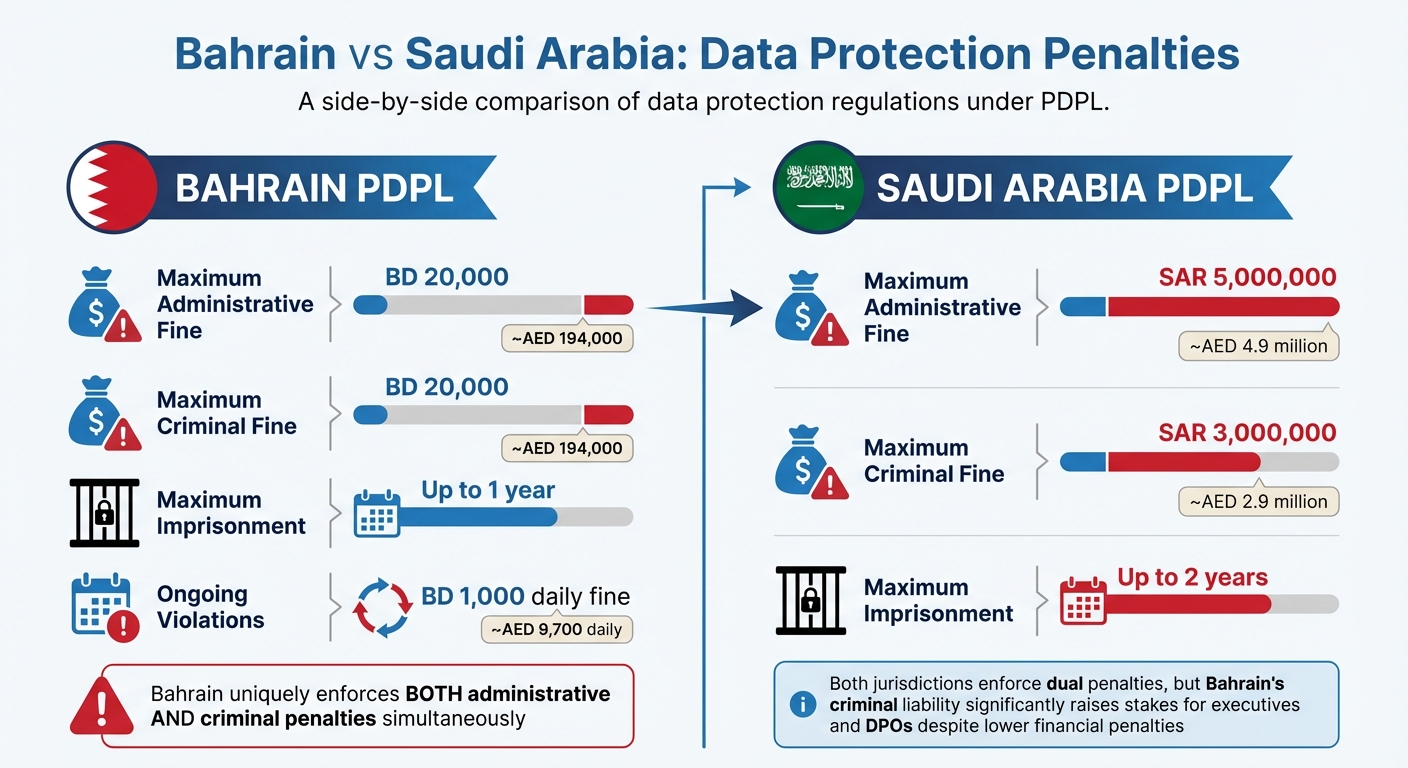
The PDPL enforces strict penalties for organisations failing to meet its requirements. Unlike many Western data protection laws that focus on civil penalties, Bahrain's PDPL imposes both administrative and criminal consequences. Administrative fines can reach up to BD 20,000 (around AED 194,000) for a single violation, with ongoing breaches incurring daily fines of BD 1,000 (approximately AED 9,700). These fines can quickly accumulate, making persistent non-compliance a costly issue.
Criminal penalties add a more serious layer of accountability. Violations such as processing sensitive data unlawfully, failing to provide required information to the PDPA, or transferring data to countries lacking adequate protections without approval can result in imprisonment for up to one year and criminal fines of up to BD 20,000. This dual enforcement model means organisations face both regulatory scrutiny and legal risks.
| Jurisdiction | Maximum Administrative Fine | Maximum Criminal Fine | Maximum Imprisonment |
|---|---|---|---|
| Bahrain | BD 20,000 (~AED 194,000) | BD 20,000 (~AED 194,000) | Up to 1 year |
| Saudi Arabia | SAR 5,000,000 (~AED 4.9 million) | SAR 3,000,000 (~AED 2.9 million) | Up to 2 years |
While Bahrain's financial penalties may seem lower compared to Saudi Arabia, the inclusion of criminal liability and potential imprisonment significantly raises the stakes for executives and data protection officers. The PDPA also holds the authority to issue stop orders, halting data collection, processing, or transfers. Furthermore, individuals who suffer damages due to PDPL violations can file civil claims in Bahraini courts, adding yet another layer of financial and reputational risk for organisations.
Cross-Border Data Transfer Requirements
Data Transfer Restrictions
Bahrain's Personal Data Protection Law (PDPL) enforces firm guidelines for transferring personal data beyond its borders. Personal data can only be transferred to countries listed on the "Adequacy List" (as outlined in Resolution No. 42 of 2022) or if the transfer satisfies specific legal exceptions.
The Adequacy List currently names 83 jurisdictions that meet Bahrain's data protection standards. This includes all GCC countries - UAE, Saudi Arabia, Oman, and Kuwait - as well as key global partners like the UK, USA, India, and EU member states. The extensive coverage simplifies cross-border operations for businesses in the region, offering a broader scope than the European Commission's equivalent list.
For countries not on the Adequacy List, businesses must rely on alternative legal mechanisms. These include obtaining explicit consent (written or electronic) from the individual, proving the transfer is essential to a contract, or showing it is necessary to protect the individual's vital interests. In some cases, organisations can apply to the Personal Data Protection Authority (PDPA) for approval, providing adequate safeguards through binding contracts akin to the Standard Contractual Clauses under the GDPR.
"The law's extraterritorial reach makes it clear that any organisation handling data related to Bahraini residents must comply, regardless of where the processing takes place." - Risk Associates
The PDPL's extraterritorial scope means international organisations processing data of Bahraini residents must comply with its requirements. This often involves using local servers or third-party processors within Bahrain, creating additional compliance obligations for businesses operating internationally.
This streamlined approach offers a contrast to other regional practices, as explored below.
Comparison with Other GCC Data Laws
Although GCC countries are aligning their data laws with GDPR principles, their approaches to cross-border transfers vary. Bahrain's reliance on a whitelist differs from Saudi Arabia's PDPL, which focuses on risk assessments and safeguards rather than pre-approved adequacy lists. In Saudi Arabia, regulations also mandate that backup and disaster recovery data remain within the Kingdom, imposing stricter localisation requirements.
The UAE presents a more fragmented regulatory landscape. Data transfer rules vary depending on whether an entity operates onshore, in the Dubai International Financial Centre (DIFC), or within the Abu Dhabi Global Market (ADGM). For example, transfers from DIFC to onshore entities may require adequacy assessments or the use of Standard Contractual Clauses, adding complexity compared to Bahrain's unified approach.
| Transfer Mechanism | Bahrain PDPL | Saudi Arabia PDPL | UAE (Onshore) |
|---|---|---|---|
| Adequacy List | 83 countries whitelisted | Risk-based assessments | Varies by jurisdiction |
| Intra-GCC Transfers | Pre-approved | Requires safeguards | Depends on the emirate |
| Data Localisation | Limited to government sector | Backups must remain in-Kingdom | Sector-specific rules |
Bahrain's inclusion of GCC countries on its Adequacy List simplifies regional data transfers significantly.
Compliance Implementation Methods
Given these regulatory differences, businesses need customised strategies to maintain compliance. The first step is mapping data flows to identify where personal data is stored, which third parties handle it, and whether the jurisdictions involved meet Bahrain's adequacy standards. This mapping exercise helps determine the appropriate legal mechanisms for each transfer.
For transfers to non-whitelisted countries, businesses should establish written contracts with adequate safeguards and submit them to the PDPA for approval. Multinational organisations can also implement "Corporate Rules", which are internal data protection policies similar to the GDPR's Binding Corporate Rules. Once approved by the PDPA, these rules simplify internal data transfers across group entities.
Additionally, businesses should adopt privacy by design principles and advanced systems to secure data transfers, as required by Resolution No. 43. For organisations relying on consent as a legal basis, automated tools can help capture and document explicit consent in line with Resolution No. 48. These measures not only ensure compliance but also improve operational efficiency across GCC markets.
"A unified 'Middle East' cloud region creates data residency conflicts because Saudi user data may process in UAE infrastructure (or vice versa), triggering cross-border transfer requirements." - Global Compliance Code
For businesses operating across multiple GCC countries, a practical solution is to deploy workloads regionally. This means using Saudi-based infrastructure for Saudi data and UAE-based infrastructure for UAE data, reducing residency conflicts and simplifying cross-border compliance challenges.
sbb-itb-058f46d
Financial Impact of PDPL Compliance
Compliance Implementation Costs
For businesses in the GCC, navigating the financial impact of PDPL compliance is essential to balancing regulatory obligations with long-term business goals.
Getting started with PDPL compliance requires an upfront investment in data mapping and technology upgrades. This step can be particularly resource-intensive for organisations managing complex data systems across multiple jurisdictions in the GCC. Labour costs and technology expenses often make up a significant portion of the initial outlay.
Annual costs for legal, consultancy, audit, and accounting services fall between BHD 500 and BHD 2,000 (around AED 4,900 to AED 19,500), with Bahrain's 10% VAT applying to these services.
Technical requirements under Resolution No. 43 add another layer of expense. Businesses must implement systems for breach notifications and ensure secure data processing. For companies transferring data to countries outside Bahrain's Adequacy List, additional costs arise from setting up safeguards like binding contracts.
While these costs may seem steep, the benefits of compliance - ranging from risk reduction to market advantages - can outweigh the initial investment over time.
Business Benefits of Compliance
The financial advantages of compliance become clear when you consider the risks it mitigates. In the GCC, the average cost of a data breach is a staggering US$4 million (approximately AED 14.7 million) per incident.
Beyond avoiding fines, compliance offers a competitive edge in today's privacy-conscious market. Research highlights that 74% of consumers are more likely to support brands that demonstrate ethical data practices, and 60% have switched services due to privacy concerns. For GCC businesses, PDPL compliance also simplifies data transfers to 83 recognised jurisdictions, including GCC countries, the USA, and EU member states.
"Bahrain is consistently ranked as the Gulf's most cost-efficient location – it maintains the most competitive tax regime in the region."
– Dalal Buhejji, Executive Director, Bahrain Economic Development Board
Moreover, automation tools introduced during compliance efforts can identify IT inefficiencies, streamline operations, and generate long-term savings.
Cost-Benefit Analysis
The table below provides a snapshot of the costs involved in compliance versus the potential benefits.
| Compliance Element | Implementation Cost | Potential ROI / Benefit |
|---|---|---|
| DPO Registration | BHD 100 – BHD 500 annually | Reduces risk of BHD 20,000 fines |
| Legal & Audit Fees | BHD 500 – BHD 2,000 | Ensures alignment and avoids daily fines of BHD 1,000 |
| Security Systems | Variable investment | Protects against breaches costing US$4 million |
| Data Mapping Tools | Operational costs | Improves data management and operational efficiency |
| Staff Training | Programme costs | Minimises human errors leading to violations |
Bahrain offers additional financial advantages for businesses. Operating costs in the Kingdom are 48% lower than those of neighbouring countries in the financial services sector. With over 350 financial entities already adhering to PDPL requirements, businesses can tap into existing frameworks and local expertise. This not only reduces implementation costs but also ensures seamless access to GCC markets.
GCC‐Wide PDPL Compliance Approaches
With the cost and risk factors in mind, businesses across the GCC are turning to advanced technology and well-structured strategies to meet PDPL requirements efficiently.
Technology Solutions for Compliance
AI-driven tools are transforming PDPL compliance efforts. These solutions can automatically scan both structured and unstructured data to identify and label personally identifiable information (PII). This step is crucial for maintaining the Records of Processing Activities mandated by Bahraini law. Additionally, these tools help pinpoint redundant or outdated data, allowing businesses to safely delete unnecessary information and lower their risk exposure.
Modern platforms also monitor cross-border data transfers, flagging any movement outside Bahrain's Adequacy List of 83 recognised nations. Automated workflows and self-service portals simplify data subject rights requests, ensuring businesses meet statutory deadlines. Digital consent management tools further enhance compliance by tracking and auditing user permissions, ensuring data is processed only for legitimate and specific purposes, as required by the PDPL.
These technologies form the foundation of integrated compliance strategies like Wick's Four Pillar Framework.
Using Wick's Four Pillar Framework

Wick's framework offers a structured approach:
- The Capture & Store pillar focuses on automating data inventories and mapping customer journeys. This generates processing registers that align with Bahraini legal standards.
- The Tailor & Automate pillar embeds privacy controls directly into customer interactions. By integrating these controls into marketing automation and personalisation efforts, businesses can enforce data minimisation practices, such as deleting expired information, to comply with the PDPL's technical requirements for safeguarding sensitive data.
Creating a Long‐Term Compliance Plan
Sustaining compliance involves more than just initial implementation. Regular data audits are essential to map personal data touchpoints, storage locations, and access levels, ensuring ongoing accuracy. Appointing a Data Protection Guardian (DPG) can help organisations stay ahead by overseeing training programmes and updating policies to match evolving GCC regulations.
"Compliance can be a differentiator, but non-compliance is now a barrier to public-sector contracts."
– Shak Ashraf, CEO, REG-1
Establishing clear breach response protocols is another critical step. Bahrain’s PDPL, for instance, requires businesses to notify the PDPA of a data breach within 72 hours. While cyber insurance is not mandatory under the PDPL, it is a wise investment given the potential fines of up to BHD 20,000 (approximately AED 195,000) and the risk of civil compensation claims.
Since each GCC jurisdiction has its own rules for sensitive data and cross-border transfers, businesses must adopt a customised approach. By leveraging technology and proactive strategies, organisations can build a resilient compliance framework that evolves with regional requirements.
Conclusion
Adopting strong compliance strategies across the GCC highlights the importance of adhering to Bahrain's Personal Data Protection Law (PDPL). This law goes beyond simply meeting legal obligations - it provides a critical framework for businesses operating in the region. Its alignment with global regulations like the GDPR ensures that organisations can navigate international markets with ease, making adherence an essential standard rather than a competitive edge.
The financial risks of non-compliance are undeniable. Penalties, both administrative and criminal, are significant. But the damage goes beyond fines - non-compliance can tarnish a company’s reputation, especially in a region that increasingly values privacy. To stay ahead, businesses must invest in technology solutions, conduct regular audits, and prioritise ongoing employee training. These measures form the backbone of resilience, enabling companies to meet breach notification deadlines and maintain accurate data records.
"The Law aims to protect the rights and freedoms of individuals and their personal data, by establishing a legal framework that defines the methods and means of processing data in a way that gives individuals confidence."
– Personal Data Protection Authority (PDPA)
By embedding privacy by design into their operations, maintaining up-to-date data inventories, and preparing for breaches with solid response protocols, businesses do more than comply - they build a foundation for long-term stability. Proactive compliance not only reduces risks but also opens doors to new opportunities in markets where trust and data protection are increasingly critical.
For companies operating across the GCC, compliance isn’t a one-time goal - it’s an ongoing responsibility. Taking action today not only avoids penalties but also strengthens trust and positions businesses to thrive in an era where digital security is non-negotiable.
FAQs
What are the key compliance requirements for businesses under Bahrain's PDPL?
Under Bahrain's PDPL, businesses are required to handle personal data responsibly and within the framework of the law. This includes ensuring that data processing is lawful, whether by obtaining explicit consent from individuals or fulfilling a contractual obligation. Maintaining transparency and fairness in how data is managed is key, along with upholding the rights of individuals. These rights include accessing their data, requesting corrections, deleting information, restricting processing, and even transferring data to another entity.
To safeguard personal data, organisations must put in place strong technical and organisational security measures. For activities that pose a higher risk to individuals' privacy, conducting impact assessments is a legal necessity. When it comes to cross-border data transfers, the law restricts such actions to countries that meet adequate protection standards. Alternatively, businesses must secure explicit consent from individuals or establish other approved safeguards.
By meeting these requirements, businesses not only ensure compliance with the law but also reinforce trust with their stakeholders, demonstrating a commitment to ethical and secure data practices.
What is the impact of Bahrain's PDPL on cross-border data transfers within the GCC?
Bahrain's Personal Data Protection Law (PDPL) places strict controls on transferring personal data to other GCC countries. To comply, businesses must meet one of the following conditions:
- The receiving country must have adequate data protection measures in place.
- Explicit consent must be obtained from the individual whose data is being transferred.
- Other legal grounds, such as contractual necessity or special approval from Bahrain's data protection authority, must be fulfilled.
For businesses operating across the GCC, ensuring compliance with these regulations is crucial. Non-compliance can result in steep penalties, making it essential to review and refine data transfer practices. Establishing robust processes for securing consent and evaluating the data protection standards of other jurisdictions is not just advisable - it’s necessary for smooth operations under PDPL.
What are the consequences of not complying with Bahrain's PDPL?
Failure to comply with Bahrain’s Personal Data Protection Law (PDPL) carries severe consequences, including hefty fines and even the possibility of criminal charges. For unauthorised data transfers, the penalties can escalate to imprisonment.
For businesses in the GCC, compliance with PDPL should be a top priority, particularly when managing cross-border data transfers. Adhering to this law isn't just about meeting legal obligations - it’s essential for protecting sensitive information and building trust with stakeholders.