

Blog / How to Compare Cloud Data Integration Vendors
How to Compare Cloud Data Integration Vendors
Choosing the right cloud data integration vendor can save your business time, money, and compliance headaches. Here's how to evaluate vendors effectively:
- Understand your needs: Define whether you require real-time data processing (e.g., fraud detection) or batch processing (e.g., financial reporting).
- Review features: Check connector libraries, automation tools, and scalability options. Ensure compatibility with your existing systems like Salesforce or SAP.
- Compare pricing: Vendors may charge based on usage, rows processed, or subscription tiers. Factor in hidden costs like infrastructure and engineering hours.
- Ensure compliance: UAE businesses must meet local data protection laws like PDPL. Verify vendors' security certifications and data residency options.
- Test support: Assess customer service responsiveness and run a Proof of Concept to evaluate performance under your specific conditions.
Quick Tip: Start small, test scalability, and always align vendor capabilities with your business objectives.
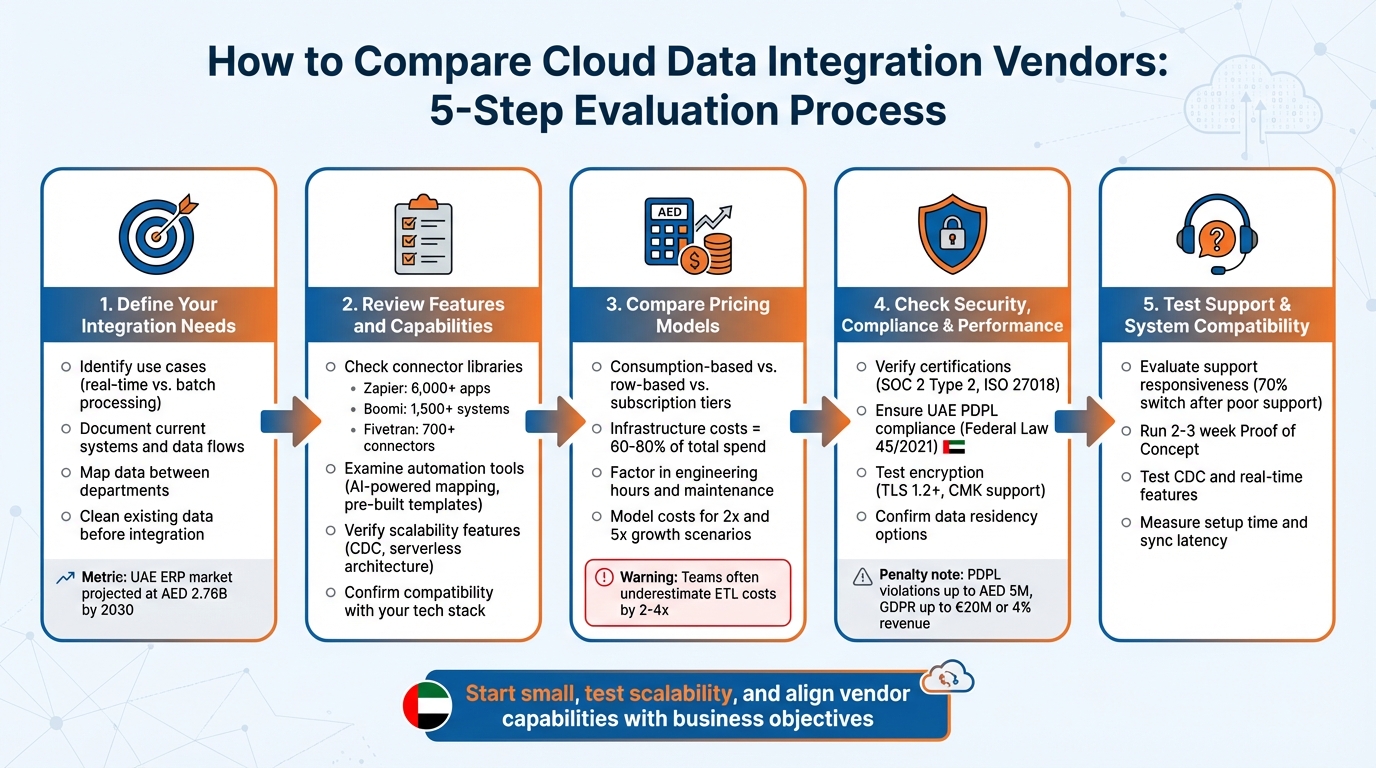
5-Step Process for Evaluating Cloud Data Integration Vendors
Step 1: Define Your Integration Needs
Before diving into vendor selection, it's essential to clarify your business goals. As Donal Tobin from Integrate.io explains:
Successful data integration projects are focused. Before selecting tools or designing pipelines, establish clear business objectives.
This might involve determining whether you need real-time reporting for fraud detection, consolidating customer profiles across departments, or ensuring compliance with UAE VAT regulations through the Federal Tax Authority. Laying this groundwork helps streamline the process when evaluating features and pricing down the line.
Identify Your Use Cases
Your specific requirements depend on your business objectives. For instance, real-time streaming is crucial when immediate insights are needed - like fraud detection systems flagging suspicious activity in the moment or live dashboards tracking inventory across multiple warehouses. On the other hand, batch processing is ideal for tasks like historical reporting or financial analysis, where overnight data updates are sufficient.
Consider this example: a bank reduced its processing time from 45 minutes to just 5, saving 10,000 hours annually. This kind of efficiency only happens when you correctly assess whether your use case requires instant data or can work with scheduled updates.
In the UAE, integration needs often go beyond typical SaaS applications. Businesses may need to connect with the EmaraTax portal for automated VAT filings, support bilingual interfaces in Arabic and English, or manage hybrid setups blending on-premises legacy systems with cloud platforms. With the UAE's ERP market projected to reach AED 2.76 billion by 2030, these decisions are becoming increasingly important.
Document Your Current Systems and Data Flows
Start by auditing your existing tech stack. Identify all systems in use - such as CRM platforms (Salesforce, HubSpot), ERP solutions (NetSuite), on-premises databases, IoT devices, and external data sources like foreign exchange rates or market data. Then, map out how data flows between departments like finance, HR, supply chain, and customer service.
Pay close attention to critical systems that require 24/7 uptime, such as e-commerce platforms, payment gateways, or healthcare record systems. Also, pinpoint where your data resides - whether in APIs, file systems, database logs, or event streams - as this will guide the type of connectors you'll need from your vendor.
Before integrating, clean your data. Eliminate duplicate customer records, outdated product SKUs, and inconsistent financial entries. Many UAE companies report seeing returns on their integration investments within 12 to 24 months, but only when they start with clean, well-documented data flows that align with UAE compliance standards for VAT reporting and bilingual data requirements.
Step 2: Review Features and Capabilities
Once you've outlined your integration needs, it's time to dive into what each platform actually brings to the table. A good platform should not only integrate seamlessly with your current systems but also grow alongside your business. Don’t just rely on marketing promises - dig into the details of connector libraries, automation tools, and scalability. This step is where you align the platform's features directly with the use cases and system requirements you've already mapped out.
Check Connector Libraries
Connector libraries are the backbone of any integration platform, ensuring smooth communication between your systems. For instance, platforms like Zapier boast over 6,000 app connections, while Boomi integrates with more than 1,500 systems, and Fivetran offers more than 700 pre-built connectors. However, the sheer number of connectors isn’t the whole story. You need to verify that these connectors align with your specific tech stack. For businesses in the UAE, this often includes checking compatibility with platforms like Salesforce, SAP, NetSuite, and Shopify.
If you’re dealing with older systems - like mainframes, COBOL copybooks, or VSAM files - make sure the vendor supports these complex formats. As Brittany Schultz from Precisely explains:
The right integration platform should connect across all of them - including delivering complex data formats like VSAM files, COBOL copybooks, and JSON, to modern cloud-based platforms like AWS, Databricks, and Snowflake.
Additionally, look for features like automated schema drift handling, which can adapt to changes in your data sources without causing disruptions. If you have niche systems requiring custom connections, check whether the platform provides a Connector Development Kit (CDK) or SDK for building those connections.
While connectors ensure compatibility, automation and scalability are what make an integration platform efficient over the long haul.
Examine Automation and Scalability
Automation can save you time and reduce the need for tedious manual work. Many platforms now leverage AI to streamline tasks like pipeline design, data mapping, and transformations. This not only speeds up deployment but also simplifies ongoing management of your integrations.
Pre-built templates and reusable connectors can cut down weeks - or even months - of custom development work. MuleSoft highlights this benefit:
Instead of having to create a custom connectivity solution every time a developer wants to integrate an application, reusable connectors, templates, and assets make that job simple.
For example, Integrate.io offers over 200 pre-built connectors tailored for SaaS, e-commerce, and database tools, while Dataddo can deliver custom connectors within around 10 business days.
Scalability is equally vital. Features like Change Data Capture (CDC) help by transferring only updated records, reducing unnecessary data movement. Cloud-native platforms also use serverless architectures, such as AWS Lambda or Google Cloud Functions, to automatically adjust computing resources based on data demands.
When evaluating automation, focus on idempotence - this ensures that failed processes can be re-run without causing duplicate data. Charles Wang from Fivetran explains:
A reliable data pipeline has high uptime and delivers data with high fidelity. One design consideration that enhances reliability is repeatability, or idempotence.
This approach keeps your integrations stable, even when unexpected issues arise.
Step 3: Compare Pricing Models
Once you've assessed the capabilities of different vendors, the next step is to align their features with your budget by carefully comparing their pricing models.
Vendors typically use one of four main pricing structures: consumption-based (pay-per-use, such as compute hours or Data Processing Units), row-based (charges based on Monthly Active Rows processed), subscription tiers (flat monthly fees with defined limits), or credit-based systems (where you purchase credits that are consumed across various services). Each model comes with its own pros and cons. For instance, consumption pricing offers flexibility but requires constant monitoring to avoid overspending, while subscription tiers provide predictable costs but may result in paying for unused capacity.
Interestingly, subscription fees often account for less than 30% of total costs. The majority - between 60% and 80% - comes from infrastructure expenses like compute power and storage for data warehouses. For example, scaling operations from 2 million to 100 million rows could increase monthly costs from AED 3,670 to over AED 36,730 with certain vendors. Many data teams underestimate ETL (Extract, Transform, Load) costs by as much as two to four times, especially as workloads grow.
When evaluating costs, don’t forget to factor in labour and engineering expenses. Tasks like maintenance, troubleshooting, and creating custom connectors can require hundreds of hours. Jim Kutz, a data analytics expert at Airbyte, advises:
Choosing the right platform and regularly revisiting cost models (at least quarterly) helps prevent budget surprises and aligns ETL spend with business value.
In other words, a cheaper tool might end up costing more if it demands significant manual effort.
For businesses in the UAE, regional pricing plays a crucial role. For example, Snowflake's UAE North (Dubai) region charges AED 9.92 per credit for its Standard Edition and AED 93.22 per terabyte per month for storage. Azure Spot Virtual Machines offer discounts of up to 90% for interruptible workloads, while savings plans for consistent usage can cut costs by up to 65%. Be sure to check regional rates and confirm whether compliance features require higher-priced "Business Critical" tiers.
Start Small and Scale Wisely
Begin with small-scale tests to validate consumption before committing to larger operations. Calculate costs based on your current data volume, then model scenarios for 2x and 5x growth, as many pricing models don’t scale linearly. Pay close attention to idle resources - platforms like Azure Data Factory, for example, can generate fees even for unused pipelines. Analysing your last three to six months of warehouse compute bills can help identify spikes caused by data ingestion, giving you a clearer picture of your actual infrastructure costs.
Build a Pricing Comparison Table
To simplify your evaluation, create a side-by-side pricing table. Here's an example, with prices converted to AED (1 USD = 3.67 AED):
| Vendor | Plan Name | Price (AED/mo) | Features | Limitations |
|---|---|---|---|---|
| Stitch | Standard | ~367 | 5M rows, 10 sources | 1 destination |
| Stitch | Advanced | ~4,588 | 100M rows, 3 destinations | Limited transformations |
| Fivetran | Standard | ~1,835* | Automated ELT, 1M MAR | Basic support |
| Matillion | Basic | ~3,670 | Credit-based (vCore-hour) | Cloud-warehouse native |
| AWS Glue | Serverless | ~1.61/hr* | Pay-as-you-go per DPU | Requires Spark expertise |
*Estimated starting price per unit of consumption.
Customise this table with the vendors you're considering, including their pricing tiers, monthly costs (in AED), features (like the number of connectors or destinations), and any restrictions (such as data volume caps or support limitations). This side-by-side comparison makes it easier to identify which plans meet your current needs and which can scale with your business as it grows.
sbb-itb-058f46d
Step 4: Check Security, Compliance, and Performance
Once you've compared pricing, it's time to ensure your chosen vendor can safeguard your data, meet UAE regulatory standards, and efficiently handle your workload. Issues like security breaches, compliance violations, or performance slowdowns can lead to major disruptions.
When it comes to data security, the goal is to prevent unauthorised access to sensitive information, such as Personally Identifiable Information (PII). This means ensuring the vendor employs strong encryption protocols. Equally important is performance - can the vendor handle sudden surges in usage while maintaining speed and reliability? Vendors with regional data centres, like AWS Middle East (UAE) Region, can help reduce latency for local users. During your Proof of Concept, simulate peak workloads to test the platform's responsiveness and throughput. Additionally, check if the vendor's infrastructure is independently audited against standards like SOC 1, 2, and 3, or ISO 27001, as these certifications signal strong systems capable of managing demanding workloads.
Review Data Security Measures
To ensure your vendor has robust security measures, look for certifications like SOC 2 Type 2 and ISO 27018, which reflect independent audits and a focus on protecting personal data in the cloud. The platform should also support "privacy by design", meaning privacy features are integrated from the start - a key requirement under GDPR. Non-compliance with GDPR can result in hefty penalties, such as fines up to €20 million or 4% of global annual turnover, whichever is higher.
Key security features to look for include:
- End-to-end encryption: TLS 1.2 or later for data in transit and infrastructure-layer encryption for data at rest.
- Customer-Managed Keys (CMK): Gives you control over encryption keys and the ability to revoke access if necessary.
- Role-Based Access Control (RBAC): Ensures users only have permissions essential to their tasks.
- Data masking or hashing: Obscures sensitive information before it reaches its destination.
- Automated monitoring: Detects unusual activity.
Vendors should also have clear data purging policies, ensuring customer data is removed from their systems immediately after synchronisation to reduce risks. Additionally, understand the shared responsibility model: while the vendor secures the infrastructure ("the cloud"), you are responsible for securing your data and configurations within that environment. For example, AWS infrastructure is monitored 24/7 and independently validated against over 2,600 global standards annually. Ask vendors about upstream security features like column masking or hashing to protect sensitive data before it leaves your systems.
Verify UAE Compliance Requirements
Security measures alone aren't enough - you also need to confirm compliance with UAE regulations. The UAE Personal Data Protection Law (PDPL), enacted under Federal Decree-Law No. 45 of 2021, applies to any organisation processing the data of UAE residents, regardless of the vendor's location. Effective from 2nd January 2022, the PDPL excludes government data, health data (regulated by Federal Law No. 2 of 2019), and banking data (overseen by the Central Bank). Vendors operating within the Dubai International Financial Centre (DIFC) or Abu Dhabi Global Market (ADGM) are subject to their respective data protection laws instead of the federal PDPL. Violations of ADGM regulations can result in fines up to $28 million, while serious breaches of the PDPL may incur penalties of up to AED 5 million.
| Regulation | Jurisdiction | Primary Oversight Body |
|---|---|---|
| Federal PDPL (Law 45 of 2021) | Onshore UAE | UAE Data Office |
| DIFC Data Protection Law 2020 | Dubai Intl. Financial Centre | DIFC Commissioner |
| ADGM Data Protection Regs 2021 | Abu Dhabi Global Market | ADGM Commissioner of Data Protection |
Request a Record of Processing Activities (RoPA) from the vendor, which outlines purposes, data types, and security measures. Vendors handling high-risk, large-scale sensitive data must appoint a Data Protection Officer (DPO), as required under Article 10 of the PDPL. Confirm the vendor's breach notification procedures, ensuring they can promptly notify the UAE Data Office of any data breaches. If data is transferred outside the UAE, the vendor must demonstrate that the destination offers "adequate" protection or provide a contract ensuring PDPL compliance. As AWS explains:
The PDPL applies to controllers and processors... located outside of onshore UAE who process personal data of data subjects in onshore UAE.
For highly sensitive data, prioritise vendors offering local data residency within the UAE or data centres aligned with GCC standards.
Step 5: Test Support Quality and System Compatibility
Once you've assessed features, pricing, and compliance, the next step is to ensure the platform delivers on support quality and system compatibility. Even the most feature-rich tool can fall short without reliable support or smooth integration. Research underscores this point: over 70% of consumers switch vendors after repeated poor support interactions, and more than half base their purchase decisions on the quality of customer service alone.
Test Customer Support Responsiveness
Use the trial period to evaluate customer support through multiple channels - live chat, email, and phone. Pay attention to metrics like First Reply Time and Resolution Time. For instance, in 2025, companies like CARET and Reverb stood out for their exceptional support KPIs.
Don’t rely solely on chatbots. Instead, trigger errors and ask specific questions about UAE compliance requirements, such as PDPL and SOC 2 standards. This will give you a sense of how knowledgeable and responsive live agents are. Additionally, explore the platform’s self-service tools to see if they meet your needs. Once you're confident in the support quality, move on to testing system compatibility with a Proof of Concept.
Proof of Concept
A Proof of Concept (POC) lets you test the platform in a real-world scenario, ensuring it meets your technical and operational requirements. Start by documenting your data sources - such as ERPs, CRMs, or SaaS applications - along with their schemas, data volumes, and dependencies. This ties back to earlier discussions on integration needs and platform features.
Choose one or two high-priority data sources to test end-to-end. Measure key factors like setup time, initial load duration, and incremental sync latency. Use a staging environment to test data transformations, verify data integrity (e.g., row counts and sample records), and evaluate failure-handling features like automatic retries and failure notifications. If your operations require near-real-time processing, test features such as Change Data Capture (CDC).
Run the POC over two to three weeks, using job logs to compare actual performance against cost estimates. For example, Coke One North America and Oldcastle Infrastructure successfully leveraged CDC and automated connectors, achieving real-time data access and saving approximately AED 1,322,280 annually in engineering costs.
Conclusion
Choosing the right vendor involves carefully weighing factors like cost, performance, and long-term compatibility. As Donal Tobin from Integrate.io points out:
Successful data integration projects are goal-oriented. Before selecting tools or designing pipelines, establish clear business objectives.
Whether your focus is on real-time reporting, customer profile consolidation, or meeting UAE compliance standards, your vendor must align with these priorities from the outset. This clarity forms the foundation for a smooth and structured evaluation process.
To make an informed choice, follow these five steps: define your needs, review key features, compare pricing, verify security and compliance, and test the vendor's support. Pay close attention to scalability and automation features, such as automated schema migration and Change Data Capture (CDC), which can reduce engineering efforts and help maintain stable pipelines.
Keep an eye on vendor updates and API enhancements to ensure long-term compatibility. It's also wise to confirm whether you can export your data models and transformations, which can help avoid costly vendor lock-in if you need to switch platforms. With the UAE's AI market expected to expand from AED 12.74 billion in 2023 to AED 170 billion by 2030, selecting a vendor that aligns with your long-term growth goals is more important than ever.
Using a weighted scoring system can simplify the decision-making process. Categorise your requirements into Functional, Technical, Support, Vendor Health, and Pricing priorities to objectively compare vendors. This method ensures that your buying team feels confident in the final decision. Ultimately, the goal isn’t to find the vendor with the most features, but to select a platform that provides a strong, flexible foundation for data integration - one that evolves alongside your business. This thoughtful approach not only addresses your current needs but also positions your company for sustained growth in the dynamic UAE market.
FAQs
What should I consider when selecting a cloud data integration vendor?
When selecting a cloud data integration vendor, prioritise compatibility, automation, and scalability. The solution should integrate smoothly with your current setup - whether it's cloud-native, on-premises, or hybrid. It should also support automated tasks like schema migration and connector integration, reducing the need for manual intervention. Features such as real-time data movement, strong security measures, and compliance capabilities are essential to address your organisation's specific needs.
Don't overlook cost, support, and local relevance. Understand the pricing structure, including any potential hidden charges, and calculate the total cost of ownership in AED (e.g., AED 12,500.00). Ensure the vendor offers 24/7 customer support in Arabic, clear SLAs, and compatibility with tools you already use, such as ERP systems, SaaS platforms, or analytics software. For businesses in the UAE, a vendor like Wick can enhance your data-driven marketing strategy by creating a seamless digital ecosystem. This includes features like metric-based reporting and support for local conventions, such as dd/MM/yyyy date formats.
How can I ensure my cloud data integration vendor complies with UAE data protection laws?
To comply with UAE data protection laws, it's essential to familiarise yourself with the regulations that apply. The Federal Decree Law No. 45 of 2021 (PDPL) outlines the rules for managing personal data across the UAE. Additionally, the DIFC and ADGM have established their own data protection frameworks. These laws emphasise lawful data processing, secure storage, and prompt reporting of data breaches.
When evaluating a vendor, start by requesting a Data Processing Agreement (DPA) that adheres to the PDPL or the relevant free-zone regulations. Confirm the location of data storage to ensure it meets UAE data residency and localisation requirements. It’s also crucial to examine the vendor’s security protocols, such as encryption and access controls, and confirm they have well-defined breach notification processes. By addressing these aspects, you can select a vendor that prioritises compliance and safeguards sensitive data effectively.
How can I test if a cloud data integration vendor works with my current systems?
To make sure a cloud data integration vendor aligns well with your existing systems, here’s what you need to do:
- Take stock of your current tools and systems: List all the platforms, databases, and applications you rely on - whether it’s SAP, on-premise databases, or SaaS apps. Check if the vendor’s solution is compatible with these.
- Test deployment across environments: Run the vendor’s solution in both your on-premise and cloud setups. This ensures it operates smoothly without requiring significant changes.
- Try a proof-of-concept (PoC): Test the vendor’s platform with a specific data flow, like transferring daily sales data to a data warehouse. This will help you gauge its performance, reliability, and user-friendliness.
- Use real-world data for evaluation: Work with a dataset that mirrors your actual production data - think along the lines of 1,000,000 rows. Measure speed, error rates, and overall costs (e.g., AED per GB transferred).
Keep a record of your results and get approval from all key stakeholders before making a final decision. This process ensures the vendor’s solution integrates seamlessly with your UAE-based infrastructure.