

Blog / How to Comply with Oman Data Privacy Laws
How to Comply with Oman Data Privacy Laws
Oman's Personal Data Protection Law (PDPL), fully effective since 13 February 2023, sets strict rules for handling personal data of Omani residents, with compliance deadlines ending on 5 February 2025. Here's what you need to know:
-
Key Requirements:
- Appoint a Data Protection Officer (DPO).
- Maintain a Record of Processing Activities (ROPA).
- Respond to Data Subject Access Requests (DSARs) within 45 days.
- Notify the Ministry of data breaches within 72 hours.
- Obtain explicit written consent for data processing, especially for sensitive data.
- Secure Ministry permits for processing sensitive or cross-border data.
-
Penalties:
- Fines up to OMR 500,000 for breaches.
- Administrative fines of OMR 2,000 per incident.
- Criminal liability for negligence.
-
Notable Exemptions:
- National security, public interest, anonymised data for research, and personal or family use are excluded.
Key Provisions of Oman's PDPL
Who the Law Applies to and What is Exempt
With the PDPL coming into effect in February 2023, organisations handling the personal data of Omani residents are now held to strict accountability standards. This law applies to all entities processing such data, regardless of their size or location, as long as the activities involve identifying a natural person.
However, the law does carve out certain exemptions. Activities related to national security, public interest, personal or family use, or anonymised data used for historical, statistical, or scientific research are not covered. Other exceptions include processing required for legal obligations, contract execution, safeguarding a data subject's vital interests, or crime prevention based on an official written request from investigative authorities. Moving forward, let’s delve into the roles and responsibilities of controllers and processors under the PDPL.
Responsibilities of Data Controllers and Data Processors
The PDPL defines two crucial roles: controllers and processors. Controllers are the entities that decide why and how personal data is processed, making them primarily accountable for compliance. Their duties include providing transparency notices to data subjects, maintaining a Record of Processing Activities (ROPA), and appointing a Data Protection Officer (DPO). Processors, on the other hand, act on behalf of controllers and must adhere to written agreements that specify the terms of data handling.
Both roles come with shared obligations. They must keep detailed records of processing activities, respond to Data Subject Access Requests (DSARs) within 45 days, and notify the Ministry of Transport, Communications and Information Technology (MTCIT) within 72 hours if a data breach occurs that could harm data subjects' rights. If the breach causes serious harm, affected individuals must also be informed within the same 72-hour timeframe. Additionally, the Ministry may require organisations to hire accredited external auditors to ensure compliance. These responsibilities underscore the PDPL’s stringent approach to data security and accountability.
Requirements for Consent and Transparency
Under the PDPL, explicit written consent is the cornerstone of lawful data processing. Unlike the GDPR, Oman's framework does not allow "legitimate interests" as a basis for processing. Consent must be freely given, unambiguous, and obtained from an individual who is eligible to provide it without undue pressure. Organisations must document consent through written, electronic, or approved methods.
Before processing any data, controllers are required to provide a written notice to data subjects. This notice must outline the controller's identity, the purpose of data processing, the methods involved, and the individual's legal rights. Separate consent is mandatory for marketing communications. For minors, the law demands the express consent of a legal guardian, ensuring the process is straightforward and transparent. When dealing with sensitive data - such as health, genetic, biometric, ethnic, political, religious, or criminal information - organisations must secure both the data subject's consent and a prior permit from the MTCIT. This permit remains valid for five years.
"The emphasis on consent and transparency places the power back in the hands of the Personal Data Subject, fostering trust in digital transactions and services."
– Mehdi Al Lawati and Lewis James, DLA Piper
PDPL Oman | Personal Data Protection Law by Mr. Sreechith Radhakrishnan | ICAI Oman | 15th Apr 2024
How to Comply with Oman's Data Privacy Laws
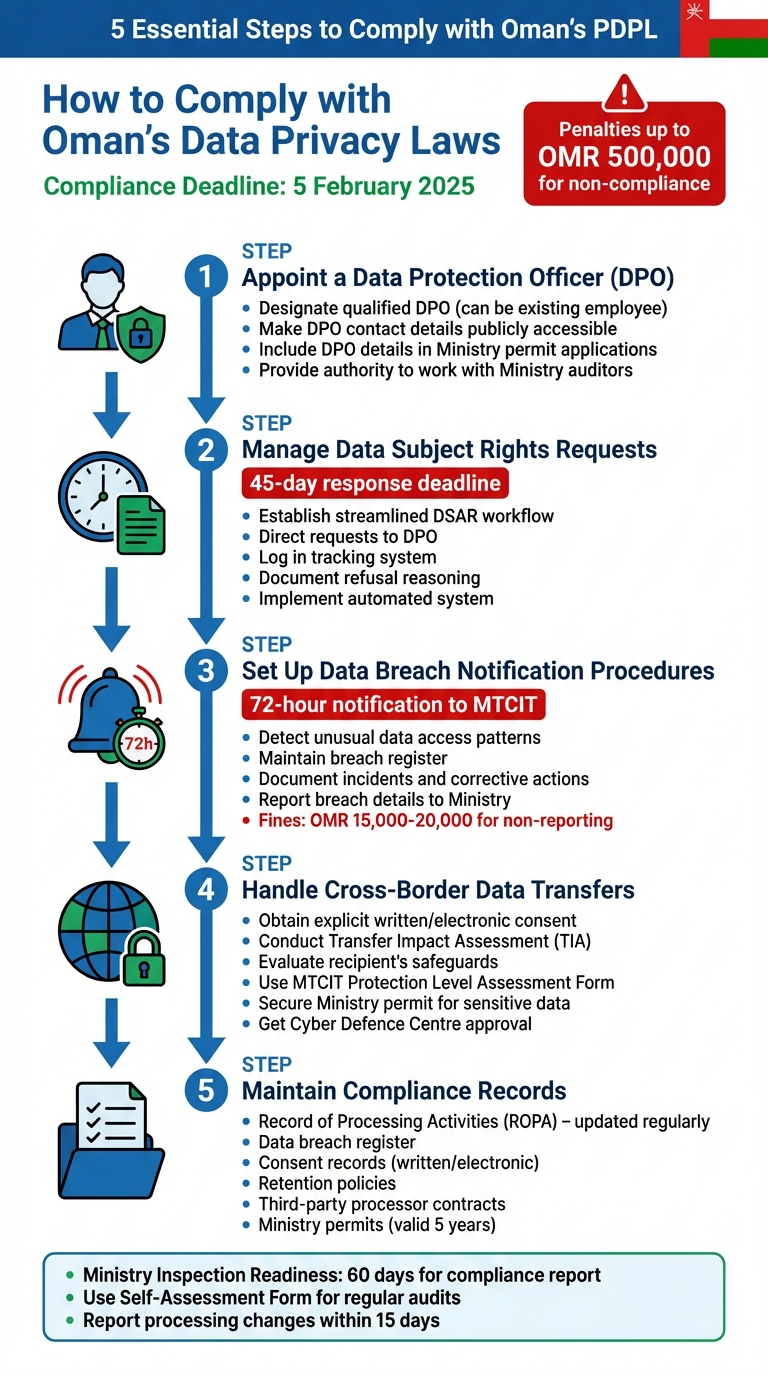
5 Essential Steps to Comply with Oman's PDPL by February 2025
By 5 February 2025, organisations handling the personal data of Omani residents must ensure their systems and processes fully comply with the Personal Data Protection Law (PDPL). Non-compliance could result in penalties of up to OMR 500,000. Below are the critical steps to align with PDPL requirements.
Appointing a Data Protection Officer (DPO)
Under Oman's regulations, every organisation processing personal data must designate a Data Protection Officer (DPO). This role can be assigned to an existing employee, provided they possess a strong understanding of the PDPL and its Executive Regulations.
The DPO's contact details must be made publicly accessible, enabling data subjects to exercise their rights. Thomas Wigley, Partner at Trowers & Hamlins, explains:
"The wording of the PDPL and Executive Regulation does not state that a personal data protection need be appointed, but rather a personal data protection officer be designated".
When applying for permits to process sensitive data, include the DPO’s professional details in your submission to the Ministry of Transport, Communications and Information Technology (MTCIT). Ensure the DPO is equipped with the authority and resources to work alongside Ministry-accredited external auditors who may inspect your systems.
Managing Data Subject Rights Requests
Efficiently handling Data Subject Access Requests (DSARs) is a key component of compliance. Organisations must respond to such requests within 45 days. Establish a streamlined workflow that directs DSARs to the DPO, logs them in a tracking system, and assigns responsibility for investigation and resolution.
If you refuse a request, document your reasoning thoroughly, as you may need to justify your decision to both the data subject and the Ministry during inspections. For deletion requests, confirm that the data is no longer needed for its original purpose or that the individual has withdrawn consent before proceeding with deletion.
To meet the 45-day deadline, consider implementing an automated system. Missing this deadline can lead to fines and harm your organisation’s reputation.
Setting Up Data Breach Notification Procedures
In the event of a data breach that could impact data subjects' rights, you must notify the MTCIT within 72 hours. Failure to report breaches can result in fines between OMR 15,000 and OMR 20,000.
Your breach response plan should include tools to detect unusual data access patterns and a breach register to document incidents, their effects, and the actions taken to address them. When reporting to the Ministry, provide details about the breach, its impact, and the corrective measures implemented. This register not only meets regulatory requirements but also serves as crucial evidence during inspections.
Handling Cross-Border Data Transfers
Cross-border data transfers require careful oversight to ensure compliance. Obtain explicit consent from the data subject - either written or electronic - unless specific exemptions apply. Additionally, conduct a Transfer Impact Assessment (TIA) to confirm that the recipient adheres to data protection standards equivalent to Omani law. Kellie Blyth, Partner at Addleshaw Goddard, emphasises:
"The Regulations therefore place greater onus on Controllers to take their obligation to carry out the transfer impact assessments... seriously".
Unlike the GDPR, Oman does not maintain a "whitelist" of approved countries or pre-approved Standard Contractual Clauses. Instead, organisations must evaluate each recipient's technical and organisational safeguards to prevent unauthorised access or data destruction. Use the official Protection Level and Risk Assessment Form provided by the MTCIT to document your findings.
For sensitive data - such as health, genetic, biometric, ethnic, political, religious, or criminal information - you must secure a permit from the MTCIT and obtain specific approval from the Cyber Defence Centre before processing or storing the data outside Oman. Consent is not required if the transfer serves an international treaty obligation or if the data is fully anonymised to prevent identification. Keep all assessment records readily available for Ministry review, as unlawful cross-border transfers can result in fines of up to OMR 500,000.
sbb-itb-058f46d
Keeping Compliance Records and Audit Trails
Good documentation is your strongest ally during inspections. According to Articles 27 and 28 of the Executive Regulations, organisations are required to maintain a Record of Processing Activities (ROPA). This document must outline essential details about data processing and is not a one-off task - it needs to be updated regularly and kept readily accessible. Essentially, it acts as a bridge between operational compliance and audit readiness.
In addition to the ROPA, organisations must also keep a data breach register. This register should detail every incident, including the facts, its impact, and the steps taken to address it. Alexandra Bertz, a Middle East Data Protection Expert at Pinsent Masons, highlights the urgency of these measures:
"Oman entities need to move quickly to put their record of processing activities, retention policies, privacy policies, and security systems and measures in place to ensure compliance with the Oman PDPL".
Building a Data Processing Inventory
Effective documentation starts with a thorough data mapping exercise. Martin Hayward, Partner at Pinsent Masons, explains its importance:
"The data mapping exercise should flow into a record of data processing activities to enable Omani companies to effectively document their data processing activities, as required under the PDPL".
Your inventory should clearly separate general personal data from sensitive categories, such as health, genetic, or biometric information, which require Ministry permits valid for five years. It should also specify retention periods for each type of data and include technical measures for secure storage. Keeping an up-to-date ROPA and documenting third-party processors with formal contracts is equally essential.
Recording Consent and Data Breaches
Before processing personal data or sending marketing communications, you must log explicit written or electronic consent from data subjects. These consent records should clearly demonstrate that permission was given freely, without any coercion, and must be easy to retrieve during inspections.
For your breach register, ensure every incident is recorded promptly, even if the risk appears minimal. Include details such as the discovery date, the nature of the breach, affected individuals, potential impacts, and corrective actions taken. This register is critical for showing that you've met your obligations under the PDPL and responded appropriately to security incidents. Such detailed documentation ensures you're prepared for audits by the Ministry.
Getting Ready for Ministry Inspections and Audits
The Ministry of Transport, Communications and Information Technology (MTCIT) may require organisations to appoint an independent, Ministry-accredited external auditor. This auditor must deliver a compliance report within 60 days of their appointment. To identify compliance gaps beforehand, use the Ministry's official Self-Assessment Form. Martin Hayward underscores the broad obligations placed on companies:
"The PDPL places broad obligations on Omani companies to cooperate with the Ministry, to appoint external auditors, and to provide any information and documentation relating to its PDPL compliance, as requested by the Ministry".
To stay ready, centralise all compliance-related documents, including your ROPA, breach register, consent records, retention policies, DPO appointment details, and permits for sensitive data. Ensure these records are easily accessible. The Ministry typically expects responses to their information requests within 30 days. Non-compliance can result in administrative fines of up to OMR 2,000 per violation, while serious breaches may lead to court-imposed penalties of up to OMR 500,000.
Conclusion: Maintaining Compliance with Oman's Data Privacy Laws
Let’s wrap up by focusing on the key steps to ensure your business stays aligned with Oman’s data privacy regulations.
Main Actions for Staying Compliant
Staying compliant with the Personal Data Protection Law (PDPL) isn’t a one-time task - it requires ongoing attention. Since the grace period ended on 5 February 2025, businesses are now expected to fully adhere to the Executive Regulations. Here’s what you need to prioritise:
- Appoint a qualified Data Protection Officer (DPO): This role is essential for overseeing compliance efforts.
- Keep your Record of Processing Activities (ROPA) updated: This document is crucial for tracking how data is handled.
- Respond to Data Subject Access Requests (DSARs) within 45 days: Timely responses are a legal requirement.
- Implement strong technical controls: These should include a 72-hour breach notification protocol to address potential data breaches.
To maintain compliance, use the Ministry’s Self-Assessment Form for regular audits. This helps identify any gaps in your processes. If you handle sensitive data, remember that Ministry permits are valid for five years and need renewal. Additionally, any changes in processing activities must be reported within 15 days.
The financial consequences of non-compliance are steep. Administrative fines can go up to OMR 2,000 per violation, while severe breaches could result in court-imposed penalties of up to OMR 500,000. By following these steps, you’ll establish a solid, audit-ready compliance framework.
How Wick Can Help with Compliance

Navigating compliance while managing customer data effectively can be challenging. That’s where Wick’s Four Pillar Framework comes in. It’s designed to help businesses build data-driven strategies that not only meet regulatory requirements but also support growth.
- Capture & Store: Wick implements systems like data analytics and customer journey mapping, which naturally align with compliance needs. These tools also help maintain essential documentation, such as the Record of Processing Activities.
- Tailor & Automate: This pillar focuses on creating marketing automation systems with consent management and transparent data handling built right in. This ensures your communications meet the PDPL’s explicit consent standards.
FAQs
What are the key steps to appoint a Data Protection Officer (DPO) under Oman’s Personal Data Protection Law (PDPL)?
To appoint a Data Protection Officer (DPO) under Oman’s Personal Data Protection Law (PDPL), your organisation needs to take a structured approach. Here’s how:
- Understand the legal requirements: First, review the PDPL to see if your organisation is obligated to appoint a DPO. This is usually necessary for businesses that manage large volumes of personal data or handle sensitive information.
- Define the DPO's responsibilities: Clearly outline the role to ensure it aligns with PDPL guidelines. Typical duties include developing data protection strategies, ensuring compliance, and acting as a liaison with regulatory authorities.
- Identify a qualified candidate: Look for someone with strong knowledge of data protection laws and practices. This could be an existing employee or an external consultant, depending on your organisation’s structure and needs.
- Provide adequate support and training: Make sure the DPO has the tools, authority, and training they need to carry out their responsibilities effectively.
Following these steps not only ensures compliance with the PDPL but also strengthens trust with your customers and stakeholders.
What steps should businesses take to handle Data Subject Access Requests (DSARs) within the 45-day deadline under Oman’s data privacy law?
To comply with Oman’s Personal Data Protection Law (PDPL), businesses need a well-organised approach to handle Data Subject Access Requests (DSARs) within the required 45-day period. Here’s a guide to get it right:
- Create a dedicated channel: Set up a specific email address or an online portal for receiving DSARs. Make sure this information is easy to find in your privacy policy.
- Confirm the requester’s identity: Use minimal but sufficient documentation, like a government-issued ID, to verify the requester and avoid unnecessary delays.
- Locate and gather the data: Use your data processing inventory to pinpoint where the individual’s personal data is stored. This includes databases, backups, and any third-party processors you work with.
- Provide the response securely: Deliver the requested data in a commonly used format, such as PDF or CSV, and ensure it’s sent through encrypted email or a secure file-sharing platform.
By regularly reviewing and refining your DSAR process, you can stay compliant, minimise the risk of penalties, and show regulators that your business takes privacy seriously. This approach not only meets legal requirements but also helps build trust with your customers.
What should businesses know about cross-border data transfers under Oman's data privacy laws?
When moving personal data outside Oman, businesses must stick to specific rules outlined in the country's data privacy laws. Here’s what they need to keep in mind:
- Consent is key: Businesses must get explicit written consent from the data subject before transferring their data internationally. This step ensures clarity and aligns with legal expectations.
- A solid agreement matters: A written agreement with the receiving party is essential. This document should clearly state the purpose of the transfer, outline security measures, and define responsibilities. While the law doesn’t specify exact clauses, having this agreement shows accountability and preparedness.
- Check the destination’s data protection standards: The receiving country must have an adequate level of data protection. If it doesn’t, businesses can use alternatives like standard contractual clauses or recognised certifications to bridge the gap. Additionally, companies might need to follow guidelines or complete forms issued by the Ministry of Transport, Communications, and Information Technology (MTCIT) to get regulatory approval.
By meeting these requirements, businesses can handle cross-border data transfers responsibly while reducing the risk of legal issues.