

Blog / Customer Journey Analytics: Insights
Customer Journey Analytics: Insights
Customer journey analytics helps businesses understand how customers interact with them across multiple channels and devices. By analysing data from websites, social media, emails, SMS, and more, companies can identify where customers engage or drop off, improving experiences and boosting results.
Here’s why it matters:
- 88% of customers value their experience with a brand as much as the product.
- Companies using analytics report a 90% reduction in data delays and 62% better personalisation.
- AI tools predict behaviours, personalise campaigns, and improve engagement by 3x.
For the UAE, industries like retail, banking, and aviation are already leveraging these tools. Emirates Airline and Emirates Islamic Bank, for example, have used analytics to improve customer satisfaction and loyalty, achieving higher Net Promoter Scores and rankings.
AI-powered tools now allow businesses to act in real-time, automate processes, and predict customer needs. Unified platforms also integrate data across systems, creating a full view of customer behaviour. This shift is no longer optional - it's key to staying competitive in today’s market.
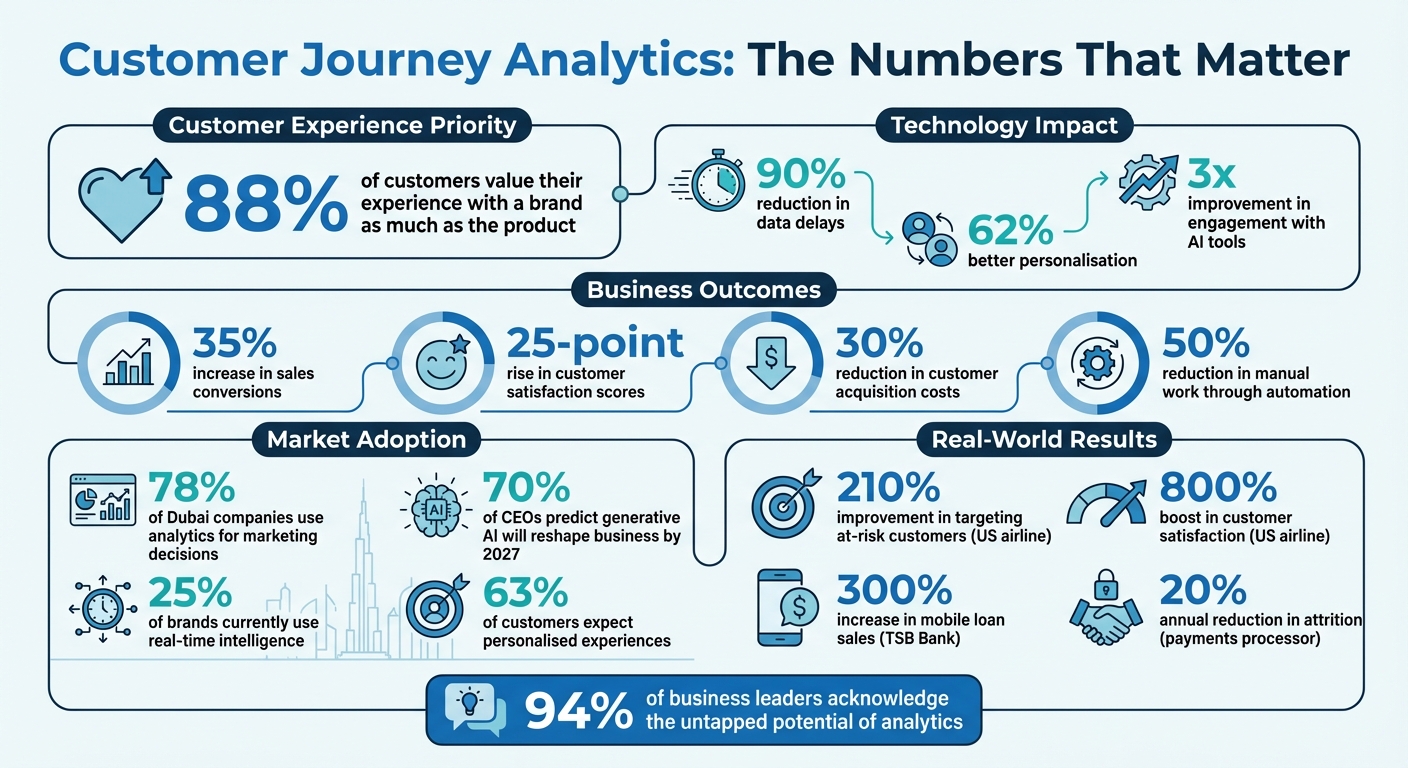
Customer Journey Analytics Impact: Key Statistics and ROI Metrics
Customer Journey Analytics Overview
AI and Technology in Customer Journey Analytics
AI is revolutionising how businesses turn data into actionable insights. With its ability to process information instantly, companies can now analyse customer behaviour in real time. For instance, while 70% of CEOs predict that generative AI will reshape how businesses create and deliver value by 2027, only 25% of brands are currently equipped to adjust their communication timing and cadence using real-time intelligence. The evolution from descriptive to predictive analytics means businesses are no longer just looking back at what happened - they’re anticipating what’s next. AI tools allow for continuous testing of content variations and fine-tuning of communication timing, making it easier to scale customer journey strategies. This is especially relevant in the UAE, where customers expect timely, personalised interactions at every touchpoint. By leveraging real-time analytics, AI delivers insights that enable businesses to make quick, informed decisions to enhance customer experiences.
AI-Powered Insights for Real-Time Decisions
AI tools are empowering non-technical teams to dive into data without any coding knowledge. With natural language prompts, marketing teams can explore customer behaviour, map data relationships, and get instant answers. Generative AI also powers Customer Digital Twins (CDTs), which simulate customer behaviour, predict churn risks, and forecast purchasing patterns before they happen.
A compelling example of AI-driven decision-making comes from a US airline in 2025. Instead of offering generic vouchers for flight delays, the airline used machine learning to personalise compensation based on customer value. Frequent flyers who had experienced multiple delays were prioritised over occasional travellers. The results? A 210% improvement in targeting at-risk customers, an 800% boost in customer satisfaction, and a 59% drop in churn rates among high-value customers.
Next Best Experience (NBE) engines take personalisation to the next level by answering a simple but powerful question: "What does this customer need most right now?". An Italian telecommunications company applied this approach in 2024–2025 after noticing a 45% spike in weekend data usage for a particular family. Over three days, the system sent a customised email with plan options, deployed an in-app assistant to simulate future bills, and arranged a call with a human advisor, supported by an AI-generated summary. This initiative led to a 5% increase in incremental revenue and a 30% margin impact within a year.
"The AI-powered next best experience capability can enhance customer satisfaction by 15 to 20 percent, increase revenue by 5 to 8 percent, and reduce the cost to serve by 20 to 30 percent." - Lars Fiedler and Nicolas Maechler, Partners, McKinsey & Company
Unified Platforms for Better Customer Experience
AI insights are only as good as the platforms they operate on. Unified platforms bring together customer data from multiple sources to create a seamless, 360-degree view. Companies often collect data across 15–20 systems but use less than 40% of it for decision-making. Unified platforms solve this problem by breaking down silos and connecting customer identities across both online and offline channels. For example, Adobe Customer Journey Analytics reduces data delays by 90%, enabling businesses to act on insights almost instantly.
Modern systems use advanced identity resolution engines to unify customer profiles across devices and channels. By employing graph-based stitching, these platforms match datasets with different identifiers without relying on traditional ETL processes. This means businesses can create a complete customer profile in milliseconds, enabling sub-second real-time processing for live analytics and responsive interfaces.
One standout example is a payments processor that used machine learning to create a digital twin of daily merchant interactions. This model predicted which merchants were likely to reduce business within a week. By automating interventions like fee waivers or technical fixes for specific merchant clusters, the company achieved a 20% annual reduction in attrition.
Karen Hopkins, Global CMO at EY, highlights the importance of integration:
"I've always had a vision of looking at marketing data more holistically from an account perspective - not an easy task when dealing with global clients and organisations. Adobe solutions work together to help us connect teams and find more proactive ways to work with clients."
Trends Shaping Customer Journey Analytics in 2026
AI-Powered Personalisation
The days of broad customer segmentation are fading, giving way to AI-driven micro-segmentation that adapts to individual needs in real time. Consider this: while 71% of consumers expect brands to predict their needs with tailored offers or useful insights, only 31% of businesses update their offers based on recent customer activity.
Take TSB Bank as an example. In 2024, they implemented real-time personalisation for loan offers. According to Emma Springham, their CMO, this approach led to a staggering 300% increase in mobile loan sales. Additionally, in-app applications surged from 24% to 75% of total sales. Telmore took a similar route, using AI to personalise offers at an individual level rather than targeting broad audiences. The result? An 11% boost in sales.
Looking ahead, organic B2C searches conducted through AI platforms are expected to hit 20% by 2027. This shift emphasises the importance of creating AI-native content that directly addresses specific customer queries. The push for hyper-personalised experiences demands a more dynamic and comprehensive approach to orchestrating customer journeys.
End-to-End Customer Journey Management
Today’s customer journeys are anything but straightforward. Gone are the days of static journey maps; modern paths to purchase are intricate, with customers engaging in an average of seven meaningful interactions before making a decision. These journeys often branch out, loop back, and evolve, requiring brands to dynamically manage touchpoints in real time.
Predictive analytics and real-time behavioural data now allow businesses to move beyond simply understanding customer needs - they can anticipate them. Yet, challenges remain. While 70% of executives admit that customer expectations are evolving faster than their organisations can keep up, 52% of consumers have stopped buying from a brand after just one poor experience. To navigate this landscape, companies need strong governance, including clear decision-making frameworks, to empower teams to innovate confidently.
By 2027, 30% of organisations are expected to adopt agentic AI capabilities. These include autonomous agents that handle tasks like scheduling, troubleshooting, and even recommending products proactively. Such advancements could redefine how businesses manage the customer journey from start to finish.
Data Unification and Practical Insights
Achieving a unified view of the customer remains a tough challenge, with only 4% of brands successfully maintaining a real-time, holistic perspective due to fragmented data systems. This is where structured data frameworks like the Experience Data Model (XDM) come into play. The XDM standardises behavioural and trait-based data, linking online and offline interactions to a single, cohesive customer profile.
Brands that have embraced unified analytics report impressive results: a 62% rise in personalised campaign creation and a 90% reduction in data latency.
"Taking time upfront to structure data at scale unlocks efficiencies, creates synergies, and leads to better outcomes in data management."
- Max Cuellar, VP of Marketing Strategy at Adobe
Despite these benefits, only 12% of organisations have implemented AI solutions that deliver a clear and measurable return on investment. This highlights a pressing need to bridge the gap between unifying data and achieving tangible business outcomes. By leveraging structured insights, companies can refine their marketing strategies to drive measurable results effectively.
sbb-itb-058f46d
How Customer Journey Analytics Affects Marketing Strategies
Improving Customer Engagement and Retention
Customer journey analytics helps businesses pinpoint the exact moments where customers lose interest - like abandoning their carts or logging in less frequently. This data highlights where improvements can be made, from refining messaging to enhancing user experiences.
By integrating customer journey insights, businesses have been able to personalise interactions more effectively and respond faster, thanks to reduced data delays. For example, real-time triggers can initiate actions like sending discount codes when a cart is abandoned or deploying chatbots to assist customers immediately.
Machine learning takes this a step further by predicting churn before it happens. By spotting early warning signs, businesses can launch proactive measures such as loyalty campaigns or personalised offers tailored to individual behaviours. Companies using these approaches have reported a 35% increase in sales conversions and a 25-point rise in customer satisfaction scores.
"I've always had a vision of looking at marketing data more holistically from an account perspective - not an easy task when dealing with global clients and organizations. Adobe solutions work together to help us connect teams and find more proactive ways to work with clients."
- Karen Hopkins, Global CMO, EY
Automation also plays a key role. Marketing teams have cut 50% of manual work by automating data alignment, which improves campaign responsiveness and agility. Campaigns that leverage journey analytics achieve 3x higher engagement rates compared to generic strategies. Considering that 88% of customers value their experience as much as the product itself, these insights are crucial for keeping customers loyal.
These advancements not only improve customer engagement but also ensure budgets are used more efficiently, ultimately boosting ROI.
Data-Driven Campaigns for Better ROI
Without clear data, marketers often waste 40% of their budgets on underperforming channels. Customer journey analytics eliminates this guesswork by identifying which touchpoints - like Instagram ads or email campaigns - drive the most sales. This allows businesses to focus their spending on what works.
In Dubai, 78% of companies now rely on analytics rather than intuition to make marketing decisions. This data-driven approach has proven effective, with AI predictions lowering customer acquisition costs by 30% and increasing customer lifetime value. Cross-channel attribution ensures every Dirham spent is tracked, from the first ad click to the final purchase.
Technical issues can also impact performance. For instance, mobile sites that take longer than two seconds to load lose 53% of their users. Analytics can identify these bottlenecks - like slow checkout pages or confusing navigation - that hurt conversion rates. Businesses that address these issues have seen a 10% boost in site traffic and a 10% rise in average order value.
Real-time optimisation is another game-changer. Businesses can dynamically adjust strategies, such as increasing PPC bids during peak hours or sending personalised offers when carts are abandoned. Predictive demand forecasting uses both historical and live data to anticipate seasonal trends, helping brands allocate ad budgets more effectively before busy periods.
"In Dubai's data deluge, winners don't just collect numbers - they connect them to human behavior."
Wick's Four Pillar Framework in Practice
Wick has built on these data-driven insights with its Four Pillar Framework, creating marketing strategies tailored to the UAE's diverse market. This framework combines analytics with actionable steps to deliver measurable results.
The Build & Fill and Plan & Promote pillars focus on foundational tasks like website development, content creation, SEO, and paid ads. Meanwhile, the Capture & Store pillar consolidates data from CRMs, social media, and sales channels into unified customer profiles, eliminating blind spots.
The final pillar, Tailor & Automate, uses this consolidated data to power AI-driven personalisation. For instance, in the UAE, campaigns can dynamically switch between Arabic and English based on user behaviour or IP location. Using Arabic content has been shown to boost consumer trust by 67%, while personalised campaigns achieve 3x higher engagement rates compared to generic ones.
Wick's Customer Data Platform (CDP) enables real-time decision-making, identifying the next-best action across multiple touchpoints. This is critical in a market where 63% of customers expect personalised experiences and are willing to switch to competitors if those expectations aren’t met. By automating processes and leveraging behavioural data, Wick turns fragmented insights into cohesive strategies, driving both efficiency and growth.
Conclusion
The UAE is at a critical point where using AI-powered customer journey analytics is no longer optional but essential for growth. Businesses tapping into predictive insights are seeing impressive results, such as a 90% reduction in data latency, a 35% increase in sales conversions, and a 25-point rise in customer satisfaction scores. These numbers aren’t just theoretical - they’re backed by success stories from leading UAE brands.
Take Emirates Airline and Emirates Islamic Bank, for example. Both have embraced real-time analytics to refine their customer experiences. Their achievements highlight an important truth: customer journey analytics isn’t a one-off initiative. Instead, it’s an evolving process that must keep pace with shifting market dynamics.
In today’s digital-first world, UAE businesses need to treat customer journey analytics as a continuous effort that blends cutting-edge AI with a personal touch. This balance is especially crucial in a region where personalised service holds significant cultural importance. As Gonçalo Traquina of KPMG Lower Gulf aptly put it:
"In the AI era, CX leadership belongs to those who build with trust, scale with purpose, and never lose sight of the human behind the screen".
This means using AI to handle routine tasks while keeping human agents at the forefront of sensitive interactions. Unified platforms can eliminate data silos, and AI-driven personalisation - tailored to the UAE’s diverse customer base - can deepen engagement and create a competitive edge.
The businesses that thrive are those that act quickly, turning data into actionable insights in real time. With 94% of business leaders acknowledging the untapped potential of analytics, the real question isn’t whether to adopt these tools but how quickly they can be implemented to stay ahead in the fast-changing digital landscape.
FAQs
How does AI enhance real-time customer journey analytics?
AI takes customer journey analytics to a new level by analysing data from various channels in real-time. It spots trends, delivers actionable insights, and automates adjustments based on live customer behaviour.
With AI, marketers can adapt campaigns on the fly, tailor communications to individual preferences, and respond to customer needs immediately. This ensures a smooth, engaging experience across every interaction point.
What are the advantages of using a unified platform for customer data?
A unified customer data platform gives businesses a clear, centralised view of every customer interaction - whether it happens online, in-store, through email, or on social media. By bringing together data from all these touchpoints into one system, businesses can create more accurate audience segments, pinpoint challenges, and leverage AI-driven insights to predict customer behaviour, such as the likelihood of churn. This eliminates the need to juggle disconnected dashboards, saving valuable time and allowing teams to concentrate on more strategic goals.
For businesses in the UAE, these platforms also simplify compliance with local data regulations and enable personalised marketing tailored to regional tastes. This can result in better conversion rates and higher average order values in د.إ. Wick’s expertise in data-driven marketing supports the creation of these unified systems, combining tools like website development, SEO, social media management, and analytics into a single AI-powered framework designed for long-term growth.
How can businesses use predictive analytics to improve customer engagement?
Predictive analytics empowers businesses to anticipate customer needs by analysing both past and real-time data. It helps forecast behaviours such as how often a customer might make a purchase, their likelihood of leaving, or their overall lifetime value. These insights allow businesses to engage customers on a more personal level by delivering the right message at the right time, ultimately improving satisfaction and loyalty.
Wick’s Four-Pillar Framework takes this concept further by combining predictive models with AI-powered personalisation. This approach helps UAE-based businesses design strategies that align with local preferences. For example, forecasts are tailored with AED (د.إ) for monetary values, DD-MM-YYYY for dates, and metric measurements for performance tracking. With these insights, brands can fine-tune customer segmentation, send timely communications, and effectively track their outcomes. The result? A more engaging, personalised experience that not only reduces churn but also supports long-term growth.