

Blog / Customizing Martech Stacks for Evolving Needs
Customizing Martech Stacks for Evolving Needs
The marketing technology (martech) landscape has exploded from 150 tools in 2011 to over 15,000 in 2025. Yet, only 33% of their capabilities are being used, with 44% of stacks underutilised and 65% of marketers struggling with data integration. This complexity and lack of flexibility lead to wasted budgets, operational inefficiencies, and stifled growth.
To address these challenges, start by auditing your tools, evaluating their integration, and aligning them with business goals. Key steps include:
- Auditing Tools: Identify underused, redundant, or costly platforms.
- Improving Integration: Map data flows and eliminate inefficiencies.
- Modular Systems: Build flexible stacks using open APIs and composable architectures.
- Continuous Optimisation: Conduct regular audits, set KPIs, and encourage cross-team collaboration.
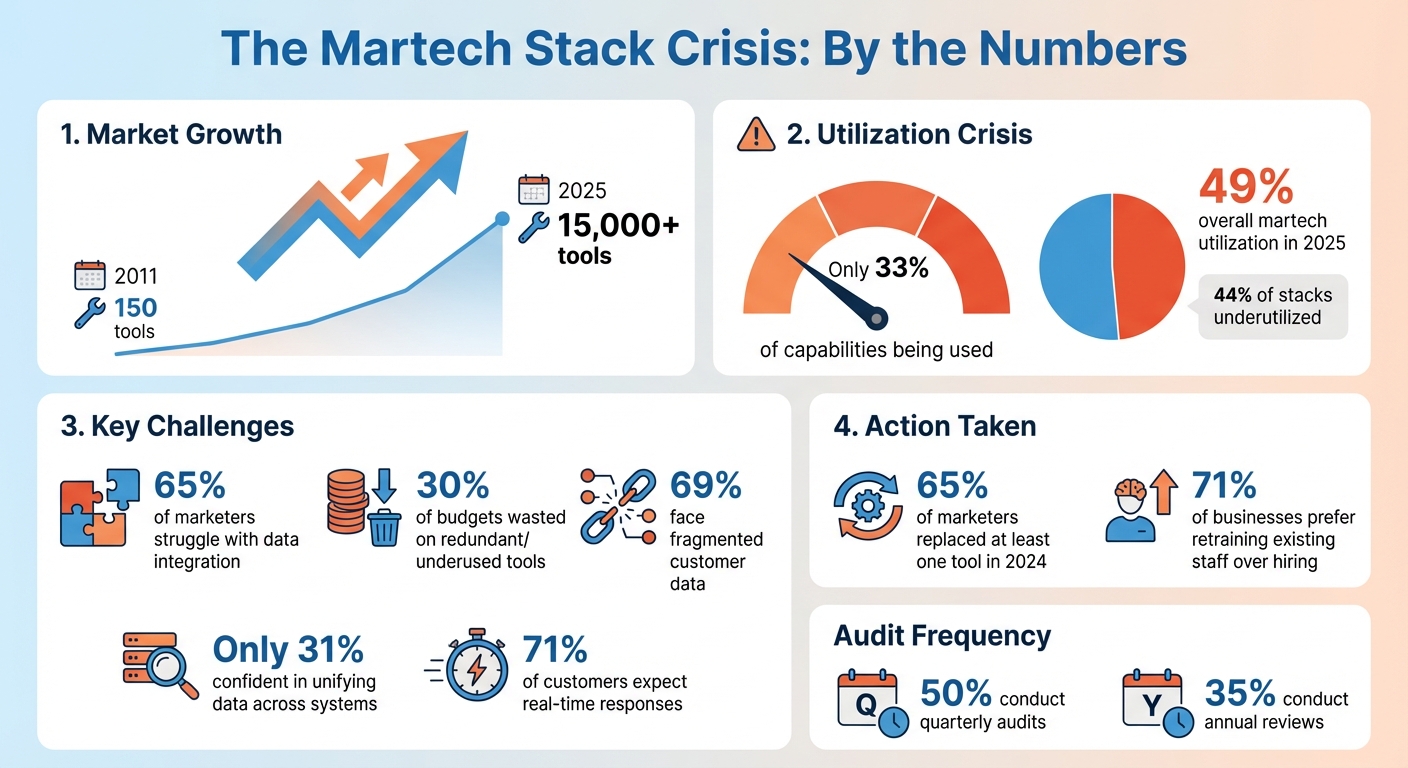
Martech Stack Challenges and Utilization Statistics 2025
Identifying Problems in Your Martech Stack
Auditing Your Current Tools
Start by taking a close look at your martech stack. Create a detailed inventory that includes each tool's name, purpose, cost, owner, and how often it's used. This step ensures you have a clear picture of what you're working with.
Speak with the users of these tools to uncover any unapproved platforms or hidden features. Sometimes, these hidden functionalities can replace entire systems, helping you cut unnecessary expenses. This is critical, especially when studies reveal that 30% of a company's martech budget is often wasted on redundant or underutilised tools.
To streamline decision-making, use a decision matrix to categorise each tool into one of four actions:
- Keep: High usage and strong ROI.
- Train: Low usage but high potential ROI.
- Replace: High usage but poor ROI.
- Cut: Low usage and poor ROI.
With a well-organised inventory, you can shift your attention to how these tools work together across your processes.
Evaluating Integration Depth
Once your inventory is sorted, the next step is to assess how well your tools integrate. Map out the data flow - from the initial customer interaction to the final reporting stage. This will help you pinpoint any bottlenecks or redundancies.
Look for signs of inefficiency, like manual CSV transfers. These manual processes often indicate a lack of automation and can slow down your ability to respond in real-time - something that 71% of customers now expect.
Scott Brinker, VP Platform Ecosystem at HubSpot, sums up the importance of integration:
"When you think about how you're designing your martech stack and which products you're adopting, are they open? Do they have open APIs? Do they allow it to fit into an ecosystem where you can add new things or remove new things relatively easily?"
Pay special attention to whether your "systems of truth", such as your CRM or customer data platform, are properly linked to your "systems of context", like engagement tools. Without this connection, customer data remains fragmented - a challenge faced by 69% of marketers, with only 31% feeling confident in their ability to unify data across systems.
Aligning Tools with Business Objectives
After reviewing tool usage and integration, the final step is to ensure each tool aligns with your business goals. Evaluate how each platform contributes to key objectives like lead generation, customer retention, and ROI.
Lisa Heay, Vice President of Business Operations at Heinz Marketing, puts it succinctly:
"Technology needs to support your marketing strategy, not be your marketing strategy"
If a tool can't clearly show its contribution to these goals, it might be draining resources without delivering meaningful results. Group your tools by their function to identify areas where you're overspending or neglecting critical needs. This approach ensures your martech stack is fine-tuned to deliver maximum performance.
Solutions for Customising Martech Stacks
Audit and Consolidate Tools
Start by identifying tools in your martech stack that overlap or go unused. Research shows that 30% of budgets are wasted on duplicate tools, while only 33% of capabilities are fully utilised. By conducting a thorough audit, you can streamline workflows and achieve measurable returns on investment.
To make this process effective, involve key stakeholders like IT, Finance, and Legal, and secure buy-in from C-level executives. Use contract renewal dates as checkpoints to evaluate whether to keep or replace software, avoiding automatic renewals for tools that deliver low returns. When transitioning to new tools, always test integrations in sandbox environments to minimise risks. Instead of hiring new staff to manage these changes, consider retraining your existing team - a strategy successfully adopted by 71% of businesses.
Once you've trimmed inefficiencies, focus on creating a more flexible system.
Adopt Modular and Composable Architectures
Traditional martech systems can lock you into a single vendor, making it hard to adapt as your needs change. Modular architectures, on the other hand, let you build your stack like LEGO blocks: independent components that can be swapped in or out without disrupting the entire system. This flexibility not only eliminates vendor lock-in but also accelerates deployment, thanks to pre-built components and open APIs.
Scott Brinker, VP Platform Ecosystem at HubSpot, explains the advantage:
"When you think about how you're designing your martech stack and which products you're adopting, are they open? Do they have open APIs? Do they allow it to fit into an ecosystem where you can add new things or remove new things relatively easily? ... if you've designed your stack in a way that makes that easier, I think that's a true competitive advantage".
To make the most of this approach, start by establishing a strong data foundation. A Customer Data Platform (CDP) can act as your stack's central hub, ensuring seamless data flow across all tools. Additionally, mapping tools along the campaign lifecycle can help you spot gaps or redundancies. Think of this as a "solar system" model: a stable core of essential tools surrounded by specialised, interchangeable components that adapt as your needs evolve.
This modular strategy also aligns well with structured frameworks like Wick's Four Pillar Framework.
Leverage Wick's Four Pillar Framework

In the UAE, Wick's Four Pillar Framework offers a structured approach to building a martech stack. The framework divides key marketing functions into four pillars:
- Build & Fill: Focuses on website development, content creation, and managing social media.
- Plan & Promote: Covers SEO, paid advertising, and influencer partnerships.
- Capture & Store: Centres on data analytics and mapping customer journeys.
- Tailor & Automate: Includes marketing automation, personalisation strategies, and AI-driven content.
This framework complements the modular architecture philosophy. Each pillar addresses a specific function but operates through a unified data layer - typically powered by a CDP. This ensures customer data flows seamlessly across all touchpoints. The beauty of this approach is its scalability: you can start with the pillars that align with your immediate goals and expand as your business evolves. Whether you're a small business building an online presence or a large enterprise transforming your digital ecosystem, this framework provides a clear roadmap for success.
Building the perfect marketing tech stack, presented by HubSpot
sbb-itb-058f46d
Establishing Continuous Optimisation Practices
Keeping your martech stack in top shape isn’t a one-and-done task. After the initial setup and customisation, regular optimisation is key to maintaining its performance and ensuring it adapts to your changing business needs. The numbers paint a stark picture: martech utilisation has dropped to just 49% in 2025. That means more than half of your investment could be sitting idle. To avoid this, you need structured, ongoing practices to keep your stack relevant and effective.
Implement Regular Audits and Reviews
Set up a routine for audits - biannual deep dives with quarterly check-ins work well - to track how your tools are being used and how they’re performing. During these reviews, take note of each tool's purpose, costs, ownership, and usage. To make this process easier, organise your stack into functional layers like Data (e.g., CDPs, Warehouses), Intelligence (e.g., Analytics, AI), Engagement (e.g., CMS, CRM), and Channels (e.g., Email, Social). This structure helps you quickly spot gaps or overlaps in your tools.
Here’s an interesting stat: 50% of marketing operations professionals conduct quarterly audits, while 35% opt for annual reviews. The more frequent reviews can help you catch issues early, which is especially important since 65% of marketers replaced at least one tool in 2024 due to costs, integration issues, or shifting requirements.
Another helpful tactic is creating visual diagrams that map how data flows between your systems. Gartner highlights the value of such visualisations:
"A stack visualisation is an effective tool to help evangelise within the enterprise how martech enables capabilities that deliver on customer expectations and drive value".
These diagrams make it easier for stakeholders to see where data might be stuck in silos or where API connections have failed. Think of regular audits as the maintenance checks that keep your stack agile and ready to adapt.
Set Performance KPIs for Martech Tools
To make your optimisation efforts more focused, establish SMART KPIs (Specific, Measurable, Actionable, Relevant, Time-bound) for every tool in your stack. The most successful organisations measure activated capabilities instead of just focusing on individual platforms.
| KPI Category | Focus Metric | Purpose |
|---|---|---|
| Utilisation | Adoption Rate (%) | Identify underused or overly complex tools |
| Financial | ROI / Cost per Capability | Justify spending and eliminate redundancies |
| Operational | Integration Success Rate | Measure data flow and reduce silos |
| Strategic | Goal Alignment Score | Ensure tools align with business objectives |
Compare each tool’s cost with its actual usage. It’s worth noting that 30% of martech budgets are wasted on redundant or underused tools. Focus on tracking actionable metrics that directly drive improvements.
Rather than evaluating tools in isolation, group them by shared systems. For example, assess your customer data infrastructure (like CDPs, analytics, and data warehouses) as a single unit. This approach helps you identify bottlenecks and find scalable ways to improve performance. Clear KPIs give your team a roadmap for progress and make collaboration more effective.
Encourage Cross-Functional Collaboration
One of the biggest challenges in martech optimisation is breaking down silos between departments like marketing, IT, sales, and finance. When teams operate in isolation, you end up with "data islands" where tools don’t communicate, leading to wasted resources and a fragmented customer experience.
To address this, appoint platform champions - team members who can promote tool adoption and encourage cross-departmental communication. This strategy works well, as 71% of organisations prefer retraining existing staff on new tools instead of hiring new personnel.
Joint audits with all stakeholders are another effective way to foster collaboration. Marketing teams can highlight campaign needs, IT can ensure security and integrations, sales can track lead flow, and finance can monitor costs. This collective effort can uncover areas where manual work persists despite automation tools being available - a sign that better training or integration is needed.
Mapping workflows across departments can also help. For instance, visualising how leads move from marketing to sales can reveal integration gaps and dependencies. Designing systems with long-term outcomes in mind ensures that your martech stack remains consistent and effective over time.
Conclusion
Key Takeaways
Building a flexible martech stack is no longer optional - it's essential. With martech utilisation dropping to just 49% in 2025, more than half of your investment could be going to waste. As we've discussed, regular audits and modular architectures are key to keeping your stack aligned with your business needs. The solution lies in three main practices: flexibility, continuous optimisation, and purposeful customisation.
A composable architecture allows you to replace underperforming tools without disrupting your entire system. This approach avoids the headaches of transitioning from rigid, monolithic platforms. Conducting audits every three to six months helps uncover redundant tools and reallocates your budget to resources that drive results. Purposeful customisation ensures your tools are aligned with your business goals, giving you more control over your strategy.
The benefits? Lower costs, better scalability, and improved performance. As Scott Brinker, VP Platform Ecosystem at HubSpot, explains:
"If you've designed your stack in a way that makes [adding or removing tools] easier, I think that's a true competitive advantage".
Here’s a quick look at how flexible, customisable stacks outperform rigid ones:
Comparison of Rigid vs. Customisable Stacks
| Feature | Rigid Stacks | Customisable Stacks |
|---|---|---|
| Scalability | Limited by vendor's roadmap | High; add or remove modules as needed |
| Integration | Siloed tools with complex "middleware mazes" | Seamless via API-first architecture |
| Adaptability | Low; requires "rip and replace" | High; plug-and-play functionality |
| Cost Efficiency | High due to redundancy and unused features | Optimised; pay only for needed capabilities |
| Maintenance Complexity | High; legacy layers create technical debt | Moderate; requires governance but reduces long-term debt |
With the martech ecosystem now boasting over 15,000 tools in 2025, success won't come from simply having more tools. Instead, it will come from crafting a stack that evolves as quickly as your business does.
FAQs
How can businesses in the UAE adapt their martech stack to meet changing goals?
To make sure your martech stack keeps pace with changing business goals, start by setting specific, measurable objectives. For example, you might aim for a 20% boost in online revenue or aim to cut customer acquisition costs by AED 5,000,000. Work closely with your team and stakeholders to define key performance indicators (KPIs) that will guide your evaluation process and ensure every tool in your stack directly supports these goals.
Conducting regular audits of your existing tools can help uncover inefficiencies, close gaps, and eliminate unnecessary solutions. Taking a flexible, data-driven approach means you can adjust individual components as needed, rather than overhauling the entire system. By integrating data for a unified customer view and using AI-driven personalisation, your martech stack can remain efficient and ready to adapt to future demands.
For businesses in the UAE, teaming up with experts like Wick can simplify this process. Wick specialises in building connected digital ecosystems, offering services such as website development, SEO, marketing automation, and analytics. Their expertise can help you create a martech stack designed to support long-term growth.
What advantages does a modular martech stack offer for businesses adapting to change?
A modular martech stack gives businesses the freedom to adjust to changing marketing demands. With this setup, individual components can be added, swapped, or removed without disrupting the entire system. This ensures growth and flexibility while keeping things simple.
By taking this approach, companies can cut down on technical debt and reduce inefficiencies in their operations. The result? A streamlined system that's ready to incorporate new tools and AI-driven technologies as they emerge. This adaptability helps businesses stay competitive and responsive in a fast-paced market, keeping their marketing efforts sharp and efficient.
How often should businesses in the UAE review their martech tools to stay effective?
To keep your martech stack running smoothly and in line with your business's changing needs, it's a good idea to perform a thorough audit at least once a year. These regular check-ups help pinpoint outdated tools, fine-tune performance, and ensure your technology keeps up with shifting market trends and customer demands.
If you're in a fast-paced industry or your business is growing quickly, you might want to increase the frequency to every six months. This way, you can stay ahead of the curve and maintain your competitive advantage. Being proactive ensures your tools continue to add value and align with your long-term objectives.