

Blog / Data-Driven Ecosystem Design: Best Practices
Data-Driven Ecosystem Design: Best Practices
Building a data-driven ecosystem is no longer optional for businesses in the UAE. With the UAE's Digital Economy Strategy aiming to double the digital economy's GDP contribution to 19.4% by 2032, organisations must prioritise data integration, governance, and AI adoption to stay competitive.
Key takeaways:
- Data ecosystems improve sales by up to 85% and gross margins by 25%.
- The UAE's Digital Data Interoperability Framework and PDPL mandate secure, compliant data sharing.
- AI adoption among UAE businesses has reached 81%, making automation a necessity.
- The Four Pillar Framework - Build & Fill, Plan & Promote, Capture & Store, Tailor & Automate - provides a clear roadmap.
To succeed, businesses should prioritise scalable architecture, strong governance, unified data sources, and AI-driven tools while fostering a data-first culture. The right strategy aligns with UAE regulations and delivers measurable growth.
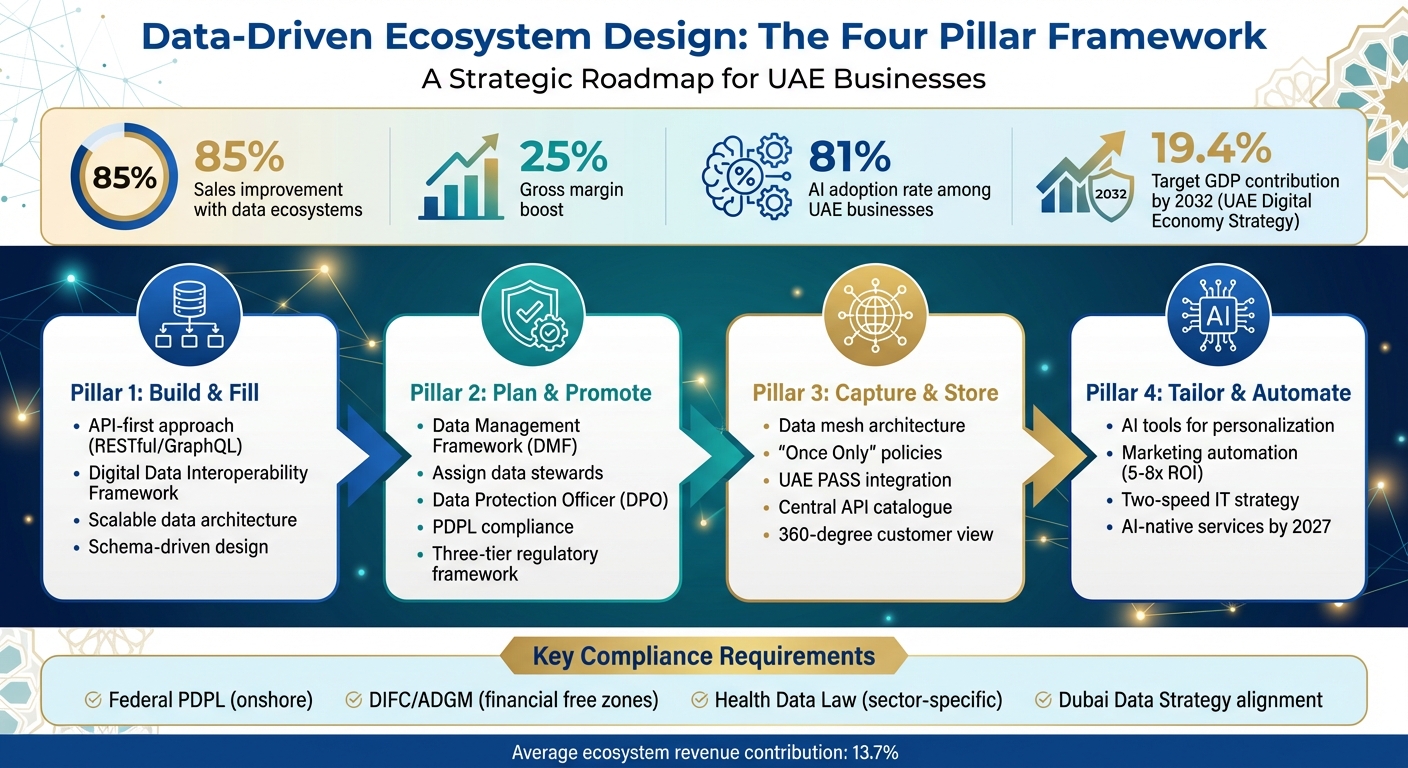
Four Pillar Framework for Data-Driven Ecosystem Design in UAE
AWS re:Invent 2019: Creating a data-driven, cloud-native ecosystem at BMW Group (AUT306)

Data-Driven Ecosystem Design Checklist
Creating a data-driven ecosystem requires a clear strategy that focuses on architecture, governance, integration, quality, and automation. By following this checklist, UAE businesses can align with national digital strategies and build scalable digital ecosystems based on the Four Pillar Framework.
Build a Scalable Data Architecture
Start with an API-first approach using RESTful or GraphQL APIs to separate data from presentation layers. This makes your system easier to scale and maintain. The UAE Design System underscores this principle:
"An API-first approach is essential for creating scalable, secure, and flexible applications".
Use the Digital Data Interoperability Framework to standardise data sharing across systems. This includes adopting common classifications for data openness and confidentiality, along with standardised exchange protocols. Tools like schema-driven design (e.g., OpenAPI, JSON Schema, GraphQL SDL) help ensure API validation.
Additionally, align your architecture with the Dubai Data Collection Guide to support the UAE's ongoing digitisation efforts.
Set Up Data Governance Policies
Implement a Data Management Framework (DMF) that includes identifying data sources, frequent data collection, and strong infrastructure. The Central Bank of the UAE Rulebook advises:
"The DMF must be organised by a separate dedicated function/team within the institution, with its dedicated set of policies and procedures".
Assign data stewards - both technical and business-focused - to ensure data meets organisational needs, stays clean, and adheres to defined rules. For organisations managing large volumes of sensitive data, appointing a Data Protection Officer (DPO) is essential under the UAE's Federal Data Protection Law (PDPL). With cross-border data transfers being tightly regulated, local data storage often becomes the preferred strategy.
Categorise data based on openness, confidentiality, and secrecy as outlined in the Digital Data Interoperability Standards. This structure supports compliance with the UAE's three-tier regulatory framework: the Federal PDPL (onshore), independent laws in financial free zones (DIFC/ADGM), and sector-specific mandates like the Health Data Law.
These governance measures form the backbone of unified data operations, ensuring seamless integration.
Connect and Unify Data Sources
Adopt a data mesh architecture, which decentralises data ownership while maintaining global governance standards for interoperability. Ahmed Abdulla from McKinsey highlights:
"Enabling rapid and decentralised access to data or data outputs is the key to scaling the ecosystem".
Introduce "Once Only" policies, where users provide information just once, and it is shared across entities. For example, the Abu Dhabi Connect Platform enables users to submit documents a single time, streamlining processes. Additionally, integrate the UAE PASS national single sign-on system to reduce repetitive document submissions.
Create a central API catalogue to document and make APIs accessible, ensuring consistent data sharing among partners. Tools like semantic layers can bridge data silos, offering user-friendly interfaces without requiring large-scale migrations. This approach helps create a 360-degree customer view by combining web, mobile, and social data with transactional insights and sentiment analysis.
Apply Data Quality and Validation Controls
Once data sources are connected, ensure their integrity with standardised validation measures. Focus on completeness, accuracy, timeliness, uniqueness, and traceability. Technical data stewards can automate quality checks using IT tools.
For UAE government-related platforms, aim for high performance benchmarks: a "Best Practices" score of 80 or above, and "Accessibility/Performance/SEO" scores of 90 or higher. Regularly use tools like Google Lighthouse to monitor metrics, ensuring the Largest Contentful Paint (LCP) is under 2.5 seconds and the First Contentful Paint (FCP) is under 1.8 seconds.
Shannon Kempe from Dataversity explains:
"Data stewards understand business standards' frameworks when taking good care of data assets".
By combining business and technical expertise, stewards can align with the Dubai Data Strategy, which aims to maximise data use while maintaining privacy and confidentiality.
Use AI and Marketing Automation
Incorporate AI tools to personalise experiences, predict trends, and automate workflows, enhancing efficiency across the ecosystem. Businesses leveraging customer behaviour insights can see up to an 85% improvement in sales growth and a 25% boost in gross margins.
In June 2022, the Dubai International Financial Centre (DIFC) introduced an AI licence to support developers and entrepreneurs with a flexible regulatory environment. By 2027, Abu Dhabi government platforms are expected to shift toward "AI-native" services.
Adopt a two-speed IT strategy: one team focuses on rapid digital development and customer initiatives, while another manages core transformations in the background. Marketing automation can also drive personalised outreach, delivering five to eight times the return on investment and increasing sales by 10% or more. Brad Brown from McKinsey notes:
"Data-enabled processes can also help businesses scale scarce institutional expertise by making specialist knowledge more readily available".
Choosing the Right Technology Stack
Technology Selection Criteria
When building your technology stack, start by ensuring compliance with local regulations. It’s crucial that your tools align with the Dubai Data Strategy and CBUAE guidelines, striking a balance between data sharing and confidentiality requirements. Cloud platforms, in particular, must meet standards for auditability, resilience, and local data residency as outlined in the CBUAE Enabling Tech Guidelines.
Interoperability should also be a top priority. Opt for tools that support Open APIs and Composite APIs to facilitate smooth integration with programmes and government entities at both federal and local levels. Additionally, linking your stack with national digital enablers like UAE PASS can enable proactive, user-driven services.
With 96% of UAE tech leaders investing in XaaS solutions, cloud-first approaches are becoming the norm. Providers like Azure and AWS, which have established local data centres, ensure compliance with data sovereignty requirements. Mohamad Majid from KPMG Lower Gulf highlights this shift:
"By prioritising data-driven strategies and leveraging cloud platforms, UAE tech leaders are transforming challenges into opportunities for sustained growth and efficiency".
Performance is another critical factor. Digital platforms should meet TDRA benchmarks, achieving a Largest Contentful Paint (LCP) of ≤2.5 seconds and a First Contentful Paint (FCP) of ≤1.8 seconds. These metrics can be assessed using the TDRA self-assessment checklist.
For AI tools, transparency and explainability are essential, particularly in automated decision-making applications. With 89% of UAE tech leaders reporting that AI and automation investments have boosted profitability over the past two years, selecting AI-ready infrastructure is key. Look for platforms that offer low-code, drag-and-drop connectors for relational databases and blob storage, which can simplify operations by reducing the need for custom code.
Recommended Technology Approach
To meet these selection standards, Wick employs a tailored approach that aligns with the Four Pillar Framework. This begins with an architecture-first strategy, where data architecture, security frameworks, and governance policies are defined before selecting specific tools. This ensures the technology stack supports long-term business objectives.
Wick also evaluates existing infrastructure to minimise unnecessary migrations. For example, databases like Azure Cosmos DB or SQL Database natively support modern features such as vector search, reducing the need to move data unnecessarily. This approach addresses a common challenge: 81% of IT leaders cite data silos as a major barrier to digital transformation.
A centralised API catalogue is another cornerstone of Wick’s methodology. This catalogue not only documents available interfaces but also supports decentralised, scalable data meshes. By enabling periodic data loads between decentralised storage systems, organisations can scale individual domains independently while maintaining global interoperability.
For businesses requiring a Customer Data Platform (CDP), Wick integrates solutions capable of unifying fragmented data from multiple channels - mobile, retail, and web - into a 360-degree view. This enables real-time personalisation and identity resolution, all while aligning technical capabilities with growth objectives.
sbb-itb-058f46d
Building a Data-Driven Culture
Creating a thriving digital ecosystem isn’t just about technology - it’s about fostering a mindset where data plays a central role in every decision. The Four Pillar Framework highlights how integrating strategy with execution is key to building a data-driven culture.
Train and Upskill Teams
Every employee needs the skills to understand and question data relevant to their role. For instance, a marketing manager should be able to analyse campaign performance, while a product team should use churn data to guide feature development.
This shift toward making data accessible is gaining momentum. A staggering 85% of top Chief Data Officers are expanding training programmes to improve data literacy. Additionally, 77% are reskilling internal teams to keep up with AI and IT advancements, and 70% are hiring new talent specifically to strengthen data capabilities. Jo Ramos, Data and AI Solution Engineering Leader at IBM, offers this insight:
"As you meet with your stakeholders, identify data needs across the business to show the value of data as a strategic asset".
Training doesn’t stop at technical skills. It must also address ethical data use to ensure trust and transparency. Many organisations are adopting "Show and Tell" sessions to showcase real-world examples of how data impacts operations. These sessions often start with simple, impactful use cases to build momentum for broader adoption.
This focus on empowering teams creates a solid foundation for leadership to drive meaningful, data-driven initiatives.
Get Leadership Support
For a data-driven culture to thrive, leadership must lead by example. Leaders should insist on data-backed decisions and actively use dashboards to guide their strategies. This approach shifts the organisational mindset from "I think" to "I know." DAS42 highlights the importance of leadership involvement:
"Leadership buy-in is more than just signing off on a budget; it's about actively using data to inform major business decisions and setting that example for the entire organisation".
To ensure sustained support, align your data initiatives with the company’s core objectives. Show how data insights can fuel growth, enhance efficiency, or minimise risks. Starting small - perhaps with a few key partners or datasets - can help achieve quick wins that justify further investment. By 2025, an estimated 95% of decisions will rely on data, making executive commitment more critical than ever.
Enable Cross-Functional Collaboration
Once leadership champions data use, the next step is breaking down organisational silos. A unified source of truth, where all teams access consistent and reliable data, is essential. For example, integrating sales CRM systems with marketing analytics can provide a comprehensive view of the customer journey. Businesses report that such data ecosystems contribute an average of 13.7% to total revenues, demonstrating their tangible impact.
Self-service analytics tools can empower non-technical teams to gather insights independently, reducing bottlenecks caused by reliance on data specialists. However, collaboration must also include legal and compliance teams early in the process. This ensures clear security protocols and avoids delays due to regulatory concerns.
In the UAE, the Digital Data Interoperability Framework underscores the importance of standardising classification for data sharing - whether the data is open, confidential, or secret. Assigning data stewards across departments helps maintain accountability for data quality and security. Engaging legal teams early can also significantly cut down partner onboarding times, from 12 months to just 3–4 months.
Maintain Data Security and Compliance
Ensuring strong data security measures is essential for protecting and scaling any data-driven ecosystem. In the UAE, this is backed by a robust regulatory framework, primarily anchored by Federal Decree Law No. 45 of 2021 - commonly known as the Personal Data Protection Law (PDPL). This law requires organisations to implement technical and organisational safeguards based on risk assessments. These regulations form the backbone of a secure and compliant data environment.
Businesses operating in free zones face additional requirements. For instance, entities in the Dubai International Financial Centre (DIFC) must comply with DIFC Law No. 5 of 2020, while those in the Abu Dhabi Global Market (ADGM) adhere to the Data Protection Regulations 2021. Both frameworks align with global standards, such as the EU's GDPR. Meanwhile, certain industries, like healthcare and finance, have stricter rules. For example, Federal Law No. 2 of 2019 prohibits transferring healthcare data outside the UAE without prior approval.
Access Controls and Encryption
Securing sensitive customer data starts with implementing strong access controls and encryption protocols. The National Cloud Security Policy requires organisations to deploy Identity and Access Management (IAM) systems to restrict access to critical infrastructure, applications, and data to authorised personnel only.
Additionally, encrypting data - whether at rest, in transit, or during processing - is a critical step. The PDPL mandates that organisations adopt technical measures proportionate to the risks of data breaches. Companies managing high-risk AI systems must also appoint an Autonomous Systems Officer to monitor compliance.
Using Data Privacy Vaults is another effective strategy. These vaults store sensitive data locally and rely on secure tokens for external processes. Before adopting AI or other high-risk systems, organisations should conduct Data Protection Impact Assessments (DPIAs) to identify and address privacy risks early. These measures help businesses align with the UAE's stringent data protection requirements.
UAE Data Regulation Compliance
The PDPL applies to all UAE-based data controllers and processors, as well as foreign entities handling the data of UAE residents. Processing personal data without consent is strictly prohibited, except in cases involving public interest, legal claims, or contractual obligations. As highlighted by the UAE Government Portal:
"The Personal Data Protection Law constitutes an integrated framework to ensure the confidentiality of information and protect the privacy of individuals in the UAE".
Certain industries have additional localisation requirements. For example, healthcare organisations must retain patient records within UAE borders for at least 25 years. Financial institutions regulated by the Central Bank must store personal and transaction data for a minimum of 5 years and report any data breaches to the Central Bank within 72 hours of discovery.
To stay compliant, organisations should maintain a Record of Processing Activities (ROPA), which details data categories, authorised personnel, processing durations, and cross-border data flows. Appointing a Data Protection Officer (DPO) is mandatory for businesses engaged in high-risk or large-scale processing of sensitive data. The UAE Data Office, acting as the federal regulator, oversees complaints and develops data protection policies to ensure consistent enforcement. These measures collectively enhance trust and reliability within the UAE's data-driven ecosystem.
Conclusion
Creating a scalable, data-driven ecosystem starts with a strong foundation. Before diving into tools, it’s critical to establish a clear architectural blueprint and governance policies that outline roles, security measures, and data ownership. This groundwork ensures your ecosystem grows in step with your business without frequent and costly overhauls.
A well-structured ecosystem directly impacts business performance. By integrating Infrastructure for data collection, Analytics for insights, and Activation for action, organisations can eliminate silos and create a unified system - a single source of truth. The results speak for themselves: data ecosystems contribute an average of 13.7% to total revenues for businesses. Companies that prioritise value creation for partners and suppliers see even greater returns, achieving 7 percentage points more enterprise value from digital transformation compared to the global average.
Security and compliance are vital for building consumer trust and driving growth. Protecting your ecosystem isn’t just about regulatory adherence; it also ensures smooth, effective operations. In the UAE, aligning with the Digital Data Interoperability Framework guarantees both security and legal compliance while enabling seamless data sharing across industries. As Ahmed Abdulla, Consultant at McKinsey Dubai, aptly puts it:
"Developing an ecosystem strategy is far more difficult than getting the tech requirements right".
To unlock the full potential of your ecosystem, involve legal teams early, implement role-based access controls, and improve data literacy across departments. Technology alone won’t deliver results; success comes from empowering teams through strong leadership, thorough training, and collaborative workflows.
A data ecosystem isn’t static - it requires ongoing refinement. Regular performance reviews and adaptability to new technologies and market trends keep your system competitive. By applying the Four Pillar Framework and following these best practices, you can ensure your ecosystem thrives in the UAE’s fast-evolving digital landscape.
FAQs
How does Wick’s Four Pillar Framework support data-driven digital ecosystems in the UAE?
Wick’s Four Pillar Framework brings together website development, SEO, content creation, social media, marketing automation, data analytics, and AI-driven personalisation to create scalable digital ecosystems tailored for businesses in the UAE. The process starts with a mobile-first, optimised website designed to gather high-quality first-party data. This data is then used for precise audience segmentation, targeting specific groups like Emirati nationals or expatriate professionals. Coordinated campaigns utilise these segments, while marketing automation tools deliver real-time insights to refine performance.
The framework is in line with UAE initiatives such as the Dubai Data Strategy, ensuring compliance with data governance, quality, and privacy standards. By tapping into the UAE’s high social media engagement and considering cultural nuances, this approach turns raw data into actionable insights. This allows businesses to measure success in AED and achieve sustainable growth.
What are the main elements of the UAE's Digital Data Interoperability Framework?
The UAE's Digital Data Interoperability Framework establishes a set of principles and standards aimed at enabling smooth data exchange across various digital platforms. Although the finer details of its components aren't widely available, the framework prioritises data integration, standardisation, and effective communication between systems. These efforts align with the nation's broader goals of advancing digital transformation.
For a deeper understanding, consulting official government resources and publications can shed more light on how the framework is implemented and its intended objectives.
Why is adopting AI essential for businesses in the UAE's growing digital economy?
Adopting AI is becoming a game-changer for businesses in the UAE, fueling innovation, boosting efficiency, and elevating customer experiences in today’s fast-paced digital economy. By 2025, an impressive 81% of companies are expected to embrace generative AI technologies, underscoring the trust in its ability to transform industries. The numbers speak volumes too - the UAE’s AI market is set to expand from AED 3.47 billion in 2023 to a staggering AED 46.3 billion by 2030, potentially contributing up to 14% of the nation’s GDP.
The UAE’s proactive approach to AI adoption is backed by visionary policies like the National Data Strategy and the AI Regulatory Framework, which lay the groundwork for seamless AI integration. Dubai’s Data and AI Platform is another standout initiative, enabling secure data sharing and advanced analytics to drive digital transformation across various sectors.
To help businesses navigate and excel in this evolving landscape, Wick provides cutting-edge, AI-powered marketing solutions. From automating marketing processes to delivering personalised customer experiences, Wick’s comprehensive strategies are designed to build scalable digital ecosystems, ensuring businesses stay competitive and achieve sustainable growth in the UAE’s thriving market.