

Blog / Data Privacy Automation for GCC Businesses
Data Privacy Automation for GCC Businesses
Data privacy automation is now essential for businesses in the GCC region to comply with evolving regulations like the UAE Federal Decree-Law No. 45 of 2021 (PDPL) and Saudi Arabia's PDPL. These laws demand strict consent management, data protection, and timely handling of privacy requests. Manual processes are no longer sufficient, especially with 90% of organisational data being unstructured and scattered across various systems.
Key Takeaways:
- Consent Management Platforms: Ensure compliance with strict consent rules (e.g., explicit and reversible consent in UAE PDPL). These tools integrate with marketing systems and support local data residency requirements.
- Data Discovery Tools: Use AI-driven scanning to locate and classify personal data, ensuring compliance with regional data sovereignty laws like Saudi Arabia's SDAIA mandates.
- Data Subject Rights Automation: Streamline handling of access, correction, and deletion requests with automated workflows, reducing errors and meeting regulatory deadlines.
Why It Matters:
- Breaches cost GCC organisations AED 25.7M–AED 36.7M on average.
- Compliance failures often stem from unmanaged "dark data."
- Automation reduces risks, ensures regulatory compliance, and improves efficiency.
For businesses in the UAE, Saudi Arabia, and the broader Gulf region, investing in these tools is critical to meet current regulations and prepare for future changes.
Purview Data Protection and Security for Power BI for GCC
1. Consent and Preference Management Platforms
Consent and Preference Management (CPM) platforms simplify the complex task of handling data privacy by aligning user preferences across websites, apps, and devices. In the UAE, the Personal Data Protection Law (PDPL) explicitly mandates that consent must be "clear, simple, unambiguous, and easily accessible", while also ensuring that individuals can "withdraw it easily". This means businesses can no longer rely on pre-ticked boxes or obscure privacy settings. Consent must be active, informed, and easy to reverse.
GCC Regulatory Fit
The Gulf region's regulatory landscape presents varying requirements for CPM platforms. For businesses operating in the UAE, especially onshore, compliance with Article 6 of the PDPL is crucial, which demands explicit and reversible consent. Meanwhile, Saudi Arabia's PDPL, introduced in September 2023, emphasises stricter data sovereignty rules. Platforms like FileCloud have adapted by offering templates tailored to Saudi regulations, automating the management of resident data.
However, there’s a key difference between the UAE’s onshore regulations and those in free zones like the Dubai International Financial Centre (DIFC) or Abu Dhabi Global Market (ADGM). Each has its own data protection framework. Businesses operating across multiple jurisdictions need CPM platforms that can handle these diverse compliance requirements simultaneously.
Cross-border data transfers further complicate matters. Both UAE and Saudi regulations impose strict controls on moving resident data outside their borders. Leading platforms like BigID and Securiti provide automated tools for discovering and classifying data across hybrid, cloud, and on-premise environments, ensuring that no "shadow data" escapes consent protocols. This makes integration capabilities critical for businesses navigating such regulatory challenges.
Integration Capabilities
For businesses in the GCC, CPM platforms must seamlessly integrate with existing marketing and data systems. For example, Tealium offers over 1,300 built-in connections across web, mobile, and offline channels, while Sourcepoint manages more than 30 billion consumer interactions monthly. These integrations ensure that consent data doesn’t remain isolated, which could lead to compliance gaps.
The rise of API-based solutions has also addressed the limitations of traditional cookie banners. Modern platforms now include no-code script control, preventing any tracking until consent is verified. This is particularly important for GCC businesses using Google’s marketing suite, as platforms now support Google Consent Mode v2. Additionally, API-based integration with Data Subject Access Request (DSAR) automation allows businesses to instantly handle user requests, such as data deletion or updates, whenever preferences change.
"OneTrust is one of the leaders in the market. When we did our assessment, we wanted to have one single application across all the business functions and all the countries that we operate in".
Such integrations not only ensure compliance but also enable businesses to scale efficiently.
Localisation and Hosting
Localisation and hosting play a critical role in the effectiveness of CPM platforms, particularly in the GCC. Regional data residency laws often require local hosting. For instance, the AWS Middle East (UAE) Region enables businesses to store and process personal data within the UAE, ensuring compliance with Federal Decree Law No. 45 of 2021. Providers like FileCloud also offer deployment options within Bahrain and the UAE for organisations with strict residency requirements.
This localisation extends beyond infrastructure. Many platforms provide Privacy Centres, which serve as consumer-facing portals where UAE residents can manage their data in formats that are both transparent and machine-readable, as required by law.
The distinction between onshore UAE regulations and those of free zones introduces additional hosting challenges. Companies must ensure their CPM provider offers hosting in the appropriate jurisdiction to avoid compliance risks. For data transfers beyond the GCC, platforms should include tools for managing Standard Contractual Clauses (SCCs) and other mechanisms to enable lawful cross-border data movement.
Scalability and Performance
Rapidly expanding businesses in the GCC face the challenge of verifying consent across multiple touchpoints without causing delays. Enterprise-level CPM platforms are designed to handle such demands. For instance, Cassie manages around 1.2 billion customer records globally, while Securiti is recognised as a leader in data privacy compliance software by the IDC MarketScape.
User reviews also highlight platform performance: Ketch scores 4.7/5 (24 reviews on Gartner Peer Insights), Sourcepoint holds 4.7/5 (17 ratings), and Tealium Customer Data Hub earns 4.6/5 (24 ratings). These platforms excel at balancing real-time consent verification with reducing repetitive privacy prompts, even as customer databases grow across cloud, SaaS, and legacy systems.
To stay compliant while maintaining performance, businesses need CPM platforms that can scale effortlessly across diverse systems and regulatory environments. This ensures that no matter how large or complex their operations become, they can continue to meet privacy requirements without compromising user experience.
2. Data Discovery and Mapping Tools
Data discovery and mapping tools play a vital role in locating personal data to ensure its protection or deletion when required. These platforms use AI-driven scanning to identify personal information across various storage environments, including cloud systems, on-premise databases, and unstructured files like emails and PDFs. Many businesses in the GCC face challenges with "dark data" - hidden or overlooked information - that can lead to non-compliance with UAE or Saudi privacy regulations. This makes these tools essential for adhering to the region’s evolving regulatory landscape.
GCC Regulatory Fit
Compliance with regulations like the UAE's Federal Decree-Law No. 45 of 2021 and Saudi Arabia’s Personal Data Protection Law (PDPL) requires organisations to maintain detailed Records of Processing Activities (RoPA). Data discovery tools simplify this process by continuously mapping data flows and automating RoPA updates, eliminating the need for error-prone manual spreadsheets. Platforms such as FileCloud and OvalEdge provide pre-built compliance templates tailored to GCC regulations, making it easier to enforce policies. These accurate data maps not only satisfy legal requirements but also improve privacy management processes.
Data sovereignty is another critical factor. Saudi Arabia’s Data & AI Authority (SDAIA) mandates that resident data must remain within the country’s borders, with penalties like doubled fines for repeated violations. Discovery tools can identify personal data stored outside the GCC, alerting businesses to potential compliance risks.
Integration Capabilities
Modern compliance needs demand tools that integrate effortlessly with existing systems. Today’s discovery tools connect seamlessly with GCC technology stacks, including cloud data warehouses like Snowflake and BigQuery, CRMs such as Salesforce and HubSpot, and productivity platforms like Microsoft 365. Their API-first architecture ensures that when a UAE resident withdraws consent or requests data deletion, the action automatically syncs across all connected systems.
"Most compliance failures don't come from what you know; they come from what you missed. You cannot protect or delete personal data if you can't find it." – OvalEdge Team
For businesses operating across DIFC, ADGM, and onshore UAE jurisdictions, integration is especially important. Discovery tools must navigate these diverse regulatory environments while remaining compatible with identity platforms like Entra ID (formerly Azure AD).
Localisation and Hosting
Regional data residency laws require discovery tools to operate within GCC borders. Leveraging regional infrastructures like AWS Middle East (UAE) ensures that personal data scanning complies with local residency requirements. This approach aligns with strict cross-border data transfer rules outlined in the UAE PDPL and Saudi regulations.
These tools also monitor data transfers in real time, flagging any unauthorised cross-border movements. In highly regulated sectors, such as healthcare, discovery tools can be configured to meet specific standards, like Abu Dhabi’s ADHICS framework.
Scalability and Performance
Scalability is just as crucial for data discovery as it is for consent management. With the privacy management software market expected to grow from US$4.4 billion in 2023 to US$63 billion by 2032 - a 35% annual growth rate - the focus has shifted from periodic compliance checks to continuous, real-time monitoring of data. Leading platforms can catalogue over 300 data sources within weeks, using machine learning to classify data and map its lineage.
For fast-growing businesses in the GCC, scalability is non-negotiable. Discovery tools must handle data from a variety of sources, including structured databases, legacy systems, and modern SaaS applications, ensuring no personal data is overlooked as operations expand.
sbb-itb-058f46d
3. Data Subject Rights Workflow Automation
Automating the workflow for data subject rights simplifies the entire process of handling privacy requests. From the moment a UAE resident submits a request - whether it’s for access to or deletion of their data - these tools manage everything through to the secure delivery of information. By automating steps like verifying identities, retrieving data from multiple systems, and generating reports, these platforms cut down on processing time and minimise human errors. This makes them a natural companion to the consent and data discovery processes previously discussed.
GCC Regulatory Fit
After addressing consent management and data discovery, automating subject rights workflows tackles another essential compliance requirement. Laws like the UAE PDPL (Federal Decree-Law No. 45 of 2021) and Saudi Arabia’s PDPL grant residents rights that demand timely and precise responses. For instance, UAE regulations mandate that organisations provide personal data in a machine-readable format for access requests. Automation tools often come with pre-configured templates to ensure workflows align with rules for access, correction, deletion, data portability, and objections.
Additionally, every step taken during a data subject request is automatically logged, creating a detailed audit trail. This is invaluable for regulatory bodies such as the UAE Data Office or Saudi Arabia’s Data & AI Authority. For companies operating in jurisdictions like DIFC, ADGM, or onshore UAE, these tools can also customise workflows to meet the legal requirements specific to each area.
Integration Capabilities
Effective automation in this area hinges on seamless integration with an organisation’s existing technology ecosystem. Leading platforms connect in real time with cloud data warehouses like Snowflake and BigQuery, CRMs such as Salesforce and HubSpot, and productivity tools like Microsoft 365. Given the diverse nature of organisational data, these systems must be capable of extracting and cleaning information from sources such as emails, PDFs, chat logs, and traditional databases.
API-driven architectures play a key role, ensuring that actions - like a customer’s request to delete their data - are automatically updated across all connected systems. Integration with Identity and Access Management (IAM) frameworks further enhances this process, enabling organisations to monitor user access and enforce least-privilege principles during data retrieval.
Localisation and Hosting
Regional compliance remains a top priority, and local hosting is crucial to meet data residency requirements. Under the UAE PDPL, cross-border data transfers are only permitted if the destination country offers equivalent protections or meets specific exceptions. By hosting automation platforms within the AWS Middle East (UAE) Region, businesses can process sensitive data locally, avoiding the complexities of transfer assessments and the need for Standard Contractual Clauses.
"AWS does not move customer content outside of the customer's chosen Region(s), except to provide services as requested by customers or comply with applicable law." – AWS
In Saudi Arabia, strict national data sovereignty rules enforced by the Data & AI Authority make local hosting mandatory. Automation tools must also maintain detailed records of processing activities, as required by Articles 7 and 8 of the UAE PDPL, to document cross-border data transfers and technical security measures.
Scalability and Performance
With the privacy management software market expected to grow from US$4.4 billion in 2023 to US$63 billion by 2032, businesses need solutions that can scale to meet increasing demand. Entry-level options like Enzuzo, priced at approximately AED 33 per month, cater to smaller compliance needs. On the other hand, enterprise-grade platforms like OneTrust offer modular pricing tailored to specific capabilities and scalability.
Scalable automation tools excel at managing requests across hybrid multicloud environments, even identifying hidden cloud-native assets. For rapidly expanding businesses in the GCC, the ability to handle hundreds of requests simultaneously while meeting regulatory deadlines is a must.
Advantages and Disadvantages
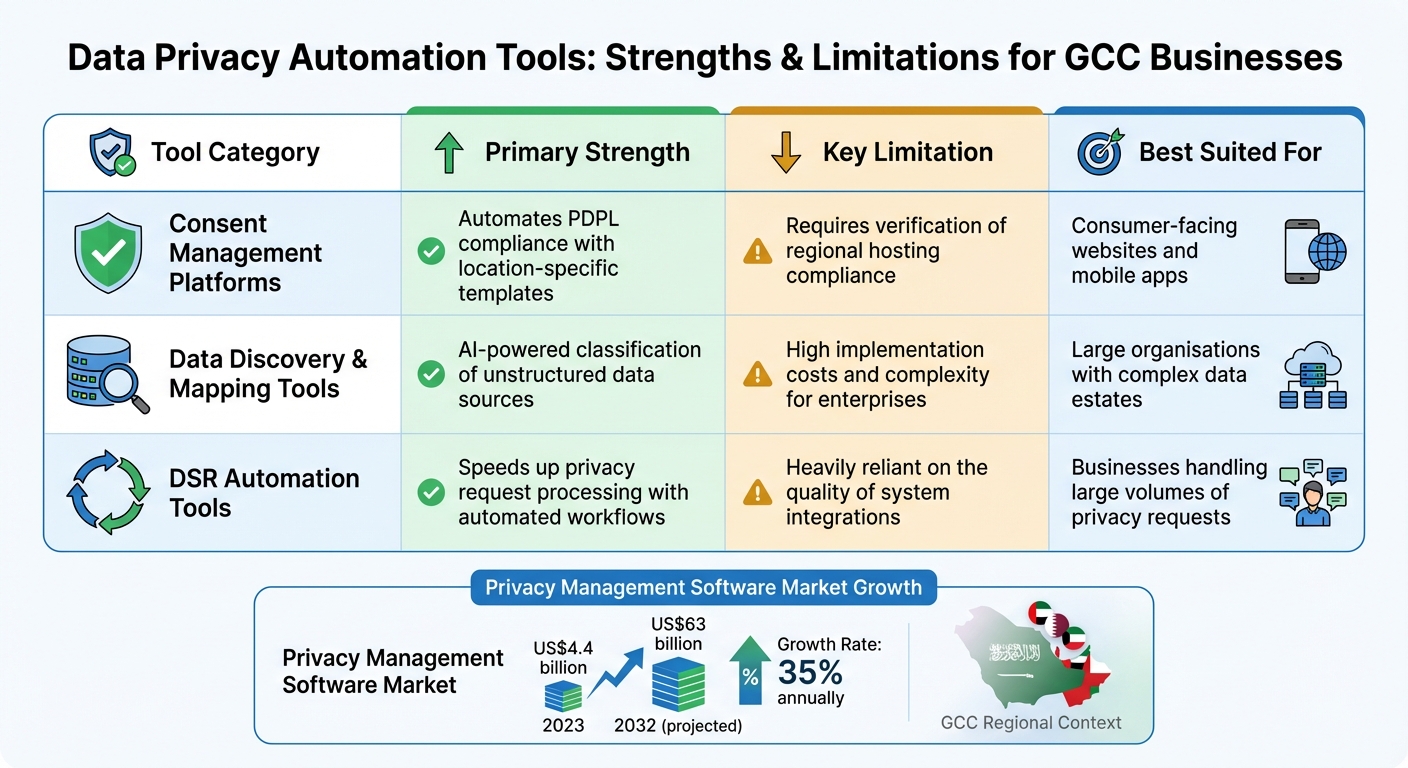
Data Privacy Automation Tools Comparison for GCC Businesses
After diving into the specifics of consent management, data discovery, and DSR automation, let’s weigh their strengths and weaknesses, especially for businesses in the GCC region.
Data privacy automation tools bring distinct benefits and challenges, shaped by the compliance and scalability needs of businesses in this region. Consent and preference management platforms are particularly effective in meeting the UAE PDPL's strict requirement that data processing cannot occur without the owner's consent. These platforms naturally align with the UAE PDPL and DIFC regulations, both of which are influenced by GDPR principles. However, businesses in highly regulated industries, like banking, must ensure their platforms meet the stricter "express consent" standards outlined by the Central Bank of UAE Consumer Protection Standards.
When it comes to data discovery and mapping tools, scalability often depends on the size of the business. Enterprise-level platforms provide extensive governance capabilities but demand significant configuration and dedicated resources, making them less feasible for smaller GCC businesses. More affordable solutions, such as Enzuzo (≈AED 33 per month), can help achieve compliance quickly but may fall short in areas like data lineage tracking and vendor risk management as the organisation grows. For companies managing large amounts of unstructured data, manual mapping becomes an unsustainable option.
DSR automation tools shine with their ability to integrate seamlessly into hybrid multicloud setups and platforms like Snowflake and Databricks. These tools cut down on manual IT and legal work while maintaining audit-ready logs to satisfy regulators. However, their effectiveness hinges on having extensive API access to internal data systems, which can be a hurdle for businesses dealing with legacy systems or fragmented technology infrastructures.
The table below provides a snapshot of the main strengths and limitations of each tool category:
| Tool Category | Primary Strength | Key Limitation | Best Suited For |
|---|---|---|---|
| Consent Management | Automates PDPL compliance with location-specific templates | Requires verification of regional hosting compliance | Consumer-facing websites and mobile apps |
| Data Discovery | AI-powered classification of unstructured data sources | High implementation costs and complexity for enterprises | Large organisations with complex data estates |
| DSR Automation | Speeds up privacy request processing with automated workflows | Heavily reliant on the quality of system integrations | Businesses handling large volumes of privacy requests |
The rising demand for privacy management solutions is reflected in the market's growth projections - from US$4.4 billion in 2023 to a staggering US$63 billion by 2032. For organisations operating across multiple jurisdictions like onshore UAE, DIFC, and ADGM, aligning tool capabilities with both current needs and future growth is critical to avoid inefficiencies and operational silos.
Conclusion
When selecting privacy automation tools, aim for a balance between compliance, scalability, and integration. The regulatory landscape in the region is complex and varies significantly - while UAE Federal Law primarily hinges on consent, DIFC and ADGM also recognise legitimate interest as a valid legal basis. For businesses operating across multiple jurisdictions, it’s crucial to choose tools that can manage these diverse requirements simultaneously. The dynamic nature of these regulations also underscores the importance of solutions that can grow alongside your business.
"Enforcement is taken very seriously. Liability exists in every jurisdiction and is very severe, with penalties for violations ranging from administrative fines to criminal charges to imprisonment." – Ksenia Andreeva, Partner, Morgan, Lewis & Bockius
For small to mid-sized businesses in consumer-facing industries, prioritising consent management platforms with UAE-specific templates and fast implementation is a smart move. On the other hand, large enterprises - especially in sectors like banking, healthcare, or telecommunications - should focus on robust data discovery tools to tackle their complex data management needs. These organisations must also ensure that their Data Subject Rights (DSR) automation integrates seamlessly with hybrid multicloud environments and adheres to sector-specific regulations, such as Federal Law No. 2 of 2019 for health data.
Ultimately, these regulatory intricacies should guide your tool selection. Start by conducting a maturity assessment to pinpoint compliance gaps. This proactive step can help you avoid costly mismatches between your operational needs and the capabilities of the tools you choose. With GCC regulations increasingly addressing AI governance and cross-border data transfers, it’s essential to invest in solutions that not only meet today’s requirements but also adapt to future regulatory shifts.
FAQs
How can businesses in the GCC use automation to comply with data privacy regulations?
GCC businesses can make compliance with data privacy laws much smoother by incorporating automation into their data management strategies. Automated tools are particularly effective at identifying and categorising personal data across various systems, ensuring adherence to regulations like the UAE PDPL. These tools also handle critical tasks such as managing user consent, enforcing purpose restrictions, and sending alerts for unauthorised data activities.
Automation also comes in handy for managing user requests - whether it's accessing, correcting, or deleting data. These tools streamline the process by routing requests efficiently and keeping detailed logs, which are crucial for audits. Compliance monitoring platforms further enhance security by flagging policy violations, such as unauthorised data transfers, and enforcing the necessary controls. Plus, real-time reporting dashboards make audit preparation easier by presenting data in local formats (like AED 1,250.00 or 12 Jan 2026) and scaling effortlessly as data volumes grow.
By tapping into automation for tasks like data discovery, consent management, user rights processing, and compliance reporting, businesses can stay on top of the GCC's dynamic data privacy requirements while maintaining efficiency and consistency.
How can AI-powered data discovery tools benefit businesses in the GCC?
AI-powered data discovery tools are transforming how GCC businesses manage sensitive information across both on-premise and cloud systems. By continuously scanning data repositories, these tools automate the process of locating, classifying, and mapping sensitive data. This not only reduces the need for manual compliance efforts but also ensures businesses stay audit-ready and maintain an up-to-date inventory that aligns with regional regulations like the UAE’s Personal Data Protection Law (PDPL).
Through AI-enabled pattern recognition, organisations can uncover hidden data silos, identify high-risk records, and simplify compliance workflows. This empowers privacy teams with a real-time, transparent view of data usage and controls, allowing them to build scalable privacy programmes specifically designed to meet GCC regulatory requirements.
Why is local data hosting crucial for businesses in the GCC region?
Local data hosting plays a crucial role for businesses in the GCC, especially in the UAE, as it helps ensure compliance with regional data privacy laws like the Federal Decree-Law No. 45 of 2021 on Personal Data Protection. These laws enforce strict guidelines on how personal data is processed and transferred, particularly when it involves moving data beyond national borders. By keeping data hosted locally, businesses can avoid the need for extra licensing or cross-border agreements, significantly reducing legal risks and the chances of penalties.
Beyond legal compliance, local hosting strengthens data sovereignty, aligns with the UAE’s cultural and social principles, and boosts application performance by cutting down on latency. It also makes regulatory audits more straightforward and builds trust with customers by showcasing a strong commitment to safeguarding data security and privacy within the local market.