

Blog / Data Privacy and Consumer Rights in GCC Marketing
Data Privacy and Consumer Rights in GCC Marketing
The Gulf Cooperation Council (GCC) is reshaping marketing practices with strict data privacy laws prioritising consumer consent. In the UAE, the Federal Decree Law No. 45 of 2021 (Personal Data Protection Law) requires explicit consent for data use, unlike the EU's "legitimate interest" basis. Violations can result in severe penalties, including fines up to $28 million in Abu Dhabi Global Market (ADGM). Other GCC nations, like Saudi Arabia and Qatar, have also implemented robust frameworks, with extraterritorial reach affecting international businesses.
Key takeaways:
- Consent-first approach: Explicit, unambiguous consent is mandatory for marketing activities.
- Consumer rights: Access, correction, deletion, and objection to data use are protected.
- Penalties: Non-compliance can lead to fines, criminal charges, or imprisonment.
- Cross-border data transfer: Requires adherence to local rules, often needing approval.
- AI usage: Strict regulations apply, including mandatory Data Protection Impact Assessments (DPIAs).
Marketers must prioritise transparency, limit data collection to specific purposes, and implement privacy-first strategies to build trust and comply with GCC laws.
Balancing Marketing Innovation with Privacy Compliance | Exclusive Lesson
GCC Data Privacy Laws and Marketing Compliance
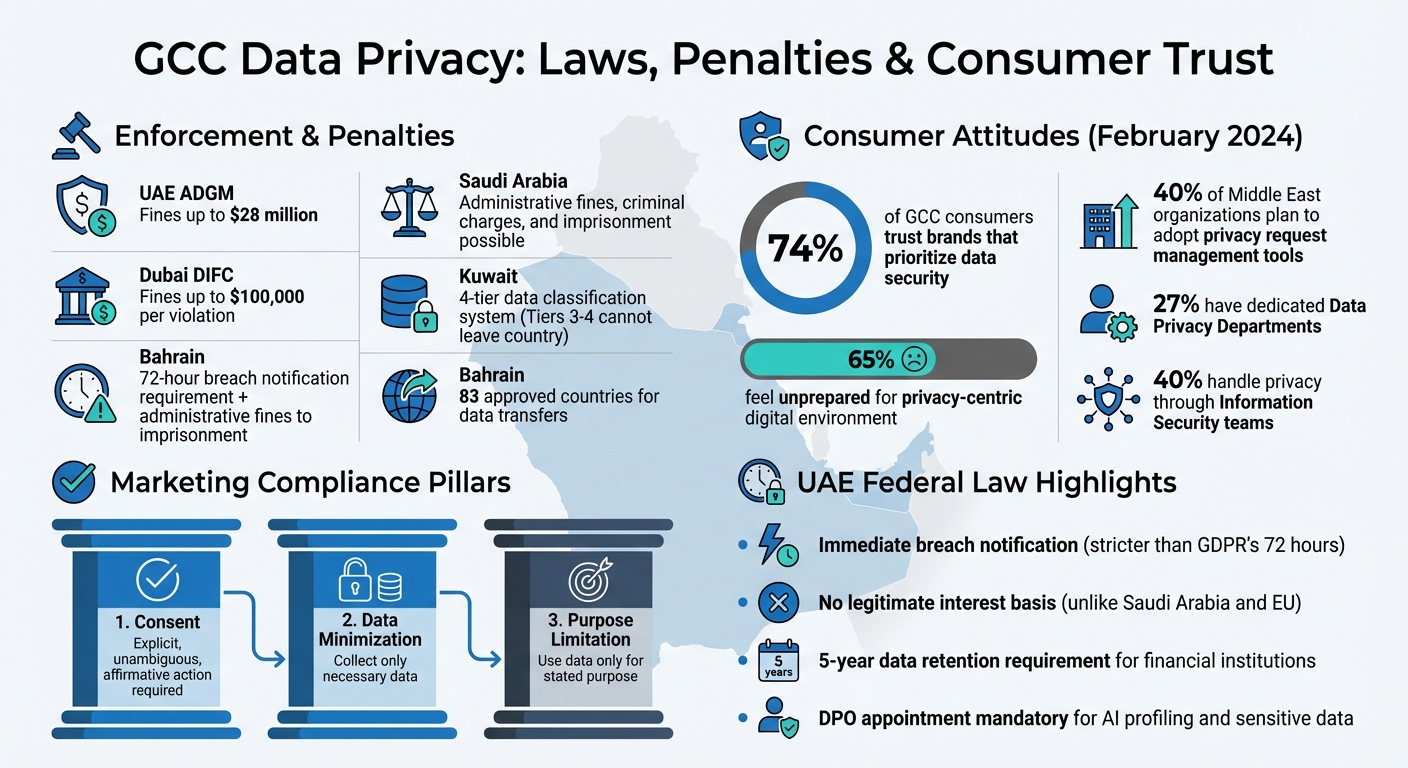
GCC Data Privacy Laws: Key Statistics and Penalties Across Gulf Nations
Data Privacy Laws Across the GCC
The UAE has taken the lead in the region with its Federal Decree-Law No. 45 of 2021, which establishes a detailed framework for data protection. In Saudi Arabia, the Personal Data Protection Law (PDPL) provides a legal basis for processing data under "legitimate interest", a stark difference from the UAE's stricter approach, which does not permit this basis. Qatar has implemented its own Personal Data Protection Law, while Bahrain and Oman have also introduced regulatory frameworks, each with varying degrees of alignment to global standards.
One key feature of these laws is their extraterritorial reach. Companies based outside the GCC are required to comply when handling the personal data of GCC residents. For instance, a marketing agency in London that targets consumers in the UAE must adhere to the UAE PDPL, regardless of where its servers are located. These laws directly shape the compliance landscape for marketers operating in or targeting the GCC region.
Marketing Compliance Requirements
Marketing efforts in the GCC are guided by three main principles: consent, data minimisation, and purpose limitation. The UAE enforces these principles with particular strictness. Consent must be clear, specific, and informed, obtained through a deliberate affirmative action.
Additionally, businesses are required to collect only the data necessary for their stated purpose. The UAE law specifies: "Personal Data shall be sufficient and limited to what is necessary in accordance with the purpose for which the processing is carried out.". For example, requesting just an email address for a newsletter subscription is acceptable, but asking for additional details without a valid reason is not.
Financial institutions face even stricter rules. The UAE Central Bank's Consumer Protection Regulation mandates that only the minimum required data be gathered, with explicit consent needed before sharing any information. Furthermore, this data must be securely stored for at least five years.
Enforcement Actions and Penalties
Authorities across the GCC take data privacy compliance seriously, with stringent enforcement measures in place. In Dubai's DIFC, the Commissioner of Data Protection can impose fines of up to US$100,000 per violation. Bahrain’s Data Protection Authority requires breach notifications to be submitted within 72 hours, with penalties ranging from administrative fines to criminal charges, including imprisonment.
Saudi Arabia also enforces its PDPL with significant penalties. Violations can result in heavy administrative fines, criminal charges, and even imprisonment. Ksenia Andreeva, a Partner at Morgan, Lewis & Bockius, emphasises:
"Enforcement is taken very seriously. Liability exists in every jurisdiction and is very severe, with penalties for violations ranging from administrative fines to criminal charges to imprisonment."
Under the UAE PDPL, organisations must notify both the UAE Data Office and affected individuals immediately upon identifying a breach that compromises privacy, confidentiality, or security. Unlike the GDPR's 72-hour notification window, the UAE law requires immediate reporting, with additional timelines to be clarified in future executive regulations.
Consumer Attitudes Towards Privacy in the GCC
What GCC Consumers Expect from Privacy
Consumers in the GCC are increasingly demanding transparency and control when it comes to their personal data. With the rapid pace of digital transformation across sectors like e-commerce, fintech, and AI, there’s a growing expectation that businesses will handle personal information responsibly. Consent is no longer seen as a one-time checkbox but as a right that individuals can exercise or withdraw depending on their comfort with how their data is used.
A study from February 2024 found that 74% of GCC consumers trust brands that prioritise data security, yet 65% feel unprepared for a privacy-centric digital environment. This gap presents a chance for marketers to step up their communication about data practices. People want clear, detailed notifications about how their information will be used before any processing occurs. They also expect complete control over their data.
Different industries face unique challenges when addressing these concerns. For example, healthcare and financial services come under greater scrutiny due to the sensitivity of medical records and the risk of fraud tied to financial data. In the UAE, even photos and videos are considered sensitive data, requiring explicit consent before being shared on social platforms.
How Trust Affects Digital Marketing
In the GCC, trust has become a cornerstone of effective digital marketing. As privacy concerns grow, trust is now a critical factor in how consumers interact with brands. Vladislav Klimov, Cloud Security and Compliance Lead at SAP, highlights this shift:
"Citizens and consumers increasingly expect their information to be processed responsibly, whilst investors demand legal certainty and operational consistency."
This growing focus on trust means that privacy-conscious marketing strategies and transparent data usage policies are now key to engaging consumers in the digital space.
The regulatory landscape in the region also underscores the importance of trust. For instance, the UAE Consumer Protection Law (No. 15 of 2020) prohibits businesses from using consumer data for marketing unless they have explicit consent. This aligns with what consumers want - clear consent management has become a crucial element in building trust within the MENA advertising ecosystem. Protiviti captures this sentiment:
"In addition to understanding local data privacy regulations, organisations should equally consider elements of increasing customer trust as part of their Data Privacy Programme."
To meet these expectations, businesses are investing in privacy-focused technologies. 40% of organisations in the Middle East plan to adopt tools for managing privacy requests and Data Subject Access Requests (DSARs). However, only 27% have dedicated Data Privacy Departments, while 40% handle privacy through their Information Security teams. This organisational gap indicates that while companies recognise the importance of trust, many are still working on building the systems needed to meet consumer demands consistently.
sbb-itb-058f46d
Challenges for GCC Marketers
Data Governance and Consent Management
Navigating consent management in the GCC can be tricky. Consent must be explicit, tied to a specific purpose, and easy for users to withdraw. On top of that, systems need to track, update, and enforce these permissions across every digital interaction in real time. Unfortunately, many organisations still rely on manual processes and fragmented systems, which makes managing data flows and ensuring compliance a major challenge.
Adding to the complexity, the UAE Federal Data Protection Law doesn’t currently accept "legitimate interest" as a legal basis for processing data. This means marketers have to rely entirely on explicit consent for personalisation and profiling efforts. Justin Whelan, Partner at HFW, highlights the risks:
"Seeking to develop a 'one size fits all' strategy for data protection in the GCC heightens the risk of non-compliance in a particular dominion."
These internal hurdles often lead to broader regional challenges, especially when it comes to data transfers.
Data Localisation and Cross-Border Transfers
Cross-border data transfers in the GCC bring their own set of obstacles. Each country has its own rules, making compliance a juggling act. For instance, Bahrain has a list of 83 "adequate" countries where data can be transferred. Meanwhile, Kuwait uses a four-tier classification system, and data in Tiers 3 and 4 cannot leave the country at all. Oman, on the other hand, requires explicit consent for cross-border transfers, which complicates real-time AI-driven personalisation that often depends on global cloud platforms.
Ksenia Andreeva and Alena Neskoromyuk from Morgan, Lewis & Bockius explain:
"Practically in every country of the GCC region, cross-border data transfers require additional consideration and, in certain cases, approval from the local authorities."
For marketers running campaigns across the region, this means implementing Standard Contractual Clauses (SCCs) or Binding Common Rules to handle transfers to countries not deemed "adequate".
AI and Privacy in Marketing
The rise of AI in marketing brings even more privacy concerns. In the UAE, using AI for profiling or processing sensitive data - like biometrics or health information - requires organisations to appoint a Data Protection Officer (DPO). Non-compliance can lead to serious consequences, ranging from administrative fines to criminal charges or even imprisonment.
For marketers deploying AI at scale, conducting a Data Protection Impact Assessment (DPIA) before launching any AI-driven initiative isn’t just a best practice - it’s a regulatory requirement. Tackling these privacy challenges is a must for any organisation aiming to adopt a privacy-first approach in the GCC.
How to Adapt GCC Marketing Strategies
Privacy-First Marketing Approaches
With the UAE Federal Law No. 15 of 2020 in place, marketers in the GCC must transition from third-party cookies to direct, consent-based first-party data strategies. This legislation requires businesses to give users the immediate ability to stop data processing, reinforcing consumer control over their personal information.
A key to building trust lies in transparency. Clearly explain what data is being collected, why it’s needed, and how it will be used. As Victoria Woods, Partner and Head of Commercial at Hadef & Partners, highlights:
"For businesses, the PDPL underscores the importance of data governance and accountability in the digital age."
By prioritising privacy as more than just a legal requirement, companies can turn it into a competitive edge. These efforts align well with the support offered by specialised consultancies that help ensure compliance.
How Data-Driven Consultancies Support Compliance
Navigating the complexities of GCC privacy laws often requires expert guidance. Specialised marketing consultancies can tailor strategies to meet local legal requirements, such as Bahrain's list of 83 approved countries for data transfers.
Consultancies like Wick offer comprehensive solutions that integrate privacy-first principles into every aspect of marketing. Using their Four Pillar Framework, they embed privacy-by-design practices into campaign development. This includes technical measures like pseudonymisation and encryption, systems to manage data subject rights (such as access, correction, portability, and erasure), and maintaining detailed Records of Processing Activities (ROPA) that document data categories, purposes, and retention timelines.
For companies dealing with large-scale profiling or sensitive data, consultancies also provide critical support. They assist in appointing Data Protection Officers (DPOs), which is a legal requirement in the UAE for such cases. Additionally, they conduct Data Protection Impact Assessments (DPIAs) to evaluate high-risk activities, such as AI-driven marketing, before implementation.
Future Trends and Recommendations
Looking ahead, regulatory and technological advancements are set to reshape marketing strategies across the GCC. For instance, the DIFC has introduced Regulation 10, which governs autonomous and semi-autonomous systems. This regulation requires transparency and ethical risk assessments for AI-driven decision-making. It reflects a shift from mere compliance to embedding digital ethics into business practices.
Another emerging challenge is quantum computing. With its potential to render current encryption methods ineffective, businesses are beginning to adopt "crypto agility" - the ability to quickly update cryptographic protocols to safeguard consent records and personal data in a post-quantum world.
The UAE is also awaiting Implementing Regulations for its Federal Data Protection Law. These regulations are expected to clarify cross-border data transfer standards and may introduce "legitimate interest" as a lawful basis for data processing. Until then, explicit consent remains the cornerstone of personalisation efforts. Staying ahead will require regular privacy audits, updated documentation, and close monitoring of regulatory changes. Consultancies play a vital role in helping businesses adapt to both current and future challenges, ensuring they remain compliant and competitive in this evolving landscape.
Conclusion
Data privacy compliance in the GCC has become a defining factor for trust and integrity in the digital business landscape. The consequences for non-compliance can be severe, ranging from fines to imprisonment. For businesses operating across these jurisdictions, taking proactive steps is no longer optional - it's essential. A key focus in this environment is the proper management of consent, which serves as the foundation for lawful data processing.
In the GCC, especially in the UAE, "legitimate interest" is not currently recognised as a legal basis for data processing. This places a significant emphasis on implementing active consent management systems that ensure explicit, real-time consent. Businesses must also navigate the unique consent and operational requirements of each GCC jurisdiction.
As regulations tighten, consumer expectations are also shifting. Organisations that prioritise transparency and respect data subject rights - like access, deletion, and portability - are better positioned to gain trust and loyalty. Both regulators and customers increasingly value businesses that demonstrate ethical data practices. To meet these expectations, companies must maintain meticulous records, adopt privacy-by-design principles (like pseudonymisation and encryption), and ensure that all consumer-facing materials comply with local requirements, such as providing them in Arabic under UAE law.
Navigating these complexities often requires expert guidance. Firms like Wick offer tailored support, helping businesses appoint Data Protection Officers, conduct Data Protection Impact Assessments for high-risk activities, and implement advanced security measures to stay ahead of emerging threats like quantum computing. With the UAE's pending Implementing Regulations and the rise of AI governance standards, partnering with knowledgeable advisors can turn compliance into a competitive advantage. By adopting these strategies, businesses can shift their perspective on compliance - from a mandatory obligation to a strategic opportunity.
FAQs
What do GCC data privacy laws mean for international businesses?
GCC data privacy laws, including the UAE Federal Decree Law No. 45 of 2021, Saudi Arabia’s PDPL, and Bahrain’s Personal Data Protection Law, align closely with GDPR principles. These principles - data minimisation, purpose limitation, and accountability - form the backbone of these regulations. One notable aspect is their extra-territorial reach, meaning they apply to international businesses that handle personal data of GCC residents or process data within the region.
For global companies, here’s what this means in practice:
- Consent: Businesses must obtain and document explicit consent before collecting any personal data. This ensures transparency and builds trust with users.
- Data transfers: Transferring data outside the GCC comes with strict requirements, such as securing explicit consent or using approved contractual clauses to ensure compliance.
- Penalties: Non-compliance isn’t taken lightly. Companies could face hefty fines based on global turnover, and in some cases, even criminal sanctions.
To meet these requirements, businesses often need to take proactive steps. Appointing a local data protection officer, establishing strong compliance frameworks, and conducting regular assessments are essential. Wick’s expertise in data-driven marketing ensures your campaigns not only comply with GCC privacy laws but also deliver personalised, effective strategies tailored to the UAE market.
What challenges do marketers face in complying with data privacy regulations in the GCC?
Marketers operating in the GCC face the challenge of navigating diverse and intricate data privacy laws across the region. For instance, the UAE’s Federal Decree Law No. 45 of 2021 and Saudi Arabia’s Personal Data Protection Law impose requirements like obtaining explicit consent, respecting rights such as data access, correction, and deletion, and implementing robust accountability measures. Adding to the complexity, many of these laws have extraterritorial provisions, meaning businesses must comply even when managing GCC residents' data from outside the region.
Compliance becomes even more critical due to the strict enforcement of these regulations. Penalties can range from hefty fines to criminal liabilities, especially concerning emerging technologies like AI-driven profiling and facial recognition, which are increasingly under regulatory scrutiny. To address these challenges, marketers should embrace privacy-by-design principles, regularly perform impact assessments, and keep thorough records of their data practices.
On top of this, sector-specific rules in industries such as healthcare, finance, and e-commerce introduce additional layers of complexity, particularly for campaigns that utilise multiple channels. Collaborating with experts like Wick can assist businesses in embedding compliance measures, including consent management and data governance, while ensuring their marketing efforts are tailored and effective within the UAE's market landscape.
How can businesses in the GCC earn consumer trust while complying with data privacy laws?
To earn consumer trust in the GCC, businesses need to focus on transparency and adhere to regional data privacy laws, such as the UAE’s Federal Decree Law No 45 of 2021. A good starting point is obtaining clear consent for data collection. This means explaining why the data is being collected in simple, straightforward terms and honouring consumer rights, including access to their data, making corrections, or requesting its deletion. Publishing a brief, easy-to-understand privacy notice, offering simple opt-out options, and providing a dedicated contact for data-related queries can further demonstrate your commitment to protecting privacy.
Building trust also involves implementing strong security measures. These include using encryption, conducting regular audits, and practising data minimisation - only collecting what’s absolutely necessary. When transferring data across borders, ensure you have the right safeguards in place and clearly communicate these measures to your customers. Not only do these steps help prevent breaches, but they also align with GCC regulations that prioritise fairness and openness.
Collaborating with a specialist like Wick can make this process smoother. Wick’s expertise combines compliance with personalised, privacy-focused marketing strategies designed to boost customer loyalty and deliver measurable results in AED. By embedding privacy into every corner of your digital operations, you can turn regulatory compliance into a powerful advantage for your business.