

Blog / How Dynamic Content Boosts Email Personalization
How Dynamic Content Boosts Email Personalization
In the UAE's diverse market, generic email campaigns no longer work. Businesses need to personalize their emails to connect with audiences across different cultures, languages, and preferences. Dynamic content is the solution. It allows you to create one email template that adjusts automatically based on subscriber data, like location, language, or behavior. This approach saves time, increases engagement, and drives conversions.
Key Takeaways:
- Dynamic content emails generate 76% higher click-through rates and 45% more conversions.
- Personalization leads to 5.7x more revenue and 6x higher transaction rates.
- UAE-specific examples: Emails can switch between Arabic and English, show AED pricing, and highlight Ramadan or Eid offers.
- Dynamic blocks use conditional logic (e.g., "If Location = Dubai, show Marina Walk events").
- Brands like icelolly.com and PrettyLittleThing saw huge boosts in engagement using dynamic content.
By leveraging subscriber data and automation tools, you can deliver emails that feel relevant to every recipient, improving both customer relationships and ROI.
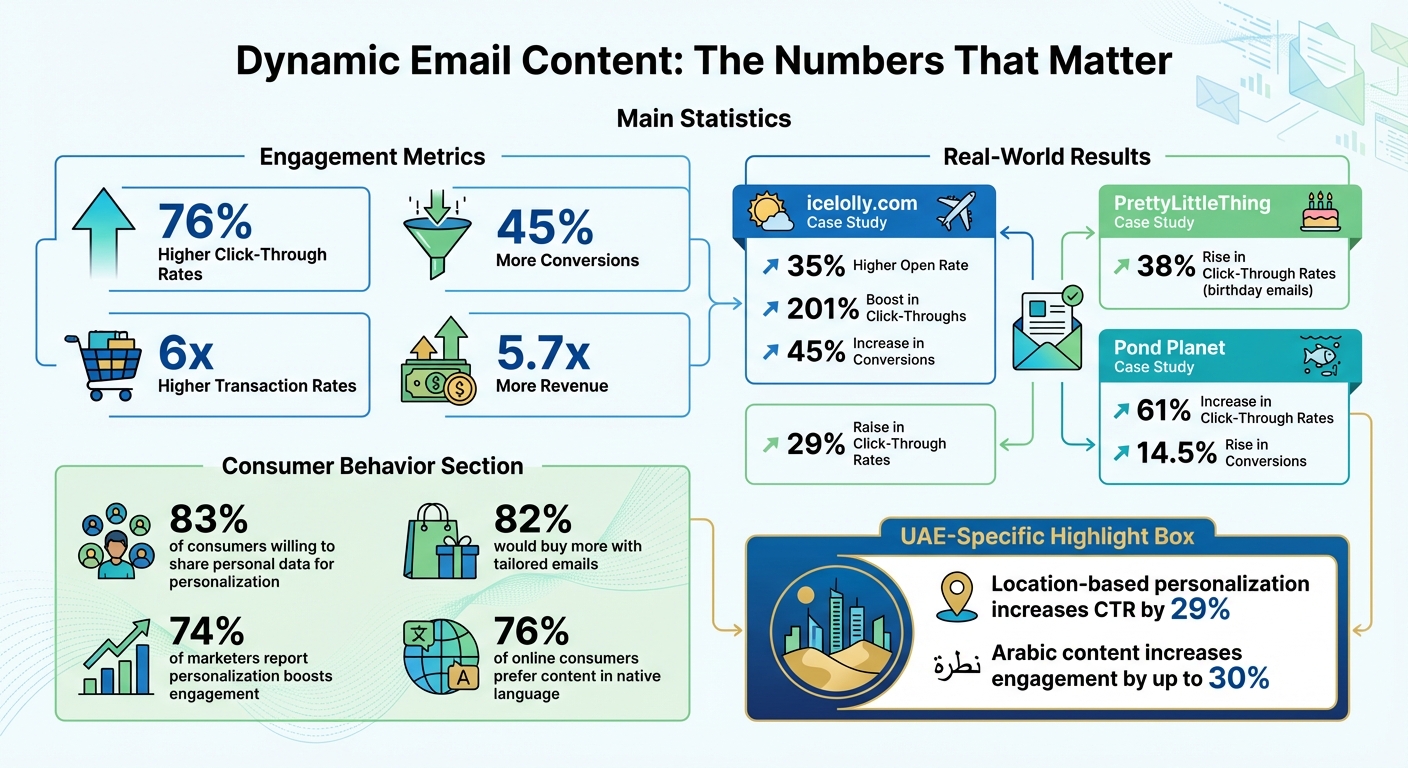
Dynamic Email Content Performance Statistics and Benefits
Dynamic Email Content 101: What it Is and How it Works
What Are Dynamic Content Blocks?
Dynamic content blocks are sections within an email - like images, text, headlines, or calls-to-action - that adjust automatically based on the recipient's profile, behaviour, or preferences. Instead of sending the same message to everyone, these blocks ensure each subscriber gets content tailored specifically to them.
Unlike static emails, which deliver identical content to all recipients, dynamic content modifies a single master template to provide personalised messages. For instance, male subscribers might see menswear promotions, while female subscribers see womenswear offers. Here's a quick comparison to highlight the differences:
| Feature | Static Content | Dynamic Content Blocks |
|---|---|---|
| Recipient Experience | Same for all | Personalised for each subscriber |
| Effort Level | High (requires multiple templates) | Low (one template with interchangeable blocks) |
| Data Usage | Minimal | Extensive (uses subscriber data and tags) |
| Logic | None | Conditional (If/Else rules) |
This comparison shows how dynamic content relies on conditional logic to deliver tailored experiences.
How Dynamic Content Blocks Work
Dynamic content blocks operate using conditional logic, like If/Else statements, to evaluate subscriber data at the time the email is sent. For example, you could set a rule such as: "If the membership level is Premium, display a VIP discount code; otherwise, show a standard offer." The email platform reviews each recipient's profile and swaps in the appropriate content block based on data like location, browsing habits, purchase history, or membership status.
The logic can range from simple to complex, but it's vital to include fallback content to avoid blank sections when subscriber data is missing.
Examples of Dynamic Content in Action
- icelolly.com used dynamic content to feature real-time travel deals, resulting in a 35% higher open rate, a 201% boost in click-throughs, and a 45% increase in conversions.
- PrettyLittleThing, an online fashion retailer, sent automated birthday emails featuring personalised star sign content based on subscribers' birthdates. This approach led to a 38% rise in click-through rates.
For businesses in the UAE, dynamic content can be a game-changer. Imagine promotional emails displaying prices in AED, showcasing emirate-specific property listings, or highlighting Ramadan-themed products. A real estate company in Dubai, for example, could use dynamic content to present luxury apartments in Downtown Dubai to high-income subscribers while promoting more affordable options in Sharjah to budget-conscious prospects - all in a single campaign.
Benefits of Using Dynamic Content for Email Personalisation
Dynamic content blocks bring a personalised touch to emails, fostering stronger engagement and customer loyalty in the UAE's competitive digital market. By replacing one-size-fits-all messages with tailored content, businesses can connect more meaningfully with their audiences.
Higher Engagement and Click-Through Rates
Dynamic content aligns emails with subscribers' interests, leading to impressive engagement metrics. For instance, brands using dynamic email content experience an average 76% increase in click-through rates and a 45% boost in conversion rates. Moreover, personalised emails generate six times higher transaction rates compared to generic ones.
In the UAE's diverse market, location-based personalisation is particularly impactful. For example, tailoring content to a subscriber's location can increase click-through rates by 29%. A Dubai retailer could highlight Marina Walk events for local subscribers while showcasing Al Ain branch promotions to customers in that area - all within a single email campaign. This strategy ensures content is not only relevant but also actionable.
The benefits go beyond clicks. Personalised emails deliver 5.7 times higher revenue. Adding urgency elements, like dynamic countdown timers, can further amplify results, with sales increasing by 332%. For instance, UK-based icelolly.com used dynamic content to display real-time travel deals, achieving a 35% higher open rate, a 201% increase in click-through rates, and a 45% rise in conversions.
Next, let’s explore how dynamic content simplifies campaign management.
Time and Resource Efficiency
Segmenting email campaigns by factors like language (e.g., Arabic, English, Hindi), location, or customer type can be time-intensive. Dynamic content solves this by enabling marketers to create a single master template that adapts automatically to each recipient's profile.
PrettyLittleThing offers a great example. They launched an automated birthday email programme featuring star-sign-specific content based on recipients' birth dates. This approach increased click-through rates by 38%. Similarly, the language learning app busuu used dynamic content to include personalised progress updates in emails, motivating inactive users with tailored messages. This strategy led to a 93% increase in open rates for weekly progress emails.
Dynamic content is especially useful during time-sensitive events like Ramadan, Eid, or the Dubai Shopping Festival. Offers and promotions can update automatically at the moment an email is opened, eliminating the need for marketing teams to manually refresh content. This ensures accuracy and keeps campaigns relevant without constant intervention.
This time-saving approach not only streamlines operations but also enhances customer engagement, which we’ll discuss next.
Building Customer Loyalty
Beyond driving engagement, personalisation plays a key role in building customer loyalty. Dynamic content helps brands connect with their audience by acknowledging individual preferences, purchase histories, and behaviours. For example, neighbourhood-specific delivery offers - like targeting Jumeirah residents versus Downtown Dubai shoppers - or product recommendations based on past activity show customers that their time and interests are valued.
The numbers back this up: 83% of consumers are willing to share personal data for better personalisation, and 82% would buy more if marketing emails were more tailored. Furthermore, 74% of marketers report that personalisation boosts customer engagement, creating the kind of positive interactions that turn occasional buyers into loyal customers.
Retailer Pond Planet leveraged dynamic content like live social feeds, countdown timers, and banners that updated in real time. This not only reduced manual work but also led to a 61% increase in click-through rates and a 14.5% rise in conversions. Similarly, when ByLaurenJean replaced a static email about diamond rings with an interactive live poll asking subscribers to vote on their favourite diamond cut, the campaign saw a 53% higher click-through rate. These dynamic, engaging elements help deepen customer loyalty and build lasting relationships.
sbb-itb-058f46d
How to Implement Dynamic Content in Email Campaigns
Creating personalised email campaigns that adapt to each subscriber's unique profile can be achieved in three clear steps. By following these steps, you can ensure your email content resonates with your audience on a personal level.
Step 1: Collect and Organise Subscriber Data
Dynamic content thrives on accurate and detailed subscriber data. The more information you have, the more tailored your campaigns can be. Focus on gathering these five key data types:
- Demographics: Age, gender, language preferences, birthdays.
- Geography: Emirate, neighbourhood, time zone.
- Behaviour: Pages visited, email engagement history.
- Transactions: Purchase history, abandoned cart items, membership levels.
- Context: Real-time factors like weather, inventory levels, or countdown timers.
To collect behavioural data, use tracking pixels to monitor activity on your website, such as which products subscribers view or how long they browse. Beyond basic fields like name and email, consider adding custom fields for unique data points relevant to your business - like favourite sports teams, pet birthdays, or membership attributes.
Centralise all this data with Wick's Capture & Store pillar, which allows you to organise and categorise subscriber profiles efficiently. With everything in one place, you can easily use this data to power dynamic content rules.
Once your data is organised, it’s time to design dynamic email elements.
Step 2: Create and Design Dynamic Blocks
Start with a master email template that includes dynamic sections tailored to different subscriber segments. These sections use placeholders or merge tags to automatically populate with personalised content for each recipient. For instance, you could show distinct hero images for subscribers in Dubai versus Abu Dhabi or suggest products based on previous purchases.
Use if/then rules to decide what content displays for each recipient. For example:
- "If Gender = Female, show Image A."
- "If Location = Dubai, show Local Offer."
For the UAE audience, incorporate imagery and messaging that align with local traditions and holidays, such as Ramadan or Eid. It’s also important to define default content for cases where data might be missing, ensuring your email looks professional and complete.
With your dynamic blocks designed, you can move on to setting up the rules that control how and when they appear.
Step 3: Define Display Rules and Automate Delivery
Establish clear rules to determine which content each subscriber sees. These rules should follow a logical order, with the system displaying content that matches the first rule resolved as true. Use Boolean logic (AND/OR) to create more complex conditions, such as requiring both a specific location and purchase history to trigger a premium offer.
To avoid blank spaces in emails, always include a default rule. For example, when using dynamic fields like {{first_name}}, add a fallback value such as {{first_name:there}} to ensure the email reads smoothly even if the data is missing.
Finally, automate your delivery process using Wick's Tailor & Automate pillar. This tool allows you to set dynamic display rules and schedule triggers based on digital behaviours, such as pages visited or time spent on your site. By automating these processes, you can keep your content timely and relevant without needing constant manual updates.
Best Practices for Effective Dynamic Content Usage
Once you've set up dynamic content blocks and automated delivery, there are several key strategies to help you make the most of them. These approaches ensure your personalised emails stay relevant, culturally sensitive, and consistently optimised for better performance.
Use Real-Time Data for Relevance
Dynamic content truly excels when it updates at the moment a subscriber opens your email - not just when it’s sent. This open-time technology ensures countdown timers remain accurate, inventory levels reflect real-time availability, and pricing stays current. For instance, if a product sells out between sending and opening an email, real-time data can automatically replace it with an available option.
You can also use contextual triggers based on your subscriber’s immediate environment. For example, if someone in Dubai opens your email during a rainstorm, dynamic content could highlight umbrellas or raincoats. Countdown timers, meanwhile, add urgency by showing precisely how much time is left on a limited-time offer. Research backs this up: emails featuring dynamic live polls see a 53% higher click-through rate compared to static versions.
Incorporating social proof, like showing how many other subscribers are viewing a specific product, can also drive immediate action. These real-time adjustments not only enhance relevance but also help fine-tune content to better match local preferences.
Localise Content for UAE Audiences
Dynamic updates are even more effective when paired with thoughtful localisation. Tailor your emails to UAE audiences by displaying prices in AED, using the DD/MM/YYYY date format, and applying metric measurements. These small but important details build trust and eliminate potential confusion.
Cultural considerations are equally important. During Ramadan, for example, adjust your messaging to focus on themes like family, charity, and community rather than promoting food or drinks during fasting hours. Schedule emails for late evening or just before Iftar, when engagement tends to peak, and ensure imagery respects local modesty standards. For UAE National Day or other celebrations, include meaningful symbols such as the falcon or date palm tree.
Language plays a critical role too. While Modern Standard Arabic (MSA) is ideal for formal communication, Gulf Arabic (Khaleeji) creates a more personal and relatable tone. Studies show that 76% of online consumers are more likely to buy products when information is presented in their native language. Brands that incorporate culturally relevant Arabic content have seen engagement rates rise by as much as 30%. Segmenting your audience can also make a big difference: local Emiratis may respond well to messages that emphasise heritage and exclusivity, while expatriates might prefer content highlighting practical benefits or international availability.
Track Metrics to Optimise Campaigns
To understand how your dynamic content is performing, focus on tracking the right metrics. Engagement indicators like open rates, click-through rates, and forwards reveal how subscribers are interacting with your emails. Conversion metrics - such as transaction rates, conversion rates, and average order value - help you measure the financial impact.
Keep an eye on deliverability metrics like bounce rates and unsubscribes. High engagement from dynamic content signals to Inbox Service Providers that your emails are trustworthy, which can improve inbox placement. Regular A/B testing is another must. Comparing dynamic content blocks against static ones helps you pinpoint exactly how much they boost engagement and conversions.
It’s also crucial to ensure your subscriber data is accurate. Empty fields can lead to broken content if default values aren’t set. Use tracking pixels to monitor post-click behaviour - such as which pages subscribers visit and how long they stay. These insights can guide future dynamic recommendations. As Mark Pekel, VP of Growth at Ongage, explains:
"Consistently delivering contextual, useful content to your subscribers–serving their needs–is the secret to better conversion rates, higher average order values, and more customer referrals".
Conclusion
Dynamic content transforms email personalisation by automating the process at scale. Instead of juggling multiple campaigns, marketers can rely on a single, adaptable email that tailors itself to each recipient's unique data, behaviour, and preferences. The result? Proven improvements in engagement and effectiveness.
By removing the need for manual segmentation and repetitive tasks, dynamic content allows marketers to shift their focus to strategy and creativity. This boost in engagement also enhances deliverability and ensures emails land where they belong - in the inbox.
In the UAE, dynamic content takes personalisation a step further by seamlessly switching languages, aligning messages with local events, displaying prices in AED, and tailoring content to specific regions - all within a single campaign. Achieving this level of localisation manually across thousands of subscribers would be nearly impossible.
For those looking to implement dynamic content effectively, Wick's Four Pillar Framework - Build & Fill, Plan & Promote, Capture & Store, and Tailor & Automate - provides a clear roadmap. By blending marketing automation with AI-powered personalisation, this approach ensures that the right message reaches the right person at the right time, paving the way for consistent customer growth.
The impact of dynamic content is clear: it doesn't just enhance email performance - it drives long-term customer loyalty. And the numbers back it up: 82% of online shoppers are more likely to make a purchase when emails reflect their preferences and past purchases.
FAQs
How can dynamic content enhance email engagement in the UAE?
Dynamic content takes email marketing to the next level by tailoring text, images, offers, and calls-to-action to match each subscriber’s location, preferences, or behaviour. In the UAE, where over 200 nationalities coexist and online shopping thrives - especially on smartphones - this personalised approach feels like it was made just for the recipient. Imagine emails featuring Arabic or English greetings, Ramadan-specific deals, or location-based offers priced in AED. These small but meaningful touches resonate deeply with the audience.
What’s the payoff? Personalisation boosts open rates, click-throughs, and conversions because it makes recipients feel seen and valued. Plus, presenting dates in the UAE's format (dd/MM/yyyy) and ensuring culturally relevant messaging removes barriers and builds trust. It's no surprise that businesses using dynamic email content report 20-30% higher engagement and as much as 15% more conversions compared to static email campaigns.
Wick embraces this approach through its Four-Pillar Framework, blending marketing automation, data analytics, and AI-driven personalisation. The result? Email campaigns that are not only impactful but also culturally aligned with the UAE’s fast-paced and diverse digital environment.
What subscriber data is key to creating personalised dynamic email content?
To craft dynamic email content that truly resonates, having a variety of accurate subscriber data is essential. Here's a breakdown of the key data types that can elevate your email campaigns:
- First-party data: This includes basic details like a subscriber's name, email address, and account information. It’s the foundation for simple personalisation, such as greeting recipients by name.
- Zero-party data: These are preferences, interests, or specific style choices shared directly by subscribers. This data lets you customise content to align with individual tastes and needs.
- Behavioural data: Tracking email opens, clicks, website browsing habits, and purchase history provides insights into what subscribers find engaging. This helps you deliver timely and relevant recommendations.
- Demographic and geographic data: Information such as age, preferred language, and location (e.g., Dubai or Abu Dhabi) allows for localised offers. You can display prices in AED, use date formats like 13 Jan 2026, and ensure the content feels regionally tailored.
- Transactional data: Details about order history, subscription plans, and spending habits enable personalised pricing, loyalty rewards, and relevant cross-sell suggestions.
When you combine these data points effectively, Wick ensures your dynamic content is not only deeply personalised but also scalable. This approach meets the expectations of UAE audiences by delivering communications that are timely, relevant, and locally adapted.
How can businesses create dynamic emails that resonate with UAE audiences?
To create dynamic emails that truly connect with UAE audiences, businesses need to prioritise local and cultural relevance. Start by leveraging audience segmentation to craft personalised messages. For instance, include content in Arabic or English depending on your recipients' language preferences, and use culturally appropriate greetings like Ramadan Kareem or Eid Mubarak. Adjust visuals and text to reflect regional norms, such as modest imagery or iconic symbols like the Burj Khalifa.
Attention to formatting is equally important. Display prices in AED (e.g., AED 1,250.00), use the day-month-year date format (e.g., 15 March 2026), and stick to metric measurements like kilograms and kilometres. Tailoring content to align with UAE-specific holidays and events - like Ramadan, National Day, or even VAT regulations - further enhances relevance. By combining precise audience segmentation with dynamic, locally tailored content, businesses can deliver emails that feel personal and culturally aligned while staying true to their brand identity.