Cross-Channel Marketing: Best Practices For 2025
16 MIN READ
AI · 19 Dec 2025 · 30 minKey email automation KPIs every marketer should track in 2025 to boost deliverability, engagement, and revenue.

Email automation is more effective than ever in 2025. With over 347 billion emails sent daily and global user numbers at 4.6 billion, standing out in crowded inboxes requires precise tracking of key metrics. Automated emails outperform traditional campaigns, offering 52% higher open rates, 332% higher click rates, and 2,361% higher conversions. For UAE businesses, where audiences are mobile-first and multilingual, tracking the right metrics ensures better engagement and higher ROI.
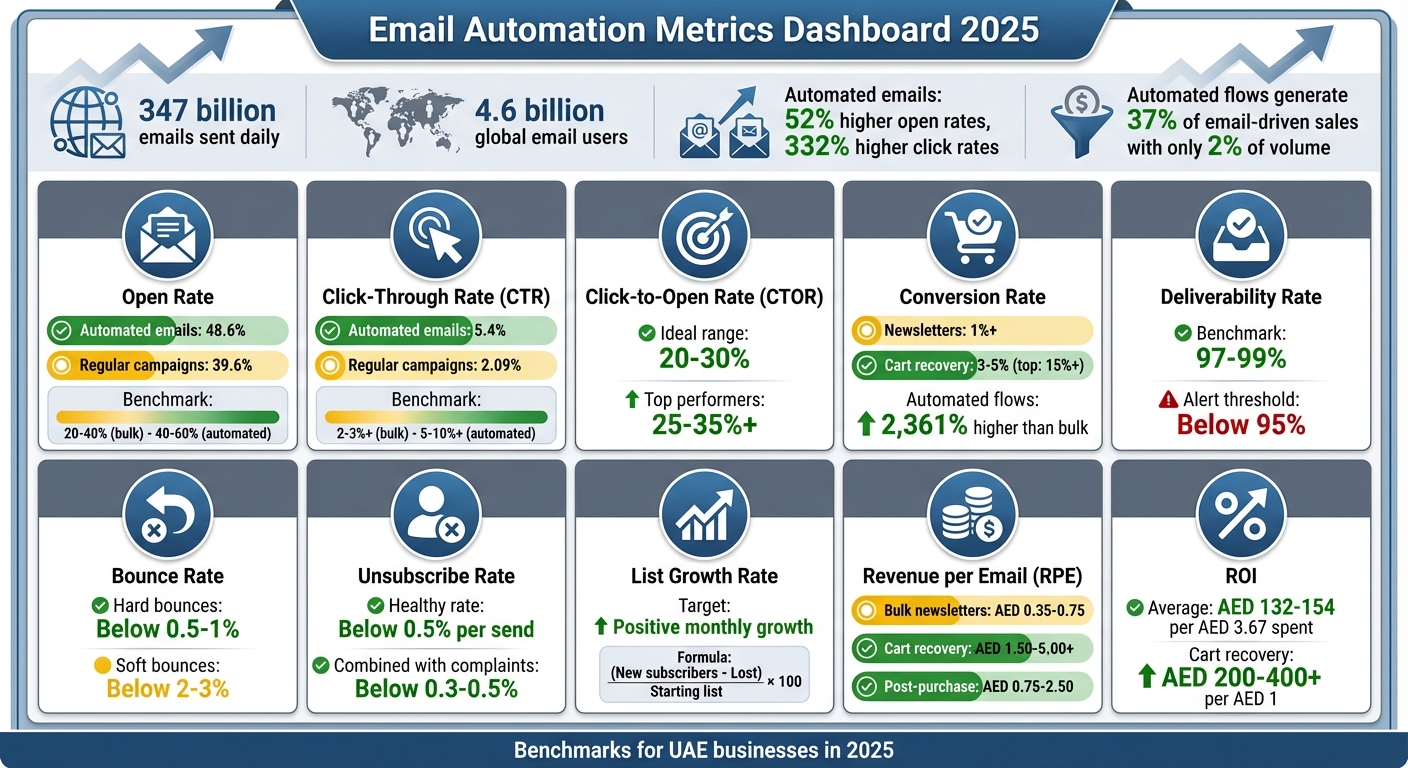
10 Email Automation Metrics to Track in 2025: Benchmarks and Performance Data
By focusing on these metrics, UAE businesses can optimize email campaigns to align with local habits, like mobile usage during evenings or key periods like Ramadan. Automated emails, enhanced by AI personalization, drive better results by targeting the right audience at the right time. Use platforms like Klaviyo, Omnisend, or Braze to track and improve these metrics, ensuring your campaigns deliver measurable revenue growth.
Open rate represents the percentage of delivered emails that recipients actually open. It’s calculated using the formula: (opens ÷ deliveries) × 100. By 2025, this metric has become a key indicator of whether your email content grabs attention or gets overlooked in crowded inboxes.
Open rates are the starting point for any email engagement. If your audience doesn’t open the email, there’s no chance for clicks, conversions, or purchases. Automated email campaigns often outperform standard ones, with open rates averaging around 48.6% compared to 39.6% for regular campaigns. For businesses in the UAE, where mobile usage dominates, even a small improvement in open rates can create more opportunities to engage.
This metric also acts as an alert system. A sudden drop in open rates could indicate problems like delivery issues, audience fatigue, or content that no longer resonates. Analyzing open rates by segment - such as new subscribers versus loyal customers, or UAE audiences compared to other GCC markets - can help pinpoint and address these issues before they affect your email reputation.
Let’s explore how AI-driven personalization is reshaping open rate performance.
AI-powered personalization is a game-changer for open rates. For instance, emails with personalized subject lines see a 26% higher open rate than generic ones. By 2025, 66% of marketers are leveraging AI to optimize send times, ensuring emails land in inboxes when recipients are most likely to engage.
AI also enables behavior-based triggers that deliver impressive results. Take back-in-stock notifications, for example - they achieve a 59.19% open rate by targeting customers at the perfect moment when their interest is rekindled. Similarly, automated flows like welcome emails and cart abandonment reminders often see open rates around 47%, as they respond to user actions in real time. For UAE audiences, timing emails to align with the local work week (Sunday–Thursday), evening mobile usage patterns, and key moments like Ramadan can further enhance engagement.
High open rates are directly tied to revenue growth. When paired with advanced audience segmentation, behavior-driven automation can boost revenue by up to 760%. In industries like retail, real estate, and hospitality, which are crucial to the UAE market, even small gains in open rates can lead to noticeable increases in revenue. For example, Klaviyo’s research shows that email flows with top-tier open rates (65.74%) generate 37% of email-driven sales, despite being sent in lower volumes.
Modern email platforms like Omnisend, MailerLite, Klaviyo, and Braze make it easy to track open rates in real time. These platforms offer dashboards that show the ratio of opens to deliveries. However, keep in mind that machine opens (like those from email scanning software) can inflate numbers, so it’s better to focus on adjusted metrics to measure genuine engagement.
A/B testing is another essential method for optimizing open rates. Experiment with subject lines by varying their length, tone, level of personalization, and language. Around 34% of marketers already use AI to refine their email copy, including subject lines. For UAE audiences, testing bilingual subject lines (English and Arabic), incorporating localized offers (e.g., "Save AED 50"), and referencing culturally relevant themes can significantly improve campaign results. By integrating email analytics with broader business metrics through unified customer data platforms, you can link open rates to clicks, revenue, and long-term customer value, ensuring every email campaign contributes to your overall goals.
Click-Through Rate (CTR) measures how many recipients of your email clicked on at least one link, expressed as a percentage. The formula is straightforward: (Total clicks ÷ Emails delivered) × 100. While open rates tell you if your subject line caught attention, CTR reveals whether your email’s content, design, and calls-to-action are successfully encouraging interaction. Essentially, it’s a key indicator of how well your message is cutting through the clutter of crowded inboxes.
CTR bridges the gap between passive interest and active engagement, showing whether your content is motivating action. For 2025, the average CTR across industries is about 2.09% for general campaigns, while automated emails achieve higher rates of approximately 5.4%. For UAE-based businesses in sectors like retail, hospitality, and real estate, even a small increase - say, 0.5 percentage points - can result in a significant boost in AED revenue when scaled across thousands of recipients.
Automated emails consistently outperform general campaigns because they’re triggered by user actions, such as cart abandonment or browsing behavior. These emails are sent when recipients are most likely to engage, making them highly effective. Analyzing CTR by automation type, device, and audience allows marketers to identify which areas need attention and which are already performing well.
AI-driven personalization is reshaping how marketers approach CTR. By tailoring content, product recommendations, and email timing to individual subscriber profiles, CTR can increase by 13%, with revenue rising by 41% as a result. AI leverages behavioral and purchase data to create highly relevant content, and with 75% of email strategies expected to incorporate AI in the near future, this trend is only growing.
For UAE audiences, personalization might mean displaying AED pricing, aligning send times with the Sunday–Thursday work week, or creating offers for key periods like Ramadan. Advanced AI systems can process over 1 million first-party data points to ensure every email feels relevant and timely. Features such as dynamic product blocks, personalized hero images, and context-aware CTAs are proving to be particularly effective.
CTR has a direct impact on revenue by turning email views into clicks that lead to revenue-generating actions, such as visiting product pages, completing purchases, or upgrading subscriptions. Automated emails, in particular, account for roughly 37% of email-driven revenue. For ecommerce brands in the UAE, improving CTR on emails like cart abandonment or back-in-stock notifications can lead to substantial increases in AED earnings.
The relationship between CTR and revenue is often linear: higher CTR translates to better revenue, provided that landing pages and checkout flows are optimized. Companies like Wick specialize in attributing revenue to specific email clicks by integrating email platform data with web analytics and CRM systems. This approach helps identify which CTR improvements are the most financially impactful.
Modern email platforms such as MailerLite, Bloomreach, and Omnisend offer real-time CTR tracking with dashboards that break down performance by campaign, automation step, device, and audience segment. Many teams also use UTM parameters with web analytics tools to monitor post-click behavior and track revenue by source. For more advanced insights, customer data platforms can consolidate CTR, conversion, and revenue data across multiple channels, enabling detailed cohort and lifecycle analysis.
To stay on top of CTR trends, use weekly dashboards segmented by flow and audience. Pair these with UTM-based analytics and AI-generated alerts to uncover meaningful shifts. To improve CTR, focus on the entire user journey, from inbox to landing page. Strategies include creating curiosity-driven subject lines, using clean layouts with one primary CTA, incorporating dynamic content based on user behavior, and ensuring mobile-friendly designs. Behavior-triggered emails, like those responding to abandoned carts or specific browsing habits, can achieve 3× higher engagement compared to general broadcasts.
| Source | Average CTR | Notes |
|---|---|---|
| MailerLite | 2.09% | Across all industries, 3.6 million campaigns |
| Bloomreach | 1.3–2.7% | Industry range; target 2%+ |
| Omnisend | 5.4% | Automated flows |
| Nutshell | 3.25% | All industries |
This analysis of CTR lays the groundwork for exploring other metrics that contribute to campaign success.
CTOR measures the percentage of email openers who click a link, calculated as (Unique clicks ÷ Unique opens) × 100. Unlike CTR, which accounts for factors like deliverability and subject line performance, CTOR zeroes in on how well your email content itself connects with your audience. Bloomreach describes CTOR as "one of the clearest indicators of how engaging your email content is" because it focuses solely on those who actually open and view the email. This metric builds upon open rates by highlighting the effectiveness of your content. For 2025, a 20% or higher CTOR is considered solid, with 25–30% being the benchmark for highly targeted campaigns.
CTOR sheds light on whether your email's design, copy, offers, and CTAs are compelling enough to drive clicks. A strong open rate paired with a low CTOR often points to content that isn’t engaging, even if the subject line performs well. Unlike open rates or CTR, CTOR gives you a sharper focus on content impact. Omnisend reports that automated emails see 332% higher click rates and 2,361% higher conversion rates compared to standard scheduled emails. For businesses in the UAE, where inbox competition is fierce and audiences are often multilingual, CTOR provides insights into whether your Arabic or English content, visuals, and AED-based offers are resonating with specific audience segments.
AI-powered personalization can significantly enhance CTOR by tailoring email content to individual behaviors and preferences. In fact, 39% of email marketers predict that AI-driven hyper-personalization will play a major role in shaping automation campaigns in the near future. For UAE businesses, this could mean dynamically showcasing products based on browsing history, tweaking send times to align with the Sunday–Thursday work week, or crafting Ramadan-specific promotions. By analyzing over 1 million first-party data points, AI systems can make email content more relevant, leading to higher engagement and click-through rates.
A higher CTOR doesn’t just indicate better engagement - it directly impacts revenue. More clicks often lead to more purchases. Omnisend data reveals that one in three clickers eventually make a purchase, while nearly half of those who click on welcome or cart abandonment emails go on to convert. Automated emails, despite their smaller volume, generate a disproportionate share of revenue. For UAE businesses, even modest CTOR improvements can lead to noticeable gains in AED revenue. Firms like Wick specialize in helping businesses integrate email automation with analytics and CRM systems, ensuring that CTOR improvements are tied to revenue outcomes across the customer journey.
Platforms like Omnisend, MailerLite, and Klaviyo offer native tools to track CTOR, breaking down performance by campaign, automation flow, and audience segment. To improve CTOR, focus on mobile-friendly designs, clear bilingual headings, and single, action-oriented CTAs. Use dynamic content blocks informed by user behavior and test different layouts and offers through A/B testing. AI-powered tools can also optimize send times, ensuring emails reach subscribers when they’re most likely to engage. By tracking how clicks translate into AED revenue, you can calculate "revenue per click" and identify which email flows offer the greatest potential for improvement. CTOR is a key piece of the puzzle, helping you connect email performance to broader automation success.
Conversion rate tells you the percentage of delivered emails that lead to a desired action. While open and click-through rates measure engagement, conversion rate is where revenue comes into play. In 2025, newsletters generally achieve conversion rates of 1% or more, triggered flows reach between 3–5%, and highly focused sequences like abandoned cart emails can hit an impressive 15% or higher. For businesses in the UAE, conversions often mean online purchases in AED - typically ranging from AED 250 to AED 1,000 per transaction, depending on the industry - or securing premium bookings and qualified leads in sectors like real estate, finance, and hospitality. This metric not only gauges the immediate success of your campaigns but also helps shape strategies for maximising revenue.
Conversion rate is the ultimate measure of how effective your email automation strategy is. Automated email flows can achieve conversion rates up to 2,361% higher than traditional scheduled sends, proving that even minor improvements can bring in significant AED gains. On average, automated flows across industries deliver a 1.9% conversion rate, with one in three clicks leading to a purchase. Nearly half of the clicks on welcome and cart abandonment emails convert into revenue. For UAE brands competing in crowded inboxes, conversion rate shows whether your AI-powered personalization and AED-specific offers are truly driving results. With email marketing delivering AED 132–AED 154 in returns for every AED 3.67 spent (mirroring a global ROI of $36–$42 per $1), conversion rate becomes a key factor in profitability.
AI personalization doesn’t just boost open rates and click-throughs - it also drives better conversion outcomes. By tailoring product recommendations, send times, and content to individual behaviors, AI-driven strategies have been shown to increase click-through rates by 13% and revenue by 41% compared to traditional email methods. Advanced segmentation, powered by AI insights, can lead to revenue boosts of up to 760%, with behavior-based emails achieving three times higher engagement and stronger conversion rates. Effective AI techniques include predicting the best offers for each user, using dynamic pricing, and optimizing send times to match local habits. AI systems that analyze millions of data points ensure your email content is both timely and focused on driving conversions.
Conversion rate is directly tied to the revenue generated per email. Automated flows, for instance, contribute about 37% of email-driven revenue while making up only a small fraction of total email volume. Even a small improvement - like increasing a conversion rate from 2% to 3% on high-intent flows - can lead to significant AED gains for businesses, especially those offering high-value products or services. Tracking conversion rates by segment and automation type helps pinpoint the most profitable flows, enabling you to shift resources away from underperforming campaigns. Companies like Wick specialize in integrating email automation with analytics and CRM tools, ensuring that improvements in conversion rates translate directly into revenue growth across the entire customer journey.
Modern email platforms like Klaviyo and Bloomreach provide dashboards that track key metrics such as sends, opens, clicks, and conversions for each campaign and flow. These platforms often include revenue-per-recipient data and industry-specific conversion benchmarks. By connecting these tools to web analytics using UTM parameters and integrating them with e-commerce or CRM systems, you can track end-to-end performance - right down to how much AED each automation generates, including multi-session and post-click conversions. Combining these insights with broader analytics creates a comprehensive view of your digital performance. To improve conversion rates, start by benchmarking your current performance against 2025 targets. Then, test localized incentives in AED, refine value propositions for mobile users, use AI-driven product recommendations, and adjust send times to align with local habits. Running A/B tests on subject lines, CTAs, and landing pages can further optimize both click-through rates and on-site conversions, enhancing the overall effectiveness of your email campaigns.
Deliverability rate refers to the percentage of emails successfully accepted by recipients' servers. In simpler terms, it measures whether your emails make it to inboxes before they even have a chance to be opened or clicked. For 2025, the benchmark sits at 97–99%, with anything below 95% signalling major problems like reputation damage or email blocks.
A low deliverability rate can derail your entire email automation strategy. When emails are delivered, automated campaigns typically achieve 42.1% open rates and 5.4% click rates. But with 347 billion emails being sent daily in 2025 and internet service providers (ISPs) tightening their filters, maintaining strong deliverability is harder than ever.
For UAE businesses, especially those leveraging behavioral triggers like abandoned cart emails - which can generate 10 times more revenue than standard campaigns - poor deliverability can be costly. For instance, a small drop from 98% to 93% in deliverability could mean losing around 5% of potential revenue before customers even see your offers. Significant differences in delivery rates between major providers like Gmail and Outlook (variances over 30%) also point to provider-specific issues that need immediate action. This metric doesn’t just reflect operational efficiency - it directly impacts your bottom line.
AI personalization plays a big role in improving deliverability by boosting engagement and enhancing your sender reputation. Emails tailored with AI-driven personalization have been shown to achieve 13% higher click-through rates and drive 41% more revenue. However, there’s a catch: 39% of marketers highlight AI hyperpersonalisation as a key trend, but overdoing it - especially without maintaining clean email lists - can trigger spam filters. The secret lies in finding the right balance: use AI to fine-tune content and send times, but back it up with good email practices like list hygiene and proper authentication protocols (SPF, DKIM, and DMARC).
Deliverability is the backbone of turning automated emails into revenue. Behavioral triggers, for example, deliver an average 1.9% conversion rate, and automated flows can achieve up to 2,361% better conversions compared to regular campaigns - provided the emails actually land in inboxes. Consider back-in-stock emails: when deliverability is high, open rates can soar to 59.19%, but poor deliverability can drag those rates below 20%. Keeping your email lists clean is non-negotiable if you want to sustain high delivery rates and maximize revenue.
Modern platforms like Bloomreach Engagement and Omnisend make it easier to monitor deliverability with real-time dashboards that track bounce rates and sender reputation. Pay close attention to hard bounces - addresses that are permanently unreachable should be removed automatically to protect your sender reputation. Monitoring performance by email provider is also crucial; variations exceeding 30% between services like Gmail, Outlook, and Yahoo could indicate ISP-specific issues that require adjustments in authentication.
To consistently hit the 97–99% deliverability target, focus on:
Bounce rate refers to the percentage of emails that never reach a recipient's inbox because they fail to connect with the mail server. These failures are classified into two types: hard bounces (permanent issues, such as invalid email addresses) and soft bounces (temporary problems like full inboxes or server errors). To calculate the bounce rate, divide the number of bounced emails by the total emails sent, then multiply by 100. As of 2025, most email platforms in the UAE automatically distinguish between hard and soft bounces.
High bounce rates can harm your sender reputation, which inbox providers closely monitor. Internet Service Providers (ISPs) use bounce rates as part of their spam filtering algorithms, meaning even a slight increase can lower deliverability for your entire email list. With 347 billion emails sent daily in 2025 and stricter ISP filtering policies, keeping bounce rates low has become essential. This is particularly crucial for UAE businesses targeting corporate or governmental domains, where repeated bounces could lead to domain-wide blocks - an issue that's challenging to resolve.
Successful email programs typically maintain delivery rates between 97–99%, with hard bounce rates staying below 0.5–1%. While soft bounces may occasionally spike during high-traffic periods or when reaching out to older segments, a sustained soft bounce rate above 2–3% signals the need for action - such as slowing down email sends or launching re-engagement campaigns.
AI is playing a major role in refining email list management, and its impact on bounce rates is no exception. AI tools can automatically suppress inactive or risky contacts before they cause hard bounces, ensuring cleaner lists. These systems are capable of identifying patterns - like recurring soft bounces, role-based email addresses, or problematic acquisition channels - and routing those contacts into validation processes or confirmation workflows. For businesses in the UAE, combining AI-driven personalization with strong data quality controls across web, CRM, and offline channels ensures healthier email lists and better engagement.
Bounce rates don’t just affect deliverability - they also directly influence revenue. A poor sender reputation reduces inbox placement and open rates, which can significantly impact email performance. Email marketing continues to deliver some of the highest returns in 2025, with an average ROI of AED 132–154 for every AED 3.67 spent. Since automated, behavior-based campaigns contribute heavily to email revenue, keeping bounce rates low in these campaigns is critical for maximising revenue per email sent.
Modern email platforms come equipped with analytics tools that provide detailed insights into delivery, bounce, and complaint metrics by campaign, segment, or domain. Many platforms now incorporate AI-driven analytics to flag unusual trends - like a sudden increase in hard bounces from a specific source - and recommend corrective actions. Effective tracking strategies include monitoring deliverability dashboards, breaking down bounce data by type and ISP, and setting up alerts for when hard bounce rates exceed thresholds (e.g., over 1% in a single campaign).
For a more comprehensive approach, data-driven consultancies like Wick can integrate email bounce data with insights from your website, CRM, and paid media. This unified view helps identify bounce-prone lead sources, optimize ad spend, and improve lead quality across all channels. By connecting findings from email campaigns to broader marketing efforts, businesses can address bounce-related issues more effectively while enhancing overall performance.
The unsubscribe rate reflects the percentage of recipients who opt out of your mailing list. It's calculated using the formula: (unsubscribes ÷ delivered emails) × 100. In the UAE, email platforms in 2025 often group unsubscribe rates with spam complaints as a combined measure of disengagement. Healthy email programs typically keep this combined rate below 0.3–0.5% for standard campaigns and under 1% for promotional emails. Automated email flows like welcome sequences and cart abandonment emails generally show lower unsubscribe rates compared to bulk campaigns, thanks to their relevance and precise targeting. This metric acts as an early signal for engagement problems that could impact overall campaign performance.
With inboxes becoming increasingly cluttered, the unsubscribe rate serves as a key indicator of list health. A spike in unsubscribe rates often signals declining engagement and revenue. Internet Service Providers (ISPs) use engagement levels and complaints to assess sender reputation, so consistently high unsubscribe rates can lead to deliverability issues that affect your entire email program. For UAE businesses catering to diverse regions and languages, this metric is invaluable for assessing whether your localization efforts, timing, and tone resonate with local audiences. Tailoring your messaging to align with local events and cultural nuances is essential to minimize opt-outs.
AI-powered email strategies are gaining momentum, with more marketers turning to generative AI for crafting email copy and optimizing send times. These AI-driven approaches can lead to a 13% increase in click-through rates and a 41% boost in revenue compared to traditional methods. Behavior-based campaigns, often enhanced by AI, tend to achieve higher engagement and lower unsubscribe rates because recipients find the content more relevant. However, using AI to simply increase email volume without proper oversight can backfire, leading to higher unsubscribe and complaint rates. To avoid this, best practices include leveraging AI to monitor and manage churn-prone segments by adjusting messaging frequency and content for users at risk of opting out. Striking the right balance in AI usage is crucial, as unsubscribe rates directly influence revenue outcomes.
Email marketing continues to deliver outstanding returns, with estimates showing AED 132–154 in revenue generated for every AED 3.67 spent. A low unsubscribe rate helps maintain the reach of high-performing automated flows, which are critical for maximising long-term ROI. Despite accounting for a smaller portion of total email volume, automated flows - like welcome, post-purchase, and cart-recovery sequences - generate a significant share of revenue due to their higher engagement and conversion rates. Elevated unsubscribe rates reduce your audience size, limiting future revenue potential from these high-performing campaigns. Since automated emails typically outperform bulk campaigns in open, click, and conversion rates, losing engaged subscribers from these sequences can have a significant negative impact on lifetime customer value, especially in key UAE sectors like retail and hospitality.
Modern email platforms offer built-in dashboards that track unsubscribes by send, segment, and automation, often alongside spam complaints and other engagement metrics. Many platforms now include AI-powered analytics to flag unusual unsubscribe patterns, identify potential causes like content or frequency issues, and recommend adjustments. To stay on top of this metric, monitor unsubscribe rates by individual send, automation journey, and as a rolling 30- to 90-day average. Compare these figures with open rates, click rates, conversion rates, and revenue-per-email metrics. For deeper insights, analyze which acquisition channels, sign-up forms, or offers are consistently linked to higher unsubscribe rates. Data-driven consultancies like Wick can integrate unsubscribe metrics into broader performance dashboards, connecting email insights with data from your website, CRM, and paid media to pinpoint and address sources of audience churn across all channels.
List growth rate tracks the net change in your subscriber base over a specific period. To calculate it, take the number of new subscribers, subtract those who left (through unsubscribes, hard bounces, or spam complaints), divide by your starting list size, and multiply by 100 to get a percentage. For example, if you begin January with 10,000 subscribers, gain 500 new sign-ups, and lose 150 contacts, your monthly growth rate would be 3.5%. For UAE marketers, it’s important to consistently monitor this metric, present figures with thousand separators (e.g., 12,500 contacts), and align reporting with local business cycles - whether that’s a calendar month, quarter, or major shopping events like Ramadan or the Dubai Shopping Festival.
This metric provides a foundation for evaluating how subscriber engagement and revenue potential evolve over time.
A steady list growth rate ensures your automated campaigns - such as welcome emails, cart recovery messages, and re-engagement efforts - always have a stream of active subscribers to target. Studies show that 20–30% of your subscriber list typically drives the majority of engagement and revenue. Without consistent growth, this active segment naturally shrinks over time due to churn, which can limit your revenue potential - a crucial factor in UAE markets. With over 75% of email operations expected to be AI-driven by 2026, maintaining a growing subscriber base helps counter rising competition for attention and increasing unsubscribe rates.
AI-driven personalization not only enhances engagement but also directly impacts subscriber growth. For instance, personalized subject lines can increase open rates by 26%, improving retention. Marketers who use targeted segmentation, often powered by AI models that group users based on behavior, report up to a 760% boost in email revenue. This makes it easier to justify investments in list-building strategies.
In the UAE, where audiences are multilingual and diverse, AI can adapt website pop-ups based on browsing habits, align lead magnet topics with trending content, and identify subscribers at risk of opting out. This allows for timely re-engagement and helps sustain a positive growth rate even as your list matures.
Email marketing continues to deliver exceptional ROI, generating AED 132–154 in revenue for every AED 3.67 spent. Automated emails - like welcome sequences, product recommendations, and abandoned cart reminders - produce 10× higher revenue than generic bulk emails, often accounting for over a third of email-driven sales despite their smaller volume.
For example, at a cost of AED 0.80 per automated email and five emails per new subscriber in the first 60 days, each new subscriber could generate approximately AED 4.00. Scaling list growth by 5,000 subscribers monthly could translate to an additional AED 20,000 in 60-day revenue through automation alone, assuming similar engagement rates. By tying list growth goals to subscriber lifetime value, UAE marketers can better allocate budgets and focus on strategies that deliver higher returns.
Accurately tracking list growth is essential to unlocking its benefits. Most email service providers (ESPs) offer built-in analytics dashboards that monitor subscriber counts, sign-up sources, and list hygiene metrics over time. These dashboards typically display details like net new contacts, unsubscribes, spam complaints, and bounces by date. Integrating ESP data with CRM and sales systems can help pinpoint which channels drive the highest revenue per subscriber.
For UAE brands, integrating email platforms with CRM systems, e-commerce tools, point-of-sale systems, and event registration platforms ensures that all new contacts are tagged with their source. This allows you to evaluate which acquisition methods - such as tablets at retail counters in Dubai or sign-ups at Abu Dhabi trade shows - yield the highest revenue and conversion rates. For seamless integration across your website, CRM, marketing automation, and analytics platforms, consultancies like Wick can provide tailored solutions to make list growth measurable across your entire digital ecosystem.
Revenue per Email (RPE) calculates the average revenue generated from each email delivered in your automation campaigns. Simply put, it’s the total revenue from a campaign divided by the number of emails delivered. For instance, if an abandoned cart email sequence generates AED 10,000 from 5,000 delivered emails, the RPE is AED 2.00 per email. This metric provides a clear picture of the financial impact of each message, making it especially relevant for UAE marketers to justify spending in AED.
RPE goes beyond basic engagement metrics, offering a direct assessment of your campaign’s profitability.
While open rates and click-through rates remain important, RPE focuses squarely on revenue. It connects your email efforts to actual financial outcomes, making it easier to evaluate how your email costs compare to the revenue they generate. Automated emails, in particular, are known for delivering strong RPE results. They account for 37% of all email-driven sales while making up just 2% of total email volume. For businesses in the UAE, tracking RPE in AED simplifies budget planning and resource allocation.
AI-powered personalization has a significant impact on RPE by customising content, timing, and offers based on individual user behavior. According to Omnisend, AI-driven email marketing can boost revenue by 41% compared to traditional methods. Additionally, AI-powered segmentation can increase email revenue by as much as 760%. In the UAE’s diverse market, AI can tailor product recommendations based on browsing habits, optimize email delivery for local business hours, and create customized offers for key events like Ramadan or the Dubai Shopping Festival. These adjustments lead to higher conversions per email delivered.
RPE is a critical indicator of your email program’s profitability. Email marketing consistently delivers impressive returns, generating AED 132–154 for every AED 3.67 spent. Behavior-triggered automated emails perform even better, producing around 10× more revenue than standard bulk campaigns. High-performing automation flows are particularly effective: nearly one in three recipients who click on these emails make a purchase, and for welcome and cart abandonment emails, almost half of those who click go on to buy. By analyzing RPE by flow, you can identify which automations are driving the most revenue and which ones may need adjustments.
Most modern email platforms - such as Klaviyo, Bloomreach, HubSpot, Mailchimp, and Omnisend - automatically calculate RPE (often referred to as "revenue per recipient") and break it down by flow, segment, or channel. To ensure accurate tracking, make sure your platform uses UTM parameters and proper revenue attribution to link purchases to specific emails. Integrating your email system with your e-commerce platform and CRM is also essential for capturing complete transaction data in AED. For UAE brands managing complex digital environments, consultancies like Wick can implement Customer Data Platforms (CDPs). These platforms consolidate over 1 million first-party data points, enabling precise RPE tracking across automated email journeys while maintaining the personalization that drives higher revenue per email.
Return on Investment (ROI) is a key measure of how profitable your email automation campaigns are. It’s calculated with a simple formula: (Revenue from emails – Cost of campaigns) / Cost of campaigns × 100. For instance, if you spend AED 5,000 on an email campaign and it generates AED 210,000 in revenue, your ROI is a massive 4,100%. In the UAE's competitive market, ROI helps justify your email marketing budget by proving its financial value.
Email marketing continues to outperform other digital channels, offering a return of AED 132–154 for every AED 3.67 spent. These figures, based on global benchmarks of $36–$42 per $1, underscore why email automation remains a top-performing strategy. For UAE marketers, ROI provides a clear, AED-based snapshot of whether your email campaigns are profitable and sustainable. It connects earlier engagement metrics to actual revenue, giving you a complete picture of your automation strategy’s success.
AI is a game-changer when it comes to boosting ROI. AI-powered email strategies can increase revenue by 41% compared to traditional methods and improve click-through rates by 13%. This is especially evident in automated email flows, where hyperpersonalisation - cited by 39% of marketers as a key factor - makes a tangible difference. Features like send-time optimization (used by 66% of marketers), AI-generated subject lines (34%), and advanced segmentation can increase email revenue by as much as 760%. By 2026, experts predict that 75% of email operations will rely on AI, making it essential for staying competitive and maximising ROI.
ROI ties directly to revenue growth by converting higher engagement into measurable financial outcomes. Automated emails consistently outperform standard campaigns, generating more revenue with fewer sends. Behavioral trigger emails, for example, produce 10 times more revenue than bulk campaigns. High-performing flows like abandoned cart and welcome series drive 87% of automated orders. Among recipients who click on automated emails, nearly one in three make a purchase, and for abandoned cart or welcome emails, almost half of those who click end up buying. This compounding effect means that better engagement leads to stronger revenue and improved ROI. For UAE businesses managing complex digital ecosystems, tracking ROI across multiple touchpoints requires advanced tools. Companies like Wick use Customer Data Platforms to consolidate over 1 million first-party data points, ensuring precise ROI tracking while maintaining the personalization that drives these results.
To measure ROI effectively, you need the right tools. Platforms like Bloomreach Engagement, Klaviyo, HubSpot, Mailchimp, and Omnisend offer built-in analytics for real-time ROI tracking. These tools can automatically calculate revenue per recipient and break down performance by flow, segment, or channel. For accurate tracking, integrate your email platform with your e-commerce system and CRM to capture all transaction data in AED. Use UTM parameters and proper revenue attribution to link purchases to specific emails. Focus on tracking ROI by automation type - flows like welcome series, abandoned cart, browse abandonment, and post-purchase emails typically deliver the best returns.
In addition, monitor your click-to-open rate (CTOR), aiming for 20–30% to assess the effectiveness of your content. Keep deliverability rates above 97–99% to ensure ROI reflects actual performance rather than technical issues. Regular A/B testing of AI-optimized send times and content variations can help pinpoint what works best, allowing you to fine-tune your campaigns for maximum profitability.
Understanding how your email campaigns measure up against industry standards can reveal areas where you're excelling and where there's room for improvement. Below is a breakdown of 2025 benchmarks for ten key metrics, organized by campaign type. These figures, based on global data, offer a useful baseline for businesses in the UAE.
| Metric | Bulk Newsletters | Cart Recovery | Post-Purchase |
|---|---|---|---|
| Open Rate | 20–30% (good: 30–40%) | 40–60%+ | 40–60% |
| Click-Through Rate (CTR) | 2–3%+ | 5–10%+ | 4–8%+ |
| Click-to-Open Rate (CTOR) | 20–25%+ | 25–35%+ | 20–30% |
| Conversion Rate | ≥1% (good: 1–3%) | 3–5%+ (top: 10–15%+) | 2–5%+ |
| Deliverability Rate | 97–99% | 97–99% | 97–99% |
| Bounce Rate | <1–2% | <1–2% | <1–2% |
| Unsubscribe Rate | <0.5–1% per send | <0.5% per send | <0.5% per send |
| List Growth Rate | Positive monthly growth | Positive monthly growth | Positive monthly growth |
| Revenue per Email (RPE) | AED 0.35–0.75 | AED 1.50–5.00+ | AED 0.75–2.50 |
| ROI | AED 130–155 per AED 1 | AED 200–400+ per AED 1 | AED 150–250 per AED 1 |
These benchmarks connect earlier insights to tangible goals for your campaigns. Automated email flows consistently outperform bulk newsletters in both engagement and revenue. Although automated emails make up only about 2% of total email volume, they account for an impressive 37% of email-driven sales.
For businesses in the UAE, these global figures offer a solid foundation, but local factors often push performance even higher. High mobile usage, seasonal shopping peaks, and the popularity of cash-on-delivery tend to increase engagement and conversions. To truly understand your audience, tracking your performance over time will help you establish internal benchmarks that better reflect your specific market dynamics.
On average, email marketing delivers an ROI of AED 132–154 per AED 1 spent. For cart recovery emails, nearly half of the users who click through end up making a purchase. This explains why these campaigns generate significantly more revenue per email than traditional newsletters. UAE brands dealing with complex customer journeys can benefit from platforms that integrate first-party data. For instance, Wick uses over 1 million data points to ensure accurate tracking and personalization, which are key to achieving these results.
To maximize your outcomes, segment this data further by industry and audience. Focus on the metrics that matter most to your business and refine your strategies consistently for better results.
By keeping an eye on these ten email automation metrics, businesses in the UAE can pave the way for better engagement and higher returns. Metrics like open rates, click-through rates, conversions, deliverability, and revenue per email help transform raw numbers into actionable insights. Data consistently shows that automated email flows outperform bulk campaigns, making it crucial to track these numbers to stay ahead of the competition.
Beyond measuring success, these metrics guide you towards smarter strategies. Email marketing has proven to deliver strong ROI, highlighting the connection between performance metrics and revenue growth. To achieve this in the UAE's dynamic market, businesses need more than just standalone tools - they need a unified strategy that ties email performance to the broader digital ecosystem. This includes everything from website behavior and SEO to social media engagement and customer data.
The Wick's Four Pillar Framework offers a seamless integration of website development, content, analytics, and automation, ensuring that your metrics reflect the entire customer journey. For instance, the Capture & Store pillar consolidates customer insights from multiple touchpoints, while the Tailor & Automate pillar leverages AI-driven personalization at scale without sacrificing a human touch. With over 1 million first-party data points managed across campaigns, this approach turns metric tracking into actionable insights.
This unified strategy is especially important for the UAE's local market, where businesses must navigate mobile-first audiences, unique shopping patterns, and seasonal peaks like Ramadan. By eliminating fragmented efforts, businesses can focus on achieving key benchmarks for 2025, such as 20%+ open rates for bulk emails, 40–70% for triggered flows, 2%+ click-through rates, and 97–99% deliverability.
Take the time to audit your current performance against these benchmarks and integrate your email analytics into a cohesive digital framework. The metrics you monitor today will directly influence the revenue you generate tomorrow.
AI-powered personalization takes email marketing to the next level by crafting content that resonates with each recipient's unique preferences, behaviors, and past interactions. By analyzing patterns in data, AI ensures that emails feel relevant and timely, increasing the chances that recipients will open them and take meaningful action.
This kind of tailored communication does more than just boost open rates - it builds trust and strengthens loyalty. When customers feel understood, they're more likely to engage with your brand regularly. In a competitive market like the UAE, where customer expectations are particularly high, personalized emails can give your business a distinct edge.
To keep up with key email automation metrics in 2025, it's essential to rely on tools that bring AI-powered analytics and effortlessly connect with your marketing setup. Platforms like Wick’s unified digital solution deliver in-depth insights into crucial metrics such as open rates, click-through rates, and conversion rates. This helps businesses make informed decisions and fine-tune their campaigns for better results.
By using these advanced tools, companies can get a sharper view of how their emails are performing and adjust strategies to align with the changing preferences of customers in the UAE market.
Email deliverability plays a crucial role in ensuring your messages land in your audience's inboxes rather than getting lost in spam folders. When your emails consistently reach the right place, the chances of them being opened, clicked, and acted upon significantly increase - directly boosting engagement and driving conversions.
On the flip side, poor deliverability can lead to lost opportunities. Emails that fail to reach their recipients mean fewer interactions and a lower return on investment (ROI) for your campaigns. By prioritising strong deliverability, you not only enhance the performance of your email marketing but also build trust and credibility with your audience.
16 MIN READ
14 MIN READ
11 MIN READ
What worked, what didn't, and what we're building next - no noise, unsubscribe anytime.