

Blog / Event-Based Automation for Cross-Channel Messaging
Event-Based Automation for Cross-Channel Messaging
Want to fix inconsistent customer messaging? Event-based automation is the answer.
This approach ensures your messages are timely, relevant, and consistent across platforms like email, SMS, WhatsApp, and social media. Instead of relying on rigid schedules, it triggers messages based on real-time customer actions - like cart abandonment, purchases, or app engagement.
Why does this matter?
- 87% of customers get frustrated repeating themselves across channels.
- Companies with strong cross-channel strategies retain 89% of customers, compared to 33% for others.
- Triggered emails have 59% higher open rates, and action-based push notifications perform 480% better.
To make it work, businesses need:
- A unified data platform to centralise customer information.
- Real-time data processing for instant responses.
- Integrated tools to sync across platforms.
In the UAE, where digital engagement is crucial, automation tailored to behaviours like mobile shopping and WhatsApp usage can boost revenue and loyalty. Done right, it eliminates repetitive messages, improves trust, and keeps customers engaged.
Mapp Marketing Cloud: Cross Channel Marketing Journey Orchestration
The Problem: Inconsistent Messaging Across Channels
When your customer data is scattered across multiple systems - one for email, another for SMS, and yet another for social media - each platform only gets a partial view of the customer journey. For example, your email tool might treat someone as a first-time visitor, while your CRM identifies them as a long-time customer. This disconnect creates noticeable gaps in messaging that customers pick up on immediately. These are the tell-tale signs of fragmented systems.
74% of consumers say they aren’t receiving personalised communications from brands. And when messaging feels generic, 54% of people find it annoying, while 47% simply ignore it. During the 2020 lockdown, over 20% of consumers switched brands due to poor or impersonal engagement. In the UAE's competitive digital marketplace, where customer expectations are particularly high, these gaps can lead to lost sales and eroded brand trust. This inconsistent approach lays the groundwork for the challenges outlined below.
How Messaging Gaps Impact Customer Engagement
Fragmented messaging leads to obvious breaks in continuity - moments when your brand feels inconsistent or unreliable. For example, a customer might enjoy a warm, conversational tone in your emails but encounter a cold, transactional style in app notifications. These shifts create a sense of disconnect, eroding trust and weakening the customer relationship.
"When customer data is scattered across systems, teams only see fragments of a person's journey. One platform might label someone as new while another treats them as loyal, creating confusion that customers notice immediately."
– Team Braze
The effects are clear. 64% of online shoppers can tell when their experience feels personalised, and more than half of consumers only buy from brands they fully trust. When customers repeatedly encounter these inconsistencies, they don’t just disengage - they leave for good.
Why Synchronising Messages Is Challenging
The examples above highlight how operational inefficiencies lead to messaging gaps. The root issue? Technical and organisational silos. Your marketing team might rely on one platform, the sales team on another, and customer support on a third. Each system holds different pieces of customer data, and without real-time communication between them, delivering context-aware messages across channels becomes nearly impossible.
Another common pitfall is the "copy-paste" approach - recycling the same content across email, SMS, and social media without tailoring it for each channel’s strengths and user expectations. This strategy ignores the fact that customers expect different tones and formats depending on the platform. For instance, an SMS should be concise and urgent, while an email can dive into more detail. Treating all channels the same misses the chance to connect with customers in a way that feels relevant and timely.
The complexity increases when you realise that more than 50% of B2C customers use between three and five channels for a single purchase. Outdated or incomplete data can cause automations to send irrelevant or poorly timed messages, leaving customers frustrated and disengaged.
The Solution: Event-Based Automation for Cross-Channel Messaging
Event-based automation tackles the problem of fragmented messaging by responding directly to what your customers do. Instead of relying on pre-set schedules, this system triggers communication based on real-time actions - like opening your app, adding items to a cart, or completing a purchase. This approach ensures your messages are not only timely but also relevant to the customer's current experience.
Here’s why this matters: triggered emails see 59% higher open rates, while push notifications sent in response to actions achieve an impressive 480% higher open rate. For example, a digital wealth platform that adopted event-based automation reported a 30% boost in open rates and significantly reduced the time needed to set up campaigns.
Let’s break down what event-based automation involves and what’s needed to make it work.
What Event-Based Automation Does
Event-based automation focuses on customer actions, milestones, or behaviours - like app usage, purchases, or abandoned carts - rather than sticking to rigid schedules. This dynamic approach resolves the identity and data fragmentation issues often seen in traditional systems. When a specific event occurs, the system determines the best message, channel, and timing to engage the customer.
An added layer of intelligence comes with "exception events." For instance, if a customer completes a purchase after receiving an abandoned cart email, the system cancels any follow-up messages to avoid unnecessary communication. This level of adaptability is crucial, with 70% of customers saying they value connected processes, such as smooth transitions between channels and departments, as a key factor in their loyalty.
Setting the Foundation for Success
For event-based automation to work effectively, three key components need to be in place:
- A centralised data platform: Tools like Customer Data Platforms (CDPs) or data warehouses (e.g., Snowflake or Segment) are essential for bringing together fragmented customer data from your CRM, website, mobile app, and in-store systems into a single, unified profile.
- Real-time data processing: This ensures that events like cart abandonment can trigger immediate responses, keeping the communication relevant and timely.
- An integrated toolstack: APIs and native integrations are critical for seamless coordination between your e-commerce platform, support databases, and messaging systems.
Before diving into automation, it’s important to audit your existing systems and consolidate customer profiles. Mapping the customer journey will help you identify critical touchpoints - such as onboarding or cart recovery - where automation can have the most impact. Additionally, applying frequency caps and setting delivery windows ensures you don’t overwhelm customers with too many messages, and that communications are sent at the most effective times.
Key Event Triggers for Cross-Channel Synchronisation
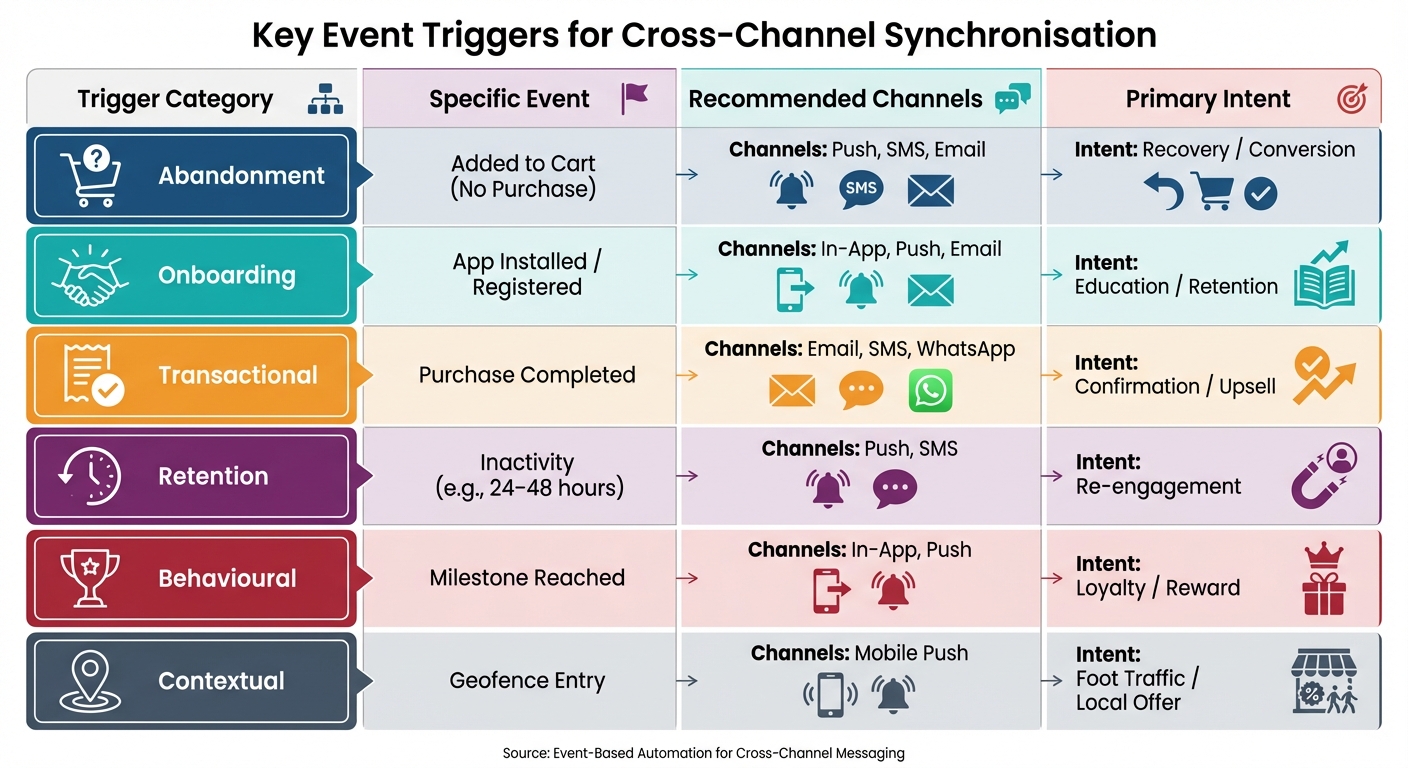
Key Event Triggers for Cross-Channel Customer Messaging Automation
To truly align your communications across multiple channels, pinpointing the right triggers is crucial. These triggers ensure your messages hit customers at just the right moments, boosting engagement and delivering results. Below are four key trigger categories that consistently drive strong outcomes.
Cart Abandonment Triggers
Shopping cart abandonment is a goldmine for recovery opportunities, with around 70% of carts left incomplete on e-commerce platforms. A smart trigger activates when a customer adds items to their cart but doesn’t complete the purchase within 30–60 minutes.
The best strategy? Use a sequence of messages. Start with an email showcasing product images and cart details. If unopened after 24 hours, follow up with an SMS, and finally, a push notification. Push notifications tied to customer actions tend to outperform generic, time-based messages.
To avoid redundant messages, set up exception events that cancel reminders once the purchase is completed. Using unique identifiers like cart_id ensures that each abandoned cart receives the correct follow-up, even if a customer abandons multiple carts.
Onboarding and Engagement Triggers
The onboarding phase is critical, especially when mobile apps lose 77% of their Daily Active Users within the first three days of installation. Onboarding triggers activate when users sign up, install your app, or take their first key action - like browsing products or using a feature.
Start with push notifications for immediate engagement, guiding users through the process in real time. If they don’t complete onboarding, follow up with detailed email tutorials. For incomplete account registrations, an in-app prompt followed by an email after 24 hours can nudge users to finish.
"In today's app market, personalisation is no longer a nice-to-have - it is an expectation. Behaviour-based marketing... enables brands to go beyond broad segmentation-triggered communication and create one-to-one experiences." – Ioana Iordache, Growth Consultant & Founder, IO Growth Lab
Another effective tactic is permission priming. Instead of asking users to enable push notifications immediately, wait until they interact with features like order tracking or price alerts. This contextual timing significantly increases opt-in rates.
Purchase and Delivery Triggers
Messages tied to purchases and deliveries see high engagement rates because customers actively expect them. As soon as a purchase is confirmed, send an automated email or SMS with order details and estimated delivery times.
Keep customers informed throughout the process with real-time updates via SMS or WhatsApp. For example, notify them when their order is dispatched, in transit, or delivered. After delivery, follow up with an email requesting a review or suggesting related products. This post-purchase phase is ideal for upselling, especially since 80% of business leaders report that personalised experiences lead to customers spending 38% more.
Prioritise urgency: use SMS for time-sensitive updates like "Your order has been dispatched" and email for detailed receipts or product suggestions.
Retargeting and Re-Engagement Triggers
Re-engagement triggers focus on customers who’ve gone quiet - whether they’ve abandoned a wishlist, stopped using your app, or ignored emails. These triggers detect inactivity periods and respond with tailored reminders or incentives.
For instance, if a customer hasn’t revisited their wishlist in three days, send a push notification highlighting a price drop on their saved items. No response? Follow up with an SMS offering a limited-time discount. You can also use contextual triggers, like geofence alerts when a customer is near your store or weather-based promotions during cooler days.
To avoid over-discounting, use propensity scoring to identify customers who need offers to convert. This ensures your promotions are targeted and strategic.
By integrating these triggers, you create a seamless customer experience where every interaction feels timely and relevant, helping to build a consistent and engaging brand presence.
| Trigger Category | Specific Event | Recommended Channels | Primary Intent |
|---|---|---|---|
| Abandonment | Added to Cart (No Purchase) | Push, SMS, Email | Recovery / Conversion |
| Onboarding | App Installed / Registered | In-App, Push, Email | Education / Retention |
| Transactional | Purchase Completed | Email, SMS, WhatsApp | Confirmation / Upsell |
| Retention | Inactivity (e.g., 24–48 hours) | Push, SMS | Re-engagement |
| Behavioural | Milestone Reached | In-App, Push | Loyalty / Reward |
| Contextual | Geofence Entry | Mobile Push | Foot Traffic / Local Offer |
sbb-itb-058f46d
Wick's Four Pillar Framework for Event-Based Automation
Wick's Four Pillar Framework provides UAE businesses with a streamlined approach to event-based automation, ensuring consistent and effective messaging across all channels. Instead of juggling multiple platforms individually, this framework integrates customer data, automates responses, and scales with your business needs - whether you're a budding startup in Dubai or a well-established retailer operating across the Emirates. It’s designed to tackle common hurdles like fragmented data and inconsistent communication while delivering real-time, cohesive messaging.
The Tailor & Automate Pillar
The Tailor & Automate pillar transforms unified customer data into actionable insights, enabling businesses to respond instantly to customer behaviour. By creating dynamic segments that update automatically based on actions - like browsing a product, abandoning a cart, or completing a purchase - this pillar ensures timely and relevant engagement.
For businesses in the UAE, this means aligning popular platforms like WhatsApp, Instagram, and Facebook with automated workflows. Picture this: a customer in Downtown Dubai browses luxury products but doesn’t make a purchase. Within hours, they receive a personalised WhatsApp message, followed by a retargeting ad on Instagram if no action is taken. This proactive approach eliminates the delays that can make messages feel irrelevant once the customer’s interest has faded.
"Automation turns your unified data into action. Instead of scheduling one-off campaigns, you can build workflows that respond to customer behaviour in real time." – Customer.io
Here’s a real-world example: In August 2024, Anigma Technologies, a UAE-based retailer specialising in gaming PC components, implemented automated workflows across Instagram, Facebook, and WhatsApp. By automating responses for abandoned carts and cancelled orders, they recovered 70% of cancelled orders and increased their customer base by 25%. Similarly, TKD Lingerie, founded by Kate Kikano, utilised WhatsApp Broadcast automation for targeted promotions in 2024, achieving a 40X return on ad spend and a 74% message open rate.
But automation works best when paired with a robust system for capturing and storing data, ensuring your workflows always operate on accurate, up-to-date information.
Integration with Capture & Store
The Capture & Store pillar provides the foundation for effective automation by consolidating customer interactions in real time. Whether it’s a WhatsApp message, a website visit, or an in-store purchase, this system ensures all touchpoints are recorded accurately. This prevents issues like duplicate messages or missed opportunities .
Imagine a scenario where a customer completes a purchase at a Dubai Mall store, but the transaction isn’t updated online. Without a unified system, they might still receive a cart abandonment email, creating confusion. The Capture & Store pillar addresses this by keeping all data synchronised, ensuring your automation workflows operate smoothly and reflect the latest customer actions.
This is especially critical in the UAE, where 65% of shoppers use their smartphones during the buying process, and more than one-third complete their purchases entirely on mobile devices.
Scalable Solutions for UAE Businesses
Wick's framework is designed to grow with your business. For smaller companies, this might mean automating simple workflows, like welcome messages or cart abandonment reminders, on a few channels. Larger enterprises, however, can manage complex event triggers across multiple platforms, including WhatsApp, email, SMS, Instagram, Facebook, and in-app notifications. With 99% of the UAE population actively using social media and the internet, this scalability ensures businesses can engage effectively across all touchpoints.
The framework also takes regional preferences into account. For instance, during Ramadan, when customer activity peaks in the evening, trigger delays can be adjusted to match these patterns. Additionally, Right-to-Left (RTL) layouts for Arabic content ensure that messaging resonates with the UAE’s diverse audience.
Measuring Success and Refining Automation Strategies
To make the most of your automation efforts, it’s crucial to track the right metrics and adjust your strategies based on data. These metrics serve as the bridge between setting up automation and achieving sustained results.
Key Performance Metrics to Track
Start by keeping an eye on engagement metrics like open rates and click-through rates (CTR) across email, SMS, WhatsApp, and social media. For businesses in the UAE, monitoring mobile-first channels like WhatsApp and SMS is especially important since 65% of consumers rely on their smartphones during retail experiences.
Next, focus on conversion metrics to measure how well automation moves prospects through your funnel. Metrics like Lead-to-MQL (Marketing Qualified Lead) and MQL-to-SQL (Sales Qualified Lead) conversion rates can reveal gaps in your workflows. For example, Beijing Tong Ren Tang restructured its marketing and sales strategies in the UAE between 2024 and 2025 using Adnika's automation tools. The result? A 93% boost in revenue and a 300% increase in monthly MQLs, thanks to clearer insights into their sales pipeline.
Revenue metrics are where it all comes together. Assess revenue per campaign and track how automated touchpoints contribute to closed-won deals. On average, marketing automation can generate AED 19.98 for every AED 3.67 spent over three years. Don’t forget to include efficiency metrics - such as time saved and manual tasks eliminated - to demonstrate the operational ROI of your automation efforts.
A/B Testing for Continuous Improvement
Once you’ve identified the metrics to track, use A/B testing to fine-tune your strategy. Test different event sequences based on customer profiles, such as location, lifetime value, and engagement levels. For instance, should an SMS follow-up be sent immediately after a non-interaction, or is a slight delay more effective? Should a WhatsApp message precede or follow an email reminder?
Using hyperlink shorteners for SMS and WhatsApp can help you compare click data with email performance. For channels like SMS, where "opens" aren’t tracked, rely on the Effective Conversion Rate (ECR) - calculated as conversions divided by total campaign members - for a straightforward performance comparison. A fintech company, Meniga, partnered with Adnika to implement HubSpot’s automation workflows. By using personalised, event-based triggers, they achieved a 57% increase in conversions within a year ending in 2025.
Additionally, run 30-day holdout tests to evaluate the long-term impact of changes in automation frequency. Regularly validate your databases using APIs to ensure email addresses and phone numbers are accurate, preventing skewed test results caused by undeliverable messages. Keep refining your workflows by applying these test insights to your overall strategy.
Adapting Strategies for UAE-Specific Behaviours
The UAE market has unique traits that should shape your automation approach. With 99% of the population active on social media and 33% making mobile purchases, it’s essential to ensure all messages and landing pages are mobile-friendly. WhatsApp is a particularly effective channel for event-based triggers like abandoned cart reminders and order confirmations, aligning with local preferences and the rise of social selling.
Segment your audience based on behaviour and cultural preferences to connect with the UAE’s diverse population. The UAE ranked 12th in the IMD World Digital Competitiveness Ranking 2023, reflecting high consumer expectations for seamless, tech-driven interactions. Incorporating live chat into your automation flow can meet the demand for immediate, responsive communication that many UAE consumers prefer.
Finally, consider the performance of multilingual funnels (Arabic and English) when tracking metrics, and adjust trigger delays to reflect regional habits. Omnichannel strategies in the UAE have been shown to drive an 80% higher rate of incremental store visits, highlighting the importance of tracking how automated messages influence both online and offline behaviours. By tailoring your measurement and testing to align with UAE-specific market trends, you can achieve maximum effectiveness.
Conclusion
Event-based automation shifts the focus from fragmented, scheduled communications to dynamic, real-time messaging driven by customer behaviour. By responding to actions as they happen, this approach ensures the right message reaches the customer through the most effective channel - whether that’s WhatsApp, email, SMS, or social media. The result? A seamless, personalised experience that avoids the inconsistencies that often frustrate customers .
This strategy holds particular importance for businesses in the UAE. In a market where digital and mobile engagement are key, event-based automation aligns perfectly with customer expectations. It synchronises data across platforms, eliminates repetitive messages, and delivers culturally relevant content at the precise moment it’s needed.
The Wick’s Four Pillar Framework plays a pivotal role in achieving this integration. For instance, the Tailor & Automate pillar uses behavioural triggers to respond instantly to customer actions, while the Capture & Store pillar centralises data from various touchpoints, breaking down silos. This ensures that whether a customer engages on Instagram, visits a physical store, or receives a WhatsApp message, the experience remains unified and contextually appropriate.
However, implementing automation is just the beginning. To maximise its potential, it’s critical to measure results and refine strategies regularly. Monitoring key metrics and adapting to shifts in customer behaviour ensures that automation stays effective. When done right, marketing automation can deliver a substantial return, with AED 20 earned for every Dirham invested over three years. This, of course, requires ongoing optimisation tailored to UAE-specific shopping habits and preferences.
FAQs
How does event-based automation ensure consistent messaging across multiple channels?
Event-based automation works by leveraging real-time triggers tied to a unified customer profile, ensuring that communication across channels - whether it's email, SMS, or social media - stays in sync. This means every interaction is timely, consistent, and tailored to the individual.
With a centralised source of customer data and decision-making, this method removes any inconsistencies in tone, timing, or messaging across platforms. The result? A smooth and unified experience that strengthens audience engagement and builds trust.
What are the essential components for effective event-based automation in cross-channel messaging?
Effective event-based automation hinges on several components working in harmony to deliver timely and personalised messages across various channels.
At the core of this process is a dependable event source. This could be anything from a website click or app activity to a purchase or sign-up, all providing real-time data. To make automation effective, these events should include contextual details like product information, cart value, or the user's location. Next, trigger rules come into play. These rules define when and how the automation is set into motion - whether it’s tied to user behaviour, a transaction, or a specific time frame. Finally, the system carries out the action, such as sending an email, SMS, or push notification, ensuring consistent communication across all platforms.
For businesses in the UAE, tailoring automation to the local context is key. This means capturing events in both Arabic and English, aligning messages with cultural moments like Ramadan, and ensuring reports are presented in AED. By weaving these elements together, companies can craft a messaging strategy that genuinely connects with the UAE’s diverse audience.
How can event-based automation help businesses in the UAE improve their cross-channel messaging?
Event-based automation offers a game-changing opportunity for businesses in the UAE to connect with their audience more effectively. By tapping into real-time behavioural data, companies can send personalised messages at just the right moment. For instance, actions like browsing a product page, leaving items in a shopping cart, or interacting with an email can automatically trigger customised campaigns. This not only enhances the customer experience but also smooths out inconsistencies across various channels.
This strategy is particularly valuable in the UAE's diverse market, where the audience spans multiple languages and cultures. Businesses can craft content in both Arabic and English while aligning their messaging with key local celebrations such as Ramadan or National Day. By integrating communication across platforms like email, WhatsApp, social media, and mobile apps, brands can avoid redundancy, build trust, and drive higher engagement.
Tools like automated WhatsApp messages for reminders or instant responses take customer journeys to the next level. These efforts can lead to a boost in ROI by up to 20% and a 30% increase in engagement. Event-based automation helps businesses not only keep pace with changing consumer expectations but also thrive in the UAE's rapidly evolving digital market.