

Blog / Hyper-Personalization with AI Segmentation
Hyper-Personalization with AI Segmentation
Hyper-personalization is reshaping how businesses interact with customers. By leveraging AI, machine learning, and real-time data, brands can create tailored experiences that meet individual needs. This approach goes beyond basic personalization by using detailed data like browsing habits, device preferences, and even contextual factors such as time or weather.
Key takeaways:
- 71% of consumers expect personalized content, while 67% feel frustrated when this is missing.
- Businesses using advanced personalization report up to 20% revenue growth and 30% higher customer satisfaction.
- AI segmentation analyzes data from multiple sources (e.g., CRM systems, social media, and e-commerce platforms) to predict behaviors and refine marketing strategies.
In the UAE, where preferences vary across languages and cultures, hyper-personalization is especially critical. Companies in retail, e-commerce, and hospitality are using AI to deliver relevant, timely content that resonates with local audiences. By automating processes and using tools like Customer Data Platforms (CDPs), businesses can stay ahead in a competitive market while respecting privacy regulations.
AI segmentation methods include:
- Demographic & Behavioral Segmentation: Adds context to basic attributes like age or location by analyzing browsing and purchasing habits.
- Predictive Models: Anticipate future actions using clustering techniques like K-Means or DBSCAN.
- Real-Time Adjustments: Continuously refine strategies based on customer behavior and feedback.
For UAE businesses, success starts with collecting high-quality data, ensuring compliance with local privacy laws, and using AI tools to deliver personalized experiences. This strategy not only increases customer loyalty but also optimizes operational efficiency and drives measurable growth.
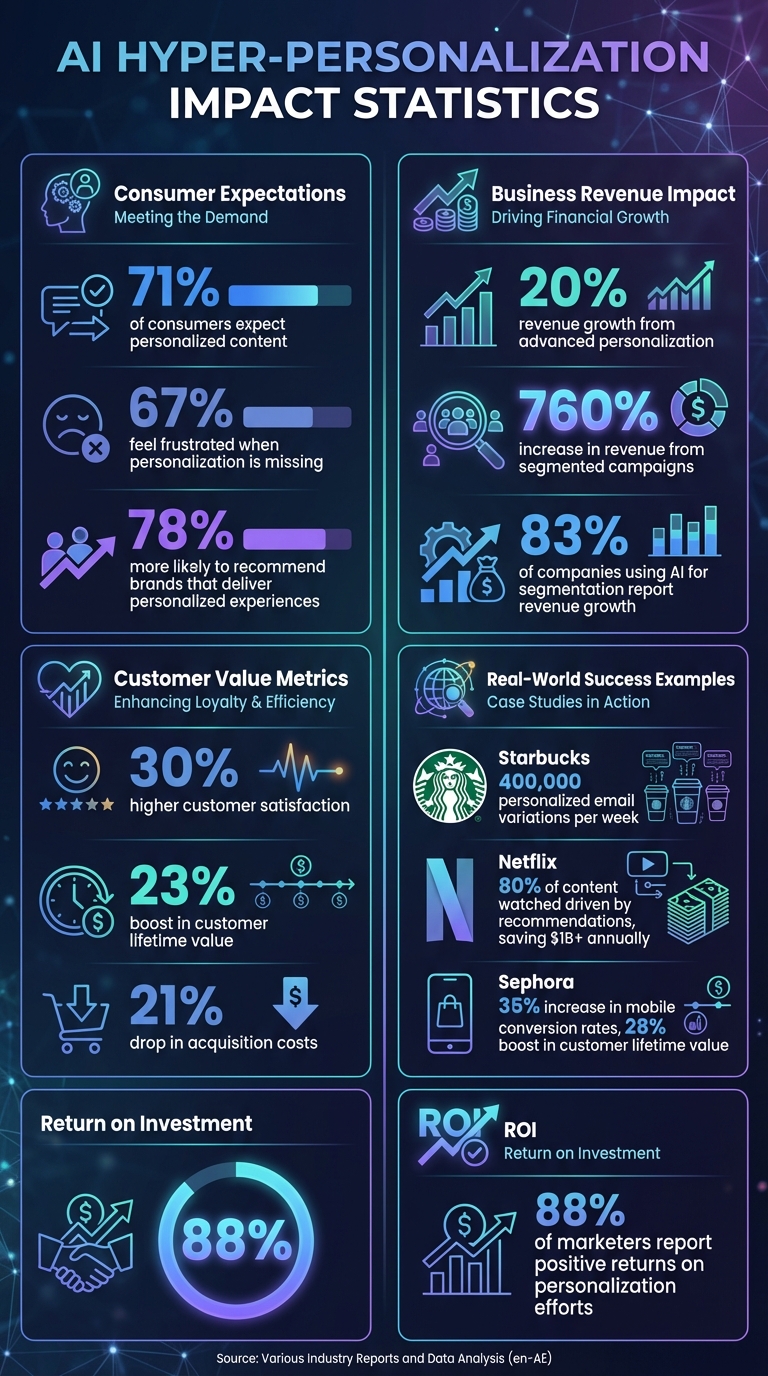
AI Hyper-Personalization Impact: Key Statistics and ROI Metrics
How to Build Customer Segments with AI (Real-World Use Case)
How AI Segmentation Enables Hyper-Personalisation
AI segmentation is reshaping how businesses understand and interact with their customers. By analysing multi-dimensional data from sources like CRM systems, e-commerce platforms, social media, and website analytics, AI identifies meaningful variables such as purchase recency, ad click likelihood, time spent on high-value pages, and brand preferences. These insights allow businesses to move beyond generic categories, creating highly specific and dynamic customer segments that reflect actual behaviours and intentions.
The results? Impressive. 83% of companies using AI for customer segmentation report revenue growth, while segmented campaigns can drive a 760% increase in revenue. Businesses leveraging these tools also note a 23% boost in customer lifetime value and a 21% drop in acquisition costs. AI’s ability to anticipate customer needs in real time ensures that marketing messages are delivered to the right person, at the right moment, through their preferred channel. Let’s explore some of the segmentation techniques making this possible.
Demographic and Firmographic Segmentation
AI takes traditional demographic segmentation to the next level by adding layers of behavioural context to basic attributes like age, gender, location, industry, and company size. For example, in the UAE market, AI distinguishes between customers with similar demographics by analysing factors like browsing habits, device preferences, and engagement with specific types of content. These profiles are continuously updated, ensuring they stay relevant as customer preferences and circumstances evolve.
Behavioural and Psychographic Segmentation
Behavioural segmentation focuses on patterns such as browsing activity, engagement rates, and purchase frequency, while psychographic segmentation delves into motivations by analysing content preferences, survey responses, and social media behaviour. AI processes this information to uncover not just what customers do, but why they do it. A great example of this is Starbucks, which generates 400,000 personalised email variations every week. By using real-time personalisation, they tailor offers based on purchase history, local weather, and emerging trends. This approach not only boosts engagement but also fosters loyalty by delivering offers that feel genuinely relevant.
Predictive and Clustering Models
AI doesn’t just stop at static segmentation - it also predicts future behaviours. Using advanced techniques like K-Means, Hierarchical clustering, and DBSCAN, AI groups users based on complex behavioural patterns that would otherwise go unnoticed. These predictive models allow businesses to anticipate customer needs. For instance, retailers can remind customers to restock frequently purchased items before they run out. Netflix is another standout example, processing over 1 billion hours of viewing data every month. Its recommendation engine drives 80% of the content watched on the platform, reportedly saving the company over $1 billion annually. These dynamic, evolving segments ensure businesses stay aligned with shifting customer preferences.
Wick's Four Pillar Framework for AI Segmentation

Wick's Four Pillar Framework offers a structured approach to AI-driven segmentation and hyper-personalisation. Instead of viewing these tools as standalone solutions, the framework weaves them into a unified digital ecosystem designed to support consistent growth. Two key pillars - Tailor & Automate and Capture & Store - are at the heart of AI segmentation. Together, they create a feedback loop where customer data shapes personalisation strategies, and these strategies, in turn, generate fresh insights for ongoing improvement.
In the UAE, where customer preferences and cultural diversity play a significant role, this framework adapts dynamically to reflect local shopping habits and cultural subtleties.
Tailor & Automate with AI-Driven Personalisation
The Tailor & Automate pillar focuses on using AI to deliver hyper-personalised marketing strategies while streamlining processes. This eliminates the need for manual intervention by automating interactions across email, websites, and social media. For businesses in the UAE, this means creating customer experiences that resonate with local preferences while maintaining operational efficiency.
AI tools in this pillar handle tasks like customising messages based on language preferences (Arabic or English), adjusting for time zones, and considering cultural nuances. For instance, marketing automation platforms can send triggered email sequences tailored to browsing behaviour, display dynamic website content based on visitor profiles, and execute personalised retargeting campaigns that adapt to each customer's unique journey.
Capture & Store via Data Analytics and CDP Implementation
The Capture & Store pillar centres on gathering, organising, and continuously updating customer data through analytics platforms and Customer Data Platforms (CDPs). These CDPs consolidate information from various sources - CRM systems, e-commerce platforms, social media, and even offline interactions - into one unified database. This integrated data powers AI segmentation models, helping businesses identify trends and extract actionable insights.
But this pillar goes beyond just data collection. It includes mapping customer journeys, analysing engagement metrics, and tracking behavioural signals that reveal intent or preferences. In the UAE, this might involve analysing preferences for cash-on-delivery versus card payments, studying shopping behaviours during events like the Dubai Shopping Festival, or observing how customers interact with multilingual content. The CDP ensures these profiles remain up-to-date, allowing segmentation models to rely on accurate, real-time information instead of outdated assumptions.
sbb-itb-058f46d
Step-by-Step Guide to Implementing AI-Driven Hyper-Personalisation
To successfully implement AI-driven hyper-personalisation, you need a systematic approach that converts raw customer data into actionable insights. This process unfolds in three key stages, each designed to adapt and improve continuously.
Data Collection and Processing
Start by gathering data from all customer touchpoints - browsing habits, purchase history, device preferences, social media activity, location, and demographics. In the UAE, this could include tracking payment preferences like cash-on-delivery versus card payments, monitoring engagement during events such as the Dubai Shopping Festival, and observing interactions with both Arabic and English content.
Once collected, consolidate this data into a unified customer profile using tools like a Customer Data Platform (CDP) or CRM. This unified profile becomes the backbone for your AI models. Real-time data processing is crucial here - hyper-personalisation thrives on capturing customer behaviour as it happens. For example, tracking cart abandonment in real time allows you to act immediately.
Use techniques like RFM (Recency, Frequency, Monetary) modelling to assess customer value. This AI-powered method evaluates customer activity through APIs, assigns scores, and groups individuals with similar behaviours into segments. Follow this with a Customer Lifetime Value (CLV) analysis to estimate the long-term value of each customer, enabling you to focus on high-value segments and allocate resources wisely.
"Knowing who your customers are is great, but knowing how they behave is even better."
Compliance is non-negotiable. Adhere to the UAE's Federal Data Protection Law by using regional data centres for processing, ensuring transparent opt-in mechanisms, and providing granular consent options. To minimise the transfer of sensitive data, consider decentralised methods like federated learning and on-device AI.
Once your data is consolidated and compliant, the next step is selecting and fine-tuning AI models.
Pattern Recognition and Model Selection
With your unified data in place, leverage machine learning algorithms to identify precise customer segments - something manual methods simply can’t achieve. K-means clustering is a popular choice for unlabelled data, but depending on your needs, you might consider alternatives like DBSCAN, Agglomerative Clustering, or BIRCH.
Determining the right number of clusters is critical for accurate segmentation. Methods like the Elbow Method, which plots K values against the total within-cluster sum of squares, can help identify the optimal point where adding more clusters no longer improves results. Other approaches, such as the Average Silhouette or Gap Statistic Methods, can also provide valuable insights into clustering quality.
AI models improve over time by learning from new interactions. For instance, Amazon’s recommendation engine analyses behavioural data from millions of users, while Sephora’s Beauty App uses insights on skin tone, beauty preferences, and purchase history to achieve a 35% increase in mobile conversion rates and a 28% boost in customer lifetime value.
Once the AI identifies potential customer segments, human marketers should step in to review these groups, add context, and incorporate additional datasets to better understand motivations and behaviours.
"Using machine learning and AI, marketers can interrogate customer data to discover patterns and nuances much faster and with greater precision than humans."
Real-Time Dynamic Segmentation and Testing
Deploy AI models in real time to track and respond to changing customer behaviours. This dynamic approach ensures higher engagement, improved conversion rates, and reduced churn compared to static segmentation. The result? Hyper-personalisation evolves into a one-to-one adaptive experience, with AI fine-tuning content, user interfaces, and recommendations based on each customer’s behaviour, intent, and context.
To measure success, run controlled experiments like A/B testing. Compare AI-driven experiences with baseline journeys to evaluate improvements in conversion rates, additional revenue, and customer satisfaction. Use both explicit feedback and implicit behavioural signals to refine recommendations and improve personalisation accuracy. Collaboration between marketing, data science, and operations teams is essential for defining features, training models, and integrating AI scores into existing CRM systems and journey orchestration platforms.
Maintaining high-quality data is critical. Implement rigorous data cleansing and validation processes, and regularly reassess your segmentation strategies to ensure they align with changing customer needs. With 71% of U.S. consumers expecting personalised interactions and 78% more likely to recommend brands that deliver them [23,6], continuous testing and refinement are essential - not just for meeting expectations but also for respecting privacy.
This structured approach aligns seamlessly with Wick's Four Pillar Framework for sustained AI-driven hyper-personalisation.
Real-World Applications and ROI of Hyper-Personalisation
Examples of Hyper-Personalised Customer Experiences
Hyper-personalisation, powered by advanced AI-driven segmentation, is changing the way businesses in the UAE connect with their customers. These strategies go beyond basic recommendations, offering tailored experiences that align with local cultural values and language preferences.
In the UAE, the retail sector is a prime example of this transformation. From luxury brands to e-commerce platforms and hospitality providers, businesses are rapidly adopting personalisation technologies. Consumers in the region expect interactions that reflect their cultural norms, whether in Arabic or English, and cater to their unique shopping habits.
Beyond enhancing the customer experience, hyper-personalisation delivers operational advantages. For instance, improved product recommendations help lower return rates, while predictive demand analytics optimise inventory management. AI-powered customer support also boosts efficiency, cutting costs while improving service quality. Together, these benefits not only enhance customer satisfaction but also streamline business operations.
Measuring ROI and Success Metrics
The impact of personalisation is clear: 88% of marketers report positive returns on their efforts. In the UAE, senior business leaders highlight notable productivity gains from AI, with many seeing measurable returns within the first year. These findings reinforce the role of AI-driven personalisation in cutting costs and driving revenue growth.
When evaluating ROI, businesses should weigh the costs of technology and training against tangible outcomes like increased revenue, higher conversion rates, and improved customer retention. Metrics such as these provide a concrete measure of success. Additionally, gathering qualitative feedback ensures that personalisation efforts not only meet business goals but also respect customer privacy under the UAE's Federal Data Protection Law. By combining data-driven insights with customer-centric values, businesses can achieve sustainable growth in a competitive market.
Conclusion
AI-driven hyper-personalisation is becoming a cornerstone for businesses in the UAE. In a diverse and multicultural market like the UAE, customers increasingly expect experiences tailored to their unique preferences and needs. This growing demand for personalisation highlights the game-changing potential of AI-powered segmentation.
By tapping into AI-driven segmentation, brands can move past one-size-fits-all campaigns and deliver targeted, meaningful messages that enhance customer engagement using real-time insights.
AI is revolutionising the UAE's digital space by enabling personalised communication, automating campaigns, and improving return on investment. Companies embracing these technologies gain a distinct advantage in a market where consumer loyalty is fragile, and switching between brands is effortless. In this landscape, timely and culturally relevant interactions are no longer optional - they're essential.
For businesses looking to adopt AI-driven hyper-personalisation, success starts with gathering high-quality data, employing predictive analytics, and continuously optimising strategies. The UAE market rewards those who combine cutting-edge technology with a deep understanding of local cultural dynamics. This dual focus not only strengthens customer engagement but also drives tangible growth, cementing a brand's position in the UAE's competitive digital environment.
Wick stands out by integrating AI-powered personalisation with advanced data analytics and automation. This comprehensive approach helps businesses build seamless digital ecosystems, enhance customer experiences, and achieve sustainable growth in one of the world's most demanding markets.
FAQs
How does AI segmentation enhance customer satisfaction through hyper-personalization?
AI segmentation plays a key role in boosting customer satisfaction by analysing real-time data and using predictive insights to craft experiences that align closely with individual preferences. These tailored interactions create a deeper connection with customers, encouraging stronger engagement and loyalty.
By offering content, recommendations, and deals that genuinely matter to each customer, AI helps reduce churn and strengthens trust. This strategy not only enhances the customer journey but also equips businesses to anticipate and fulfil client needs effectively, paving the way for sustained success.
What are the main benefits of using AI-powered hyper-personalisation for businesses in the UAE?
AI-powered hyper-personalisation is revolutionising how businesses in the UAE engage with their customers. By analysing real-time data, companies can craft experiences that feel tailor-made - offering personalised deals, messages, and recommendations at just the right moment. The impact? Higher conversion rates and increased average order values. For industries like retail and hospitality, this often translates into larger basket sizes that frequently surpass AED 1,000, while also fostering stronger customer loyalty.
In a multicultural market like the UAE, where Arabic, English, and Hindi are widely spoken, AI enables businesses to customise interactions in the language most relevant to their audience. This not only resonates with diverse demographics but also ensures that marketing budgets are spent wisely on high-value micro-segments. With 71% of UAE consumers expressing a desire for personalised experiences, adopting AI-driven strategies builds trust and loyalty. It also aligns with the UAE AI Strategy 2031 and adheres to local data privacy regulations, creating a seamless digital experience. The result? A dynamic ecosystem that boosts long-term growth and delivers measurable revenue gains across the Emirates.
How can businesses comply with UAE privacy laws when using AI for personalization?
To align with the UAE’s Federal Data Protection Law and other privacy standards, businesses need to embrace a privacy-by-design strategy when implementing AI-driven personalisation. This starts with a comprehensive data audit to identify what personal information is collected, how it’s stored, and who can access it. Data processing should be limited strictly to what’s necessary for its intended purpose. Additionally, businesses must secure clear, opt-in consent from customers, while offering straightforward options for withdrawing consent or requesting data deletion.
Whenever feasible, employ anonymisation or pseudonymisation techniques to safeguard customer identities. Maintain detailed records of how data is used and conduct regular risk assessments. For cross-border data transfers, ensure the destination country offers adequate protection or establish contractual safeguards to secure the data. Appointing a Data Protection Officer and performing routine compliance audits can further bolster your privacy measures.
Wick supports businesses in integrating AI models while staying compliant with UAE-specific privacy regulations. By creating consent-focused data pipelines and embedding strong protections, Wick helps organisations deliver highly personalised customer experiences without jeopardising trust or risking regulatory penalties.