

Blog / How to Localize Visual Content for Gulf Audiences
How to Localize Visual Content for Gulf Audiences
Localizing visual content for Gulf audiences means aligning your designs, imagery, and messaging with the values and preferences of the GCC region (Saudi Arabia, UAE, Qatar, Kuwait, Bahrain, and Oman). This involves:
- Language Adaptation: Use Gulf Arabic (Khaleeji) for casual and marketing content, while Modern Standard Arabic suits formal contexts. Account for Arabic text expansion (25–30%) in layouts.
- Right-to-Left (RTL) Design: Mirror layouts, adjust navigation, and ensure typography readability with larger font sizes and proper line spacing.
- Culturally Sensitive Visuals: Showcase family, community, and local attire (e.g., abayas, kanduras). Use authentic imagery and avoid overly generic stock photos.
- Thoughtful Colour Choices: Colours like gold, green, and red hold symbolic meaning. Maintain accessibility with proper contrast ratios.
- Resonant Symbols: Incorporate meaningful icons like falcons, dhows, or mosques, while respecting local traditions and modern aspirations.
With only 2% of global marketing content in Arabic, there’s a significant opportunity for brands to connect with a market valued at USD 1.7 trillion. Testing your content with local audiences and tracking metrics like view duration and click-through rates ensures your efforts succeed. Gulf audiences value respect for their values and expect premium, relatable experiences.
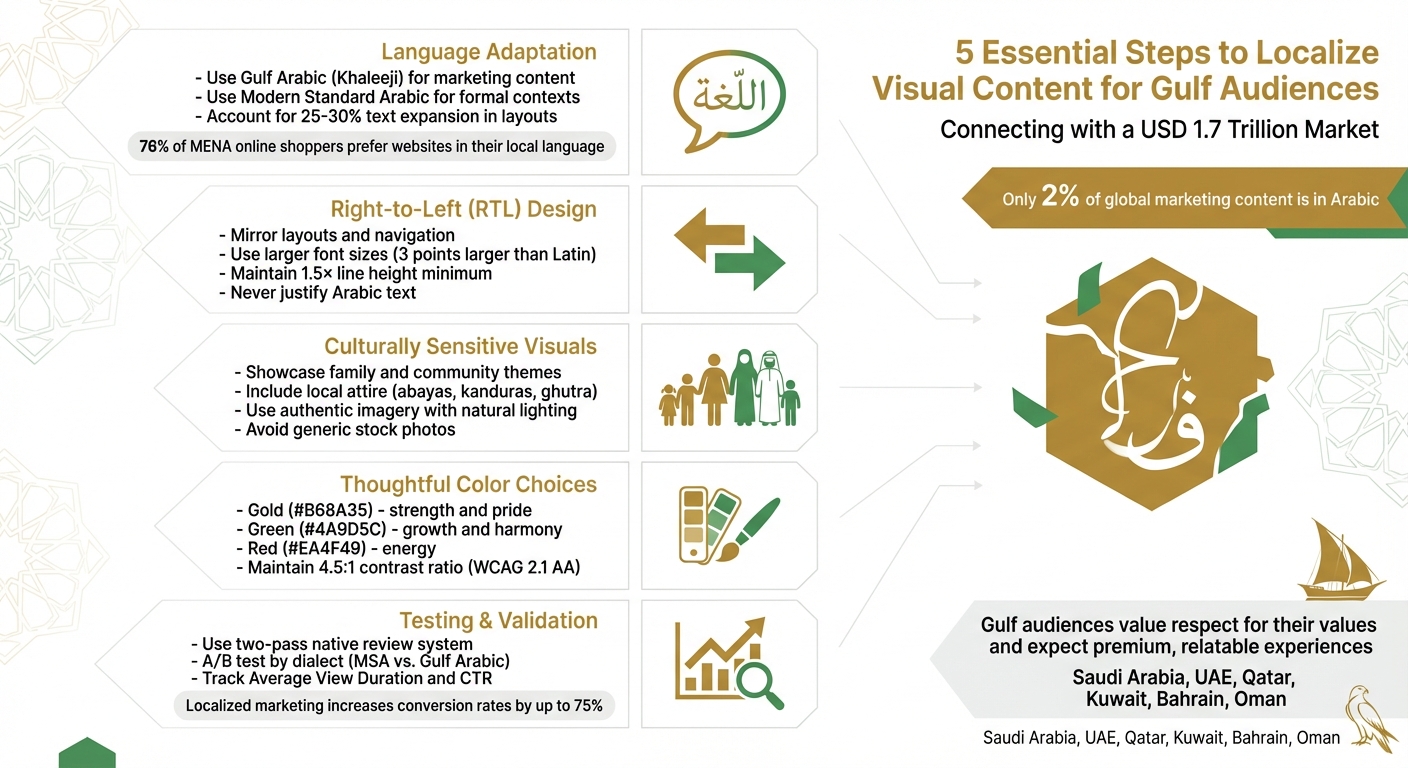
5 Essential Steps to Localize Visual Content for Gulf Audiences
Gulf Cultural Norms and Sensitivities
Understanding the cultural norms of the Gulf region is key to building trust with audiences who value respect and authenticity. The visual content preferences in the GCC are deeply rooted in Islamic values, tribal traditions, and a collective identity that contrasts with Western individualism. This cultural awareness isn't just about avoiding missteps - it can serve as a powerful way to connect with your audience. Aligning visual content with the region's religious and social values helps establish that trust.
Religious and Social Values
Islamic principles play a central role in shaping visual content across the Gulf. Modesty, purity, and respect should influence every creative decision, whether it’s about clothing, social interactions, or overall tone. Traditional attire, such as the Abaya for women and Kandura for men, represents both religious devotion and cultural pride. These elements must be depicted with care and respect.
"While western marketing may speak to consumers' individualism, Arabic consumers prioritise a sense of family and togetherness." – Igloo Digital Marketing
Visual storytelling in the Gulf often highlights themes of family and community. For instance, Nissan markets its SUVs in the UAE as "family cars", focusing on the importance of togetherness rather than technical features. Prestige is another important cultural aspect. Luxury brands excel in the region by integrating traditional elements with subtle indicators of status - like incorporating premium cufflinks into Kandura designs - appealing to wealthy consumers while respecting modesty.
Balancing Traditional and Modern Design
Modern design in the Gulf skilfully blends traditional values with forward-thinking aesthetics. Initiatives like Saudi Arabia's Vision 2030 and the UAE's progressive outlook encourage creative approaches that respect heritage while embracing innovation. A standout example is Unilever’s Comfort brand, which celebrated Saudi Arabia's 94th National Day in September 2024 by creating the world’s largest floral logo in Jeddah. This installation used 125,000 fresh flowers and 5,600 pots, spanning 94 square metres. Similarly, Coca-Cola adapted its global "Christmas Truck" concept for Ramadan, featuring a truck delivering bottles to street-party Iftars under sparkling fairy lights. This clever adaptation merged a Western icon with local religious traditions.
Visually, modern Gulf design leans toward minimalism, featuring clean geometric shapes, natural lighting, and uncluttered backgrounds to keep the focus on the subject. However, designs must also cater to right-to-left reading patterns and maintain a formal, polished tone to resonate with local audiences. This often requires reimagining the entire visual hierarchy rather than simply flipping English layouts.
Language and Text Adaptation
When it comes to connecting with Gulf audiences, language is just as crucial as cultural nuances. But localising language for visual content involves far more than simple translation. In the Gulf, where bilingualism is the norm, striking the right balance between Arabic and English is essential. Choosing the appropriate form of Arabic - whether Modern Standard Arabic (MSA) or Gulf Arabic (Khaleeji) - can make the difference between your message feeling relatable or out of touch.
Arabic and English Usage
Modern Standard Arabic suits formal communication - think government documents, legal texts, or corporate statements. On the other hand, Gulf Arabic is better for marketing, social media, and consumer-focused campaigns. This dialect mirrors everyday speech, creating a more personal connection with local audiences.
The need for bilingual content is underscored by the fact that 76% of online shoppers in the MENA region prefer websites in their local language. Yet, English remains indispensable for reaching a broader audience. The challenge lies in knowing when to prioritise Arabic and when to seamlessly blend both languages.
Arabic text typically expands by 25–30% compared to English. This means design layouts must account for longer text strings to avoid breaking buttons, tabs, or other fixed-width elements. Factoring in this expansion during the design phase is far easier than making adjustments after translation.
This bilingual approach naturally leads to design considerations for right-to-left (RTL) text.
Right-to-Left Text Design
Designing for RTL languages like Arabic involves more than flipping layouts. The entire visual hierarchy needs to be mirrored. Navigation menus move to the right, content flows from right to left, and even directional icons must be repositioned. However, some elements - like media playback controls, clocks, and numbers - always remain left-to-right, even within Arabic text.
Typography is another critical aspect. Arabic script is more intricate than Latin alphabets, requiring larger font sizes - about 3 points larger - and a minimum line height of 1.5× to ensure readability. Fonts like Noto Sans Arabic or Alexandria are excellent choices for maintaining clarity.
"Never justify texts in both English and Arabic as it slows down the reading speed for users." – UAE Design System
Arabic text should always be right-aligned, and justification should be avoided to prevent uneven spacing that disrupts readability. Directional icons, such as "next" arrows, should be placed on the left side of the text and point left, aligning with the RTL flow.
Regional Visual Elements
When adapting your text and layout for Arabic, it's equally important to ensure your visuals - imagery, colours, and design elements - resonate with Gulf audiences. While language and layout changes set the tone, visuals bring the message to life. What works in Western markets often falls short here, as cultural nuances play a significant role. Striking a balance between tradition and the region's modern identity is essential. This means refining imagery, colour palettes, and symbols to align with local expectations.
Culturally Appropriate Imagery
Visuals should feel authentic and relatable. The UAE Design System emphasises the importance of using real people in imagery to foster connection, particularly by showcasing diversity, equality, and the quality of life enjoyed by residents and citizens alike. Unlike Western marketing, which often highlights individuality, Gulf audiences value family, community, and togetherness.
"Imagery conveys more than a message; it conveys a feeling ... a vibe. A consistent style of imagery is at the heart of creating your brand identity." – UAE Design System
When selecting photographs, include local attire such as the abaya and hijab for women, and the ghutra, bisht, or dakhla for men. Highlight the region's iconic landscapes - golden sand dunes, rugged mountains, and cutting-edge cityscapes that reflect its architectural marvels. Avoid overused stock photos or heavily filtered AI-generated images; instead, opt for natural lighting and ensure the subject occupies about 50% of the foreground for clarity. A standout example of culturally relevant visuals is the UAE Government Media Office’s 2022 initiative, led by Executive Director Khaled Al-Shehhi, which transformed the Burj Khalifa into the "world's largest donation box." This campaign visually represented 1.2 million meals donated to those impacted by the pandemic, blending creativity with cultural resonance.
Colour Schemes with Local Meaning
Colours in the Gulf region carry deep cultural and emotional significance. The UAE federal design system identifies AEGold (#B68A35), AEGreen (#4A9D5C), and AERed (#EA4F49) as core colours symbolising strength and national pride. Complementary shades like Camel Yellow (#F29F0E) and Desert Orange (#EB5F24) add warmth and reflect the local environment.
For accessibility, ensure a contrast ratio of at least 4.5:1 for text and interactive components, adhering to WCAG 2.1 AA standards. For instance, while AEGold (#B68A35) is the brand colour, a darker variant (#92722A) is used for user interface elements to maintain readability against white text. Avoid using gradients that blend UAE Green and UAE Gold, as they can disrupt the intended visual harmony.
Local Symbols and Icons
Incorporating culturally resonant symbols can deepen your connection with Gulf audiences. The falcon, a revered symbol of strength, sharp vision, and heritage, holds particular importance in the UAE. As stated in the UAE Federal Government Visual Identity Guidelines:
"Watchful, prepared and firmly grounded, the falcon embodies our strength and unity in the present, our pride in our past, and our agility to soar high into the future."
Other meaningful symbols include dhows, heritage tents, and modern landmarks, which together bridge the region's rich traditions with its forward-thinking ethos. Icons should be minimal, clear, and contextually appropriate - such as the widely recognised mosque symbol. Additionally, ensure your visual hierarchy and icon placement align with Right-to-Left (RTL) layouts, including directional cues. By grounding your visuals in these cultural elements, you create a strong foundation for testing and refining audience engagement in future steps.
sbb-itb-058f46d
Testing and Validation with Local Audiences
Once you've tailored your content to fit cultural and linguistic nuances, the next step is testing. This process ensures your efforts resonate effectively with your intended audience. For Gulf audiences, authenticity is non-negotiable - they can quickly sense when something feels out of place. As Iryna Avramenko from AIR Media-Tech points out:
"The Middle East is a nuanced region. The audience here knows when something feels 'off.' If the cultural adaptation isn't right, the damage is fast and measurable. Retention drops. Shares disappear. Trust fades."
Localised marketing has the potential to increase conversion rates by up to 75%, with 72.4% of consumers preferring content in their native language. However, these benefits only materialise when your content genuinely connects with the audience. Testing helps ensure you're not just translating but truly localising. Here’s how you can refine your approach.
Focus Groups and Surveys
To gauge how well your content lands, start by gathering feedback directly from your target audience. Focus groups and surveys can help uncover how your visuals, colour schemes, and messaging are received. But don’t settle for generic feedback - you need cultural validation in addition to linguistic accuracy.
Use a two-pass native review system: one reviewer from your specific target market (such as the UAE, KSA, or Qatar) and another with a pan-Arab perspective. This dual-layered approach ensures both local relevance and regional appeal. For example, a phrase or symbol that resonates in Dubai might not have the same effect - or could even cause offence - in Riyadh.
When working with Arabic content, consider running A/B tests by dialect. Short clips (60–120 seconds) in different dialects can reveal which version resonates more. Modern Standard Arabic (MSA) often feels too formal for casual or entertainment content, leading to 62% lower view durations compared to dialects like Gulf or Egyptian Arabic. A great example of successful localisation is Unilever Arabia’s campaign for the 94th Saudi National Day in September 2024. They created the "World's Largest Saudi National Day Logo" using 125,000 fresh flowers in Jeddah, perfectly aligning with local culture and timing.
Also, don’t overlook the importance of testing Right-to-Left (RTL) layouts. Ensure your designs don’t break or overlap, even when browser zoom is increased to 175%. Be mindful of the local calendar when scheduling testing sessions - Ramadan, for instance, brings unique consumer habits and sensitivities that can impact content performance.
Data Analytics for Engagement Tracking
While focus groups and surveys explain why your content works (or doesn’t), data analytics show the impact. Track specific metrics to measure how well your localised content connects with Gulf audiences.
Start with Average View Duration (AVD), a key indicator of emotional engagement. Compare the performance of your localised content to the original version. For example, one Arabic adaptation achieved an AVD of 6:46, outperforming the English original’s 6:26. Similarly, monitor Click-Through Rates (CTR) for localised metadata - properly translated titles and descriptions can double CTR compared to auto-generated versions.
Keep an eye on sentiment metrics in comment sections and share rates. These often highlight cultural missteps faster than other indicators. Relying solely on AI-generated dubs without human validation can reduce retention rates by four to five times. During religious holidays like Ramadan, track subscriber churn closely, as sensitivities to humour, music, or specific imagery tend to spike.
Don’t forget accessibility. Ensure your content meets UAE federal standards, such as WCAG 2.1 AA level guidelines, which require a contrast ratio of at least 4.5:1 for text and interactive elements. This ensures inclusivity for all users, including people of determination.
For a comprehensive approach, tools like Wick's data-driven marketing solutions can help you systematically track these metrics. With over 85% of the UAE population using WhatsApp, it’s essential to monitor engagement across both traditional platforms and messaging apps. This holistic view will help you understand how your content resonates with Gulf audiences and guide future adaptations.
Conclusion
Localising visual content for Gulf audiences is about more than just translating words - it’s about reshaping your entire message to fit the region's unique cultural and linguistic landscape. This can mean adopting Right-to-Left (RTL) design for your interface or choosing Gulf Arabic (Khaleeji) over Modern Standard Arabic. These changes aren’t just technical tweaks - they’re the foundation of storytelling that feels authentic to the audience.
Striking the right balance between respecting cultural values and embracing modern design is key. Visuals must honour religious and social norms while also reflecting the progressive energy of the region. For example, Arabic text typically takes up about 30% more space than English, so your layouts need to accommodate this expansion. Additionally, imagery preferences can vary significantly - what resonates with audiences in Dubai might need rethinking for more conservative markets, like Saudi Arabia.
Beyond design and language, success in the Gulf hinges on building relationships. Here, "wasta" - a concept rooted in trust and reciprocity - holds significant value. Your content should highlight themes of family, community, and togetherness, which are deeply valued in Gulf culture, rather than focusing on Western ideals of individualism. With 98.99% of the UAE population active on social media, visual content becomes a vital tool for creating these connections and fostering trust.
Every element of your content must undergo thorough validation. From human reviews to market testing, this step ensures your message truly resonates with the audience. The Gulf region represents a massive opportunity, with a market valued at US$1.7 trillion. Yet, only 2% of global marketing content is currently produced in Arabic. Brands that invest in localisation have a significant chance to stand out and build lasting relationships with Gulf consumers.
FAQs
How can I make sure my visual content aligns with Gulf cultural values?
To create visual content that aligns with Gulf cultural norms, it's crucial to respect the region's social and religious values. Choose images that highlight positive and relatable interactions, steering clear of anything that might be deemed inappropriate. This includes avoiding immodest clothing, out-of-context use of religious symbols, or visuals depicting alcohol or gambling. For aesthetics, opt for natural colours, simple backgrounds, and realistic lighting to produce content that is both appealing and culturally appropriate.
Here are some practical tips to keep in mind:
- Use visuals captured locally, featuring modest attire and family-friendly environments.
- Include regional touches, such as iconic Dubai landmarks, traditional Arabic calligraphy, or patterns inspired by Gulf art.
- Format dates as dd/MM/yyyy, and apply the decimal separator “,” and the thousand separator “ ” in numbers.
- Stick to metric units like kilograms and metres, and use Celsius for temperature measurements.
- Present financial figures in AED (د.إ) to reflect the local currency.
- Follow regional spelling norms, such as using "Emirates" in informal contexts instead of "United Arab Emirates."
By focusing on these details, you demonstrate respect for Gulf culture, fostering trust and connection with your audience. Wick can assist in applying these strategies through a data-driven approach tailored specifically to the region's preferences.
What are the main differences between Gulf Arabic and Modern Standard Arabic in marketing?
The main distinction between Gulf Arabic and Modern Standard Arabic (MSA) in marketing lies in their tone and purpose. MSA is primarily reserved for formal, written communication like websites, press releases, and official TV ads. It serves as a universal language understood across the Arab world. Gulf Arabic, however, is an informal dialect used in daily conversations, marked by its unique vocabulary, pronunciation, and expressions that are specific to the Gulf region.
When it comes to marketing, here’s how this difference plays out:
- Vocabulary and expressions: Gulf Arabic incorporates region-specific terms and local references, such as "majlis" (a gathering space) or "ghutra" (a traditional headscarf), which connect deeply with Gulf audiences but may not appear in MSA.
- Tone and style: Gulf audiences appreciate a friendly, relatable tone that mirrors their local customs and values. In contrast, MSA often carries a more formal and serious tone.
- Cultural alignment: Messaging and visuals should reflect Gulf values like family, hospitality, and luxury to establish trust and relevance.
For campaigns targeting Gulf Cooperation Council (GCC) audiences, Gulf Arabic creates stronger connections and engagement. Meanwhile, MSA works best for reaching a wider regional audience.
How can I ensure my localized visual content resonates with Gulf audiences?
To evaluate how well your visual content resonates with Gulf audiences, start by setting specific KPIs tailored to UAE users. Metrics like click-through rates, conversion rates, or time spent on the page are great starting points. Then, create two versions of your visuals: one with a global appeal and another tailored to Gulf-specific cultural and design elements. Use A/B testing with similar audience groups to see which version gets better results.
Dive deeper by segmenting your audience. For example, compare the behaviour of UAE nationals versus expatriates or focus on mobile-first users. Complement this with qualitative insights from surveys or user testing to understand their preferences. Use this data to fine-tune your content so it better reflects Gulf cultural sensibilities. Keep an eye on performance trends over time to adjust as audience behaviours shift.