

Blog / Maximize ROAS with AI Budgeting
Maximize ROAS with AI Budgeting
Want to make every dirham work harder in digital advertising? AI can help.
AI-powered budget allocation ensures your ad spend delivers maximum returns by analyzing performance in real time and reallocating funds to the most effective channels. This approach is transforming how businesses in the UAE optimize their Return on Ad Spend (ROAS), with results like:
- 47% increase in ROAS within 30 days for an e-commerce retailer.
- 28% lower customer acquisition costs through predictive AI models.
- 18% higher conversions using AI-driven cross-channel strategies.
Here’s how AI simplifies budget management:
- Predictive Analytics: Forecast channel performance and avoid overspending.
- Dynamic Bidding: Adjust ad bids in real time for better efficiency.
- Automated Budget Reallocation: Shift funds daily or weekly to high-performing campaigns.
By integrating tools like ARIMA models for trends, server-side tracking for clean data, and platforms like Performance Max, businesses in the UAE can achieve higher ROAS while saving time. Whether you’re targeting Ramadan shoppers or scaling campaigns, AI ensures every dirham counts.
The future of advertising isn’t spending more - it’s spending smarter.
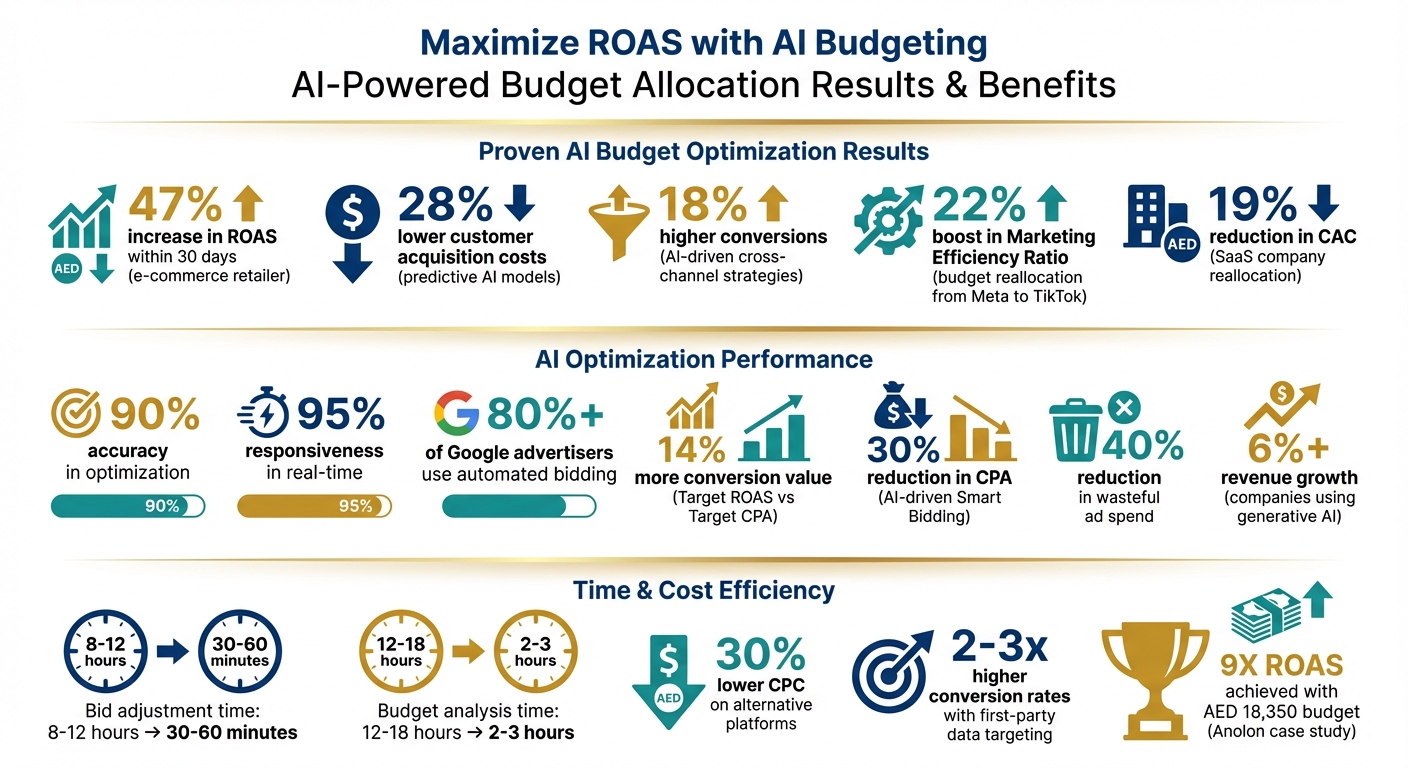
AI Budget Optimization Impact: ROAS Improvements and Cost Reductions in UAE Digital Advertising
AI Agents vs. Manual Marketing: 5X ROAS Playbook + Free Tool
AI Techniques for Budget Optimization
AI isn’t just about automating tasks - it’s a game-changer for managing campaign budgets. By combining predictive insights, real-time adjustments, and automated processes, AI helps ensure every dirham is spent where it delivers the most impact. Below, we’ll explore how AI predicts outcomes, adjusts bids, and reallocates budgets to optimise marketing performance.
Predictive Analytics and Campaign Forecasting
Predictive analytics leverages historical data - like spend, revenue, and key performance indicators - to forecast which channels will deliver the best results. Tools such as ARIMA and Facebook’s Prophet break down time-series data into trends and seasonal patterns to predict returns. These models don’t just forecast; they also calculate marginal ROAS (Return on Ad Spend), helping marketers identify when additional spending starts yielding diminishing returns.
For example, in 2025, an e-commerce brand shifted 15% of its budget from oversaturated Meta audiences to TikTok. The result? A 22% boost in Marketing Efficiency Ratio (MER). Similarly, a SaaS company reduced its Customer Acquisition Cost (CAC) by 19% by reallocating budget from Google Search to LinkedIn based on predicted SQL-to-win rates. For UAE businesses, where seasonal campaigns like Ramadan or summer promotions are key, SARIMA models can account for these fluctuations. When paired with Lifetime Value (LTV) models, budgets can be prioritised for channels driving long-term growth. AI can even score ad creatives and audience segments before launch, minimising wasted spend on underperforming assets. But forecasting is just the start - AI also takes spending to the next level with dynamic bidding.
Dynamic Bid Management
Dynamic bid management eliminates the need for manual bidding by using AI to adjust bids in real time - auction by auction. Instead of relying on fixed bids, AI evaluates factors like search queries, device type, location, time of day, and browser to determine the ideal bid for each opportunity. This approach ensures high-intent users are targeted while minimising spend on low-conversion prospects.
Transitioning from a Target CPA (Cost Per Acquisition) to a Target ROAS strategy has led advertisers to achieve 14% more conversion value at a similar ROAS. AI-driven bidding offers up to 90% accuracy in optimisation and 95% responsiveness in real time, delivering better cost efficiency and performance. In fact, over 80% of Google advertisers now rely on automated bidding.
"Smart Bidding offers true auction-time optimisation. It sets bids for each individual auction, not just a few times a day. This allows you to tailor bids to each user's unique search." – Google Ads
These systems have slashed bid adjustment times from 8–12 hours to just 30–60 minutes. However, success depends on setting boundaries. Implementing CPA or ROAS limits and allowing a 4-week calibration period for new bid policies can prevent overspending. Accurate conversion tracking is also critical to ensure the system focuses on the right goals.
Automated Budget Reallocation
Automated budget reallocation takes optimisation one step further by redistributing funds from underperforming campaigns to high-potential ones - no manual intervention needed. AI analyses cross-channel data, such as spend, revenue, and LTV, to estimate the additional revenue each dirham could generate per channel. Budgets are then adjusted daily or weekly to maximise overall efficiency.
By monitoring performance across platforms, AI can shift funds from oversaturated channels to those with lower costs, providing a holistic view that focuses on improving the total Marketing Efficiency Ratio (MER). For instance, Performance Max campaigns using AI for cross-channel allocation have increased conversions by 18%, while AI-driven Smart Bidding has reduced CPA by up to 30%. AI tools for budget impact modelling have also cut analysis times from 12–18 hours to just 2–3 hours. Companies using generative AI for marketing have reported revenue growth of 6% or more.
"AI budget optimisation doesn't replace marketers - it frees them from spreadsheet shuffles to focus on creative and positioning." – RevenueXpress
To ensure AI aligns with business goals, it’s crucial to set strategic guardrails. Define minimum and maximum allocation percentages per channel to maintain brand safety and honour geographic constraints. Weekly reviews of AI-driven recommendations allow human oversight, ensuring budgets align with upcoming promotions or market trends. Additionally, regular audits of data quality - integrating robust conversion tracking with offline data from CRM and GA4 systems - help sustain long-term success.
How to Implement AI-Driven Budget Allocation
Implementing AI-driven budget allocation involves centralising your data, rigorous testing, and ongoing oversight. It starts with centralising your data infrastructure - bringing together data from your website, CRM, social media, and ad platforms into a single data lake. With this unified view, AI models can analyse performance across all channels, identify patterns, and allocate budgets to areas that promise the best returns. This is especially useful during high-traffic periods like Ramadan or the Dubai Shopping Festival, where precise targeting can make all the difference.
Data Integration and Audience Targeting
To maximise your return on ad spend (ROAS), start with clean, integrated data. Use tools like GA4 server events or Meta Conversions API to implement server-side tracking. Deduplication methods, such as event_id, help avoid double-counting conversions. Clean up your historical data by removing outliers and inconsistencies while focusing on key metrics like cost per acquisition (CPA), conversion rates, and lifetime value (LTV).
Once your data is clean, shift your attention to advanced audience segmentation. Data Management Platforms (DMPs) can help organise audience data and uncover new customer segments through demographic and behavioural analysis. A great example comes from October 2024, when the cookware brand Anolon matched customer email and mailing addresses with demographic and advertising IDs using the Untitled DSP's vast 300-million-record dataset. This enabled precise 1:1 targeting, re-engaging customers who hadn't purchased in two years. With a modest AED 18,350 (USD 5,000) budget, the campaign achieved an impressive 9X ROAS. This targeted approach is particularly effective when tailoring messages to specific emirates or demographic groups.
Continuous Testing and Real-Time Tracking
AI thrives on data and constant refinement. Establish a structured routine: review AI recommendations weekly, retrain models monthly, and adjust guardrails quarterly. For example, test incremental changes, like increasing spend by 5% on top-performing channels, before scaling up. This prevents overspending on channels that may already be saturated and ensures your budget is used effectively.
Refresh your ad creatives every 2–4 weeks to prevent ad fatigue. Use frequency capping - limiting impressions to 2–3 per user per week - to extend your campaign’s reach. Monitor metrics like marginal ROAS (mROAS), which measures the revenue impact of small budget adjustments, to guide incremental spending decisions.
In addition to testing, use forecasting to predict your campaign’s future performance and make proactive budget adjustments.
Monitoring and Forecasting for Long-Term Results
Maintaining high ROAS requires a balance of monitoring current performance and forecasting future trends. AI can predict future outcomes using forecasting models like ARIMA for time-series data, Facebook's Prophet for seasonal trends, or Amazon's Chronos for language-based predictions. These tools can help you anticipate when specific channels are nearing saturation and identify new opportunities for budget allocation.
To keep control, define minimum and maximum budget percentages for each channel. This ensures AI-driven optimisation aligns with your brand’s safety guidelines and upcoming campaigns or market trends.
"In the AI era, budgeting and forecasting can be done in real time if data from various customer touchpoints and channels is centralised and readily available throughout the customer journey."
– Benu Aggarwal, Founder and President of Milestone Inc.
sbb-itb-058f46d
Benefits of AI Budgeting for UAE Businesses
By tapping into AI-driven allocation methods, businesses in the UAE can enjoy notable advantages in both efficiency and staying ahead of the competition. AI budgeting eliminates wasteful spending and scales campaigns seamlessly, which is essential in a market where standing out is a necessity, not a luxury.
Higher ROAS and Lower CPA
AI-powered tools excel at making real-time bidding adjustments, leading to better Return on Ad Spend (ROAS) and lower Cost Per Acquisition (CPA). This means every dirham spent works harder. For instance, advertisers transitioning from a Target CPA strategy to a Target ROAS strategy have seen an average of 14% more conversion value while maintaining the same ROAS. Additionally, techniques like real-time bid optimisation and negative keyword mining can reduce wasteful ad spend by up to 40%, directly improving ROAS.
Predictive scaling adds another layer of efficiency. By gradually increasing budgets by 10–20% daily, businesses can maximise returns without causing algorithmic instability. Interestingly, companies adopting generative AI have reported revenue growth of over 6% annually, with 86% of them seeing measurable improvements.
Time Savings and Scalability
Managing budgets manually can be a tedious process. AI takes this load off by automating tasks like bid adjustments, budget allocation, and performance tracking across platforms. For example, tools like Performance Max automatically spread budgets across Search, Display, YouTube, and Discovery networks, ensuring the highest-converting opportunities are captured.
For UAE small and medium enterprises (SMEs) planning to grow their digital ad spend through 2026, AI offers a way to handle increasing budgets without overburdening their teams. Predictive scaling strategies, such as testing small budget increments of +5%, allow businesses to experiment with growth while maintaining control. This level of automation and precision gives businesses the flexibility they need to thrive in the UAE's fast-paced market.
Flexibility in a Competitive Market
The UAE's ever-changing economy requires businesses to adapt quickly. AI budgeting equips companies with the ability to respond to market fluctuations, seasonal trends, and shifting consumer behaviours in real time - an essential feature during high-stakes periods like Ramadan or the Dubai Shopping Festival.
AI also supports diversification across platforms. When ad costs rise on major platforms like Google or Meta, AI can shift budgets to alternative channels such as Microsoft Ads, Reddit, or Quora, which often deliver 30% lower Cost Per Click (CPC) while maintaining effective targeting. For B2B businesses, optimising bids during peak hours can enhance performance and improve ROAS without increasing overall spend.
"Smart Bidding offers true auction-time optimisation. It sets bids for each individual auction, not just a few times a day. This allows you to tailor bids to each user's unique search."
– Google Ads
Lastly, leveraging first-party data provides a strong competitive edge. Allocating around 25% of the budget to campaigns targeting CRM-based audiences can deliver conversion rates 2–3 times higher than campaigns aimed at cold traffic. This strategy helps UAE businesses achieve sustainable growth, even as customer acquisition costs continue to climb.
Wick's Four Pillar Framework for AI-Driven ROAS Optimisation

Wick's Four Pillar Framework provides a structured approach to maximise ROAS (Return on Ad Spend) in the UAE market. With digital advertising spend in the UAE expected to exceed AED 4.4 billion by 2025 and 71% of retailers prioritising AI adoption, having a well-integrated system that connects data, automation, and scalability is more important than ever. This framework complements the AI techniques discussed earlier, focusing on real-time budget optimisation.
Capture & Store: Building a Solid Data Foundation
The first step in optimising budgets with AI is collecting accurate and organised data. Wick's Capture & Store pillar focuses on unifying data from various sources - like consumer behaviour, retailer insights, competitor analysis, and brand performance - into a centralised system. This is particularly vital for UAE businesses operating under the Personal Data Protection Law (PDPL 2022).
To ensure data reliability, Wick performs audits to clean and standardise information, such as verifying product codes and updating customer records. This step is crucial for avoiding errors that could lead to wasted budgets or flawed predictions. Once the data is cleaned, it becomes the foundation for predictive models that forecast campaign outcomes and pinpoint the best ways to allocate budgets.
Tailor & Automate: Turning Data into Actionable Insights
In the Tailor & Automate phase, AI transforms raw data into clear strategies for budget allocation. Wick's AI models analyse both historical and real-time data to determine the most effective distribution of budgets across channels, publishers, and ad placements. A key focus is on Marginal ROAS (mROAS), which identifies diminishing returns and reallocates budgets to maximise incremental revenue for every additional dirham spent.
Another critical component is precision marketing. AI creates detailed customer segments based on actual behaviour, such as identifying shoppers who respond well to discount codes or those who prefer WhatsApp for communication - currently the preferred platform for over 60% of UAE consumers. Additionally, dynamic bid management adjusts ad bids in real time, prioritising conversions over mere clicks.
Custom Plans for Businesses of All Sizes
Wick's framework offers flexible pricing plans designed to meet the varying needs of UAE businesses. These plans allow companies to adopt AI-driven budget optimisation at their own pace:
- Basic Plan (AED 30,000–70,000): Ideal for small businesses, this includes essentials like website development, basic SEO, and content creation.
- Advanced Plan (AED 80,000–200,000): Designed for mid-sized companies, this tier includes predictive models, paid ad management, and data analytics to help scale digital efforts.
- Enterprise Plan (AED 250,000–1 million+): Tailored for large organisations, this offers the full Four Pillar Framework, including custom AI implementations, CDP integration, and strategic consulting for multi-channel campaigns.
This modular approach allows businesses to start small and expand as results become evident. Maintenance costs typically range from 15–20% of the initial project cost annually. Furthermore, cloud-based solutions eliminate the need for costly hardware while meeting the UAE's local hosting requirements for government and healthcare sectors.
Conclusion
AI-driven budget allocation takes the guesswork out of advertising by enabling real-time, predictive adjustments - an absolute game-changer in the UAE's competitive market. By adopting Marginal ROAS (mROAS), businesses can identify the point where additional spending no longer delivers profit, helping to avoid over-investing in channels that have already reached their peak.
"AI-powered budget allocation isn't just about automating decisions – it's about making smarter, data-driven choices that drive real business results." - Xtend
The numbers speak for themselves: AI-driven budget optimisation can increase ROAS by 20–35%, while generative AI has been shown to boost revenue by over 6%. These advancements are reshaping how companies allocate resources, explore new audiences, and scale successful campaigns - all without compromising performance.
Wick's Four Pillar Framework brings these AI strategies to life, offering businesses a structured way to unify data and automate budget adjustments. Whether you're a small business starting with the Basic Plan or a larger enterprise looking for tailored AI solutions, this framework adapts to your needs while adhering to the UAE's Personal Data Protection Law. It empowers businesses to make budget changes dynamically, based on real-time performance signals, rather than relying on outdated periodic reviews.
The future of digital advertising in the UAE isn’t about spending more - it’s about spending smarter. AI budgeting ensures every dirham is allocated with precision, reducing waste and driving sustainable growth in the UAE's ever-evolving market.
FAQs
How does AI-driven budgeting help improve ROAS in digital advertising?
AI-powered budgeting takes Return on Ad Spend (ROAS) to the next level by processing massive amounts of real-time data. It identifies the most effective audiences and channels, then adjusts budgets dynamically to focus on areas that drive the highest conversions. This ensures that your marketing budget is spent where it matters most.
By automating adjustments and cutting down inefficiencies, AI budgeting reduces wasted ad spend while boosting the overall performance of your campaigns. For businesses in the UAE, this means achieving tangible results while making the most of their digital marketing investments in dirhams (AED).
How can I use AI to optimise my advertising budget and maximise ROAS?
To make the most of your advertising budget using AI and boost your return on ad spend (ROAS), the first step is to get your data in order. Gather historical performance data from platforms like Meta, Google, and TikTok. Make sure this data is cleaned up - free of duplicates, standardised (e.g., using AED for currency and dd/mm/yyyy for dates), and complete with no gaps.
Next, segment your audience. Break them down by language, behaviour, and demographics. Set clear ROAS targets for each segment to give AI the direction it needs for effective optimisation.
With your data ready, it’s time to select an AI budgeting model. Whether you go for a predictive algorithm or a tool provided by your ad platform, configure it to allocate your budget dynamically across different channels. Link the model to your ad platforms so it can make real-time adjustments based on performance data. Start small - something like AED 50,000 - to test the waters. Keep a close eye on key metrics like ROAS and cost per acquisition (CPA) to fine-tune the system before scaling up. For campaigns tailored to the UAE, don’t forget to factor in local cultural and seasonal events, such as Ramadan or National Day, to better connect with your audience.
If this feels overwhelming, Wick can step in to help. They specialise in preparing data, setting up AI models, and integrating them with platforms, making sure your campaigns are optimised for growth in the UAE market.
How can AI help optimise audience targeting during Ramadan's high-traffic periods?
AI has the ability to sift through vast amounts of historical and real-time data to uncover consumer behaviour unique to Ramadan. For instance, it can detect patterns like increased mobile usage after Iftar or a preference for family-focused products. By analysing factors such as purchase history, language preferences (Arabic or English), location, and device type, AI ensures your ads are targeted at the most relevant audience, precisely when they’re most likely to engage.
For businesses in the UAE, AI can go a step further by incorporating local insights, such as prayer timings, public holiday schedules, and Ramadan-specific trends. This allows for personalised ad campaigns that truly connect with the audience. Predictive models can pinpoint peak engagement times, such as 20:00–22:00 local time, enabling brands to dynamically adjust their ad creatives, offers, and budgets. The result? Every dirham is allocated towards reaching high-intent users, optimising return on ad spend (ROAS) during this important season.
Wick employs state-of-the-art AI tools as part of its Four-Pillar Framework, empowering UAE businesses to run data-driven campaigns that are both culturally relevant and highly effective throughout Ramadan.