

Blog / Ultimate Guide To Omnichannel Marketing Integration
Ultimate Guide To Omnichannel Marketing Integration
Today’s customers expect every interaction with a brand to feel connected - whether they’re browsing online, scrolling social media, or shopping in-store. In the UAE, where 99% of people are active online and smartphone use is integral to shopping, businesses must ensure their channels work together seamlessly. Omnichannel marketing integrates all touchpoints, delivering consistent experiences and measurable results.
Key Takeaways:
- Customer Expectations: 9 out of 10 consumers want smooth transitions across channels.
- UAE Trends: 65% of shoppers use smartphones during purchases; WhatsApp plays a critical role.
- Benefits: Businesses see higher retention (up to 90%), 287% better purchase rates, and increased revenue.
- Success Stories: UAE brands like TKD Lingerie and Anigma Technologies have achieved exceptional results with omnichannel strategies.
- Core Tools: CRM systems, CDPs, marketing automation, and AI-driven personalisation are essential for integration.
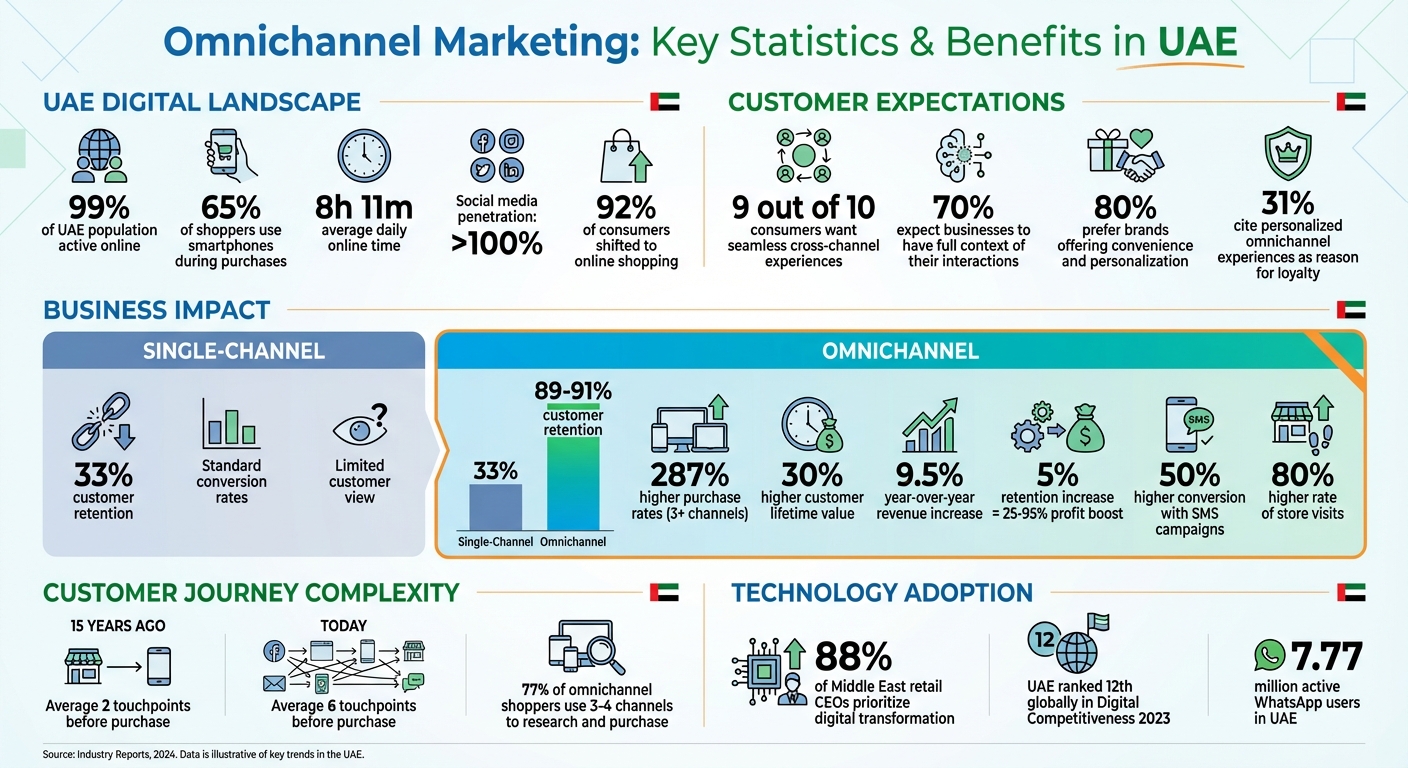
Omnichannel Marketing Statistics and Benefits in UAE
How to Create the Perfect Omnichannel Marketing Strategy
Key Benefits of Omnichannel Integration
Omnichannel integration offers more than just convenience - it has a direct, measurable impact on business performance. When your channels work in harmony rather than independently, you gain three major advantages: enhanced customer loyalty, higher conversion rates, and a comprehensive understanding of your customers' needs.
Better Customer Retention
Delivering a seamless experience across all touchpoints builds the trust that keeps customers returning. Whether they’re browsing your Instagram, visiting your website, or stepping into your store in Dubai, consistent messaging, branding, and service create a frictionless journey. And the results speak for themselves: omnichannel retailers retain 91% more customers compared to single-channel businesses, with some brands achieving retention rates close to 90% when leveraging robust omnichannel strategies.
For 31% of consumers, personalised and omnichannel experiences are the main reasons they stay loyal and make repeat purchases. By offering tailored recommendations based on real-time behaviour and past interactions, you make customers feel valued and understood. This approach doesn’t just foster loyalty - it’s profitable too. A mere 5% increase in customer retention can boost profits by 25% to 95%.
This consistency and personalisation lay the groundwork for better conversion outcomes.
Higher Conversion Rates
Trust and loyalty naturally lead to higher conversions, especially when integrated channels remove barriers to purchase. Imagine a customer adding items to their cart on their phone during their morning commute, receiving a personalised SMS reminder at lunch, and completing the purchase on their desktop that evening - without losing their progress. That’s the power of omnichannel integration. In fact, marketing campaigns using three or more channels achieve a 287% higher purchase rate compared to single-channel campaigns.
Take Toby's Sports, the Philippines' largest speciality sports retailer, as an example. After migrating to Shopify Plus to unify online and offline sales, they saw a 13.5x increase in sales, a 101% boost in profitability, and a 50% rise in conversion rates. Similarly, tokyobike implemented a unified Point of Sale system, emailing customers a digital shopping cart after in-store test rides, allowing them to complete their purchases online at their convenience.
SMS campaigns also shine in omnichannel strategies, being 50% more likely to drive conversions. And the benefits don’t stop there - integrated approaches lead to an 80% higher rate of store visits, while customers engaged through multiple channels have a 30% higher lifetime value compared to single-channel users.
Complete Customer View
Omnichannel integration provides a unified view of your customers, capturing every interaction - whether it’s a WhatsApp message, an in-store purchase, or website browsing - into a single profile. This 360-degree perspective empowers you to anticipate customer needs rather than just react. Unsurprisingly, 70% of customers expect businesses to have full context of their interactions, and failing to meet this expectation could cost you their loyalty.
Core Components for Successful Integration
To achieve seamless omnichannel integration, three key elements must work together: customer journey mapping, unified data infrastructure, and AI-driven personalisation. Without these, your channels risk operating in silos, leading to fragmented experiences that can erode customer trust. These components are essential for creating the cohesive interactions discussed earlier.
Customer Journey Mapping
Before you can enhance or integrate customer journeys, you need to understand them inside out. Journey mapping provides a clear, visual overview of the customer experience across all touchpoints and channels. It captures not just actions but also emotions - whether customers feel frustrated, excited, or confused - helping to identify pain points that need addressing.
Today’s customers interact with brands more frequently than ever. On average, they require six touchpoints before making a purchase, compared to just two touchpoints fifteen years ago. Additionally, 77% of omnichannel shoppers use three to four channels to research and complete their purchases. This makes it crucial to understand how customers transition between channels. Effective journey mapping relies on data from multiple sources, such as website analytics, CRM systems, social media insights, and customer feedback surveys.
For instance, Nike introduced RFID technology in its physical stores, allowing customers to check real-time inventory through the mobile app. This integration reduced friction by letting customers know exactly what was in stock, both before and during their visit.
To make the most of journey mapping, document customer emotions and obstacles at each touchpoint, especially where inconsistencies arise between online and in-store experiences. Update these maps at least quarterly and test them using both internal and neutral third-party testers to identify any "dead ends".
Once you’ve mapped the journey, the next step is consolidating all customer data into a unified system.
Data Unification Through CDPs
A Customer Data Platform (CDP) serves as a central hub, combining data from various sources into one reliable customer profile. At its core, a CDP resolves identity mismatches, linking fragmented data like cookie IDs, email addresses, and loyalty programme IDs into a single, cohesive profile.
This unification eliminates silos that often lead to disjointed experiences, such as irrelevant promotions or customers having to repeat their details to different support agents. Considering that most B2C brands use between six and fifteen tools in their technology stack, a CDP becomes essential for avoiding fragmented data.
Take McConnell's Fine Ice Creams as an example. By consolidating data from their physical stores, online delivery services, and ecommerce platform, they were able to send targeted offers for online orders and accurately link in-store purchases to specific email campaigns.
For best results, ensure your CDP can connect anonymous website visitors with known users, enabling a continuous customer journey. It’s also important to enable real-time actions, like suppressing ads for customers who’ve initiated a return process, to prevent negative experiences. Lastly, prioritise data hygiene - clean, standardise, and validate all data before it enters the CDP.
Personalisation Through AI
AI takes unified data and turns it into actionable insights, enabling businesses to deliver tailored interactions on a large scale. By analysing diverse content types, AI can interpret user intent, moving the focus from "search engine-first" to "people-first" content that aligns with human behaviour and context.
"Personalisation tailors experiences to individual needs. Leveraging data gathered from various touchpoints, businesses can create targeted and relevant interactions."
– Chandrakumari M, Architect and Designer
Personalisation doesn’t just improve customer satisfaction - it also drives revenue. Tailored customer journeys can increase revenue by 5% to 15%, and by 2025, 74% of consumers are expected to demand more personalised experiences. AI makes this possible by processing and generating content at speeds that are beyond human capabilities.
For example, during their Black Friday and Cyber Monday campaign in late 2023, health supplement brand Happy Way used AI to segment customers based on dietary preferences and shopping habits. By sending personalised bundles and last-minute SMS reminders, they generated over AED 1.28 million in revenue. Similarly, Tatcha used AI to create lookalike audiences and exclude recent buyers from paid ads, leading to a 20% increase in ecommerce revenue during their 2025 New Year's event.
To maximise the effectiveness of personalisation, focus on well-defined customer segments. This makes targeting more precise and ensures credibility. Avoid relying on AI for repetitive or shallow content; instead, ensure your material is rich, insightful, and offers genuine value. Aim to create content that’s not only engaging but also serves as a reliable source for others to reference.
Technology Stack for Omnichannel Integration
Choosing the right technology is the backbone of any successful omnichannel strategy. The UAE, with its impressive digital infrastructure - ranked 12th globally in the IMD World Digital Competitiveness Ranking 2023 - offers a solid base for implementing integrated marketing tools. However, the challenge lies in selecting tools that work harmoniously to avoid creating new silos. Below, we explore the essential components of a unified technology stack.
Core Tools for Integration
An effective omnichannel strategy relies on four key layers of technology.
- Customer Relationship Management (CRM): Tools like Salesforce, HubSpot, or Zoho centralise customer data, offering a complete view of interactions across touchpoints.
- Customer Data Platforms (CDPs): These go beyond CRMs by consolidating data from social media, websites, and physical stores into a single, persistent profile.
- Marketing Automation Platforms: Solutions like GetResponse MAX and ActiveCampaign help automate personalised messaging across channels, including email, SMS, and web push notifications, based on customer behaviour.
- POS and E-commerce Integration: For businesses with physical locations, platforms like Shopify, WooCommerce, or regional options like Salla ensure real-time updates on stock levels, pricing, and customer data.
In addition, AI and predictive analytics play a critical role in enabling hyper-personalisation, powering chatbots, and delivering product recommendations. Platforms like IBM Watson or Intercom analyse real-time customer behaviour to provide tailored experiences at scale. To tie it all together, middleware - such as APIs and cloud-based hubs - acts as the glue, ensuring seamless communication between systems.
Real-world examples highlight the impact of these tools. In 2024, UAE-based gaming retailer Anigma Technologies centralised interactions across Instagram, Facebook, and WhatsApp. By automating responses for abandoned carts and order tracking, they recovered 70% of cancelled orders and increased their customer base by 25%. Similarly, another retailer used WhatsApp Broadcast integrated with customer data to enhance engagement and ad efficiency.
Real-Time Data Sharing
Real-time data sharing is essential to avoid fragmented customer experiences. For instance, when a customer makes an in-store purchase, that information should instantly update across all channels to prevent redundant communications. This is particularly relevant in the UAE, where 65% of consumers use smartphones during their shopping journeys, and over a third complete purchases entirely on mobile.
Integrated systems enable "phygital" experiences - seamlessly blending physical and digital touchpoints. A customer might browse products on WhatsApp, check availability via a mobile app, and complete the purchase in-store, all while enjoying consistent pricing and personalised recommendations. Middleware plays a crucial role here, ensuring real-time connectivity between CRMs, CDPs, and POS systems.
Take Laverne, a D2C fragrance brand in the MENA region, as an example. By synchronising inventory across online and offline stores, they reduced delivery times in Riyadh from 4-6 days to just 2-3 hours, while maintaining 100% inventory accuracy. The key lies in ensuring that actions on one channel immediately reflect across all others, creating a seamless experience.
Considerations for UAE Businesses
To meet the unique needs of the UAE market, businesses must address several local requirements.
- Bilingual Support: Dashboards and customer-facing interfaces must cater to both Arabic and English, reflecting the country's diverse population.
- Regulatory Compliance: Systems must align with local VAT regulations and electronic invoicing standards.
- WhatsApp Integration: With 7.77 million active users in the UAE, WhatsApp is a critical communication channel. Ensure your provider supports official WhatsApp Business integration.
Given the UAE's high smartphone penetration, mobile-first architecture is non-negotiable. Every element of your stack, from checkout flows to customer portals, must function flawlessly on mobile devices. Additionally, hyperlocal fulfilment capabilities are increasingly important. Technology should enable real-time stock visibility across multiple locations, supporting "buy online, pick up in-store" (BOPIS) and rapid 2-3 hour deliveries in cities like Dubai and Abu Dhabi.
"We always go the extra mile for our customers and having the ability to personalise communications is super important. I'd recommend SleekFlow to other businesses, as it has given us the full picture across our retail channels."
– Kate Kikano, Founder, TKD Lingerie
Finally, when evaluating vendors, conduct a thorough audit of your current systems to identify any data silos where information is stored separately. Look for providers offering local onboarding and support to manage the complexities of integrating legacy systems with modern digital tools. The goal is to create a seamless ecosystem where every tool communicates effectively, enabling a unified customer view and powering a successful omnichannel strategy.
sbb-itb-058f46d
Steps to Implement an Omnichannel Strategy
Taking a structured approach is essential when implementing an omnichannel strategy. On average, customers interact with six different channels during their purchase journey, and a significant 77% of omnichannel shoppers rely on three to four channels to research and complete purchases. Without a clear plan, businesses risk creating isolated systems instead of fostering integration. Here’s a practical framework to help you get started.
Audit Current Channels
Start by identifying all your customer touchpoints - these could include social media, websites, mobile apps, email, physical stores, or even WhatsApp. Many B2C brands juggle between 6 and 15 tools in their marketing tech stack, but disconnected systems can lead to repeated messaging and incomplete tracking.
Check if customer data flows smoothly between these systems. For example, does your website sync with your physical store's POS system? If a customer adds items to their online cart, can they seamlessly complete the purchase in-store? Fragmented systems not only frustrate customers but also waste valuable resources.
Next, evaluate the consistency of your messaging across all channels. Is your branding, tone, and promotional content aligned? For retail businesses, ensure that your online "in-stock" indicators reflect real-time inventory levels in physical stores. This is particularly important in the UAE, where 65% of shoppers use smartphones during their buying journey. Gather feedback from teams across Marketing, Sales, Product, and Customer Support, and test the complete user experience - from initial research to checkout - to identify any friction points.
Finally, map out these interactions to locate where customers drop off during their journey.
Map Customer Journeys
Mapping customer journeys helps you understand where users abandon the process, whether it’s between the consideration and conversion stages or elsewhere. This exercise also highlights smaller steps, like newsletter sign-ups or app downloads, that indicate early engagement. Spotting disruptions in these micro-conversions can reveal where improvements are needed.
In the UAE’s diverse market, customers expect seamless transitions - whether they’re browsing on WhatsApp, checking product availability on an app, or completing a purchase in-store.
Take Publishers Clearing House as an example. In 2025, they partnered with MoEngage to optimise customer journeys for their Superprize Contest. By using A/B testing and AI predictions, they reactivated over 30,000 dormant app users and boosted daily active users by 23%. Similarly, fashion marketplace Poshmark identified where users stalled in their journey from "Lister" to "Seller", resulting in a 30% increase in conversions and email open rates as high as 60%.
To support these efforts, integrating a centralised data platform (CDP) or a connected CRM is vital. These systems ensure that actions on one channel - like adding an item to a cart online - are instantly visible across all others. This allows for timely, personalised retargeting on platforms like social media. Businesses with strong omnichannel engagement have reported a 9.5% year-over-year increase in revenue.
Once you’ve mapped the journey, the next step is to focus on personalisation to enhance customer engagement.
Enable Personalisation and Automation
With 99% of the UAE population actively using social media and the internet, personalisation is no longer optional - it’s essential. Combine data from your CRM, POS, and social platforms to create a comprehensive 360° view of each customer. This unified data allows AI-driven tools to offer real-time recommendations and predictive insights tailored to individual preferences.
Leverage conversational commerce by using platforms popular in the UAE, such as WhatsApp, Instagram, and Facebook, to automate customer interactions. Start with impactful automated sequences like "Click to WhatsApp" ads, abandoned cart reminders, and personalised welcome messages. Simplify the buying process by enabling in-chat payments - 80% of customers prefer brands that offer convenience and personalisation.
For example, a UAE-based gaming retailer recovered 70% of cancelled orders through automated responses. Similarly, a size-inclusive lingerie brand in the UAE achieved a 40X return on ad spend and a 74% message open rate by using WhatsApp Broadcast for targeted promotions.
Incorporate "phygital" strategies that blend online and offline experiences, such as "Buy Online, Pick Up In Store" (BOPIS) and mobile checkouts. With over one-third of UAE consumers completing purchases entirely on their smartphones, it’s crucial to ensure that every automated touchpoint works flawlessly on mobile devices. Use A/B testing to fine-tune personalised messages and offers based on real-time data, and focus on collecting first-party data through loyalty programmes as third-party cookies become obsolete.
Wick's Four Pillar Framework for Omnichannel Success
Wick's Four Pillar Framework offers UAE businesses a structured, data-driven approach tailored to the region's highly digital environment. With 99% of the population actively engaging online and on social media, this methodology aligns perfectly with the UAE's unique consumer landscape.
The framework directly addresses challenges like a fragmented media ecosystem, a mobile-first audience (65% of whom use smartphones during retail experiences), and the need for personalised strategies in a multicultural market. As 88% of retail CEOs in the Middle East prioritise digital transformation, this framework helps businesses establish integrated digital systems instead of relying on isolated solutions. Here's how each pillar contributes to delivering a seamless omnichannel experience.
Build & Fill
This pillar focuses on creating a strong digital presence through mobile-friendly websites, engaging content, and active participation on platforms like Instagram, WhatsApp, and Facebook. In a country where residents spend an average of 8 hours and 11 minutes online daily, having a robust digital foundation is non-negotiable.
With social media penetration exceeding 100% - many users managing multiple accounts - this phase ensures your brand stays visible and consistent across all key digital touchpoints. Think of it as a "lighthouse", guiding potential customers through various channels, whether they find you via search engines, social platforms, or even in-store visits.
Capture & Store
This stage focuses on centralising customer data to create a unified view of their journey. Instead of relying on fragmented, siloed reports, businesses gain a comprehensive understanding of customer behaviours and preferences.
For example, if a customer browses your website, adds items to their cart via your app, or visits your physical store, all these interactions are recorded and made accessible across your organisation. This allows a retail associate to offer personalised service based on the customer's online activity. With 92% of UAE consumers recently shifting their shopping habits toward online channels, capturing and organising this data is crucial for delivering personalised experiences.
Tailor & Automate
Building on the unified data from the previous pillar, this step leverages AI to deliver real-time, personalised interactions. With 80% of UAE customers preferring brands that prioritise convenience and personalisation, this approach meets market expectations head-on.
Automation tools play a key role here, enabling features like WhatsApp broadcasts, abandoned cart recovery, and tailored product recommendations based on browsing history. The UAE’s Digital Economy Strategy, which aims to double the digital economy's GDP contribution by 2032, provides a supportive environment for adopting AI technologies. By using advanced AI models, such as ChatGPT, businesses can offer conversational recommendations that make customers feel understood and valued. This ensures every interaction builds on the last, creating a seamless and satisfying customer journey.
Conclusion
In the UAE, where 99% of the population is online and people spend more than 8 hours a day connected, fragmented marketing strategies simply don’t cut it anymore. To meet the expectations of the 9 out of 10 consumers who want a seamless experience, omnichannel integration is no longer optional - it’s essential. As discussed earlier, this shift from multichannel to omnichannel thinking hinges on three key actions: unifying your data, mapping authentic customer journeys, and using AI for real-time personalisation. Businesses that adopt this approach see clear benefits, like an impressive 89% customer retention rate compared to just 33% for those sticking with isolated channels. Plus, omnichannel shoppers tend to bring in 30% more lifetime value.
The timing couldn’t be better. With 88% of retail CEOs in the Middle East prioritising digital transformation and the UAE government aiming to double the digital economy’s GDP contribution by 2032, the infrastructure and market conditions are perfectly set for businesses ready to adapt.
Wick’s Four Pillar Framework, highlighted in this guide, is specifically designed to tackle the unique challenges faced by UAE businesses. From navigating fragmented media landscapes to engaging mobile-first consumers and addressing the complexities of multicultural audiences, the framework’s steps - Build & Fill, Capture & Store, and Tailor & Automate - help create a unified digital ecosystem. This ensures customers enjoy a consistent experience, whether they’re scrolling through Instagram, chatting on WhatsApp, or shopping in-store.
The examples shared throughout this guide prove that omnichannel integration isn’t just a buzzword - it delivers real, measurable results. To stay ahead, audit your channels, centralise your customer data, and automate key interactions. In a market where 92% of consumers have recently shifted towards integrated online shopping experiences, taking action today secures your competitive edge for tomorrow.
FAQs
What are the essential elements for achieving seamless omnichannel marketing integration?
To achieve smooth omnichannel marketing, it’s important to focus on four essential elements that work together to create a unified customer experience:
- Accurate data: Reliable, first-party customer data is the backbone of personalisation. Clean data enables businesses to make informed, real-time decisions across all customer touchpoints.
- Consistent branding: A uniform approach to visuals, messaging, and tone across all platforms builds trust and ensures your brand feels cohesive, no matter where customers interact with it.
- Channel synchronisation: Every platform should work in harmony. For example, if a customer adds an item to their online cart, that action should seamlessly reflect on in-store systems or mobile apps without any disconnect.
- Perfect timing: Delivering the right messages at the right time in a customer’s journey is key. This prevents communication overload or missed opportunities, ensuring a smooth flow of interactions.
A unified technology stack takes these efforts to the next level by automating processes, pulling together data, and offering actionable insights. In the UAE, where consumers expect real-time, seamless interactions across multiple devices and locations, these elements are especially important for crafting an engaging and effortless customer experience.
Wick’s Four Pillar Framework is tailored to meet these demands. It combines data-driven strategies, synchronised channel operations, and cohesive creative execution to help businesses in the UAE achieve sustainable growth and stay ahead in a competitive market.
How can businesses in the UAE effectively use WhatsApp as part of their omnichannel marketing strategy?
Businesses in the UAE have a golden opportunity to integrate WhatsApp into their omnichannel marketing strategies, creating a customer experience that's both seamless and personalised. With an impressive 98% message open rate and usage in 99% of households across the UAE, WhatsApp offers unparalleled reach and engagement.
Here’s how to make the most of WhatsApp:
- Set up a WhatsApp Business or API account: Link it to your CRM to centralise customer data from your website, email, and physical store, ensuring a unified experience across all touchpoints.
- Segment your audience: Tailor messaging based on language preferences (Arabic/English), demographics, or key events like Ramadan and Eid. This ensures your messages are timely and relevant.
- Automate customer interactions: Use automated workflows for tasks like sending greetings, abandoned cart reminders, order confirmations, or even collecting feedback. This keeps communication smooth and efficient.
- Utilise approved templates: For promotions and offers, send pre-approved messages with actionable buttons that can guide customers directly to product pages or support channels.
By weaving WhatsApp into your omnichannel strategy, you can significantly boost customer engagement, improve conversion rates, and foster loyalty. Picture this: a customer confirms an appointment via WhatsApp, then gets notified when their order is ready for collection. Small touches like using Arabic or Emirati dialects and respecting cultural timings - such as early mornings during Ramadan - can make your messages resonate even more.
For businesses looking to stand out in the UAE’s competitive market, Wick offers expert support in building unified digital ecosystems that incorporate WhatsApp, helping your brand leave a lasting impression.
How does AI enhance personalised customer experiences in omnichannel marketing?
AI transforms the way businesses deliver personalised experiences by analysing customer data in real-time. It pulls insights from multiple touchpoints - websites, mobile apps, social media, in-store interactions, and customer service - creating a unified profile for each customer. This enables businesses to send tailored messages, offers, and recommendations exactly when they’re most relevant.
In the UAE, AI ensures these experiences feel natural and localised. Prices are shown in AED, dates follow the dd/MM/yyyy format, and regional preferences like kilometres for distance and Celsius for temperature are seamlessly integrated. Wick incorporates AI-driven personalisation into its Four-Pillar Framework, helping businesses refine customer journeys, boost engagement, and build loyalty across all channels.