

Blog / Optimizing Arabic Content for Mobile-First GCC Users
Optimizing Arabic Content for Mobile-First GCC Users
The GCC region is one of the most mobile-driven digital markets globally, with over 90% of users accessing the internet via smartphones. Yet, Arabic content represents just 5% of online material, despite the region's high demand for localized, mobile-optimized experiences. To succeed in this space, businesses must focus on:
- Mobile-first design: Ensure fast load times, responsive layouts, and user-friendly interfaces tailored for Arabic (RTL) text.
- Arabic SEO: Use region-specific keywords, including dialect variations, and avoid direct translations.
- Cultural relevance: Align visuals, messaging, and language with Gulf preferences, such as using Modern Standard Arabic (MSA) for formality and local dialects for emotional engagement.
- RTL design: Adjust layouts, typography, and navigation to respect Arabic reading patterns.
- Performance optimization: Use lightweight Arabic fonts and ensure compatibility across devices.
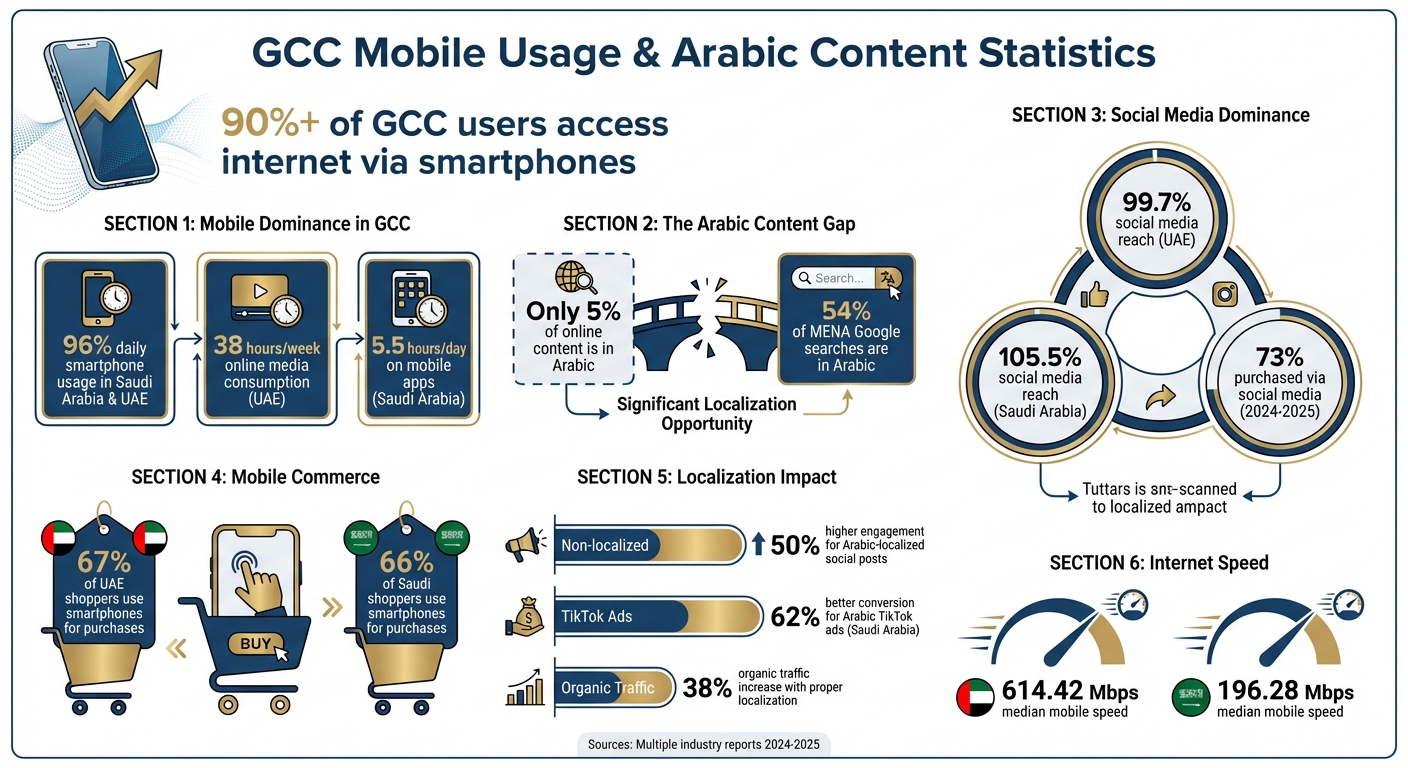
GCC Mobile Usage and Arabic Content Statistics: Key Market Insights
Mobile-First Behavior in GCC Markets
Mobile Usage Patterns Among Arabic Speakers
The GCC region is one of the most connected markets globally, with 96% of residents in Saudi Arabia and the UAE using smartphones daily. In the UAE, people spend an average of 38 hours per week consuming online media, while in Saudi Arabia, users dedicate 5.5 hours daily to mobile apps.
Social media has transformed how people in the Gulf consume media. Traditional platforms like television and news websites are losing ground, with only 30% relying on TV and 22% on news websites. Social media, on the other hand, dominates, with a reach of 99.7% in the UAE and an impressive 105.5% in Saudi Arabia. TikTok, in particular, is projected to reach 134.6% of the adult population in the UAE by late 2025.
This mobile-first trend is also reshaping commerce. Between 2024 and 2025, 73% of consumers in Saudi Arabia and the UAE made purchases through social media platforms. Moreover, 67% of UAE shoppers and 66% of Saudi shoppers used their smartphones for their most recent purchase. The UAE leads in mobile internet speeds, with a median speed of 614.42 Mbps, far surpassing Saudi Arabia’s 196.28 Mbps.
These insights highlight the region's reliance on mobile technology and set the stage for exploring how cultural influences shape content preferences.
How Culture Shapes Mobile Content Preferences
While mobile usage determines accessibility, cultural context drives engagement. In the GCC, Arabic plays a pivotal role in building trust and connecting with local audiences. Arabic-localised social media posts, for instance, achieve 50% higher engagement than English-only content. Similarly, TikTok Arabic ads in Saudi Arabia convert 62% better than their English counterparts.
"The Gulf is a patchwork of hyper-connected but deeply distinct consumer behaviours, digital habits, and tech appetites."
- Thando Mafongosi, Strategy Partner, We Are Social
Cultural preferences also influence content formats. Gulf audiences gravitate towards narrative-driven visual content, which outperforms static images or text-heavy posts. However, there’s a gap in representation: only 14% of Saudi users feel represented in the advertisements they encounter. This underscores the need to move beyond broad pan-Arab messaging and craft content that resonates with the unique identities of local audiences.
Social media also plays a key role in product research. In Saudi Arabia, 57.1% of users rely on social platforms for this purpose, compared to 46.4% in the UAE, where search engines are more widely used.
To create truly localised Arabic content, it’s essential to align with these cultural and behavioural insights while refining strategies like RTL design and SEO.
Right-to-Left (RTL) Layout Design
RTL Design Fundamentals
Designing an Arabic interface means flipping the visual layout to align with the right-to-left reading direction. This shift impacts how users interact with the interface.
When creating an RTL layout, mirror the entire design. For example, navigation menus should move to the right, submenus should expand to the left, and primary call-to-action buttons should also shift to the right. Similarly, progress bars and sliders should fill from right to left, with forward arrows pointing left and backward arrows pointing right.
Typography adjustments are crucial for Arabic. Use modern sans-serif fonts like Cairo, Tajawal, or Noto Kufi Arabic. Increase line spacing to 1.5x and bump up font sizes by 3 points to accommodate the script's cursive and context-sensitive nature.
"Arabic text typically requires 25-40% more space than its English counterpart. This expansion affects button sizes, menu layouts, and overall interface spacing." - Code Guru
Directional icons should be mirrored, but symmetrical icons can remain as they are. Media controls like play, pause, and seek buttons should stay in their standard format, as they are universally recognised. While text flows right-to-left, elements like phone numbers, dates, and IDs should always be displayed left-to-right, ensuring the digit order remains intact.
Once these design changes are made, thorough cross-platform testing becomes critical to ensure everything functions as intended.
Testing RTL Interfaces Across Platforms
Applying RTL design principles requires precise technical execution. For instance, use the dir="rtl" attribute on the <html> tag instead of the <body> tag to avoid issues with scrollbar positioning in certain browsers. Tools like Flexbox and CSS Grid simplify RTL transitions, handling many layout adjustments automatically.
For interfaces that mix Arabic and Latin content, leverage <bdi> or dir="auto" to maintain the correct text flow. Input fields should adapt based on the first character typed, ensuring a seamless user experience.
To convert left-to-right code into RTL, tools like css-flip and RTLCSS can be helpful. However, testing with native Arabic speakers is essential to catch subtle usability issues. Common mistakes include incomplete mirroring, using fonts designed for Latin scripts that distort Arabic characters, and placing scrollbars on the wrong side.
In GCC markets like Saudi Arabia, consider adding dual-calendar displays that show both Gregorian and Hijri (Umm al-Qura) dates. Additionally, configure calendars to start on Sunday to match the region's Sunday-to-Thursday workweek.
Language and Cultural Adaptation for Arabic Content
Modern Standard Arabic vs. Gulf Dialects
When crafting Arabic content, it's essential to distinguish between Modern Standard Arabic (MSA) and Gulf dialects. MSA is ideal for formal communications, such as business, legal, and technical materials, as it conveys professionalism and appeals to a broad regional audience. On the other hand, Gulf dialects are more effective for building emotional connections, particularly in marketing, social media, and customer service aimed at affluent audiences in Saudi Arabia, the UAE, Qatar, and Kuwait. For instance, bilingual brands in the UAE have reported up to 40% higher social media engagement.
"Arabic remains the emotional language of trust and heritage." - Labeeb.ae
The approach is simple: use MSA for formality and wide appeal, while Gulf dialects work best for high-value products and community-focused interactions. Regional differences in terminology also matter. For example, "mobile phone" is referred to as "جوال" in Saudi Arabia but as "هاتف متحرك" in the UAE. This linguistic nuance is crucial, especially since 54% of Google searches in the MENA region are conducted in Arabic. Tailoring your keywords to these variations can significantly improve your search rankings.
Once the language style is established, the next step is to ensure your visuals and messaging align with local cultural expectations, creating a seamless and relatable user experience.
Adapting Visuals and Messaging for Local Audiences
Language alone isn't enough - visuals play a critical role in connecting with MENA audiences. To resonate with the region's diversity, visuals should authentically reflect local attire, gestures, and symbols.
"If you must use stock images, pay for the appropriate ones. Free stock images are misrepresentative and insulting. They look nothing like Arabs." - Firas Ghunaim, iSpectra
When choosing visuals, consider the region's conservative standards, particularly regarding gender representation and clothing. Messaging should also reflect key values such as family, community, heritage, innovation, sustainability, and generosity. For example, during Ramadan, successful campaigns often focus on themes of togetherness and generosity rather than direct product promotion.
Timing is another crucial factor. Schedule your campaigns around significant local events like Ramadan, Eid, and National Days. For Saudi audiences, it's wise to provide text alternatives for videos with music, as some viewers may find it inappropriate. Additionally, automated translations can erode trust in markets like the UAE, where cultural and linguistic accuracy is highly valued. To ensure your content resonates, always collaborate with native Arabic speakers who can fine-tune language fluency, cultural relevance, and punctuation.
SEO for Arabic Content in GCC Markets
Arabic Keyword Research Methods
When it comes to Arabic keyword research, a simple translation from English won't cut it. Direct translations often miss the mark on local search intent, leading to terms that users rarely search for. Arabic is a language of rich diversity, with over 30 dialects and significant regional differences in search behaviour.
Here's a key stat: 54% of Google searches in the MENA region are conducted in Arabic. This means using the correct regional term is critical if you want your content to rank. For example, the term for "mobile phone" varies greatly - it's "جوال" (jawwal) in Saudi Arabia but "موبايل" in Egypt and Jordan. These differences directly affect search rankings.
Another unique aspect of Arabic search behaviour is the use of informal spellings. Many users skip formalities like the hamza on the letter alef, and these informal variations often generate higher search volumes. To capture this, it's essential to collaborate with native speakers from your target market. They can fine-tune keyword lists and account for the nuances of local dialects.
Modern Arabic SEO also leans towards creating clusters of semantically related topics rather than stuffing pages with keywords. With over 85% of searches in the Middle East coming from smartphones, focusing on long-tail keywords and natural language queries that mimic conversational voice searches is a must.
While correctly localising keywords is a game-changer, avoiding common pitfalls is just as important.
Common Arabic SEO Mistakes to Avoid
One major misstep in Arabic SEO is treating it as a simple translation exercise rather than a comprehensive localisation effort. A great example? A Saudi eCommerce site replaced its translated pages with well-localised Arabic content tailored to specific product categories. The result? A 38% increase in organic traffic within just six months. This was achieved by using native Arabic copywriters who understood both local search intent and the cultural context.
| Common Error | Impact | Corrective Approach |
|---|---|---|
| Literal Translation | Misses local search intent; awkward phrasing | Work with native speakers for keyword research and content creation |
| Ignoring Informal Spelling | Misses high-volume search traffic | Include both formal and informal spelling variations |
| Missing Hreflang Tags | Incorrect regional targeting | Use region-specific codes (e.g., ar-sa, ar-ae) |
| Broken RTL Implementation | Disrupts user experience and indexing | Ensure proper Right-to-Left layouts in CMS configurations |
Technical errors can also derail your Arabic SEO efforts. For instance, keeping Arabic URL slugs short (3–5 words) can help avoid 404 errors, especially in CMS platforms that struggle with non-Latin characters. A SaaS platform catering to Arabic-speaking users saw a 40% higher lead conversion rate after replacing machine-translated pages with native Arabic content. This shows how investing in quality localisation can directly boost business outcomes.
"Arabic SEO is not a project, it is an ongoing effort." - GTECH
In mobile-first GCC markets, where 75% of users never scroll past the first results page, getting Arabic SEO right is critical. And with Arabic content making up only about 5% of the global digital landscape, optimising for this underserved market offers a real opportunity to stand out.
sbb-itb-058f46d
Responsive Design for Arabic Mobile Content
Handling Arabic Text Expansion
In the GCC region, where over 90% of users access the web through smartphones and tablets, designing for Arabic text expansion is not just a consideration - it’s a necessity. Arabic text often takes up 25% to 40% more horizontal space compared to English. This can create challenges for mobile layouts, especially for elements like button labels and menu items. For example, a simple English button labeled "Submit" might require significantly more space for its Arabic counterpart, "إرسال", making it essential to design with flexibility in mind.
To address this, designers should rely on flexible layouts using CSS Grid or Flexbox instead of fixed pixel dimensions. Units like percentages, em, or rem allow layouts to adapt seamlessly to text expansion. This approach ensures that text remains legible and avoids issues like truncation or awkward line breaks.
Typography also plays a critical role in responsive design. One helpful strategy is the "one-step decrease" rule: dynamically adjust heading sizes based on the viewport. For instance, a desktop H1 (text-h1) can scale down to an H2 (text-h2) on smaller screens. Following the UAE Design System's guidance, a base font size of at least 16px (1rem) ensures readability on mobile devices.
For optimal readability, aim for 60 to 100 characters per line. On larger screens, limiting content width to 60% of the total screen width prevents overly long lines that can strain the eyes. Additionally, Arabic text should always be right-aligned rather than justified, as justification can create uneven spacing and disrupt the reading experience.
By adopting these flexible and adaptive strategies, designers can ensure that Arabic text remains clear, readable, and visually appealing on mobile devices.
Performance Optimisation for Arabic Typography
Arabic fonts are inherently complex, with thousands of glyphs to accommodate context-sensitive shapes and essential ligatures like "Lam-Alef". This complexity can lead to slower load times, especially on mobile devices. To optimise performance, choose lightweight, performance-focused fonts such as Noto Kufi Arabic for body text or Alexandria for headings. Both are available via Google Fonts, which automatically delivers the smallest file size suitable for each user’s browser.
To further enhance performance, limit font weights to a maximum of five per page. Ideally, stick to just three - regular, medium, and bold - to reduce loading demands, particularly on slower networks. Always include system font fallbacks in CSS (e.g., font-family: "Noto Kufi Arabic", sans-serif;) to ensure content remains legible even if the primary font fails to load.
Arabic script often requires more vertical spacing due to its ascenders, descenders, and diacritics (tashkeel). To maintain readability, set a minimum line height of 1.5x for body text. For headings, slightly tighter line heights (1.125rem to 1.325rem) work well but should never drop below 1rem.
For a smooth mobile experience, aim for a Largest Contentful Paint (LCP) of 2.5 seconds or less and a First Contentful Paint (FCP) of 1.8 seconds or less. Techniques like lazy loading for images and using modern formats like WebP can significantly reduce load times. Additionally, bundle splitting ensures users only download the resources they need for their current interaction.
"Prioritising performance ensures that digital government services are accessible, fast, and efficient for everyone - including users on slow networks, older devices, or with limited data plans." - UAE Design System
Measuring Arabic Localization Performance
Performance Metrics for Arabic Content
To gauge the success of Arabic localization efforts, it’s essential to track key engagement metrics like click-through rates, bounce rates, and dwell time. These indicators help determine if your localized Arabic pages are connecting with audiences in GCC markets. Research shows that effective Arabic localization can drive a 10% to 20% increase in monthly traffic compared to basic translation.
Another critical area to evaluate is user acquisition. Compare how well localized calls-to-action perform against generic translations. In the GCC, where 54% of Google searches are conducted in Arabic, compared to only 34% in English, these insights can help ensure you're effectively reaching Arabic-speaking audiences.
Retention metrics such as customer lifetime value and repeat purchase rates among Arabic-speaking segments provide long-term performance insights. Additionally, social media engagement offers instant feedback on cultural relevance and resonance.
Given that 90% to 95% of web traffic in Arab regions comes from mobile devices, optimising for mobile - such as improving page load speeds for right-to-left (RTL) layouts - is crucial for success.
| Metric Category | Key Performance Indicators |
|---|---|
| User Engagement | Click-through rates, average time on page, social media shares, sentiment analysis |
| Conversion | Lead generation, inquiry rates, e-commerce sales, newsletter sign-ups |
| Technical/UX | Bounce rates on RTL pages, Core Web Vitals, Arabic text rendering performance |
| Business Impact | Customer lifetime value, market share gains, brand awareness |
Monitoring these metrics not only helps refine your localisation strategy but also sets the stage for measuring the return on investment in GCC markets.
Calculating Localization ROI
To assess the return on investment (ROI) of Arabic localization, compare revenue growth in Arabic-speaking markets with your localization expenses. The MENA region’s digital economy, valued at AED 202 billion (approximately US$55 billion) and growing at 8% annually, presents a promising opportunity.
Your ROI framework should include factors like market share gains and reduced customer support costs, which can be achieved by offering better-localized FAQs and self-service tools. Tools like Google Analytics and Search Console are invaluable for isolating Arabic keyword performance and identifying top-performing landing pages.
A/B testing localized content - comparing regional Gulf dialects with Modern Standard Arabic - can further refine your approach. Additionally, campaigns tied to local events like Ramadan and Eid often see higher engagement rates than generic global campaigns.
Strong Arabic SEO rankings are another cornerstone of ROI, as they ensure visibility in a competitive market. Comparing customer acquisition costs for localized versus non-localized campaigns often reveals that cultural adaptation leads to higher engagement and, over time, lower marketing expenses. This makes investing in Arabic localization a smart strategy for sustainable growth in GCC markets.
WWDC22: Design for Arabic | Apple
Conclusion
Optimising Arabic content for mobile-first users in the GCC goes beyond basic translation. It calls for a thoughtful, data-driven strategy that takes into account the technical, linguistic, and cultural specifics of the region. With mobile access being nearly universal across the Middle East, ensuring mobile-friendly content is not just an option - it’s essential for digital success.
The potential here is immense. Arabic content makes up only 5% of all internet content, leaving a vast opportunity for brands that invest in high-quality localisation. By focusing on culturally and technically tailored digital experiences, businesses can gain a competitive edge. This means paying attention to details like implementing proper right-to-left (RTL) layouts using the dir="rtl" attribute, choosing readable Arabic fonts, and factoring in regional dialects during keyword research.
Such localisation efforts directly impact both user experience and technical performance. With 75% of users never venturing beyond the first page of search results, aspects like mobile site speed, Core Web Vitals, and seamless RTL rendering become critical to attracting and retaining users. Regular testing with native speakers ensures that translations don’t disrupt layouts or use inappropriate terminology.
Combining optimised technical performance with consistent tracking of key metrics creates measurable business outcomes. A data-focused strategy monitors everything from Arabic keyword rankings to conversion rates and customer lifetime value. Tools like Google Analytics and Search Console provide the insights needed to refine your strategy and prove its impact. By adopting this approach, you can position your brand for long-term success in GCC markets.
FAQs
How can businesses effectively incorporate Gulf Arabic dialects into their content for mobile-first users?
To effectively engage mobile-first audiences in the Gulf, businesses should view Gulf Arabic dialects as more than just a translation tool - they're a way to truly connect. Start by performing regional keyword research that incorporates local slang and expressions, such as yalla, habibi, or phrases unique to Emirati culture. This approach ensures your content aligns with how people naturally search and communicate online. Collaborating with native speakers can further refine the tone and phrasing, making your language feel genuine to each specific Gulf region.
Focus on keeping your content short and mobile-friendly, using concise sentences that are easy to read on small screens. Remember to optimise for the right-to-left Arabic script, ensuring a smooth user experience. Avoid using overly formal Modern Standard Arabic, which can come across as distant - especially on social media. Instead, incorporate culturally relevant elements like local holidays, sports, or popular foods to create a stronger emotional bond with your audience.
For continued success, consider partnering with a data-driven consultancy like Wick. Using AI-powered tools, they can help fine-tune your Gulf Arabic content, keeping it relevant and engaging while adapting to the UAE’s dynamic, mobile-first environment.
What are the essential steps for designing an Arabic-friendly RTL interface?
Creating an effective right-to-left (RTL) interface for Arabic-speaking, mobile-first users goes beyond simply flipping text direction. It involves thoughtful technical adjustments to ensure the design feels intuitive and works smoothly. Start by setting the document's language and direction at the root level using <html lang="ar" dir="rtl">. This step ensures proper rendering and layout alignment across the interface.
Instead of using physical CSS properties like margin-left or float: left, switch to logical properties such as margin-inline-start and float: inline-start. These allow for automatic mirroring when RTL is enabled, making the design process more efficient.
Key layout elements like navigation bars, sliders, and breadcrumbs should mirror properly, but icons and logos might need selective adjustments to preserve the brand's identity. Choose fonts that are optimised for Arabic, and ensure line spacing and letter spacing are clear and legible, especially on smaller screens. Additionally, test how mixed-script content (Arabic and English) and numeric data are displayed. This includes verifying the formatting of Arabic-Indic digits, decimal separators, and currency symbols (e.g., AED 1,234.56).
Thorough testing on both iOS and Android devices is essential to identify and resolve any RTL-specific challenges. This ensures that the interface works consistently across platforms.
Wick’s expertise in data-driven development guarantees that every detail of RTL design - from precise markup to rigorous cross-device testing - is handled with care. The result is a seamless, high-performance experience tailored specifically for Gulf audiences.
Why is optimizing Arabic SEO crucial for connecting with GCC mobile users?
Optimising Arabic SEO is crucial for connecting with mobile users in the GCC, where the majority of the audience speaks Arabic and relies heavily on mobile devices for browsing. By adapting your content to include right-to-left (RTL) formatting and prioritising mobile-first indexing, you can improve both visibility and accessibility for this audience.
Focusing on Arabic SEO allows you to align with the unique preferences and search habits of Gulf users. This not only increases traffic but also helps establish trust by delivering content that is culturally relevant and mobile-friendly, creating stronger connections with local audiences.