

Blog / Personalization vs. Privacy: Finding the Right Balance
Personalization vs. Privacy: Finding the Right Balance
UAE consumers demand personalization but are wary of privacy risks. While 80% expect brands to understand their needs and 66% want tailored offers, 90% are concerned about online privacy. Striking this balance is critical for businesses aiming to thrive in the region.
Here’s the core takeaway:
- Personalization boosts revenue by 1.5X to 2.9X when powered by first-party data.
- Privacy concerns are rising, with 43% of consumers willing to switch brands for better privacy experiences.
- UAE's strict regulations, like PDPL, require explicit consent and robust data management to avoid fines up to AED 5 million.
Businesses must prioritize transparency, secure systems, and ethical data use to build trust while meeting personalization expectations.
The ethics of data: Privacy vs. personalization - Xconf Singapore 2023
How Personalisation Benefits UAE Marketing
In the UAE's digital-first economy, personalisation has shifted from being a nice-to-have to an absolute must. With 66% of consumers expecting personalised offers at all times, businesses are under pressure to meet these elevated standards. This growing demand for tailored experiences is reshaping how companies engage with their audience, boost revenue, and differentiate themselves in the competitive GCC market.
Better Customer Engagement
Personalisation plays a crucial role in how UAE consumers connect with brands. When done right, it builds the trust that 91% of online shoppers consider essential when making a purchase. Additionally, 44% of consumers appreciate personalisation for simplifying their shopping journey, while 41% value receiving timely, relevant information.
However, there's still a gap to bridge. A staggering 70% of UAE shoppers report receiving irrelevant messages and notifications, highlighting the persistence of outdated "one-size-fits-all" marketing strategies. Transitioning to a "one-to-one" approach - where behavioural data informs every interaction - can eliminate this disconnect and foster stronger customer relationships.
A standout example comes from Maggi, which launched an AI-driven Performance Max campaign across the Middle East during Ramadan in 2022. By leveraging first-party data from website registrations, they tailored newsletters and personalised website experiences based on user interests in recipes and kitchen tips. The result? A 66% boost in website registrations and a 118% jump in click-through rates. This kind of engagement not only deepens customer relationships but also lays the groundwork for measurable business growth.
Higher Revenue Through Data Insights
When it comes to revenue, personalisation is a game-changer. Companies that utilise first-party data for marketing see a 1.5X to 2.9X increase in revenue compared to those that don't. AI-driven personalisation further enhances these outcomes, boosting conversion and cross-sell rates by 30% to 40%, while personalised offers deliver three times the ROI of generic promotions.
This impact extends far beyond one-off sales. Personalised strategies can elevate customer lifetime value by up to 20%, and brands that focus on data-driven customer experiences have reduced churn by as much as 60%. For instance, an Italian telecom company introduced an AI-powered "next best experience" engine, which resulted in a 5% increase in incremental revenue and a 30% improvement in margins within a year.
"The AI-powered next best experience capability can enhance customer satisfaction by 15 to 20 percent, increase revenue by 5 to 8 percent, and reduce the cost to serve by 20 to 30 percent." - Lars Fiedler and Nicolas Maechler, Partners, McKinsey
These revenue gains are not just about numbers - they also strengthen a brand's position in the GCC's competitive landscape.
Standing Out in the GCC Region
In the GCC, where premium service is the norm, personalisation is key to standing out. UAE consumers increasingly associate tailored experiences with high-quality service, with 88% expecting empathy in their interactions with brands. This demand is driving growth in sectors like luxury, where the UAE market is forecasted to grow from AED 15.4 billion in 2024 to AED 25.7 billion by 2033, fuelled by a preference for personalised luxury.
Understanding local preferences is essential for differentiation. For example, 45% of UAE consumers expect personalised customer service, and 44% prefer tailored email communications. Communication channels also matter - 25% of consumers want the flexibility to choose their preferred platform, whether it’s WhatsApp, email, or live chat. Brands that deliver consistent, relevant experiences across these touchpoints gain a clear edge over competitors still relying on generic campaigns.
"Personalization is no luxury, it's a necessity. Consumers today expect personalization during the retail buying journey; it is no longer a 'nice-to-have' but a 'must-have'." - CM.com
While personalisation drives engagement and revenue, it also highlights the importance of balancing these benefits with robust privacy measures.
Privacy Breach Risks in the UAE
Personalisation can fuel business growth, but mishandling data can lead to serious consequences. With the UAE's regulatory framework becoming more stringent and cyber threats growing in complexity, businesses face a challenging environment. A single mistake could result in hefty fines, reputational harm, and operational setbacks. This makes it essential to prioritise strong data protection measures in every personalisation effort.
Loss of Consumer Trust
Poor data management can lead to a "trust crisis", where customers turn to brands that prioritise privacy. The fallout can be severe: 83% of organisations that suffer an initial data breach experience subsequent breaches.
"The initial data breach sets off a chain reaction that inflicts short-term damage on your bottom line while eroding brand value and customer trust over time." – Privacy Bee
Take, for instance, a UAE-based fintech startup in 2024. The company faced penalties for failing to disclose its data processing practices within its app. This not only resulted in a public trust crisis but also delayed an important investment round.
Compliance Challenges with UAE PDPL
The UAE's Federal Decree-Law No. 45/2021 (PDPL) introduces strict rules for personalised marketing. Unlike some international laws, the PDPL does not offer clear exceptions for marketing purposes. Its reach extends beyond the UAE, applying to any company processing data of UAE residents, regardless of where the business operates.
Under the PDPL, businesses handling sensitive or large-scale personal data must appoint a Data Protection Officer (DPO). Failure to comply with this requirement poses significant risks. Additionally, companies are mandated to address user data requests, such as access or deletion requests, within 30 days.
Non-compliance carries severe repercussions, including fines, suspension of business licences, and even halting specific data processing activities. In the DIFC, amendments effective from July 2025 give individuals the right to sue organisations directly for damages. Administrative fines range from AED 36,700 to AED 183,500 per violation. On top of this, technical vulnerabilities demand robust cybersecurity measures to ensure compliance.
Cybersecurity Threats
The technical risks tied to data collection are just as alarming. Social engineering attacks are now the fastest-growing form of data breaches in the region, targeting employees to gain access to sensitive data. These attacks often succeed regardless of an organisation's cybersecurity defences.
The financial toll is steep: a single data breach could cost between AED 25.7 million and AED 36.7 million. Such breaches may also violate Decree-Law No. 34 of 2021, which criminalises hacking and unauthorised access. Moreover, personalisation initiatives that gather detailed personally identifiable information (PII) increase the risk of identity theft, cyberstalking, and doxxing.
To counter these threats, businesses need to adopt robust technical protections like encryption, strict access controls, and vulnerability assessments from the outset. Equally critical is having a well-defined breach response plan with clear steps for detection and notification. The PDPL mandates that businesses report breaches to the UAE Data Office and affected individuals within specific timeframes.
UAE Data Privacy Regulations: What You Need to Know
Understanding the UAE's data privacy laws is crucial for businesses aiming to personalise marketing efforts while staying compliant. The regulations emphasise consent, transparency, and accountability, all while encouraging responsible innovation.
UAE Personal Data Protection Law (PDPL) Overview
The UAE introduced its first federal data privacy law, Federal Decree-Law No. 45/2021, also known as the Personal Data Protection Law (PDPL), which came into effect on 2 January 2022. This law applies to all organisations handling the personal data of UAE residents.
Under the PDPL, individuals are granted several rights, including the ability to access, correct, delete their data, and object to automated profiling. For marketers, one key takeaway is that explicit consent is mandatory for using personal data in marketing, as there are no exceptions to this requirement.
"The PPD Law provides no obvious exception to the requirement for a data subject's consent that would apply to the use of personal data for marketing purposes." – Adil Shafi, Partner, Chambers and Partners
Additionally, businesses engaging in high-risk data processing are required to appoint a Data Protection Officer (DPO). The UAE Data Office, established under Federal Decree-Law No. 44 of 2021, oversees compliance, handles complaints, and enforces the law. It’s important to note that financial free zones like the DIFC and ADGM have their own independent data protection regulations.
These regulations highlight the need for strict adherence to consent and transparency principles.
Consent and Transparency Requirements
The PDPL sets a high bar for consent. Businesses must obtain explicit, specific, and clear consent before engaging in profiling or automated decision-making. Pre-ticked boxes or vague terms are not acceptable. Users must actively and knowingly agree to the use of their data.
Transparency is equally important. Companies are required to clearly explain the logic behind profiling and automated decisions. Privacy notices must detail the type of data collected, its purpose, and whether it will be shared with third parties. Additionally, businesses should follow the principle of data minimisation by collecting only the data that is absolutely necessary.
Users have the right to withdraw their consent at any time. This process should be as simple as giving consent in the first place. For marketers, this means providing easy opt-out options and maintaining detailed Records of Processing Activities (ROPA), which can be requested by the UAE Data Office at any time.
Non-compliance with the PDPL can result in steep penalties. Fines range from AED 50,000 to AED 5 million, while administrative penalties in the DIFC can range from AED 36,700 to AED 367,000 per violation. The law’s extraterritorial scope also requires international brands operating in the UAE to adapt their consent processes specifically for local audiences. Although businesses were initially given a six-month grace period to comply following the issuance of Executive Regulations, that window has now closed. Compliance is no longer optional - it’s mandatory for any organisation operating in the UAE.
sbb-itb-058f46d
Personalization Benefits vs. Privacy Risks: A Comparison
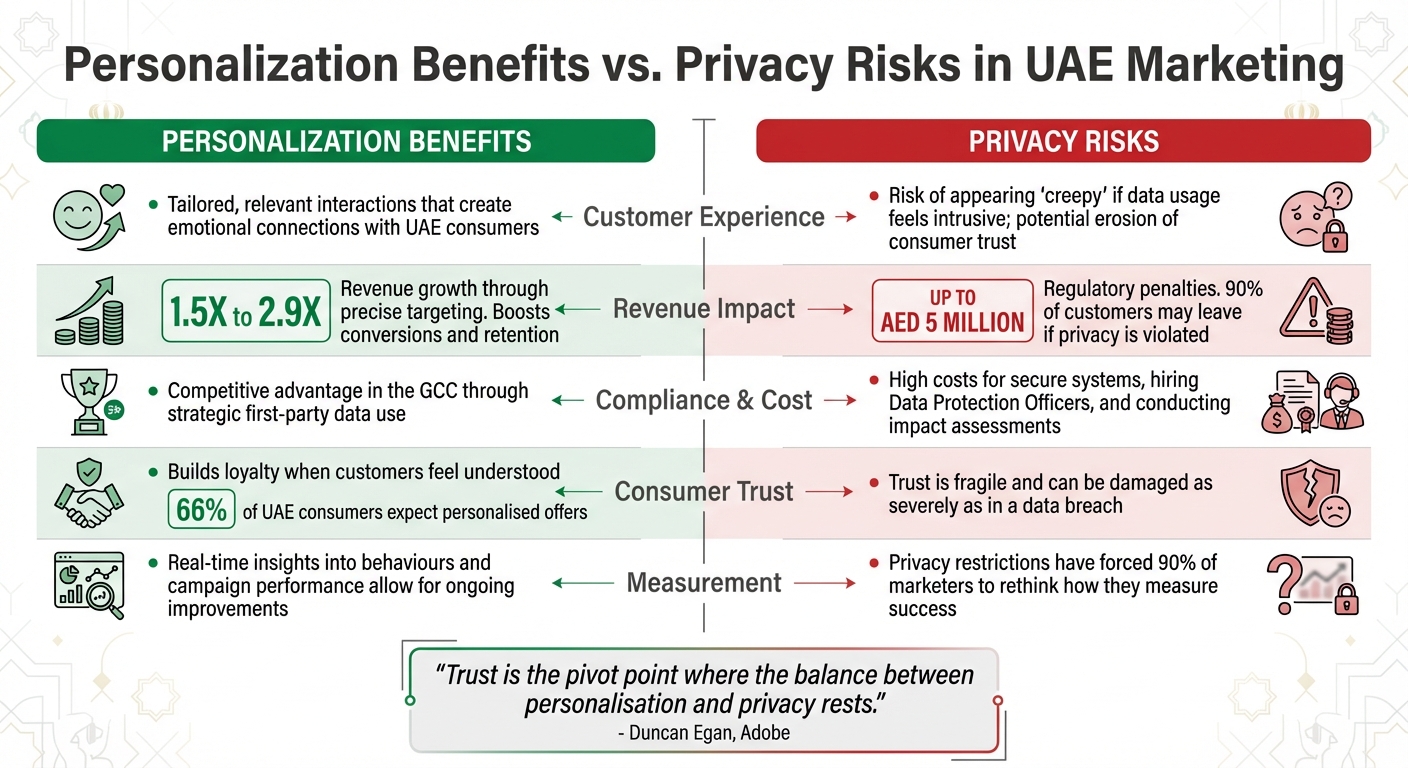
Personalization Benefits vs Privacy Risks in UAE Marketing
In the UAE, digital marketing is being shaped by two powerful forces: personalisation and privacy concerns. On one side, 66% of UAE consumers want personalised offers tailored to their preferences. On the other, a staggering 90% of customers are ready to stop doing business with companies that fail to respect their privacy.
These opposing demands have significant consequences for businesses. Companies that effectively use first-party data can see their revenue grow by 1.5 to 2.9 times. However, ignoring privacy regulations like the UAE's PDPL (Personal Data Protection Law) could result in fines of up to AED 5 million, not to mention the reputational damage that comes with losing customer trust.
"Trust is the pivot point where the balance between personalisation and privacy rests." - Duncan Egan, Adobe
Trust plays a central role in this equation. A brand’s ability to safeguard personal data directly influences trust for 55% of consumers across the UAE, Egypt, and Saudi Arabia. At the same time, 90% of marketers admit that changes in data privacy laws have made it harder to measure performance and prove ROI. This creates a challenging balancing act: businesses must deliver personalised experiences while remaining transparent and compliant with privacy laws.
Comparison Table: Personalisation Pros vs. Privacy Cons
| Aspect | Personalisation Benefits | Privacy Risks |
|---|---|---|
| Customer Experience | Tailored, relevant interactions that resonate with UAE consumers, creating emotional connections | Risk of appearing "creepy" if data usage feels intrusive; potential erosion of consumer trust |
| Revenue Impact | Revenue growth of 1.5X to 2.9X through precise targeting, boosting conversions and retention | Regulatory penalties up to AED 5 million; 90% of customers may leave if privacy is violated |
| Compliance & Cost | Competitive advantage in the GCC through strategic first-party data use | High costs for secure systems, hiring Data Protection Officers, and conducting impact assessments |
| Consumer Trust | Builds loyalty when customers feel understood; 66% of UAE consumers expect personalised offers | Trust is fragile and can be damaged as severely as in a data breach |
| Measurement | Real-time insights into behaviours and campaign performance allow for ongoing improvements | Privacy restrictions have forced 90% of marketers to rethink how they measure success |
This table underscores a critical reality: while personalisation can significantly boost business outcomes, mishandling privacy can undo those gains in an instant. The solution lies in finding the right balance - delivering the tailored experiences consumers crave while maintaining the transparency and security required by UAE regulations.
How Wick's Four Pillar Framework Balances Both

Wick's Four Pillar Framework addresses the challenges of the UAE PDPL (Personal Data Protection Law) by bridging the gap between personalisation and privacy. With its two interconnected pillars - Tailor & Automate and Capture & Store - the framework ensures tailored marketing experiences while maintaining compliance with PDPL requirements for consent, security, and transparency. This approach creates a balance where personalisation and data protection coexist seamlessly.
Tailor & Automate for Ethical Personalisation
The Tailor & Automate pillar focuses on using AI-driven personalisation responsibly, ensuring customer privacy is safeguarded at every step. Wick collects only the data necessary for clearly defined purposes, adhering to PDPL guidelines. To further strengthen this, Wick conducts Data Protection Impact Assessments (DPIAs) to identify and address privacy risks tied to AI-driven personalisation. Customers are also empowered to object to automated decision-making, including AI-based profiling for marketing.
"The good news is what I'm seeing and hearing a lot from organisational leaders is an interest in leveraging this technology (AI) responsibly and ethically." – Dave Horstein, Advisory Client Partner Services, Hitachi Solutions
Wick’s AI personalisation operates exclusively on first-party data obtained through explicit, specific, and unambiguous consent. This ensures that customers remain in control of their data while enabling ethical personalisation practices.
While this pillar focuses on personalisation, it is complemented by the Capture & Store pillar, which reinforces data security.
Capture & Store for Secure Data Management
The Capture & Store pillar is designed to ensure that all customer data is collected, stored, and managed securely in compliance with PDPL standards. Wick employs advanced measures like encryption and pseudonymisation to protect data from unauthorised access. Given that a single data breach can cost between $7 million and $10 million USD and that 83% of organisations facing one breach often experience multiple incidents, these measures are critical.
To enhance transparency, Wick maintains a comprehensive Record of Processing Activities (ROPA) for each client. This log details what data is collected, its purpose, and the security measures in place. It is readily available to the UAE Data Office upon request, ensuring full accountability. Regular audits are also conducted to remove outdated or redundant data, helping to prevent compliance errors. These proactive measures reduce the risk of administrative fines, which can range from AED 50,000 to AED 5 million.
Practical Ways to Balance Personalisation and Privacy
In the UAE, businesses face the tricky task of creating personalised customer experiences while respecting privacy. With 82% of customers wanting AI to improve their interactions but 67% hesitant to share personal data without full transparency and control, the challenge is clear. Below are actionable steps to strike this balance effectively.
Get Explicit Consent
The UAE's PDPL requires consent to be specific, informed, unambiguous, and given through clear affirmative action. This means no more pre-ticked boxes or vague terms. Instead, offer customers granular options. Allow them to opt in separately for things like personalised product suggestions, marketing emails, or WhatsApp updates. Provide user-friendly dashboards where they can manage their preferences, adjust data-sharing settings, or request data deletion in real-time. This level of control is crucial, considering that 43% of consumers would switch to a competitor offering a better privacy experience.
Use First-Party Data Sources
First-party data - collected through registrations, loyalty programmes, and sign-ups - is a goldmine, with potential revenue boosts of 1.5X to 2.9X. To maximise its value, conduct regular audits that assess the data's accessibility, relevance, timeliness, reliability, and size. Also, ensure that consent is consistent across all customer touchpoints, including email, SMS, and WhatsApp, which are particularly important in the UAE.
Implement Privacy-Preserving AI
AI can deliver personalised experiences while safeguarding customer identities through methods like pseudonymisation and anonymisation. Pseudonymisation, required under Article 7 of the PDPL, processes data so it can't be linked to an individual without additional, separately stored information. Use these pseudonymised datasets to train AI models, enabling personalisation without compromising privacy. For long-term data storage and trend analysis, anonymisation ensures individuals are completely unidentifiable.
When using AI for profiling or processing sensitive data on a large scale, conduct a DPIA as mandated by Article 21. Additionally, respect the "Right to Object", giving users the option to opt out of automated decision-making and direct marketing. Adopting a "Privacy by Design" approach - integrating these privacy measures during the initial stages of campaign and AI model development - can save businesses the cost and hassle of retrofitting solutions later.
Conclusion
Trust is the cornerstone of sustainable growth in the UAE market. With 90% of customers willing to abandon brands that fail to protect their privacy and 43% ready to switch to competitors offering better privacy safeguards, it’s clear that data security is more than just a compliance requirement - it's a business imperative. Striking this balance is essential, not only for meeting legal standards but also for fostering long-term customer loyalty.
The path forward is straightforward: prioritise first-party data, adhere to the UAE PDPL, and embed privacy considerations into every phase of your marketing strategy. Businesses that embrace privacy-first practices gain a distinct edge, achieving revenue growth while building loyal customer relationships. With 80% of UAE consumers expecting brands to understand their unique needs and 55% judging brands on their ability to protect personal data, the stakes have never been higher.
This isn’t just about avoiding penalties that can reach up to AED 5,000,000. It’s about turning privacy into a competitive advantage. Transparency, explicit consent, and privacy-preserving AI aren’t hurdles; they’re enablers of sustainable personalisation. When customers feel confident that their data is secure and ethically managed, they’re more likely to share it, creating a cycle of trust and engagement that benefits everyone.
The choice is clear: respect privacy while delivering personalised experiences, or risk losing customers to brands that do. In a region where 66% of consumers expect personalised offers, the ability to balance personalisation and privacy is what sets market leaders apart.
FAQs
How can businesses in the UAE balance personalised marketing with data privacy?
To navigate the delicate balance between personalised marketing and data privacy in the UAE, businesses need to prioritise transparency, consent, and compliance. Start by collecting only the information that customers willingly provide and ensure they clearly understand how their data will be used. Offer straightforward privacy notices, simple opt-in and opt-out options, and let users update or delete their data upon request.
It’s also essential to comply with the UAE’s Federal Decree-Law No. 45 of 2021 (PDPL). This means securely storing customer data, using it only for its intended purpose, and following strict rules for transferring data across borders. By focusing on consent-driven, first-party data, businesses can harness AI to deliver personalised experiences that respect privacy while still offering meaningful value.
Wick supports businesses in the UAE by combining website development, SEO, content creation, social media, marketing automation, and AI-powered personalisation - all within a unified framework built on privacy-by-design principles. This approach ensures marketing strategies align with local regulations and foster sustainable growth.
What are the risks of not adhering to the UAE's Personal Data Protection Law (PDPL) in personalised marketing?
Non-compliance with the UAE's Personal Data Protection Law (PDPL) in personalised marketing carries serious risks for businesses. These risks include hefty fines, potential legal actions, and even the suspension of data-processing activities. However, the consequences don't stop there. A failure to adhere to the law can also cause damage to a company's reputation, weakening consumer trust and potentially harming long-term business relationships.
To mitigate these risks, businesses in the UAE must prioritise data privacy and regulatory adherence in their marketing efforts. By aligning with the PDPL's requirements, companies can deliver personalised experiences while maintaining trust and staying within the bounds of the law.
Why is first-party data essential for creating personalised marketing strategies?
First-party data - gathered directly from your customers through interactions on your digital platforms like website activity, purchase history, or surveys - plays a key role in creating personalised experiences. It offers precise, timely, and relevant insights that allow you to craft marketing campaigns tailored to your audience. This ensures your message resonates with the right people at the right moment, boosting conversion rates while building lasting customer loyalty.
In today’s privacy-conscious environment, first-party data also supports compliance with regulations such as the UAE’s data-protection laws. Collecting data with explicit consent and managing it transparently not only keeps you compliant but also strengthens customer trust. This trust is essential for delivering personalised experiences that respect individuals' privacy.
Wick helps UAE businesses harness the power of first-party data with tools like data analytics, AI-driven personalisation, and marketing automation. These insights enable you to design impactful and privacy-safe customer journeys that fuel growth and keep you ahead in a competitive market.