Cross-Channel Marketing: Best Practices For 2025
16 MIN READ
AI · 29 Jan 2026 · 12 minUAE e-commerce can use real-time behavioral data to reduce cart abandonment, personalize offers, and boost sales and retention instantly.

Real-time behavioral data is transforming e-commerce in the UAE, enabling businesses to act instantly on user actions to increase sales and improve customer experiences. With the UAE's e-commerce market projected to reach AED 50.7 billion by 2029, leveraging live analytics is no longer optional. Here's what you need to know:
With more than two-thirds of UAE consumers shopping via mobile, real-time data is essential for staying competitive. By integrating tools like AI-driven personalization and dynamic pricing, businesses can meet demand and boost loyalty. UAE companies that act now will lead the market in delivering fast, personalized, and efficient e-commerce experiences.
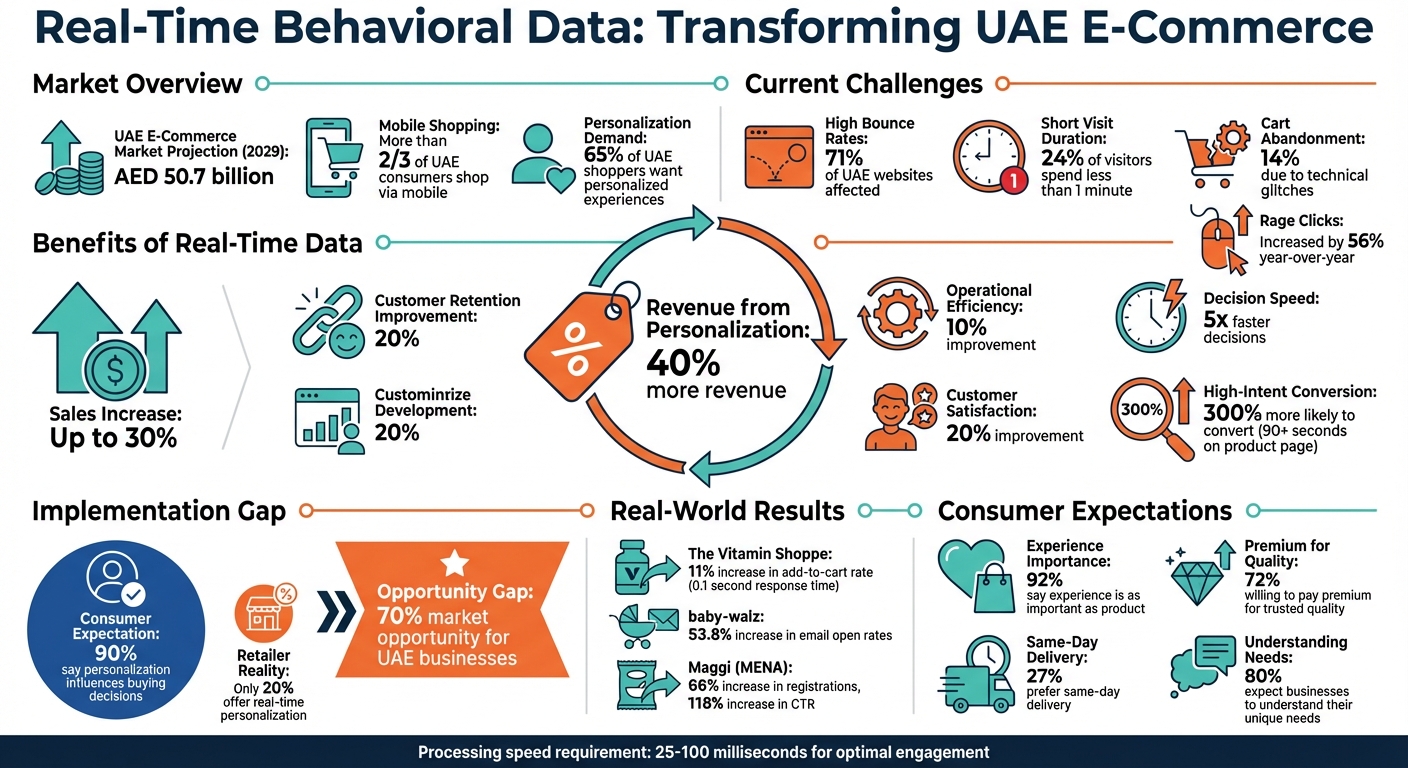
Real-Time Behavioral Data Impact on UAE E-Commerce: Key Statistics and Benefits
Real-time behavioral data helps identify the exact moments shoppers face challenges during checkout. For instance, when a visitor repeatedly clicks the same button - known as a "rage click" - it signals a potential frustration point that could lead to cart abandonment. Acting on these insights immediately, instead of relying on delayed reports, prevents lost sales.
For shoppers in the "movable middle" - those showing interest through actions like hovering over prices or repeatedly comparing products - automated interventions can make all the difference. These could include chat invitations, personalized discounts, or even product comparison videos. Data shows that customers spending over 90 seconds on a product page and engaging with variants are 300% more likely to convert compared to the average visitor.
"The true advantage lies in never being caught off guard. Instead of discovering problems after the fact, real-time analytics lets you tackle them head-on." - Colin Spooner
This ability to address issues in real time paves the way for deeper personalization and a more seamless shopping experience.
Real-time data transforms how UAE shoppers interact with e-commerce platforms. With 80–90% of site visitors browsing anonymously, tracking live signals like scrolling patterns and mouse movements becomes essential to understanding their intent. Modern consumers expect engagement almost instantly - within 3–7 seconds - and this requires data to be processed in as little as 25–100 milliseconds.
When executed effectively, personalization can drive revenue up by 40% and deliver returns on investment up to 10 times higher through real-time campaigns. Despite this, only 20% of retailers currently offer real-time personalization, even though 90% of consumers say it influences their buying decisions. For UAE businesses, this gap presents a major opportunity to lead the market by investing in advanced data systems.
"Engagement must happen in the moment to be most effective, as you may not get another chance with a customer and it's too late." - Ben Wightman, Strategic Business Value Engineering Lead, Tealium
Leveraging these insights not only enhances customer loyalty but also equips businesses with the agility to respond faster to market demands.
In the fast-paced UAE market, speed is everything. Real-time analytics empowers businesses to make quicker decisions, improving both operational efficiency by 10% and customer satisfaction by 20%.
Issues like high bounce rates - impacting 71% of UAE websites - can be flagged and addressed instantly. Businesses can adjust ad budgets, tweak pricing based on demand, or respond to stock alerts in real time, ensuring no opportunity slips through the cracks.
"Real-time analytics isn't just a choice anymore; it's a lifeline for ecommerce businesses aiming to thrive." - Colin Spooner
With real-time data, every scroll, click, or hesitation is captured - even for the 80–90% of visitors who remain anonymous. Machine learning models use this information to predict a shopper's next move, whether it’s making a purchase, abandoning a cart, or upgrading to a higher-value item. This shifts personalization from static, segmented approaches to dynamic, one-to-one interactions. These experiences reflect the shopper's current behavior, like recent searches or loyalty status.
Take The Vitamin Shoppe, for example. Using Bloomreach's AI-powered engine, they delivered personalized product recommendations within 0.1 seconds of user activity. This real-time adjustment of category pages boosted their add-to-cart rate by 11%. Similarly, baby-walz, an online retailer specialising in baby products, tailored email campaigns based on real-time data like gender and expected due date. By aligning content with each customer’s specific pregnancy stage, they achieved an impressive 53.8% increase in email open rates.
For businesses in the UAE, where consumers are highly connected and expect customized experiences, this strategy is especially relevant. The challenge lies in minimising latency - recommendation engines must process and deliver results within 100 milliseconds to maintain a smooth user experience. With 90% of consumers valuing personalization but only 20% of retailers offering real-time experiences, UAE companies have a significant opportunity to stand out. These personalized interactions can also support dynamic pricing strategies, enhancing overall performance.
Real-time behavioral data enables businesses to fine-tune prices based on live factors like competitor pricing, demand trends, and individual shopper behavior. Instead of applying broad discounts, companies can identify "high-intent" shoppers willing to pay full price, preserving profit margins. At the same time, targeted offers can be sent to shoppers in the "movable middle", encouraging conversions. This level of precision has a big impact - companies leveraging real-time data have reported 80% revenue growth, contributing to an estimated $2.6 trillion in global industry gains. For UAE retailers, this is a game-changer.
Real-time tracking also enhances inventory management. Businesses can monitor stock levels instantly, ensuring shelves are never empty. AI tools analyze live sales data to forecast demand, automate restocking, and prevent overstocking, which reduces carrying costs. Alerts can even prompt immediate stock transfers between locations when order patterns shift unexpectedly. These insights ensure businesses are always prepared to meet customer demand.
Real-time data sheds light on where and why customers struggle during checkout. For instance, rage clicks - repeated clicks on unresponsive elements - have jumped by 56% year-over-year, and website errors have driven a 40% increase in exits. Around 14% of shoppers abandon their carts due to technical glitches. Identifying these friction points allows businesses to make immediate fixes.
A great example is Cargo, a car rental app. They used Fullstory, BigQuery, and VertexAI to detect high-intent abandonment signals in real time. By integrating Fullstory Streaming Webhooks with Braze, they sent dynamic, personalized push notifications to users about to leave the app without completing a booking. These interventions only work when executed instantly.
For UAE users, where mobile sessions often last just three minutes, optimizing for mobile performance is critical. Addressing frustration signals and offering localized payment options like digital wallets or Buy Now, Pay Later (BNPL) can significantly lower abandonment rates. Businesses using Stripe have reported revenue increases of up to 14% simply by adding BNPL options.
Collecting real-time data is just the first step for UAE e-commerce businesses - the real challenge lies in using it to drive immediate actions. With 75% of companies struggling to act on customer data in real time, Wick's Four Pillar Framework offers a solution by integrating data from various platforms. Its core strength is breaking down data silos. Without integration, systems like your website, CRM, email campaigns, and social media create disconnected customer profiles, making real-time decisions nearly impossible. Wick’s framework ensures these platforms seamlessly connect and share data. Here’s how each pillar can be implemented effectively.
Start by consolidating data from all customer interactions - web, mobile, email, and social media - into a Customer Data Platform (CDP). This creates a Single Customer View (SCV), linking anonymous data (like cookies and device IDs) with identifiable information (such as emails and phone numbers) to map each shopper’s journey comprehensively.
"The ability to bring all of our consumer information together - in real time - is critical to helping us engage with billions of Coca-Cola consumers around the globe." - Keith Bartig, Director of Precision Marketing Technologies, The Coca-Cola Company
For UAE businesses, prioritising privacy is essential. With 55% of consumers in the UAE, Egypt, and Saudi Arabia saying that data protection directly impacts their trust in a brand, this framework ensures compliance by detecting personally identifiable information (PII) and managing user consent automatically. Customer profiles are updated instantly with every interaction, such as page views, add-to-cart actions, or search queries.
Once data is centralized, AI and machine learning models can analyze it to predict customer behavior. These propensity models evaluate the likelihood of a customer converting or churning, enabling automated segmentation that adjusts in real time based on in-session behavior. Advanced AI tools can even modify promotions, pricing, or recommendations without human input.
This solid data foundation allows businesses to scale personalization to match customer expectations. For example, in 2022, Maggi implemented this approach across the Middle East and North Africa during Ramadan. By collecting first-party data through website registrations and integrating it into Customer Match, they identified consumer interests in recipes and ingredients. Automated tools then delivered personalized content to millions, resulting in a 66% increase in website registrations and a 118% increase in click-through rates.
For UAE e-commerce, where 80% of consumers expect businesses to understand their unique needs and 66% demand personalized offers, automation is no longer optional. Companies that excel at real-time personalization generate an average of 40% more revenue than their competitors. Personalized marketing efforts can deliver returns as high as AED 73 for every AED 3.67 spent.
Once you've integrated and automated real-time data, the next step is measuring its impact to fine-tune your strategy.
Tracking the right metrics is essential to understanding how your real-time data strategy is performing. Live engagement metrics like "Visitors Right Now" and active cart counts offer an instant view of site activity, while sales velocity - measured as revenue per minute or hour - shows the immediate effect of promotions or flash sales. For UAE e-commerce, where 24% of visitors spend less than a minute on-site and 22% view just one page, keeping an eye on funnel progression is critical. Metrics like users currently in checkout, completed purchases, and drop-off points help identify and address friction in real-time.
Other useful indicators include "rage clicks" and "exit after error" events, which can highlight user experience issues that lead to abandonment. Beyond basic metrics like page views, focus on interaction depth - how long users spend exploring specific product details, their scroll behavior, and click-to-conversion paths.
It’s also important to assess differences between first-time and returning visitors, as well as performance across devices. For instance, mobile users in the UAE are 175% more likely to browse 2-5 pages compared to desktop users, making device-specific optimization a priority. When implemented effectively, real-time analytics can increase sales by up to 30% and improve customer retention by 20%.
These metrics lay the groundwork for the best practices outlined below.
To keep your strategy effective and responsive, use these metrics to regularly refine your approach. A tiered monitoring system works best: check critical issues every few seconds or minutes, engagement metrics hourly, and conduct strategic analysis daily. Not every metric requires constant monitoring - focus your real-time efforts on areas with the most impact.
Continuous model retraining is key to maintaining accurate AI predictions. Update your propensity models weekly to adapt to changing consumer trends and avoid "model drift", ensuring personalization stays relevant. Use unique identifiers, like email addresses or user IDs, to track behavior across devices and calculate Customer Lifetime Value more accurately.
Pay special attention to the "movable middle" - those shoppers who show high intent but hesitate to complete their purchase. Real-time signals, such as extended browsing or deeper scroll activity, can help you target these potential buyers with personalized nudges instead of over-focusing on visitors who leave immediately. Regularly auditing your data quality is also essential to avoid issues like latency or inaccuracies that could lead to poor automated decisions.
For businesses in the UAE, meeting local expectations is crucial. With 27% of UAE customers preferring same-day delivery, real-time inventory data can trigger "low stock" alerts and prioritize fulfillment for local regions. To avoid losing conversions, aim for systems that deliver personalized content within 0.1 seconds. A great example is The Vitamin Shoppe, which in October 2025 achieved this speed using Bloomreach's recommendation engine, leading to an 11% boost in add-to-cart rates on product category pages.
Real-time behavioral data is becoming a cornerstone of success in the UAE's e-commerce landscape. With the industry projected to hit AED 50.7 billion by 2029 and 65% of UAE customers expecting brands to treat them as individuals, the stakes are high. Leveraging real-time analytics can increase sales by up to 30% while improving customer retention rates by 20%. Even more impressively, decisions based on real-time insights can be made up to five times faster compared to relying solely on historical data.
However, challenges such as high bounce rates and fleeting visitor attention continue to hinder growth. Real-time data provides the tools to address these issues on the spot - whether it's fixing a broken checkout process or enhancing mobile experiences for the majority of UAE shoppers who prefer shopping via smartphone. By concentrating on the "movable middle" - those high-intent shoppers who just need a nudge - you can turn hesitation into completed transactions.
"92% of customers in the UAE say the experience a company provides is as important as its product or services." - Salesforce
Real-time responsiveness, achieved through tools like automated alerts, dynamic pricing, and instant personalization, lays the groundwork for sustainable growth.
To fully harness the potential of these insights, a well-structured strategy is essential. Building on earlier discussions around real-time interventions, Wick's Four Pillar Framework offers a clear roadmap for UAE businesses. From creating a solid first-party data infrastructure with the Capture & Store pillar to deploying AI-driven personalization through Tailor & Automate, this framework provides actionable steps. With 72% of UAE shoppers willing to pay a premium for trusted quality, investing in the right data foundation not only drives transactions but also fosters long-term customer loyalty.
Real-time behavioral data is a game-changer for tackling cart abandonment in the UAE. By analyzing customer actions and preferences, businesses can create tailored shopping experiences. For instance, they can recommend products that align with a shopper's interests or offer personalized promotions that resonate with individual needs.
This data also helps refine the checkout process. It highlights common pain points, like overly complex payment steps or surprise costs, allowing businesses to address these issues effectively. When shoppers encounter fewer hurdles, they're more likely to complete their purchases.
By delivering timely and relevant offers while ensuring a smooth shopping journey, businesses not only enhance engagement but also improve their conversion rates. This proactive approach is key to reducing abandoned carts and driving sales.
AI is transforming real-time personalization in e-commerce by analyzing customer behavior, preferences, and interactions as they occur. This allows businesses to offer spot-on product recommendations, customized content, and exclusive offers almost instantly.
With AI, e-commerce platforms tackle issues like cart abandonment and low conversion rates more effectively. These personalized experiences don’t just boost customer engagement - they also help build trust, paving the way for increased sales and lasting loyalty.
Integrating real-time analytics has become a must for businesses in the UAE, especially in today’s rapidly changing digital environment. With the UAE boasting high internet penetration and a predominantly mobile-first audience, real-time data provides businesses with the ability to instantly understand customer behavior. This means they can adjust strategies on the fly and tackle issues like cart abandonment or low conversion rates head-on.
Using real-time insights, businesses can tailor customer experiences, fine-tune their marketing efforts, and make informed decisions rooted in data. In such a competitive market, this level of adaptability isn’t just helpful - it’s essential for staying relevant and ensuring steady growth over time.
16 MIN READ
14 MIN READ
11 MIN READ
What worked, what didn't, and what we're building next - no noise, unsubscribe anytime.