

Blog / SEO vs. AEO Metrics for Gulf Content Campaigns
SEO vs. AEO Metrics for Gulf Content Campaigns
In the Gulf, where 99% smartphone penetration fuels mobile-first behavior, the choice between SEO (Search Engine Optimisation) and AEO (Answer Engine Optimisation) isn't about picking one - it’s about knowing when to use each. SEO drives website traffic by improving rankings on search engines like Google, which holds 96% of the UAE market. AEO, on the other hand, focuses on direct answers for AI tools and voice searches, critical in a region where 67% of users engage in daily voice searches.
Key Points:
- SEO: Optimises for long-form content, keyword rankings, and local searches (bilingual: English & Arabic).
- AEO: Targets featured snippets, voice search queries, and AI-driven zero-click results.
- Gulf Trends: 80% of searches are mobile, and AI adoption is 23% above global averages.
Quick Comparison:
| Metric | SEO Focus | AEO Focus | Gulf Relevance |
|---|---|---|---|
| Traffic | Organic website visits | AI mentions and citations | Mobile-first users demand instant info |
| Keyword Rankings | Tracks SERP position (1-10) | Tracks "Position Zero" snippets | Bilingual queries (Arabic & English) |
| Core Web Vitals | Page speed, LCP, CLS | Schema markup for AI readability | High-speed expectations on mobile |
| Local SEO | Google Business Profile metrics | Voice search for local queries | Hyper-local searches dominate |
Takeaway: Use SEO for in-depth research-based content (e.g., e-commerce, guides) and AEO for quick answers (e.g., voice search, AI summaries). Combining both ensures visibility across search engines and AI platforms in the Gulf’s evolving digital landscape.
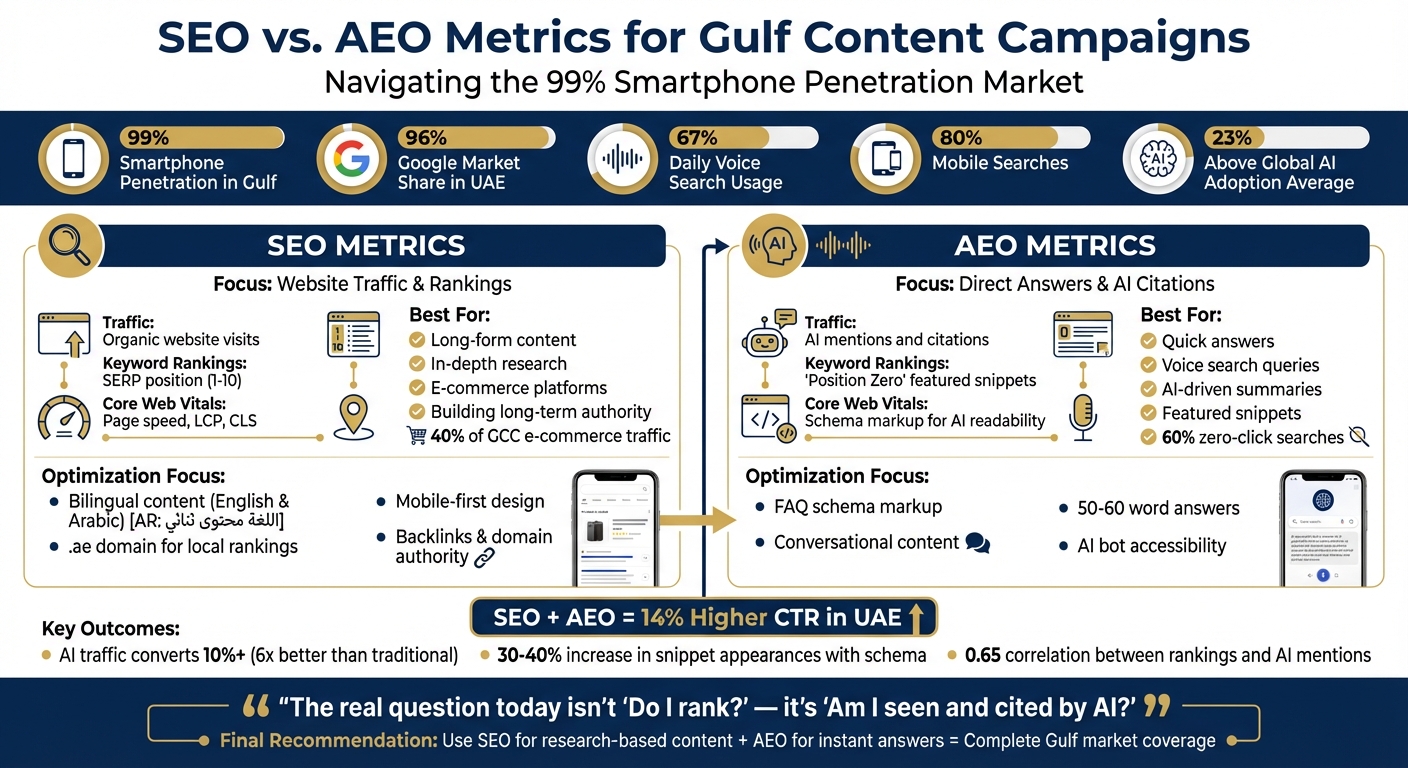
SEO vs AEO Metrics Comparison for Gulf Content Campaigns
SEO Metrics for Gulf Content Campaigns
Traffic and Keyword Rankings
Breaking down organic traffic by language can uncover how users from different linguistic backgrounds engage with your content. In the Gulf, where Google dominates the search engine market, businesses should analyse traffic separately for English and Arabic users. Arabic searches typically take a conversational tone, often starting with phrases like "How to..." or "What is...". On the other hand, English queries tend to be shorter and more transactional, such as "Best restaurants Dubai." To fully understand these behaviours, track keyword rankings for both languages using paired terms like "real estate Dubai" and "عقارات دبي." This bilingual strategy ensures you have a comprehensive view of your audience.
"SEO in the UAE requires a bilingual, mobile-first, and locally optimised approach." - Felix Rose-Collins, CEO/CMO, Ranktracker
From a technical standpoint, using hreflang tags can help avoid duplicate content issues between your English and Arabic pages. Additionally, implementing a .ae domain can significantly boost your local rankings, especially when 75% of users rarely move past the first page of search results. These foundational practices set the stage for measuring your technical SEO performance.
Core Web Vitals and Mobile Optimisation
With mobile devices responsible for 80% to 95% of searches in the UAE, optimising for Core Web Vitals is non-negotiable. Metrics like Largest Contentful Paint (LCP), Interaction to Next Paint (INP), and Cumulative Layout Shift (CLS) are crucial for ensuring smooth and fast user experiences. Gulf users expect pages to load almost instantly, and any delays can lead to higher bounce rates and lower search rankings.
In early 2025, a luxury salon in Dubai worked with The DOT Google to resolve technical SEO issues impacting mobile performance. By enhancing site speed, improving Core Web Vitals scores, and refining mobile usability - like making buttons easier to tap - the salon saw a significant increase in both online traffic and walk-in appointments. This case highlights the value of using modern techniques like WebP image formats, browser caching, and lazy loading to keep LCP under two seconds. Hosting your website on regional servers in Dubai or Fujairah can also minimise latency and improve load times.
While technical optimisation ensures a seamless online experience, local SEO metrics focus on capturing user interactions tied to physical locations.
Local SEO Metrics
For businesses with a physical presence in Gulf cities like Dubai or Abu Dhabi, appearing in the Local Pack - the top three map results - is essential for driving engagement. Your Google Business Profile (GBP) serves as your digital storefront, and key metrics to monitor include direction requests, click-to-call actions, and review volume. Active profiles can generate up to 70% more direction requests and 50% more website clicks compared to inactive ones.
Maintaining consistent NAP (Name, Address, Phone number) details across local directories such as Yellow Pages UAE, Dubai Chamber, and Dubizzle can enhance your local ranking authority. Search habits in the Gulf are also evolving, with users increasingly favouring hyper-local queries like "reliable AC repair in Dubai Marina" over broader terms like "AC repair Dubai". Regularly reviewing your GBP insights can help you identify which search terms are triggering your profile, how users engage with your listing, and whether your bilingual descriptions (in English and Arabic) resonate with the 93% of consumers who rely on online reviews before making purchasing decisions.
AEO Metrics for Gulf Content Campaigns
Featured Snippet and Voice Search Performance
Tracking Position Zero appearances shows how often your content is featured as the direct answer above organic search results. This is especially important in the Gulf, where voice search is widely used - 67% of UAE residents use voice search daily, and 30% of searches in Kuwait are voice-initiated. Tools like SEMrush and Ahrefs can help monitor the specific queries that trigger these snippets.
Take Noon, the Dubai-based e-commerce leader, as an example. They created FAQ pages in conversational Arabic and used the FAQPage schema to target voice search queries like "buy clothes in Dubai." This approach led to a 20% growth in featured snippet appearances in 2024. To optimise for voice search, aim to provide answers within the first 50–60 words of your content and ensure your responses are concise and conversational.
Using Google Analytics 4 (GA4), you can track voice-initiated traffic and identify patterns in how users phrase their questions in both Arabic and English. Proper schema implementation can further increase your chances of appearing in featured snippets by 30–40%, which is critical in a region with a 99% smartphone penetration rate.
Schema Markup Effectiveness
Structured data plays a vital role in boosting content visibility by enabling search engines and AI systems to better understand your content. For Gulf-focused campaigns, schema markup should be tailored to local needs, using tags like addressCountry set to "AE", priceCurrency set to "AED", and phone numbers formatted with the +971 prefix.
Key schema types for the Gulf include:
- LocalBusiness to highlight physical locations in cities such as Dubai or Riyadh.
- FAQPage to target voice search queries.
- Product schema to showcase prices in AED or SAR for GCC e-commerce platforms.
For instance, Salla, a Riyadh-based platform, published a comprehensive guide on "Saudi e-commerce trends" using JSON-LD for enhanced AI readability. By 2025, this guide was cited in 15% of AI-generated responses related to Saudi online retail.
"AEO comes from Google's evolution from keyword-driven search to one that uses machine learning and NLP to parse queries and serve content to match intent. Authority, user intent, and topical relevance are key ranking factors."
– George Chasiotis, SEO Expert
To maximise effectiveness, use schema markup in both Arabic and English to capture diverse, multicultural search queries. Data shows that sites with schema markup have experienced up to a 40% increase in click-through rates, while combining AEO and SEO strategies in the UAE has resulted in a 14% higher CTR compared to traditional SEO efforts.
AI and Zero-Click Results
AI-driven interactions are reshaping how AEO performance is measured. Today, about 60% of Google searches result in zero clicks, as users get answers directly on the search results page. For Gulf audiences, who are mobile-first and expect immediate answers, appearing as a cited authority in these zero-click results can significantly boost brand credibility.
Metrics like AI Share of Voice and inclusion rate can help measure your brand's presence in AI-generated responses from platforms like ChatGPT, Perplexity, and Google SGE. Additionally, monitoring server logs for crawlers like GPTBot, ClaudeBot, and PerplexityBot ensures your content is indexed correctly for these answer engines.
"In LLM environments, you win by being included in the answer, not clicked in the link."
– Rob Welsby, Global Head of SEO, Gravity Global
A great example is Xcite in Kuwait, which optimised 50 product pages with local Arabic keywords and built backlinks from trusted sources like the Kuwait Times. This effort resulted in a 35% increase in organic traffic within six months in 2024. While AI-driven traffic may account for less than 1% in volume, its conversion rates can exceed 10%. Monitoring increases in direct branded queries can serve as a useful indicator of the impact of zero-click AI visibility. Additionally, using FAQ schema can help AI systems extract clear, concise answers for featured snippets and voice responses.
Is SEO Dead? Or Is It Evolving Into AIO, AEO & AI-Driven Search
sbb-itb-058f46d
SEO vs. AEO Metrics: Direct Comparison
SEO focuses on increasing website traffic, while AEO is all about delivering direct answers to AI and voice searches. In simple terms, SEO is about improving rankings to attract clicks, whereas AEO measures how often your content is cited by AI and voice assistants. In the Gulf's mobile-driven landscape, both approaches cater to different needs but work together effectively. Here's a closer look at when each metric aligns best with Gulf campaign goals.
SEO builds authority through backlinks and domain strength, while AEO relies on well-structured content for instant AI citations. In the Gulf, where nearly 60% of Google searches result in zero clicks, people expect quick answers on their mobile devices. By 2025, it’s projected that one in four search queries will be conducted through AI platforms, making AEO metrics increasingly important for businesses in the region.
"The real question today isn't 'Do I rank?' - it's 'am I seen and cited by AI'."
– Sean Si, Editor-in-Chief, SEO Hacker
Comparison Table: SEO vs. AEO Metrics
| Metric Name | SEO Application | AEO Application | Gulf Relevance | Strengths | Limitations |
|---|---|---|---|---|---|
| Keyword Rankings vs. Snippets | Tracks position (1-10) on SERPs | Tracks "Position Zero" or featured snippets | High; voice search accounts for 30% of Kuwaiti queries | Boosts visibility and establishes authority | Snippets are dynamic and can disappear quickly |
| Traffic vs. Citations | Measures total organic sessions/clicks | Tracks brand mentions in AI summaries (e.g., ChatGPT/SGE) | Crucial for UAE's 99% mobile-first culture | Builds brand trust even without a click | Difficult to measure with traditional analytics |
| CTR vs. Share of Voice | Percentage of users clicking a link | Likelihood of being cited across multiple AI tests | Key for bilingual (Arabic/English) audiences | Highlights dominance in specific topics | Requires repeated testing for accuracy |
| Dwell Time vs. Engagement | Time spent on a landing page | Measures depth of interaction (e.g., follow-up prompts) | Indicates relevance for GCC users’ intent | Reflects content depth and user satisfaction | AI platforms don’t yet provide detailed engagement data |
| Technical Health | Core Web Vitals, load speed, mobile UX | Schema markup (FAQ, HowTo) and AI bot crawl rates | Essential for high-speed mobile users in Dubai and Riyadh | Ensures content is machine-readable for AI | Technical SEO is a must-have before AEO |
Businesses in the UAE using a combination of SEO and AEO report 14% higher click-through rates compared to those relying solely on SEO. SEO lays the groundwork with domain authority and organic traffic, while AEO grabs immediate attention through featured snippets and voice search results. For Gulf campaigns aimed at both research-focused users and those seeking fast answers, tracking both SEO and AEO metrics ensures visibility across traditional search engines and emerging AI platforms. This comparison highlights how blending these strategies can optimise digital success in the region.
When to Use SEO, AEO, or Both in Gulf Strategies
When to Focus on SEO
SEO is your go-to strategy when your audience is searching for in-depth, research-based content. In the Gulf region, where 90% of consumers in Kuwait, Dubai, and Riyadh research online before making a purchase, SEO plays a pivotal role in industries like e-commerce, hospitality, and finance. These sectors thrive on detailed product pages, guides, and comparison content to establish trust and drive conversions. In fact, SEO accounts for around 40% of e-commerce traffic in the GCC.
For businesses aiming to build long-term authority, SEO is essential. It starts with robust technical optimisation, such as improving Core Web Vitals, boosting mobile speed, and implementing LocalBusiness schema tailored to Gulf locations. These foundational steps ensure visibility on traditional search engines while setting the stage for more advanced strategies like AEO.
While SEO lays the groundwork for sustained growth, AEO steps in to capture attention quickly with concise, direct answers.
When to Focus on AEO
AEO shines when your audience needs quick, precise answers without diving deep into lengthy content. In the UAE, 67% of residents use voice search daily on their smartphones, and 30% of searches in Kuwait are voice-driven. This makes AEO a powerful tool for local businesses addressing queries like “best digital marketing agency in Dubai” or “where to buy electronics in Kuwait.”
A great example comes from Noon in Dubai, which, in 2024, created FAQ pages using conversational Arabic (e.g., "وين أشتري ملابس في دبي؟") and implemented FAQPage schema. This effort resulted in a 20% boost in featured snippet appearances. AEO is also a smart choice for luxury brands looking to establish authority by offering clear, definitive answers to complex customer questions. With zero-click searches now making up nearly 60% of all Google searches, AEO ensures your brand remains visible even if users don’t click through to your website.
Benefits of Combining SEO and AEO
Blending SEO and AEO allows you to cover both ends of the spectrum - detailed research and instant answers - perfectly aligning with the evolving habits of Gulf consumers. A hybrid approach can drive higher engagement by appealing to both those who value in-depth content (SEO) and those seeking immediate solutions (AEO). While AI-driven traffic may be lower in volume, it boasts conversion rates exceeding 10%, and in some cases, it converts up to six times better than traditional SEO traffic. For instance, Webflow reported that over 10% of its total signups in late 2025 came from AI search, with these signups converting at significantly higher rates than other channels.
"The biggest mistake is treating SEO and AEO as mutually exclusive strategies. UAE businesses that abandon SEO for AEO lose valuable traffic, whilst those ignoring AEO miss opportunities in voice search."
– 10G Spectrum
There’s also a strong connection (0.65 correlation) between high organic rankings and mentions in AI-generated responses. For Gulf campaigns targeting bilingual audiences, combining both strategies ensures visibility across Arabic and English searches, as well as conversational voice queries and AI-driven summaries. A seamless integration of SEO and AEO creates a unified campaign, as demonstrated in Wick’s Four Pillar Framework, which tracks rankings, snippets, and conversions across both metrics. This approach is ideal for the region’s mobile-first, AI-savvy audience, delivering a cohesive digital presence that adapts to their preferences.
Conclusion
Deciding between SEO and AEO metrics highlights how each method fuels Gulf content strategies. SEO metrics like organic traffic, keyword rankings, and click-through rates remain crucial for establishing long-term authority and tapping into the 40% of e-commerce traffic still driven by traditional search in the GCC. On the other hand, AEO metrics - such as featured snippets, AI citations, and voice search selections - address the evolving reality where nearly 60% of Google searches result in zero clicks, with AI Overviews appearing in 47% of those searches.
The data suggests that businesses adopting a hybrid strategy see enhanced results. This approach is especially critical in the UAE, where a staggering 99% smartphone penetration has created a mobile-first culture, increasing the reliance on voice search.
"Today's AI-search engines are answering machines rather than search engines. We have to take that into account in our optimisation strategies for LLMs and GenAI."
– Klaus-M. Schremser, Co-founder, Otterly.AI
To stay ahead, the next step involves seamlessly integrating both metric types. Track traditional rankings alongside AI-driven visibility. Keep an eye on featured snippets, organic traffic, and brand mentions in AI-generated responses. Additionally, monitor AI bot activity (like GPTBot and ClaudeBot) in server logs to ensure your content is included in future AI summaries. With Gartner projecting a 25% decline in traditional search volume by 2026, Gulf businesses that balance SEO foundations with AEO advancements will remain visible no matter how search evolves.
Campaigns in the Gulf must cater to both detailed researchers and mobile users looking for quick answers. By aligning your metrics with this dual focus - and applying data-driven strategies like those in Wick's Four Pillar Framework - you can capture the full range of search behaviours shaping the region's digital landscape.
FAQs
How can I combine SEO and AEO strategies for effective Gulf content campaigns?
To get the most out of your content campaigns in the Gulf region, it’s essential to combine SEO and AEO strategies. This approach allows you to target both traditional search engines and AI-powered answer platforms effectively.
Start by laying a strong SEO foundation. Make sure your website is technically optimised, mobile-friendly, and fast-loading - aim for load times between 1 to 1.2 seconds. Conduct multilingual keyword research in both English and Arabic to resonate with the UAE’s diverse audience.
Once your SEO basics are in place, focus on AEO (Answer Engine Optimisation). Use structured data like FAQ or How-To schema to increase visibility in featured snippets and voice search results. Develop clear, conversational content that directly addresses common user questions, making it easier for AI assistants and chatbots to pick up. AI tools can assist in creating these answer-focused blocks while also tracking your rankings on AI-driven platforms.
Lastly, monitor Gulf-specific KPIs to measure success. Pay attention to metrics like featured snippet click-through rates, voice search conversions (tracked in AED), and performance on AI platforms. By blending the broad reach of SEO with the precision of AEO, you can effectively engage the UAE’s mobile-first, multilingual audience across all search channels.
What are the main differences between SEO and AEO metrics for Gulf content campaigns?
SEO metrics revolve around tracking keyword rankings, organic traffic, backlinks, and click-through rates (CTR). These indicators show how effectively your website draws in and engages users through search engines.
On the other hand, AEO (Answer Engine Optimisation) focuses on achieving visibility in answer engines. This includes featured snippets, voice search results, and brand mentions that deliver direct answers to user questions - often without the need for users to click through to a website.
Both strategies offer distinct benefits, and the choice between them depends on your specific campaign objectives. In Gulf markets, where digital habits and consumer preferences shift quickly, blending these approaches can boost your content’s reach and ensure it stays relevant to your audience.
Why is Answer Engine Optimisation (AEO) becoming more significant for businesses in the Gulf region?
AEO is quickly gaining traction in the Gulf region, and it’s not hard to see why. The UAE boasts one of the highest internet penetration rates in the world, paired with a strong embrace of AI technologies and mobile-first behaviours. In fact, about 67% of UAE residents use voice search daily. This trend signals a clear preference for AI-driven platforms that provide instant, direct answers over traditional click-through search results.
On top of that, businesses in the region are pouring significant digital marketing budgets into staying ahead in an increasingly tech-focused market. AEO plays a critical role here, helping create smooth, relevant, and efficient user experiences that resonate with the Gulf’s tech-savvy population.