

Blog / Serverless Marketing Apps: Benefits and Use Cases
Serverless Marketing Apps: Benefits and Use Cases
Serverless computing is transforming marketing by reducing costs, speeding up development, and handling unpredictable traffic effortlessly. Here's why it matters:
- Cost Savings: Pay only for execution time, cutting expenses by over 50% for some businesses.
- Automatic Scaling: Handles traffic spikes during events like Dubai Shopping Festival without extra infrastructure.
- Faster Deployment: Launch campaigns faster by skipping server management.
- Real-Time Personalisation: Adjust messaging instantly based on user actions.
- Data-Driven Insights: Process massive data sets for campaign analysis without heavy infrastructure.
For marketing in the UAE, serverless platforms simplify scaling during peak events, streamline workflows, and help deliver personalised experiences. While challenges like cold start latency and vendor lock-in exist, strategies like provisioned concurrency and open-source tools can address these issues. Serverless empowers marketing teams to focus on results, not infrastructure.
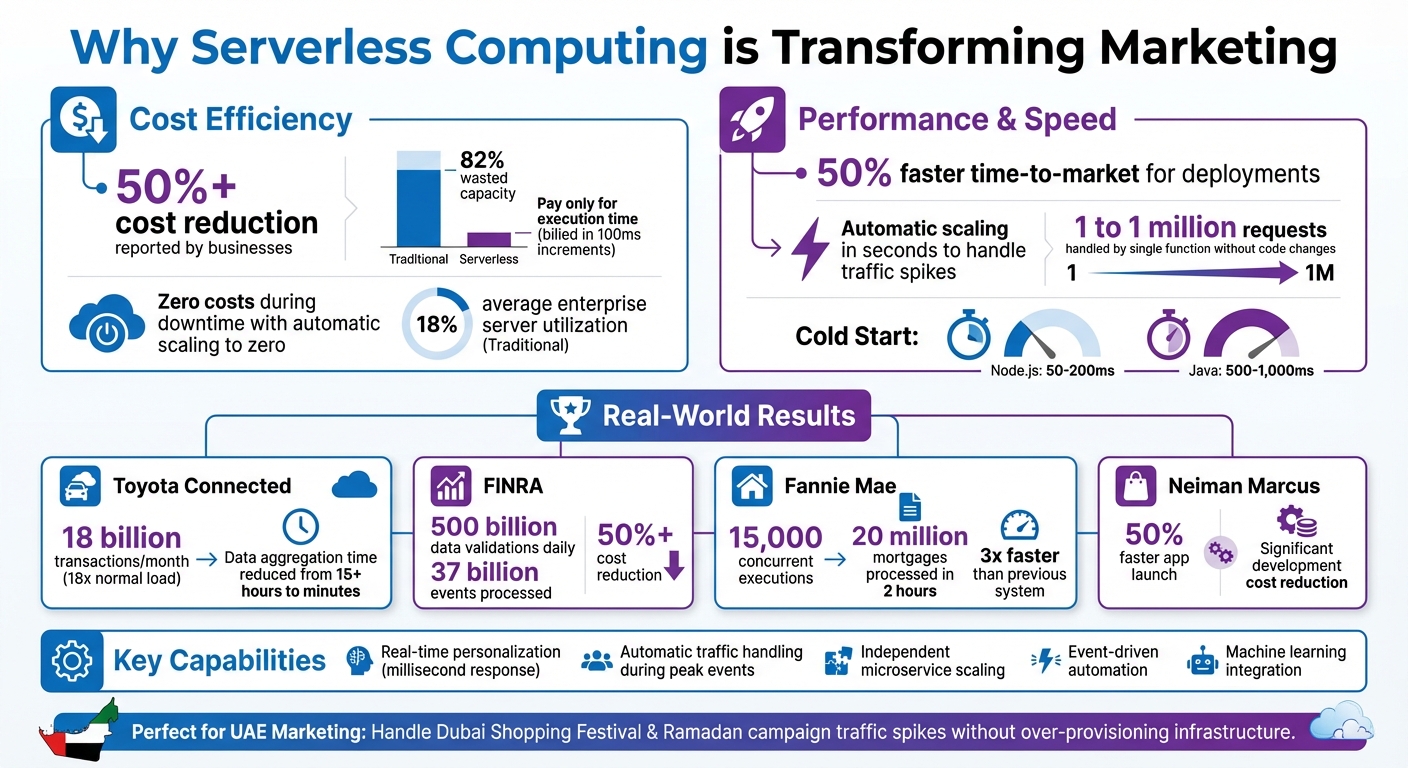
Serverless Marketing Benefits: Cost Savings and Performance Statistics
Benefits of Serverless Architectures in Marketing
Pay-Per-Use Pricing Reduces Costs
In traditional cloud setups, you're billed for server capacity even when it's sitting idle. Serverless architecture flips the script by charging only when your code runs, often in increments as small as 100 milliseconds. Essentially, you're paying only for what you use.
Consider this: the average enterprise server utilisation often hovers around just 18%. That’s a lot of unused capacity going to waste. Serverless eliminates this inefficiency by scaling resources to zero during downtime.
For marketers in the UAE, this model is a game-changer, especially during high-traffic events like Ramadan campaigns or the Dubai Shopping Festival. Instead of over-provisioning servers to handle potential spikes, serverless ensures resources are allocated dynamically, exactly when needed. Plus, with cloud providers handling updates, patching, and hardware configurations, your team can focus more on crafting impactful campaigns.
This cost-effective approach not only saves money but also ensures your platform can handle traffic surges without breaking a sweat.
Automatic Scaling for Campaign Traffic
Serverless platforms excel at scaling automatically to meet demand, often responding within seconds. Whether it’s a viral social media post or a flash sale, your infrastructure grows to handle the load and shrinks just as easily when traffic subsides.
This feature is especially valuable for marketing applications built using microservices. For example, a campaign landing page or a lead-capture form can scale independently. A single serverless function can process anywhere from one to a million requests without requiring any changes to your code. This ensures a seamless user experience, even during unexpected traffic spikes.
Faster Development and Deployment
Speed is everything in marketing, and serverless architectures deliver. By removing the need to manage infrastructure, teams can focus entirely on building and refining features that drive campaign success. No more waiting for server provisioning or dealing with patching.
Applications in a serverless environment are built as individual functions, allowing for targeted updates. For instance, if there’s a bug in an email trigger, you can fix that specific function without disrupting the rest of your platform.
"Serverless computing helps teams increase their productivity and bring products to market faster, and it allows organisations to better optimise resources and stay focused on innovation." – Microsoft Azure
This streamlined process can cut time-to-market by as much as 50%, giving marketers a critical edge. The ability to deploy updates instantly also enables real-time testing and iteration, letting you adapt quickly to customer feedback.
Support for Testing and Experimentation
Marketing thrives on experimentation, and serverless makes testing new ideas both easy and affordable. Since you’re only charged for the actual time your code runs, running multiple small-scale experiments costs far less than maintaining dedicated test environments.
The event-driven design of serverless systems is perfect for rapid prototyping. Whether you’re trialling a new chatbot or experimenting with real-time content personalisation, lightweight functions can be deployed to process user interactions instantly. And because tests run independently, there’s no risk of disrupting your live campaigns.
This low-cost, low-risk setup encourages bold experimentation. Failed tests are inexpensive, which opens the door to innovative strategies that can lead to standout campaign successes.
Use Cases for Serverless in Marketing
Real-Time Personalisation in Campaigns
Serverless technology shines when it comes to delivering personalised experiences at the exact moment a customer engages with your platform. For example, Amazon Kinesis can process massive amounts of clickstream data in real-time, allowing you to adjust your messaging instantly. If a user clicks on a product or abandons their shopping cart, serverless functions can quickly trigger actions like sending personalised emails or showing tailored recommendations - often within milliseconds.
Edge computing adds another layer by processing data closer to the user, enabling lightning-fast and locally relevant offers. Combine this with built-in machine learning models, and you can perform real-time sentiment analysis or suggest products on the fly. These instant responses aren’t just about speed - they also make it easier to automate intricate marketing workflows.
Automated Event-Driven Marketing Workflows
Serverless architectures take the hassle out of managing complex marketing workflows. By using webhooks from tools like your CRM or social media platforms, serverless functions can instantly handle tasks like nurturing leads, sending follow-up messages, or updating customer profiles. All of this happens automatically, with no need for manual input.
Brands adopting this approach have reported impressive results, such as cutting deployment times in half and reducing provisioning times from hours to mere minutes. This kind of automation not only saves time but also leverages the inherent cost and speed advantages of serverless systems.
Content Delivery Through Microservices
Breaking your marketing platform into serverless microservices lets you update specific features - like social media integrations or email template tools - without affecting the entire system. For instance, if a user uploads an image, serverless functions can instantly create optimised thumbnails or convert video formats for seamless multi-channel delivery.
API gateways play a key role here by managing traffic surges and directing requests to the right microservices, ensuring your platform maintains top performance even during peak demand. A great example is Toyota Connected, which scaled to handle 18 billion transactions per month - 18 times its usual load - thanks to serverless architecture. They also slashed data aggregation times from over 15 hours to just a fraction of that.
This microservices model doesn’t just improve performance; it also supports advanced data insights, making it easier to build detailed reporting pipelines.
Data Analytics and Reporting Pipelines
Serverless platforms are perfect for processing marketing data without requiring a permanent infrastructure. Companies like Liberty Mutual and Taco Bell have used serverless pipelines to handle massive data sets, enabling real-time campaign analysis without hefty infrastructure costs.
For marketing teams in the UAE, this means you can track customer journeys, measure campaign performance, and generate detailed reports without breaking the bank. Since serverless systems only process data when needed, they make sophisticated analytics affordable and accessible for businesses of all sizes.
Build a Serverless Email Marketing Application in 30 Minutes! | AWS Project Step-by-Step Tutorial
sbb-itb-058f46d
Challenges and Best Practices
Serverless architectures come with plenty of perks, but they also bring their own set of challenges - issues like cold start latency, vendor lock-in, and execution time limits can’t be ignored. Let’s break these down.
Cold start latency happens when a function has been idle, and the cloud provider needs to spin up a fresh execution environment before responding. This delay can range from 50–200 milliseconds for Node.js and stretch to 500–1,000 milliseconds for Java. For marketing tools that rely on real-time interactions, such as chatbots or personalised web APIs, these delays can disrupt user experiences and reduce engagement.
Vendor lock-in is another hurdle. Serverless applications often depend on proprietary services - think AWS Lambda paired with CloudWatch for monitoring or API Gateway for routing. This tight integration can make switching providers a costly and complicated process. Such dependency can limit flexibility if your business needs evolve.
Then there’s the issue of execution time limits. For instance, AWS Lambda caps functions at 15 minutes. Tasks like high-resolution video encoding or large-scale data ETL processes often exceed this limit and need splitting into smaller, chained functions. Debugging distributed systems adds another layer of complexity, requiring robust monitoring and logging to trace errors across multiple services.
So, how do you tackle these obstacles? Here are some practical strategies:
- Cold start mitigation: Use tools like provisioned concurrency on AWS or minimum instances on Google Cloud to keep latency in check for applications that need quick responses.
- Avoiding vendor lock-in: Open-source frameworks like the Serverless Framework or Knative can help maintain portability between cloud providers, giving you more flexibility.
- Handling long-running tasks: Break these into smaller steps triggered by queues like Amazon SQS or manage workflows with orchestration tools like AWS Step Functions.
- Optimising permissions: Apply the Principle of Least Privilege by assigning fine-grained IAM roles, ensuring each function only accesses the resources it truly needs.
- Balancing performance and cost: Tools like AWS Lambda Power Tuning can help you find the sweet spot between memory allocation and execution time, keeping costs under control.
Serverless and Wick's Four Pillar Framework
Serverless computing fits seamlessly into Wick's Four Pillar Framework for streamlined and effective marketing strategies. Its pay-per-use model and ability to scale automatically align perfectly with the framework’s focus on efficiency, agility, and data-driven growth. Let’s break down how each pillar benefits from serverless technology.
Build & Fill: Enhancing Content and Web Delivery
Serverless architectures make it easier and quicker to launch websites and update content, enabling brands to execute digital campaigns faster. For instance, in 2020, Neiman Marcus managed to speed up the launch of their omnichannel app, Connect, by 50%, while also cutting development costs significantly.
"Using AWS cloud-native and serverless technologies, we increased our speed to market by at least 50 per cent and were able to accelerate the launch of Connect."
- Sriram Vaidyanathan, Senior Director of Omni Engineering, Neiman Marcus
Additionally, edge computing services like Lambda@Edge bring content closer to users, reducing latency for global audiences. This is particularly beneficial for businesses targeting customers across the UAE and the broader MENA region.
Plan & Promote: Scaling Campaign Execution
Once content delivery is optimised, the next step focuses on scaling promotional campaigns. Serverless scalability is a game-changer for handling unpredictable traffic surges, such as those caused by flash sales, viral trends, or seasonal shopping spikes. These architectures automatically adjust to demand, ensuring smooth performance while the pay-as-you-go model keeps costs under control, even for sporadic campaigns.
Capture & Store: Enabling Data-Driven Marketing
Serverless pipelines play a crucial role in processing vast amounts of data in real time, enabling marketing teams to make informed decisions. For example, FINRA leveraged AWS Lambda to validate 500 billion pieces of data across 37 billion events daily, reducing their costs by over 50%.
"With Lambda, the system was faster, cheaper, and more scalable. So at the end of the day, we've reduced our costs by over 50 per cent, and we can track it daily, even hourly."
- Tim Griesbach, Senior Director, FINRA
This kind of efficiency allows marketing teams to gather and process customer insights at an unprecedented scale, transforming how campaigns are planned and executed.
Tailor & Automate: Driving Personalisation with Automation
The final pillar, 'Tailor & Automate,' leverages serverless technology to deliver personalised experiences through automation. Serverless functions can segment audiences in real time, enabling targeted marketing efforts. Hosting machine learning models on serverless platforms allows for on-demand predictions at lower costs. Event-driven architectures can trigger personalised emails, notifications, or content recommendations based on user behaviour.
A great example is Fannie Mae, which used AWS Lambda to run Monte Carlo simulations for mortgage risk modelling. The system scaled to 15,000 concurrent executions, processing 20 million mortgages in just two hours - three times faster than their previous setup. This demonstrates how serverless infrastructures can support complex analytics and segmentation at scale without requiring heavy investments in hardware.
Serverless platforms also integrate effortlessly with machine learning tools and APIs, making it easier for marketing teams to perform sentiment analysis, generate tailored content, and recommend products. By building reusable automation functions, teams can create a flexible 'toolbox' of capabilities to streamline and enhance campaign execution.
Conclusion
Serverless architectures bring a game-changing approach for marketing applications, as highlighted through the benefits and strategies discussed earlier. For marketing teams in the UAE, serverless provides clear advantages, such as a pay-per-use model that cuts costs by avoiding expenses tied to idle infrastructure, and automatic scaling that effortlessly handles sudden traffic surges. This means marketing teams can focus on boosting customer engagement rather than worrying about server maintenance. In fact, many organisations have reported reducing their time to market by at least 50%.
These benefits also translate into notable cost savings and faster performance, making serverless a smart choice for modern marketing needs.
By integrating serverless into Wick's Four Pillar Framework, businesses can unlock enhanced efficiency across key areas like content delivery, campaign scalability, data processing, and personalisation. This architecture empowers teams with the flexibility to adapt to market changes, the scalability to support growth, and the cost-effectiveness that encourages innovative experimentation.
In the UAE, where digital transformation and tailored customer experiences are becoming increasingly vital, serverless provides a practical and forward-thinking solution. Starting with specific, targeted use cases can help businesses build a marketing stack that is both flexible and scalable, paving the way for long-term success.
FAQs
How does serverless computing help reduce costs for marketing campaigns?
Serverless computing offers a smart way to manage costs by charging only for the computing power actually used. In simple terms, you only pay for what your marketing campaigns consume - no extra expenses for idle servers or overestimating your needs. This makes it a practical and budget-friendly option.
Another advantage is its ability to automatically adjust resources based on demand. During quieter periods, this means avoiding unnecessary spending, giving marketers the flexibility to use their budgets more wisely. This adaptability is particularly useful for dynamic marketing campaigns in fast-moving markets like the UAE.
How can businesses address cold-start latency and vendor lock-in challenges in serverless architectures?
Cold-start latency and vendor lock-in are two hurdles that often come with serverless architectures, but there are practical ways to tackle them.
To address cold-start latency, businesses can use provisioned concurrency, which keeps functions ready to execute, reducing delays. Another option is employing warm-up strategies, where critical functions are pre-loaded during peak usage periods. Both methods help ensure users experience faster response times.
Vendor lock-in, on the other hand, can be mitigated by adopting a multi-cloud approach or leveraging abstraction layers. These techniques make applications less tied to any single cloud provider. Additionally, designing serverless applications with portability in mind - such as following open standards - can provide more flexibility down the road. These approaches allow businesses to stay agile and scalable while minimising the challenges of serverless computing.
How does serverless technology enable real-time personalisation in marketing?
Serverless technology empowers marketers to deliver real-time personalisation by reacting instantly to user actions such as clicks, location searches, or purchases. With fully managed infrastructure, serverless functions can process these events and provide tailored content or offers within milliseconds. This eliminates delays typically caused by manual server setup or scaling processes.
This event-driven approach integrates seamlessly with serverless Customer Data Platforms (CDPs). These platforms handle data ingestion, enrichment, and decision-making only when required, ensuring cost efficiency, high availability during traffic surges, and effortless scalability - from zero to millions of users. Additionally, the globally distributed nature of serverless services ensures personalisation logic is executed near the user, minimising delays and delivering context-aware experiences. For example, in the UAE, this could mean displaying prices in AED, formatting dates as dd/MM/yyyy, and aligning with other local preferences.
For consultancies like Wick, serverless technology enables the use of real-time behavioural signals, AI-powered recommendations, and automated marketing workflows. This translates into dynamic website banners, customised email campaigns, and adaptive product suggestions that evolve with user behaviour. The result? Enhanced engagement, higher conversion rates, and a cost-efficient, flexible tech stack designed to keep up with user intent.