Cross-Channel Marketing: Best Practices For 2025
16 MIN READ
AI · 1 Feb 2026 · 19 minCompare top platforms to unify customer data and deliver AI-driven, real-time segmentation across email, web, SMS and apps.

Cross-channel segmentation helps businesses unify customer data from websites, apps, emails, and physical stores to deliver consistent, personalized experiences. With 62% of UAE consumers leaving brands due to generic interactions and 49% more likely to repurchase after tailored experiences, segmentation is essential for growth. Below are the top tools to streamline this process:
These tools enable businesses to craft personalized, data-driven strategies across multiple channels, boosting retention and revenue.
| Tool | Key Feature | Channels Supported | AI Capabilities | Integrations | Starting Price (AED) |
|---|---|---|---|---|---|
| Wick | Unified CDP with AI personalization | Email, SMS, ads, website | Predictive analytics | Custom integrations | Custom pricing |
| Mailchimp | Predictive segmentation | Email, SMS, social media, landing pages | Send time optimization, recommendations | 300+ integrations | Free to Paid Plans |
| Intempt | Real-time segmentation | Email, push, web personalization | Churn scoring, journey orchestration | Analytics platforms | Custom pricing |
| Amplitude | Behavioral analytics | Websites, apps | Predictive LTV, churn probability | 1,000+ integrations | Custom pricing |
| Survicate | Feedback-driven segmentation | Email, in-app, surveys | Sentiment detection | CRM, marketing tools | AED 217/month |
| Qualtrics | Real-time sentiment tracking | Email, SMS, mobile apps, web | Text and predictive analytics | Enterprise CRMs | Custom pricing |
| EngageLab | Unified messaging | Email, SMS, WhatsApp, push | Channel preference prediction | Flexible APIs | Usage-based pricing |
| HubSpot | Smart CRM and predictive scoring | Email, SMS, ads, live chat | Lead scoring, journey mapping | 1,900+ integrations | Free to AED 13,212 |
| Klaviyo | Historical and real-time updates | Email, SMS, WhatsApp, social ads | Predictive CLV, smart send time | 350+ integrations | Custom pricing |
Start by identifying your business needs, such as real-time updates or omnichannel support, to choose the right tool for your segmentation strategy.
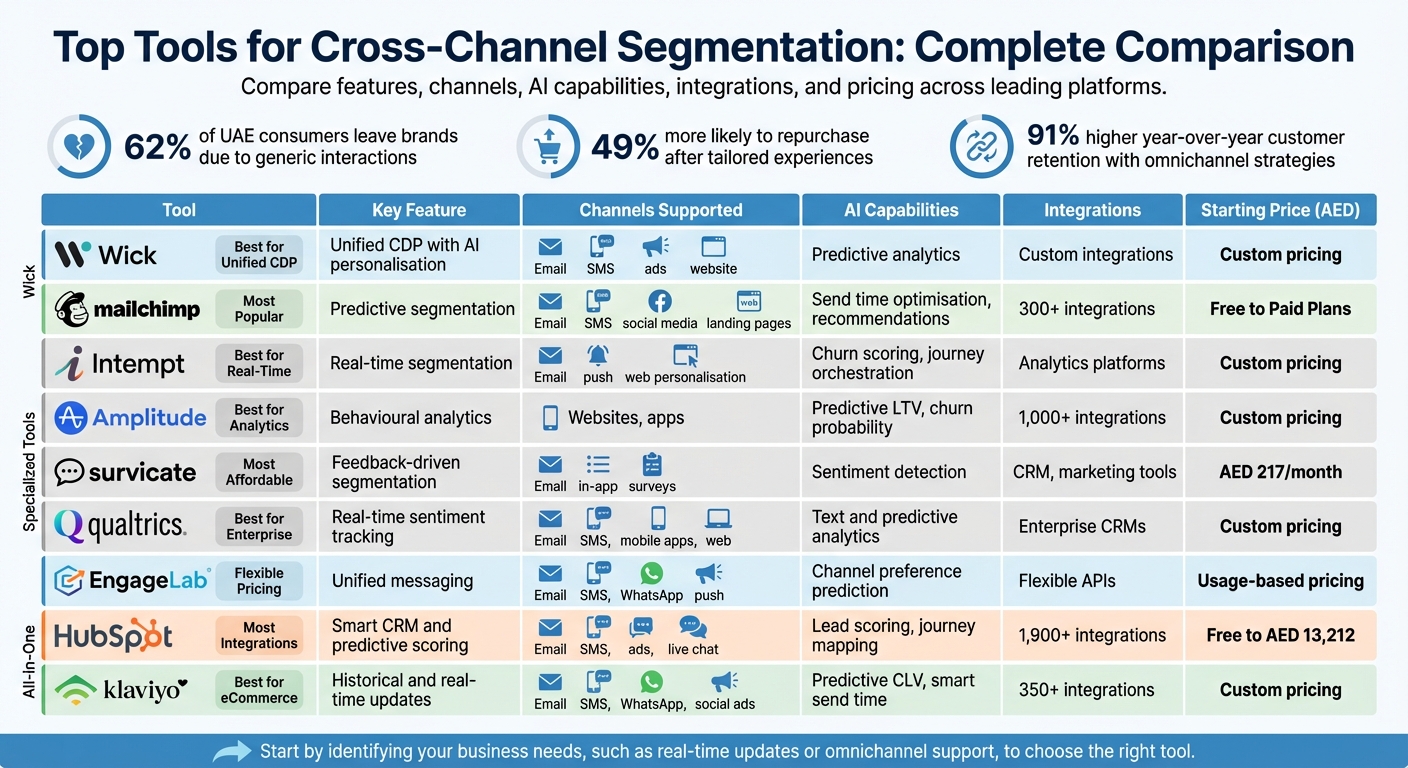
Cross-Channel Segmentation Tools Comparison: Features, Channels, AI Capabilities and Pricing

Wick is a data-driven marketing consultancy that uses its Four Pillar Framework to create seamless digital ecosystems. By consolidating customer data from websites, mobile apps, email, and social media, Wick helps businesses achieve a unified view of their audience.
One of Wick’s standout strengths is its AI-driven personalization. This technology tailors customer experiences by analyzing unified profile data. Essentially, as customers interact across different channels - whether browsing a website, reading an email, or engaging on social media - your marketing messages adjust automatically to stay relevant. The AI focuses on identifying behavioral patterns and fine-tuning content delivery to align with individual preferences.
Wick excels in Customer Data Platform (CDP) implementation, which is crucial for effective cross-channel segmentation. They bring together data from diverse sources like website analytics, CRM systems, marketing automation platforms, and social media into one comprehensive customer profile. This approach eliminates fragmented data, giving businesses a clearer understanding of their customer journey.
Using its Build & Fill and Plan & Promote pillars, Wick supports segmentation across websites, content platforms, email systems, and paid advertising networks. Meanwhile, the Capture & Store pillar ensures smooth data transfer between these channels, and the Tailor & Automate pillar applies segmentation insights to deliver scaled, personalized experiences. This approach is especially valuable for businesses in the UAE, where customer journeys often span both digital and traditional platforms.
Mailchimp is known for its ability to automatically update customer segments as they interact with campaigns. With around 500 million emails sent daily and a deliverability rate exceeding 99%, it's a dependable choice for businesses in the UAE and beyond, especially those managing extensive contact databases. This functionality sets the stage for precise segmentation that delivers actionable results.
Mailchimp's "Live" segments dynamically adjust based on customer behavior. You can apply up to five conditions, including exclusions, to fine-tune your audience. For instance, you could target users who opened your last email, visited a specific product page, but haven’t made a purchase in the past 30 days. The platform monitors activity across websites, emails, SMS, and e-commerce platforms in real time. Between January 2023 and December 2024, businesses on Standard and Premium plans using predictive segmentation saw 266% more revenue compared to those relying on non-predictive segments.
Mailchimp provides a unified platform for email, SMS (offered as a paid add-on for US plans), social media retargeting, mobile push notifications, and landing pages. It also integrates with Point-of-Sale systems, bridging the gap between physical and digital interactions. For example, if a customer browses products on your website, the system can trigger personalized follow-ups via email or SMS - all managed from one dashboard.
Mailchimp leverages AI to analyze vast amounts of data, offering recommendations for optimal send times, customer value, and purchase likelihood. The predictive segmentation tool helps identify which customers are most likely to make repeat purchases, enabling you to focus on high-value segments before they lose interest. With the "Segments AI" feature, you can simply describe an audience in plain language - like "customers in Dubai who spent over AED 500 last quarter" - and the system will create the segment for you.
Mailchimp offers over 300 integrations, connecting seamlessly with platforms like Shopify, WooCommerce, Salesforce, Squarespace, Wix, SurveyMonkey, and LinkedIn Lead Gen Forms. These integrations ensure smooth data sharing across tools, making it easier to manage campaigns and customer insights in one place.
Intempt's GrowthOS platform is designed to manage customer data in real time, enabling personalized cross-channel interactions. Instead of relying on batch updates, the system processes user interactions instantly, allowing for immediate responses.
GrowthOS offers tools for dynamic segmentation, updating customer groups as soon as users take action. For instance, if someone browses a specific product category or abandons their cart, the platform captures this behavior and adjusts their segment membership on the spot. This level of responsiveness is especially beneficial during busy shopping seasons in the UAE, where timely engagement can make all the difference. On top of real-time updates, AI modules enhance customer insights for more precise targeting.
The platform employs machine learning to pinpoint high-value customers, identify churn risks, and recognize loyal advocates. Its Edge feature delivers predictive scoring and affinity analysis, while Agentic AI (Navigator) monitors customer behavior for unusual patterns. For example, if a typically engaged customer suddenly becomes inactive, the system can flag this as a potential churn risk, giving you a chance to act before it escalates.
GrowthOS also functions as a centralized customer data platform, pulling information from various touchpoints. This consolidated data approach ensures smooth activation of customer segments across your entire marketing strategy.
Amplitude brings together customer behavior data from websites, mobile apps, and product applications, tracking actions across platforms like iOS, Android, React Native, Flutter, and server-side environments. This approach creates a unified view of customer interactions, which is especially valuable in the UAE's multi-device landscape. With this solid data foundation, Amplitude enables real-time segmentation that drives actionable insights.
Amplitude's real-time segmentation adapts dynamically to user behavior. The platform updates segments every minute using real-time syncs, ensuring they always reflect the most current user actions. For example, as users' behaviors change, they are automatically added to or removed from specific cohorts. These updates sync seamlessly with tools like Braze, HubSpot, and Facebook Ads, allowing marketers to respond quickly across channels. A great example of this in action is Jersey Mike's, a restaurant chain that used Amplitude's capabilities to more than double its online orders and significantly boost app downloads.
Amplitude also incorporates advanced AI tools to enhance marketing efforts. Predictive cohorts use machine learning to forecast actions such as churn or conversion, while AutoML provides recommendations and natural language processing makes chart creation intuitive. Eddie Lee, VP of Product at NBC, highlights the platform's value:
"Amplitude provides us a richer and deeper framework beyond what we could get elsewhere. We move faster, ideate quicker and understand our users more deeply".
With over 156 pre-built integrations, Amplitude connects effortlessly with customer data platforms, marketing tools, ad networks, and data warehouses. Its bidirectional syncing feature allows teams to both import data and export enriched segments to marketing tools. For instance, TicketSwap used this capability to identify users facing technical issues during purchases and synchronised these segments with paid social and CRM systems in real-time. This effort led to a 15% increase in sales funnel completion. Additionally, Amplitude integrates directly with data warehouses like Snowflake, BigQuery, and Redshift, enabling teams to analyze data within their existing systems.
Survicate takes a feedback-focused approach to customer segmentation, seamlessly integrating across multiple channels to enhance data from other platforms. Its strength lies in capturing customer feedback through various touchpoints - email, websites, in-product interfaces, and mobile apps - while incorporating metrics like NPS (Net Promoter Score), CSAT (Customer Satisfaction Score), and CES (Customer Effort Score). These insights are then synced with your marketing and CRM systems, enabling real-time updates to customer segments.
Survicate works with Twilio Segment to trigger surveys in real time based on user actions, such as completing a purchase or hitting a significant milestone. It collects individual data points like email, job title, and company size through Identify calls, while Group calls gather account-level information for precise targeting. To ensure smooth integration, the platform automatically standardizes attribute keys and flattens object attributes. This two-way data flow allows survey responses to feed back into connected platforms as track events, further refining segmentation efforts.
Survicate seamlessly connects with major platforms like Intercom, Slack, Segment, Pipedrive, Shopify, HubSpot, Mailchimp, Microsoft Teams, Salesforce, and Google Analytics. These integrations enable immediate actions based on survey results. For instance, a low NPS score can automatically trigger a retention offer via your CRM. Real-time analytics also let you monitor responses as they come in, helping you fine-tune engagement strategies on the spot. Pricing starts at AED 217 per month, with a 10-day free trial available.
The platform also provides customisable, logic-driven surveys that segment customers based on behavior, demographics, and preferences. When paired with a Customer Data Platform like Segment, Survicate merges qualitative survey feedback with quantitative behavioral data, offering a comprehensive view of your customers.
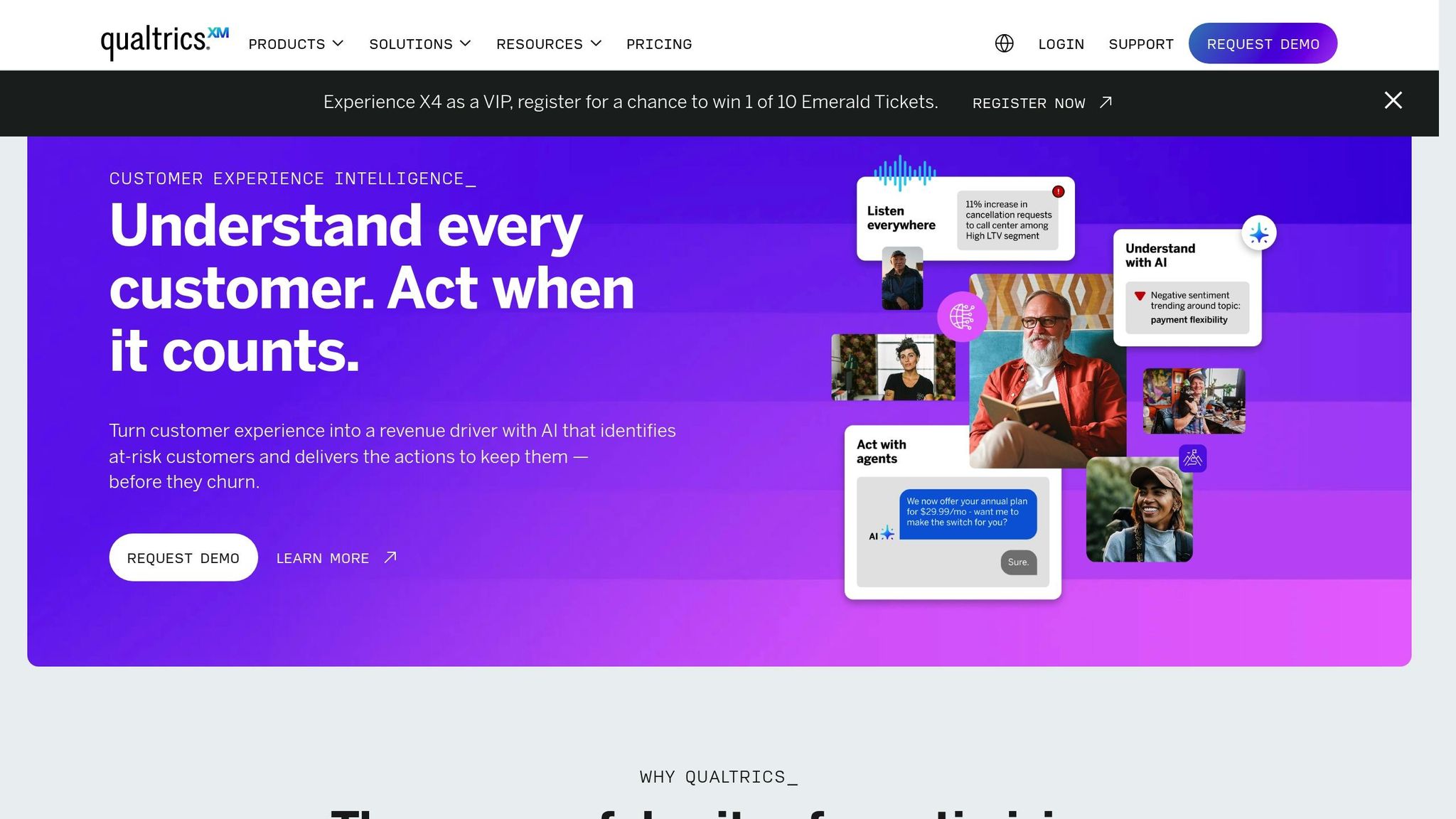
Qualtrics takes cross-channel segmentation to the next level by merging data from every customer interaction into a comprehensive 360° view. It gathers insights from both digital and physical channels, offering businesses a full understanding of their customers.
Qualtrics operates around the clock, tracking customer sentiment, trends, and potential churn risks in real time. Using advanced AI and Natural Language Processing (NLP), it organizes incoming data into dynamic customer profiles and segments. For example, GM Financial saw a rise in customer loyalty from 68% to 81% after using Qualtrics to process thousands of daily interactions from chat and phone calls. Michael Beste, SVP Analytics, Reporting & Research at GM Financial, highlighted the impact:
"Analyzing the thousands of customer conversations from chat and phone calls plays a key role in knowing what our customers are thinking. [Qualtrics] analyses topics and emotional tone from thousands of interactions."
These real-time insights enable businesses to make data-driven decisions quickly and effectively.
Qualtrics Assist, the platform's AI assistant, answers natural language queries instantly, uncovering trends and insights on demand. Its Natural Language Understanding (NLU) technology goes beyond basic demographics, identifying customer intent, effort levels, and emotional tones within their interactions. Additionally, Experience Agents, powered by AI, use this unified data to engage customers with personalized, brand-consistent interactions. They also address friction points as they arise, helping businesses reduce cost per contact by 7.5% annually when adopting an omnichannel strategy.
To enhance its AI and segmentation capabilities, Qualtrics integrates effortlessly with existing CRMs, data warehouses, and Customer Data Platforms like Twilio Segment. Its "xFlow" technology automates workflows, such as triggering alerts or creating support tickets, based on real-time customer actions. By eliminating data silos and ensuring seamless communication across systems, Qualtrics provides a unified source of truth and facilitates immediate, informed action across your technology stack.
EngageLab provides a secure and scalable solution for omnichannel engagement. It caters to various messaging needs, from routine notifications to high-volume market alerts and secure authentication messages, making it a great fit for organizations in the UAE.
EngageLab shines in unified messaging, offering support for multiple channels, including AppPush, WebPush, Email, WhatsApp, and SMS, all managed through a single dashboard. This seamless integration ensures consistent messaging and smooth data flow. Interestingly, businesses using omnichannel strategies experience 91% higher year-over-year customer retention compared to those relying on single-channel methods.
The platform features detailed API documentation and tailored integration solutions, making it adaptable for businesses with unique technological setups. Its architecture effortlessly integrates with existing CRM and marketing tools. Plus, EngageLab’s usage-based pricing model ensures affordability for organizations of all sizes in the UAE.
"EngageLab stands out as a comprehensive omnichannel customer engagement platform that excels in security and message delivery across multiple channels."
With enhanced authentication and security protocols, EngageLab is particularly well-suited for financial services and e-commerce companies that prioritize secure transaction communications.
Building on the approaches of platforms like Wick, Mailchimp, and Intempt, HubSpot offers a unified solution for data synchronisation and audience targeting. Its platform is powered by Smart CRM, which integrates marketing, sales, service, and commerce data. HubSpot takes it a step further by identifying and targeting anonymous website visitors in real-time, considering both fit (demographics and firmographics) and intent (behavioral signals). Businesses using HubSpot report 83% higher conversion rates and a threefold increase in inbound leads within just six months.
HubSpot's dynamic lists automatically update as contact criteria change, ensuring real-time accuracy. With Data Sync, the platform maintains consistency across over 100 integrations. Users have found it highly effective, with 83% agreeing that HubSpot unifies their data seamlessly, and achieving a 41% faster time to value.
The platform also offers Lookalike Lists, which help identify potential customers who resemble your existing high-value clients. Segment analytics monitor changes in size or engagement over a week, while the Segment Journey report provides insights into how users progress from website visits to form submissions and, eventually, closed deals.
HubSpot's segments can trigger actions across various channels, including:
These segments act as dynamic data sources for workflows, personalized chatflows, and targeted marketing campaigns. Additionally, HubSpot integrates with advertising platforms, allowing you to sync segments for real-time retargeting or exclusion lists.
HubSpot's Breeze AI Suite simplifies segmentation by using natural language generation to create filters from plain-text descriptions. It also offers predictive scoring, which predicts churn risk, purchase likelihood, and the best times to engage specific segments. Another standout tool, Pathfinder, analyses customer journey data to pinpoint the exact moments when visitors are ready to convert.
The platform provides goal-based suggestions, helping businesses identify valuable segments, like engaged contacts who haven't yet converted into qualified leads. Impressively, 96% of users report that personalized experiences through HubSpot have boosted their sales.
HubSpot's Marketplace boasts over 1,900 integrations, including a bi-directional sync with Salesforce. This feature automatically updates lead intelligence - such as email opens, form submissions, and website activity - giving sales teams real-time insights. It also connects with cloud storage solutions like Snowflake.
Pricing starts with a free tier at AED 0, while the Professional plan costs AED 3,267 per month for three seats, and the Enterprise plan is priced at AED 13,212 per month for five seats.
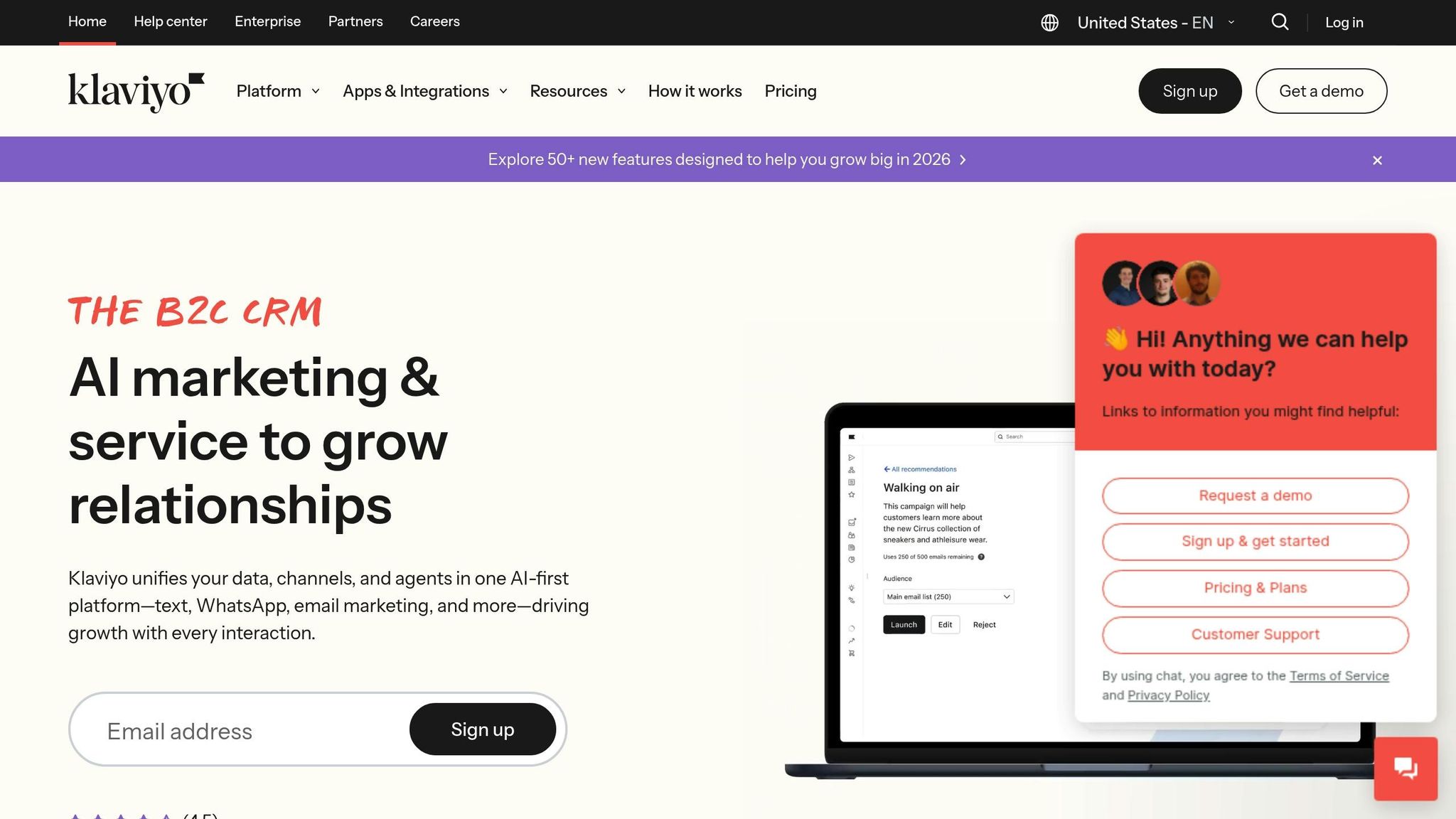
Klaviyo stands out among cross-channel segmentation tools with its real-time features and advanced audience insights.
This platform combines a built-in CDP with real-time segmentation, pulling data from over 350 integrations into a single source. What makes it unique is its ability to retain event data indefinitely. This means you can create segments based on a mix of historical and recent data - for example, a customer's first purchase from three years ago alongside their website visit five minutes ago.
Klaviyo automatically updates segments as customer behavior changes, ensuring your messages are perfectly timed. With Segments AI, you can create audience groups using plain language. For instance, you might define a group as "customers who opened a support ticket and have a predicted CLV of AED 1,835".
One success story comes from Ruffwear, an outdoor gear brand that saw a 49% boost in click rates by using RFM (Recency, Frequency, Monetary) segmentation. This approach grouped customers based on their specific purchase habits.
The platform also includes Engagement Tiers, which let you target nearly-lapsed customers or those with high average order values. This goes beyond the typical "engaged" or "unengaged" categories. To test campaigns before a full rollout, you can use the "Sample Segment Members" feature to validate their impact.
Klaviyo enables seamless activation of segments across various channels, including email, SMS/MMS, mobile push notifications, WhatsApp, RCS (in private beta), and social media ads on Facebook, Instagram, and Google. Its Flow Filters prevent channel overlap by tracking interactions across all platforms. For instance, if a customer engages with a campaign via email, they won't receive the same message on SMS.
In 2024, Rebecca Minkoff, a fashion brand, increased SMS revenue by 23% year-over-year within 70 days of using Klaviyo. Under the guidance of Jonathan Guez, CTO at Sunrise Brands, the team implemented flow filters to better coordinate their email and SMS campaigns.
"I fundamentally think that if you're going to be sending emails and SMS, they have to know what each other are doing." - Jonathan Guez, CTO, Sunrise Brands
Klaviyo's Channel Affinity ensures messages are sent through the channel (email, SMS, or push notifications) that each customer is most likely to respond to. This reduces over-messaging while keeping interactions personal. The platform also uses Predictive Analytics to estimate churn risk, customer lifetime value (CLV), next order date, and spending potential. However, these features require at least 180 days of order history and data from 500 customers who have made a purchase.
"Channel affinity has really helped us reduce over-messaging and create opportunities to do more brand-building in extensive flows." - Luke Styles, CRM Manager, Lorna Jane
Smart Send Time is another useful feature, determining the best times to send messages based on a recipient's previous engagement patterns. Additional tools include automated product recommendations and gender prediction using first names and census data.
With more than 350 pre-built integrations, Klaviyo connects seamlessly with major ecommerce platforms like Shopify and BigCommerce, as well as advertising and customer service tools. For example, Daily Harvest, a meal subscription service, replaced four separate ecommerce tools with Klaviyo's unified system. This switch reduced their technology costs by 18% while enabling more advanced automated review flows and better customer segmentation.
Klaviyo's flexible APIs also allow businesses to import custom data, giving them the ability to create highly targeted campaigns. These capabilities make Klaviyo an excellent choice for businesses in dynamic markets like the UAE, where precision and adaptability are key.
Choosing the right cross-channel segmentation tool means understanding what each platform offers. The table below compares key features like real-time segmentation, omnichannel capabilities, AI-driven tools, and integration options - all critical for delivering personalized messages across multiple touchpoints.
| Platform | Real‑Time Segmentation | Omnichannel Channels | AI Features | Integration Options |
|---|---|---|---|---|
| Wick | Real‑time tracking via unified CDP | Email, SMS, social media, paid ads, website personalization | AI‑driven personalization, predictive analytics, customer journey mapping | Custom integrations within its Four Pillar Framework ecosystem |
| Mailchimp | Basic audience updates with manual refresh | Email, SMS, social media ads, landing pages | Predictive demographics, send time optimization, product recommendations | 300+ pre‑built integrations with ecommerce and CRM platforms |
| Intempt | Instant segment updates based on live actions | Email, push notifications, in‑app messages, web personalization | Predictive churn scoring, AI‑powered journey orchestration | Native integrations with analytics and marketing tools |
| Amplitude | Real‑time cohort analysis and behavioral grouping | Focused on analytics and experimentation | Predictive LTV, churn probability, behavioral clustering | 1,000+ integrations via data streaming and warehouse connections |
| Survicate | Survey response‑triggered segmentation | Email, in‑app surveys, website widgets | AI‑powered response analysis, sentiment detection | Integrations with CRM and marketing automation platforms |
| Qualtrics | Experience data updates in real‑time | Email, SMS, mobile app, website feedback | Predictive analytics, text analytics, statistical modeling | Enterprise‑grade integrations with CRM, analytics, and business intelligence tools |
| EngageLab | Event‑based real‑time audience updates | Email, SMS, push notifications, WhatsApp | Intelligent delivery timing, channel preference prediction | API‑first approach with flexible custom integrations |
| HubSpot | Automatic list updates based on contact properties | Email, SMS, social media, live chat, ads | Predictive lead scoring, content recommendations, conversation intelligence | 1,500+ integrations available in the HubSpot App Marketplace |
| Klaviyo | Instant segment updates with indefinite event data retention | Email, SMS/MMS, push notifications, WhatsApp, RCS, social ads | Channel affinity, predictive CLV, smart send time, churn risk scoring | 350+ pre‑built integrations with ecommerce and advertising platforms |
This side-by-side comparison showcases each platform's strengths in delivering real-time segmentation, extending omnichannel reach, leveraging AI tools, and offering flexible integration options. A solid integration framework is especially crucial for creating a seamless customer experience across all platforms.
Unified segmentation brings all your customer data together, enabling personalized interactions at every stage of the customer journey. When 62% of consumers are willing to leave a brand after a generic experience, tailoring engagements becomes more important than ever.
Choosing the right tool plays a big role in this process. Look beyond just features - consider the total cost of ownership, local expertise, and whether the tool fits your team's technical skills. For example, a low-code interface might be a better fit if your IT resources are limited.
Before diving in, map out your customer journey and set shared KPIs. Start small by focusing on three or fewer high-priority use cases, like recovering abandoned carts or creating personalized website experiences. This keeps the implementation manageable and ensures early wins. From real-time data insights to unified ecosystems, these tools are designed to elevate your customer journey and drive results.
To maximize success, standardize your data with clear naming conventions and use server-side tracking for key events. Advanced segmentation strategies can lead to noticeable improvements in both revenue and customer retention.
Cross-channel segmentation is all about grouping customers into categories based on how they behave, what they prefer, and how they interact with your brand across different platforms. These platforms could include websites, mobile apps, social media, email, or even physical store visits. The goal? To get a clearer picture of how customers engage with your brand at multiple touchpoints, allowing you to create more tailored and seamless experiences.
In the UAE, this strategy holds particular importance. The region's population is incredibly diverse and digitally engaged, making it essential for businesses to tap into these behaviors. By diving into cross-channel data, companies can align their marketing efforts with local habits and preferences, ensuring their campaigns strike the right chord. This not only leads to happier customers but also builds loyalty and helps businesses thrive in the UAE’s dynamic and competitive marketplace.
AI brings a new level of precision to cross-channel segmentation through real-time analysis and predictive insights. By processing massive amounts of customer data - covering behaviors, preferences, and interactions across multiple platforms - it quickly identifies detailed and actionable customer segments.
What sets AI apart is its ability to adapt as customer behaviors evolve. This means marketing efforts stay relevant and personalized, helping businesses anticipate customer needs. For example, AI can pinpoint high-value prospects or flag customers at risk of leaving, enabling companies to adjust their messaging and offers accordingly. By making segmentation smarter, more adaptable, and capable of handling growth, AI empowers businesses to boost engagement and improve conversion rates.
When selecting a cross-channel segmentation tool, there are a few important aspects to keep in mind to ensure it aligns with your business requirements. First, choose a platform that can combine data from multiple sources - such as web, mobile, email, and offline interactions - into one cohesive view. This unified perspective is essential for building precise customer segments.
Platforms offering real-time analytics and AI-powered segmentation are particularly useful. They allow you to respond instantly to customer behavior, making personalization and engagement more effective. It's also crucial to ensure the tool adheres to privacy regulations, especially with the changing landscape of data protection laws, and supports solutions that don't depend on third-party cookies.
Finally, assess the platform’s user-friendliness, its ability to integrate seamlessly with your existing systems, and its capacity to scale with large datasets. These features not only make the tool easier to adopt but also ensure it can grow alongside your business.
16 MIN READ
14 MIN READ
11 MIN READ
What worked, what didn't, and what we're building next - no noise, unsubscribe anytime.