

Blog / UAE Data Protection Law: What Marketers Need to Know
UAE Data Protection Law: What Marketers Need to Know
The UAE's Personal Data Protection Law (PDPL), effective since January 2022, requires marketers to secure explicit consent for processing customer data. Unlike GDPR, the PDPL does not allow using "legitimate interests" as a basis for data processing. This law applies to UAE-based businesses and foreign entities handling UAE residents' data, with penalties reaching up to AED 28 million for non-compliance.
Key takeaways for marketers:
- Consent is mandatory: All marketing activities need clear, informed, and specific consent from individuals.
- Data minimisation: Collect only the data necessary for the stated purpose and delete it when no longer needed.
- Individual rights: Customers can request access, correction, deletion, or transfer of their data and object to its use for marketing.
- Jurisdictional differences: Businesses in DIFC or ADGM follow separate rules, more aligned with GDPR.
- Breach reporting: Onshore businesses must notify breaches immediately, unlike DIFC/ADGM's 72-hour window.
To comply, marketers should audit their processes, update privacy policies, and implement tools for consent management and data subject requests. Proper adherence not only avoids fines but also builds trust among customers in the UAE.
Tsaaro X Paramount | UAE Data Protection Law: Regulations & Compliance | #webinar #compliance
sbb-itb-058f46d
Core Principles of UAE PDPL for Marketing
The UAE PDPL lays out a clear framework that shapes how marketers in the UAE handle customer data. These principles establish the legal foundation for every marketing strategy, from email campaigns to customer databases, ensuring compliance at every step.
Data Minimisation and Purpose Limitation
Only collect what's necessary. The PDPL mandates that personal data be "sufficient and limited to what is necessary in accordance with the purpose for which the processing is carried out". For example, when someone signs up for a newsletter, there’s no need to collect their physical address or phone number unless explicitly required.
"Personal Data shall be sufficient and limited to what is necessary in accordance with the purpose for which the processing is carried out."
– Federal Decree Law No. 45 of 2021
Additionally, purpose limitation ensures that data is used strictly for the purpose it was collected. For example, if a customer registers to receive updates about a specific product, you cannot repurpose that data for unrelated campaigns without obtaining fresh consent. Michael La Marca, Partner at Hunton Andrews Kurth, highlights this distinction:
"The UAE Data Protection Law does not include an exception to consent that would allow for processing on the basis of a controller's 'legitimate interests', as is common in data protection legislation in other jurisdictions".
The law also enforces storage limitation, meaning personal data must be deleted or anonymised once its intended purpose is fulfilled. This ensures marketers retain only the data necessary for ongoing activities.
Consent Management
Consent is the foundation of marketing under the PDPL.
"Consent must be 'specific, informed and unambiguous' and must be given by a statement or by a clear affirmative action in writing or electronic form."
– Hunton Andrews Kurth
Marketers are required to secure explicit consent through clear, affirmative actions, such as ticking an unchecked box. Consent requests must use accessible language that explains how the data will be used. To stay compliant, marketers should maintain detailed records of consent, including when, where, and how it was obtained. Additionally, every communication must include an easy way for individuals to opt out or unsubscribe.
If a customer withdraws their consent, the process must be just as simple as giving it. For instance, websites should feature a straightforward mechanism for revoking consent. While withdrawal does not retroactively affect past data processing, it must immediately halt any future use of that data for marketing purposes.
These consent protocols align with the rights granted to individuals under the PDPL.
Data Subject Rights
Under the PDPL, UAE residents have strong rights over their personal data, and marketers are responsible for addressing their requests promptly. Controllers must respond to requests within one month, with a possible extension of two months for more complex cases. These rights underscore the accountability of marketers in respecting individual privacy.
One key right is the ability to object to the use of personal data for direct marketing, including profiling. When this right is exercised, all marketing communications related to the individual must stop immediately.
Other key rights marketers must address:
| Right | Implications for Marketing |
|---|---|
| Access | Individuals can request a copy of all personal data held about them, including details on how it was collected and used. |
| Correction | Individuals can request updates to any inaccurate or incomplete data. |
| Erasure | Known as the "right to be forgotten", individuals can ask for their data to be completely removed from your systems. |
| Data Portability | Individuals can request their data in a structured, commonly used format to transfer to another controller. |
To handle these requests effectively, marketers must establish clear workflows for Data Subject Access Requests (DSARs). This includes knowing who is responsible for processing requests, verifying the identity of requesters, and ensuring data is extracted, corrected, or deleted across all platforms in a timely manner.
UAE Data Protection Laws by Jurisdiction
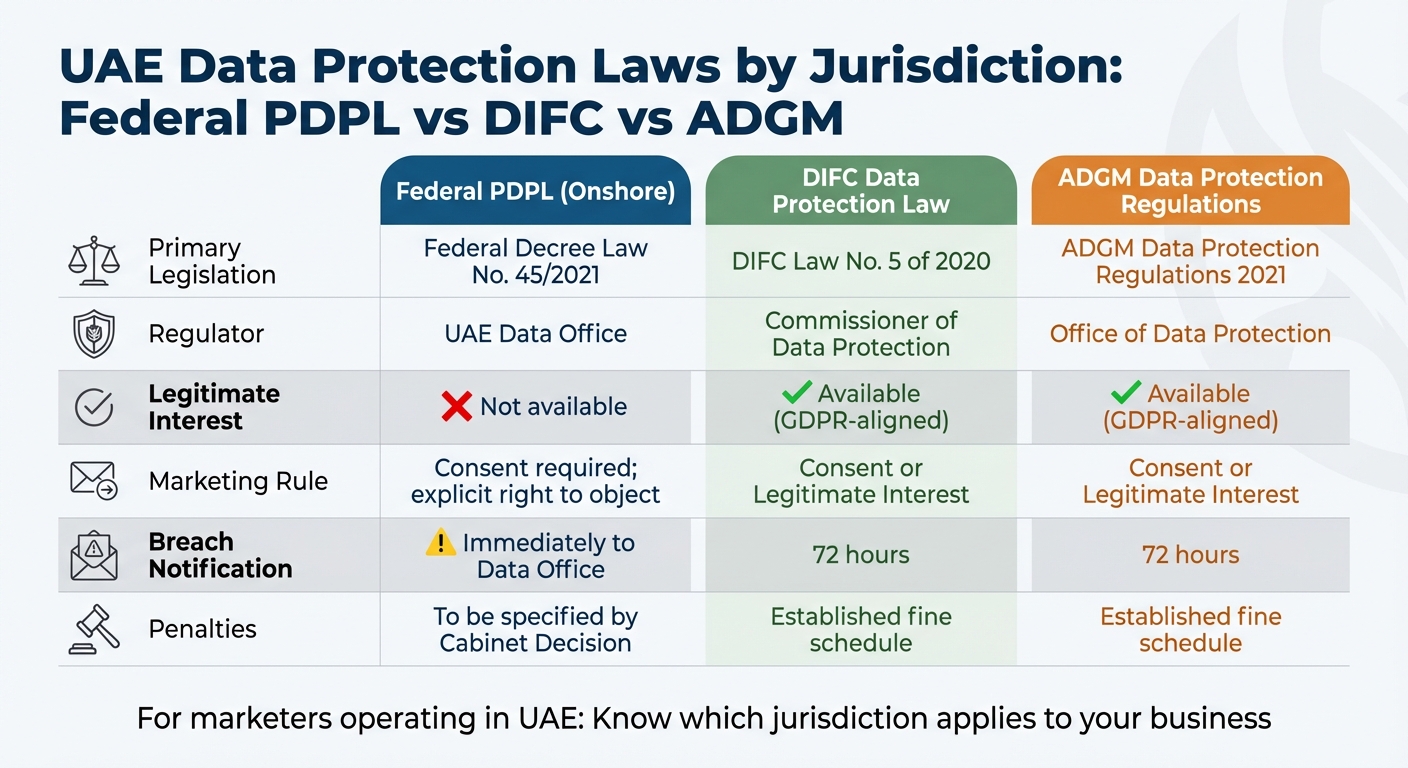
UAE Data Protection Laws Comparison: Federal PDPL vs DIFC vs ADGM
Navigating data protection laws in the UAE can be tricky, as there isn't a single federal law that applies to all businesses. Instead, the regulations vary depending on your location. Businesses might fall under one of three frameworks: the Federal PDPL, the DIFC Data Protection Law, or the ADGM Data Protection Regulations. Each framework has its own rules, regulators, and enforcement methods. Here's a closer look at how the Federal PDPL compares to the DIFC and ADGM frameworks.
Federal PDPL vs DIFC vs ADGM

The Federal PDPL applies to businesses operating onshore in the UAE, as well as foreign companies that process data belonging to UAE residents. However, businesses based in the DIFC or ADGM are exempt from the Federal PDPL, as these zones have their own data protection regulations.
One major distinction lies in the legal basis for processing data. Under the Federal PDPL, "legitimate interest" is not recognised as a valid reason for data processing. This is a significant departure from the DIFC and ADGM laws, which align with GDPR principles and allow processing based on legitimate interest. For marketers, this means the Federal PDPL requires explicit consent for almost all marketing activities.
Another key difference is how breaches are reported. The Federal PDPL mandates that businesses notify the UAE Data Office immediately upon discovering a breach. Meanwhile, the DIFC and ADGM frameworks follow a more standardised 72-hour window for breach notifications. This puts additional pressure on onshore businesses to act quickly when incidents occur, requiring robust response systems to stay compliant.
| Feature | Federal PDPL (Onshore) | DIFC Data Protection Law | ADGM Data Protection Regulations |
|---|---|---|---|
| Primary Legislation | Federal Decree Law No. 45/2021 | DIFC Law No. 5 of 2020 | ADGM Data Protection Regulations 2021 |
| Regulator | UAE Data Office | Commissioner of Data Protection | Office of Data Protection |
| Legitimate Interest | Not available | Available (GDPR-aligned) | Available (GDPR-aligned) |
| Marketing Rule | Consent required; explicit right to object | Consent or Legitimate Interest | Consent or Legitimate Interest |
| Breach Notification | "Immediately" to Data Office | Typically 72 hours | Typically 72 hours |
| Penalties | To be specified by Cabinet Decision | Established fine schedule | Established fine schedule |
This table summarises the key differences that marketers and businesses need to consider when ensuring compliance across the UAE.
Unlike the DIFC and ADGM, which already have GDPR-inspired fine schedules in place, the Federal PDPL's penalty structure is still pending. By early 2025, specific fines and penalties are expected to be detailed in the upcoming Executive Regulations.
For businesses operating in multiple jurisdictions, understanding which rules apply is essential. Companies incorporated in the DIFC or ADGM must comply with their respective free zone laws, while onshore businesses or those targeting UAE residents from abroad are subject to the Federal PDPL. These distinctions are critical for ensuring compliance and avoiding potential penalties.
Marketing Compliance Requirements under UAE PDPL
This section delves into the specific actions marketing teams need to take to align with the UAE Federal Personal Data Protection Law (PDPL). Unlike many other jurisdictions, the UAE PDPL does not include a "legitimate interest" exception. This means that explicit consent is required for all marketing activities involving the processing of personal data. Marketers must rethink how they gather, store, and utilise customer data across digital platforms.
Digital Tools and Data Storage Requirements
To comply with PDPL, marketing teams must carefully configure tools like CRM systems, email marketing platforms, analytics software, and social media pixels. These tools should:
- Collect only the data necessary for their purpose.
- Delete or anonymise data once it is no longer needed.
- Maintain a detailed Record of Processing Activities (ROPA).
The ROPA should outline what data is collected, where it is stored, who has access, and how long it will be retained. For cross-border data transfers, ensure the receiving country offers adequate protection or implement appropriate safeguards. In certain industries, such as finance, personal data and transaction records must be retained for at least five years. Meanwhile, sectors like healthcare, banking, and retail payment services may require data to remain stored within the UAE.
Consent and Unsubscribe Mechanisms
As a data controller, you must keep timestamped records to prove when and how consent was obtained. Individuals also have the right to withdraw their consent at any time. Make sure the process to withdraw consent is as simple as the initial opt-in. This applies to all direct marketing efforts, as individuals have the absolute right to object to their data being used for marketing or profiling.
Federal Law No. 15 of 2020 on Consumer Protection also prohibits the use of consumer data for marketing without proper consent. These consent requirements extend across all digital platforms, ensuring users have full control over their data.
Social Media and Influencer Marketing Rules
When collecting personal data through methods like lead generation forms, social media pixels, or influencer campaigns, you must obtain clear and informed consent. All social media and influencer marketing activities must follow strict consent protocols and maintain transparency in data practices.
The Telecommunications and Digital Government Regulatory Authority (TDRA) enforces these privacy standards and can remove content that violates privacy rights. If you collaborate with influencers or agencies, your privacy notices should clearly state which third parties will have access to the data and explain the safeguards in place for any cross-border transfers.
For marketing activities involving large-scale profiling or the handling of sensitive data, appointing a Data Protection Officer is mandatory. By integrating social media practices with PDPL requirements, you create a unified compliance approach across all marketing channels.
Penalties and Breach Reporting Requirements
Failing to comply with the UAE PDPL can lead to severe financial and operational consequences. Administrative fines range from AED 50,000 to AED 5,000,000, depending on how serious the violation is. For marketing teams, even a small mistake - like mishandling consent or improperly storing data - can result in penalties running into millions of dirhams. On top of that, criminal sanctions include at least six months of detention. Courts can also seize funds tied to violations, and the UAE Data Office has the authority to impose operational restrictions, which could significantly disrupt marketing efforts. These strict penalties emphasise why marketing teams must prioritise compliance.
Common Violations and Penalties
Marketing teams often face penalties for actions such as processing personal data without explicit consent, failing to implement strong security measures, or not properly documenting data processing activities. The PDPL strictly prohibits any marketing without explicit consent, leaving no room for assumptions or implied permissions. If multiple violations occur, fines can double, reaching up to twice the maximum amount. Industry estimates highlight the financial impact of data breaches, with costs ranging between $7 million and $10 million USD per incident. These figures, combined with frequent occurrences of data breaches, highlight the critical need for robust compliance strategies.
72-Hour Breach Notification Rules
The PDPL also enforces strict rules for reporting data breaches. According to Article 9, data controllers must notify the UAE Data Office of any breach that compromises the privacy, confidentiality, or security of personal data. While initial regulations required immediate notification upon discovering a breach, certain sector-specific rules - like the Retail Payment Services and Card Schemes Regulation - have adopted a 72-hour reporting window, requiring notification to the Central Bank within that timeframe. Breach reports must include details of the incident, contact information for the Data Protection Officer (DPO), potential impacts, and the steps being taken to address the issue. If the breach affects an individual’s privacy or confidentiality, the affected parties must also be notified.
To meet these demanding timelines, it’s essential to have a breach response plan in place. This plan should allow for swift investigation and reporting. If your team works with external data processors, such as marketing agencies or SaaS providers, ensure they alert you immediately if a breach occurs. Review third-party contracts to confirm they include strong data processing terms and clear breach notification requirements. Without a well-tested response plan, your team risks missing the notification deadline, which could lead to even higher penalties.
How Marketing Teams Can Achieve Compliance
Meeting UAE PDPL requirements isn't just about avoiding penalties - it’s also about earning your audience’s trust and safeguarding your organisation’s reputation. To get there, you’ll need to systematically review, refine, and adjust your existing processes.
Audit Existing Processes and Tools
Begin with a data mapping exercise to pinpoint what personal data your marketing team collects, where it’s stored, and how it’s processed. Maintaining a Record of Processing Activities (ROPA) is essential. This document should detail data categories, types of data subjects, recipients, and retention timelines.
"All businesses that are covered by the DP Law will need to audit their existing data use in order to update processes, contracts, notices and employee awareness to ensure compliance" – Addleshaw Goddard LLP
Your audit should cover key areas:
- Consent Mechanisms: Ensure all opt-ins are active and that every data processing activity has a valid legal basis.
- Third-Party Vendors: Review all external partners, from CRM providers to email marketing tools, and secure Data Processing Agreements (DPAs) with them.
- Data Subject Rights: Confirm your systems can handle requests like data portability, the right to be forgotten, and objections to automated processing.
Here’s a quick breakdown of compliance essentials:
| Audit Area | Compliance Requirement | Action Item |
|---|---|---|
| Consent | Specific, informed, and unambiguous | Use active opt-ins |
| Data Storage | Retain data only as long as necessary | Set automated deletion schedules in CRM systems |
| Vendors | Act only on Controller's instructions | Sign DPAs with all SaaS vendors |
| Subject Rights | Right to object to direct marketing | Add one-click unsubscribe/opt-out options |
| ROPA | Include data categories and access lists | Centralise all marketing data flows |
Once your audit is complete, update your privacy policies and train your staff to align with these findings.
Update Privacy Policies and Training
After auditing, revise your privacy policies to meet PDPL standards. These policies should be clear, concise, and easy to access. They must explain the purpose of data processing, identify data recipients, and outline safeguards for international transfers. Additionally, your policies should highlight data subjects’ rights, including the ability to object to direct marketing and profiling.
Equally important is training your team. They need to grasp both the legal requirements and your company’s internal privacy procedures. Conduct role-specific training sessions, focusing on data mapping for marketing staff. If your marketing involves sensitive data or large-scale profiling, appoint a Data Protection Officer (DPO) - either internally or externally - to oversee compliance.
"For businesses within the scope of the PDPL, the management of personal data is no longer simply a matter of internal policy and good practice. It is a legal obligation" – Hadef & Partners
Leverage Wick's Four Pillar Framework
Once your policies and audits are in place, you can incorporate compliance into your overall marketing strategy. Wick's Four Pillar Framework offers a structured way to align compliance with effective marketing.
For instance, the Capture & Store pillar ensures your data analytics and customer journey mapping respect data minimisation principles while still providing actionable insights. The Tailor & Automate pillar focuses on using marketing automation and AI-driven personalisation within the boundaries of explicit consent, ensuring relevance without breaching PDPL rules.
Given the UAE PDPL's strict consent requirements, Wick’s framework emphasises building strong consent management systems from the outset. By embedding compliance into your marketing infrastructure - rather than treating it as an afterthought - you can meet the PDPL’s "privacy by design" mandate. This approach also makes it easier to handle data subject access requests or implement one-click unsubscribe options, as required by law.
Conclusion
The UAE PDPL offers a chance to strengthen your marketing strategies while prioritising data privacy. By committing to transparency and obtaining clear consent - as outlined earlier - your brand positions itself as a trustworthy steward of personal data. This is particularly critical in a market where 83% of organisations experiencing an initial data breach often face subsequent incidents.
"Businesses who get ahead of the data privacy curve can differentiate themselves and further increase brand equity with consumers." – Privacy Bee
Compliance not only helps you avoid penalties but also builds customer trust. Showing a commitment to responsible data practices - through clear privacy policies, easy-to-use unsubscribe options, and well-defined breach protocols - gives your brand a competitive edge. Aligning with global standards further boosts your credibility with international clients and partners.
To make these principles actionable, it's crucial to take concrete steps. As discussed earlier, regular audits and updated consent mechanisms are key. Start with a comprehensive audit, refine your consent processes, and weave compliance into your marketing operations. Whether you're running campaigns under Federal jurisdiction or within the DIFC and ADGM free zones, a systematic approach ensures consistency and accountability. Embedding data protection into your strategy from the beginning safeguards your customers and protects your brand's reputation over time.
With data breaches costing anywhere between $7 million and $10 million per incident, a proactive approach to compliance not only mitigates risks but also positions your brand as a trusted leader in the UAE's digital economy.
FAQs
How does the UAE PDPL differ from the EU GDPR for marketers?
Both the UAE Personal Data Protection Law (PDPL) and the EU General Data Protection Regulation (GDPR) emphasise the importance of data security, fairness, and consent. However, there are key differences that marketers should be aware of when working within these frameworks.
The PDPL is specifically designed for organisations operating in the UAE or processing the personal data of UAE residents, even if the processing occurs outside the country. That said, it excludes certain entities, such as government bodies and data governed by the Abu Dhabi Global Market (ADGM) or Dubai International Financial Centre (DIFC). On the other hand, the GDPR casts a wider net, applying to any organisation - regardless of location - that processes the personal data of EU residents.
When it comes to consent, the PDPL places a higher burden on marketers by requiring proof that consent was explicitly obtained. While both laws provide individuals with rights like the ability to correct their data or withdraw consent, the GDPR goes further by offering additional rights, such as data portability and the "right to be forgotten." Another notable distinction is that the PDPL does not require organisations to appoint a Data Protection Officer (DPO), unlike the GDPR.
For marketers in the UAE, the focus should be on obtaining clear, documented consent, adhering to the PDPL’s specific rights, and recognising that data within the ADGM, DIFC, or government entities falls under separate regulations.
What steps should marketers take to manage consent under the UAE PDPL?
Under the UAE Personal Data Protection Law (PDPL), marketers are required to obtain clear and valid consent before processing personal data - unless certain exemptions apply, such as fulfilling a contract or carrying out a public-interest task. This consent must be freely given, specific, informed, and unambiguous, and individuals should have the option to withdraw it at any time through a straightforward, cost-free process.
To handle consent properly, marketers can take the following steps:
- Implement a consent-management system: Use tools to capture opt-ins with clear options, such as subscribing to newsletters or agreeing to data sharing. Keep detailed records of when and how consent was obtained.
- Use plain, accessible language: Ensure consent notices are written in British English spelling (e.g., "organisation") and are easy to understand. These notices should be readily available where data is collected.
- Simplify the withdrawal process: Offer an easy way for users to revoke consent, like an "unsubscribe" link, and ensure data processing stops immediately upon withdrawal.
- Address cross-border data transfers: Obtain separate consent for transferring data outside the UAE and document the safeguards in place to protect this information.
For marketers looking to integrate these practices efficiently, Wick provides the expertise to align digital strategies with PDPL requirements. This allows businesses to comply with the law while ensuring a seamless experience for users.
How can businesses in the UAE prepare for reporting data breaches under the PDPL?
To get ready for data breach reporting under the UAE Personal Data Protection Law (PDPL), businesses need to take a well-organised and forward-thinking approach. Start by appointing a Data Protection Officer (DPO) or assigning a senior manager to handle breach management and serve as the point of contact with the UAE Data Bureau. Create a detailed incident response plan that clearly defines roles, communication procedures, and timelines, ensuring it aligns with the PDPL's mandate to report breaches within 72 hours of identification. Regularly test this plan to ensure its effectiveness.
Keep a comprehensive breach register that records key details such as the nature of the breach, the data affected, potential consequences, and the actions taken to address the issue. If the breach presents a serious risk, notify the UAE Data Bureau in writing and communicate with affected individuals using clear, straightforward language. Once the breach is resolved, conduct a thorough review to pinpoint its root causes, strengthen security measures, and offer staff training to reduce the likelihood of future incidents.
By taking these steps, businesses can meet their legal responsibilities, maintain their reputation, and protect the privacy of UAE residents. Always ensure dates are documented in the dd/MM/yyyy format and monetary amounts are displayed in AED (e.g., AED 1,000).