

Blog / How User Intent Shapes SEO Frameworks in 2025
How User Intent Shapes SEO Frameworks in 2025
SEO in 2025 revolves around one thing: understanding what users want. Search engines now prioritise content that aligns with user intent - whether it's learning, comparing, or buying. This shift is powered by advanced AI models like BERT, MUM, and Gemini, which interpret search context more accurately than ever.
Here’s what you need to know:
- User intent is categorised into four types: informational (learning), navigational (finding specific sites), commercial investigation (comparing options), and transactional (making a purchase).
- Websites that align content with these intent types see 25–40% higher engagement, a 35% drop in bounce rates, and up to 45% higher click-through rates.
- AI tools and SERP features like snippets, shopping ads, and "People Also Ask" boxes help identify intent and personalise content.
- For UAE businesses, localisation is key - think AED pricing, bilingual content (Arabic/English), and region-specific search behaviour.
The takeaway? Mapping user intent to the right content type is essential for better rankings, engagement, and revenue in today’s search landscape.
SEO in 2025: How to Use Keyword Search Intent for SEO Success
The 4 Main Types of User Intent
The 4 Types of User Intent in SEO: Content Strategy Guide
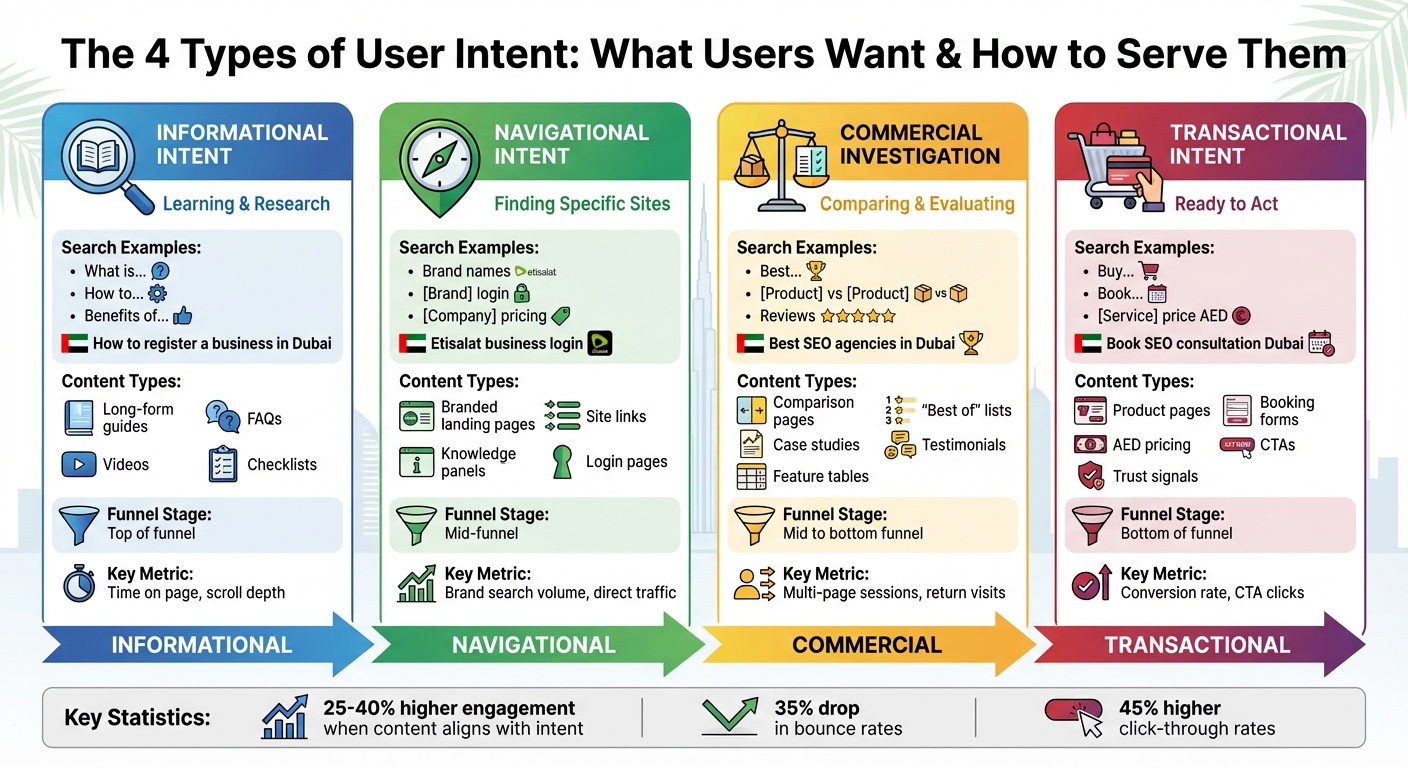
Every search query falls into one of four categories: informational, navigational, commercial investigation, or transactional. Each type requires a distinct content strategy, structure, and call-to-action to meet user needs effectively. When done right, this approach enhances relevance, engagement, and conversions across your digital platforms.
For businesses in the UAE, mapping user intent is especially useful for localisation. It helps determine whether to display prices in AED, offer content in both Arabic and English, or identify trust signals that resonate with high-intent users. Companies like Wick integrate intent classification into their Four Pillar Framework, ensuring that every piece of content - whether it's an educational blog or a service page - guides users toward the next logical step in their journey. Here's a closer look at each type of user intent and how to tailor content accordingly.
Informational Intent: Content for Learning and Research
Users with informational intent are looking to learn or solve a problem. Their searches often include phrases like "what is…", "how to…", or "benefits of…". In the UAE, these might include queries like "how to register a business in Dubai", "VAT rules for e-commerce in UAE", or "how SEO pricing works in AED."
The best way to address these queries is by creating detailed yet scannable content like long-form guides, FAQs, videos, and checklists. To improve visibility in search results, answer the main question upfront, use clear subheadings that match common search terms, and apply structured data (e.g., FAQ or HowTo schema). Localising content for the UAE means referencing local regulations, using the dd/mm/yyyy date format, and including metric measurements.
Since informational content sits at the top of the funnel, keyword research should focus on learning-based queries. Plan a publishing calendar filled with educational resources and cluster related topics - like "SEO in UAE", "digital marketing trends in Dubai", and "WhatsApp marketing rules in UAE". These clusters can link to pillar pages and supporting articles, with internal links guiding users to content optimised for navigational or commercial intent as their interest grows.
Navigational Intent: Helping Users Find Specific Sites
Navigational intent comes into play when users search for a specific brand, website, or known resource, such as "Wick marketing consultancy Dubai", "Etisalat business login", or "Wick pricing." To cater to this intent, focus on strong branded search engine results page (SERP) coverage. This includes optimising for site links, knowledge panels, and clear metadata for key pages like Home, Services, Pricing, and Login. Ensure that content accommodates both Arabic and English spellings to reach a broader audience.
Streamlined URL structures, descriptive labels, and dedicated landing pages for frequently searched queries also help users find what they need quickly. Navigational intent often overlaps with brand protection strategies - ensuring you rank first for branded queries, using paid search for high-value keywords, and optimising social profiles and local listings. For a consultancy like Wick, owning search results for terms like "Wick SEO framework" or "Wick Dubai office" builds credibility and directs users to authoritative information.
Commercial Investigation Intent: Content for Comparison and Evaluation
Commercial investigation intent reflects users who are evaluating options before making a decision. Their searches might include "best SEO agencies in Dubai", "SEO pricing UAE", or comparisons like "HubSpot vs Mailchimp for UAE SMEs." Content aimed at these users should include comparison pages, "best of" lists, feature tables, case studies, testimonials, webinars, and product demos.
To appeal to UAE audiences, highlight regional success stories, showcase local client logos, and include measurable results - like "30% increase in organic leads for a Dubai real estate firm". Use clear comparison tables to outline features, AED pricing, contract terms, and support hours in Gulf Standard Time. Behavioural metrics like scroll depth, click patterns on CTAs (e.g., "Request proposal in AED"), and time spent on pages can guide refinements. Tools like Google Search Console can reveal search queries and click-through rates for terms like "best", "vs", or "review". Heatmaps and session recordings can identify areas for improvement, such as repositioning pricing tables or simplifying explanations of UAE-specific terms like VAT or free-zone structures. Wick also uses A/B testing to optimise CTAs and comparison criteria for different market segments.
Transactional Intent: Optimising for Conversions
Transactional intent applies to users ready to act. Their searches include phrases like "buy [product] online UAE", "book SEO consultation Dubai", or "SEO package price AED." To convert these users, focus on action-driven titles and meta descriptions, clear CTAs, simplified forms, transparent AED pricing, and trust signals like secure payment icons and refund policies. Highlight local compliance and offer popular UAE payment methods to build confidence.
Technical SEO plays a key role here, ensuring fast page speeds (especially on mobile), logical schema markup, and clean URL structures. UX considerations should also include details on service availability across all emirates.
To connect the four intent types into a seamless content journey, classify keywords into informational, navigational, commercial, and transactional clusters, mapping each to the right page type and funnel stage - whether it’s learning, comparing, deciding, or acting. For example, an informational guide on "SEO basics in UAE" can link to a commercial page comparing "in-house vs agency SEO in Dubai", which then leads to a transactional page like "book SEO audit in AED." Performance dashboards segmented by intent can help identify drop-off points and areas for improvement. Consultancies like Wick integrate this mapping into their Four Pillar Framework, aligning SEO, content, marketing automation, and AI-driven personalisation to deliver tailored, context-specific messages - complete with AED-based pricing - across every channel. This approach ensures users in the UAE find relevant content at every stage of their journey.
Aligning Content with User Intent Signals
Building on the understanding of user intent types, this section focuses on how to align your content with specific intent signals. In 2025, SERP features provide clear clues about what users expect when they search. For example, featured snippets, People Also Ask boxes, and video carousels are strong indicators of informational intent. On the other hand, seeing shopping ads, product cards with AED pricing, or availability filters suggests commercial investigation or transactional intent. In the UAE, local packs featuring Maps, opening hours, and directions often indicate a mix of navigational and transactional intent, especially for searches like "best shawarma near me" or "car service centre Sharjah".
Reading SERP Features to Identify Intent
To understand user intent, observe the SERP features that dominate for your target keywords. Pay attention to what occupies the most space above the fold. If more than half of this area is filled with product ads or booking options, the query likely reflects transactional intent. Conversely, if in-depth guides, FAQs, or how-to videos are prominent, the intent leans towards informational. For instance, bilingual queries like "أفضل مطعم ستيك دبي" and "best steak restaurant dubai" may show intent differences - Arabic searches often focus on local services, while English searches may favour tourism-related bookings.
Grouping Keywords by Intent Type
Once you’ve identified the intent signals, organise your keyword data to create actionable insights. Add columns for intent type (Informational, Navigational, Commercial, or Transactional), funnel stage (Learn, Compare, Decide, Buy), and geography (UAE-wide or specific emirates like Dubai or Abu Dhabi). Group keywords by these categories to align them with the right content assets - like guides, comparison pages, or transactional landing pages. For businesses operating across multiple emirates, only create separate clusters and pages if user intent differs significantly by city. Otherwise, centralise shared informational content to maintain strong authority and avoid diluting it across weaker pages. This keyword clustering ensures your content directly addresses user needs, as confirmed by real-time data.
Testing Intent Alignment with Live Search Data
After grouping keywords, validate your strategy using real-world search data. Platforms like Google Search Console reveal which queries drive clicks to specific pages, along with metrics like impressions, click-through rates, and average rankings. If you notice informational queries landing on transactional pages with low engagement, it’s a signal to either adjust the page to serve informational needs or create a new asset to address them.
On-site search logs can also highlight unmet needs. For example, frequent searches like "pricing in AED", "delivery Abu Dhabi", or "Arabic support" indicate gaps in transactional or local content. Additionally, analytics tools track user paths - if visitors often navigate from informational pages to pricing or service pages during the same session, consider adding clearer CTAs, AED pricing details, and "next step" modules earlier in the journey to better guide intent transitions.
Companies like Wick use advanced data systems to integrate customer insights, including behavioural tracking and journey mapping. These tools allow for real-time refinement of content strategies, ensuring they stay aligned with user expectations.
sbb-itb-058f46d
AI Tools for Intent Recognition and Personalisation
Artificial intelligence has pushed SEO far beyond simple keyword matching. By 2025, advanced tools like large language models and natural language processing (NLP) can now map user queries to specific intent stages - such as learning, comparing, solving, or buying. These systems also account for bilingual queries in English and Arabic, as well as local factors like AED pricing. When combined with intent-based keyword grouping and SERP analysis, as discussed earlier, these AI insights create a well-rounded SEO strategy tailored to the UAE market.
Google's Helpful Content System and Intent Matching
Google's Helpful Content System is a prime example of how machine learning evaluates content against user intent. Using AI, it assesses whether a page genuinely meets the needs behind a query. Factors like depth, topical focus, expertise, and post-click engagement play a role in determining if the content fully addresses the user's question and matches the expected format - be it a detailed guide, comparison table, or product page highlighting AED pricing. Pages that provide clear, direct answers and generate strong engagement signals are more likely to appear in featured snippets or AI Overviews. To optimise for this, site owners should map each query to a specific intent type, choose formats that align with that intent, and regularly analyse Google Search Console data. This helps identify which queries drive impressions, allowing for adjustments to titles and on-page content to better reflect user language.
Delivering Content Based on Intent Stage
AI-powered personalisation engines analyse query patterns and user behaviour to categorise visitors into different intent stages - awareness, consideration, and decision. This enables the dynamic delivery of tailored content:
- Educational guides for awareness-stage users exploring "what is..." queries.
- Comparison pages, case studies, and AED pricing ranges for those in the consideration phase.
- Service pages, booking forms, and limited-time offers for decision-ready visitors.
For instance, after presenting a general guide, the system might highlight a UAE-specific case study or a booking call-to-action (CTA) if a user engages with multiple comparison pages. Well-aligned content like this can improve engagement metrics by 25–40% and reduce bounce rates by roughly 35%. This approach integrates seamlessly with analytics to ensure content continues to align with user intent.
Using AI Analytics to Track Intent Signals
Metrics like click-through rates, dwell time, scroll depth, and navigation paths provide valuable feedback for AI systems to refine intent classifications. These insights reveal user behaviours, such as journeys from blog posts to pricing pages and eventually to contact forms. By segmenting metrics based on intent and page type, businesses can enhance thin pages, adjust internal links, or consolidate content where user journeys appear unclear. Modern AI analytics platforms treat intent as fluid, updating classifications in real time based on new search queries, SERP shifts, seasonal trends, and on-site behaviour. Firms like Wick specialise in implementing intelligent data systems that unify customer insights, including behavioural tracking and journey mapping, allowing for on-the-fly strategy adjustments.
Measuring Results from Intent-Based SEO
Tracking the right metrics is essential to turning intent-based SEO strategies into measurable outcomes. For businesses in the UAE, focusing on key engagement indicators like organic clicks, pages per session, average session duration, scroll depth, and return visits is critical. These metrics not only highlight user engagement but also help identify areas where intent-based content is reducing early exits. Additionally, monitoring organic conversions and attributing revenue in AED provides a clearer picture of the business impact. Since mobile search dominates the UAE market, it’s also important to segment results by country and device to tailor strategies effectively. Below, we break down the key metrics for different intent types, ensuring a data-driven approach.
Engagement Metrics for Intent-Matched Content
Metrics vary depending on the type of user intent:
- Informational pages: Focus on bounce rate, time on page, and scroll depth to assess how well the content retains and engages users.
- Transactional pages: Prioritise metrics like call-to-action (CTA) click-through rates and conversion rates to measure success in driving actions.
- Commercial investigation: Track multi-page sessions and return visits to understand how users explore their options.
Monitoring Performance in Featured Placements
Tools like Google Search Console are invaluable for tracking SERP features such as featured snippets, People Also Ask boxes, image packs, and video carousels. Compare the click share from these features to standard organic results to understand their impact. Keep an eye on visibility and position changes by tracking URLs that secure these features, noting any shifts - like losing a feature or being replaced by AI overviews. For informational and commercial investigation intents, analysing the share of clicks and impressions from these features versus standard blue links can provide insights into how zero-click behaviour is evolving.
Ranking stability is another important factor. Measure this through metrics like average position, week-to-week variance, and how long a page holds a top-three or featured spot. For high-value transactional and commercial pages, review these metrics weekly. For broader informational clusters, a bi-weekly or monthly review may be sufficient. Given the UAE’s unique search landscape, compare local rankings to global averages, as local competitors and Arabic-language results can significantly influence search dynamics.
Improving Performance Through Regular Analysis
Consistent analysis is key to improving SEO performance. High-value pages should be reviewed weekly, content clusters monthly, and internal links and SERP changes audited quarterly. Use tools like Search Console and analytics platforms to segment data by intent group, identify pages with declining engagement or rankings, and monitor SERPs for shifts in intent expression. If intent shifts are detected, update titles, structure, or content depth as needed.
User feedback is another powerful tool. Collect insights from on-page polls, customer support queries, and sales objections to refine how well your content meets user needs. Timing updates around key local events can also boost relevance. Companies like Wick specialise in integrating behavioural tracking and journey mapping, enabling real-time adjustments based on customer insights. By regularly analysing performance and fine-tuning content, you can ensure your strategy stays aligned with user intent, driving continuous improvement.
Conclusion
In 2025, user intent has become the cornerstone of SEO strategies. Aligning content with the four primary intent types can increase engagement by 25–40% while reducing bounce rates by up to 35%. Google's AI-powered algorithms now prioritise pages that thoroughly address user needs, not just keywords, making depth, clarity, and completeness critical for ranking in both SERPs and featured snippets. This shift highlights the importance of tailoring strategies to regional market dynamics.
For businesses in the UAE, understanding local search behaviours is key. This involves creating transactional pages priced in AED, catering to bilingual search habits, and optimising for the mobile-first experiences that dominate the region. By designing intent-driven funnels that guide users from learning to comparing to deciding, businesses can attract more qualified traffic and ultimately increase revenue.
Measurement and adaptation are ongoing necessities. Keep an eye on metrics like scroll depth, time on page, and SERP feature performance. Analyse content clusters monthly and high-value pages weekly to ensure strategies remain aligned with evolving user behaviours and search technologies. AI tools can assist by classifying queries, customising CTAs, and identifying intent signals in real-time. However, the core remains human-focused content that answers specific questions at the right moment.
The search landscape continues to evolve, with AI Overviews, voice queries, and multimodal search fundamentally changing how users access information. Static SEO plans quickly lose relevance, making continuous intent research essential for keeping strategies effective. For UAE businesses aiming to expand regionally or globally, this adaptability is vital to navigate local events, seasonal trends, and cultural shifts.
To stay ahead, businesses should integrate intent insights across SEO, content, UX, and analytics. Consultancies like Wick, with their Four Pillar Framework spanning website development, SEO, content, social, automation, and AI personalisation, can transform intent data into cohesive digital ecosystems that drive growth. As search engines advance, brands that embed intent across their digital strategies will secure long-term visibility and success.
FAQs
How can businesses align content with user intent for SEO success in 2025?
To stay ahead in 2025, businesses need to focus on aligning their content with user intent. The first step? Gaining a deep understanding of how their audience searches and what they prefer. This means diving into search queries, engagement metrics, and user feedback to uncover exactly what users are seeking and how they want to consume that information.
Once you’ve nailed down the intent, match it with the right type of content. Here's how:
- Informational intent: Think blogs, guides, or FAQs that provide in-depth answers and insights.
- Navigational intent: Streamline landing pages with clear navigation and bite-sized, relevant details.
- Transactional intent: Prioritise product pages, pricing breakdowns, and strong calls-to-action that drive conversions.
By regularly refining your content strategy to meet these intents, you can forge stronger connections with your audience and boost your SEO efforts. This approach is especially relevant in the UAE’s progressive digital market, helping businesses remain relevant and thrive in a constantly shifting environment.
How does AI help understand user intent to improve SEO strategies?
Artificial intelligence has become a game-changer in decoding user intent, allowing businesses to craft more precise and impactful SEO strategies. By sifting through massive datasets, AI can spot trends in user behaviour, search habits, and preferences, giving insights into what people are truly searching for.
With AI-powered tools, content can be tailored to match user intent, ensuring that search results meet users' actual needs. This accuracy not only boosts search rankings but also creates a smoother, more satisfying user experience - building stronger connections and loyalty to the brand over time.
How can businesses in the UAE optimise their SEO strategies to align with user intent?
To refine SEO strategies for user intent in the UAE, businesses should take a well-rounded approach that blends data insights, localised content, and AI-driven personalisation. It’s essential to dive into user behaviour, preferences, and search trends unique to the UAE market.
Craft content that genuinely connects with the local audience by factoring in cultural subtleties, commonly spoken languages, and region-specific keywords. Make sure your website meets UAE-specific expectations - this includes using the metric system, displaying prices in AED (د.إ), and tailoring your messaging to resonate with the region's diverse population. By weaving these elements into your SEO plan, you’ll engage users more effectively and set the stage for steady growth.